क्रिएटिव फ़ाइल
Bionic Butterflies Inspired by Nature’s Flight
The concept of flight has long been a major focus within the Bionic Learning Network. Building on knowledge gained from earlier projects such as the BionicOpter and eMotionSpheres, researchers developed a new generation of flying robotic insects known as eMotionButterflies.
Taylor Brooks
निर्माता
फ़ाइल नोट
नीचे पूरा ट्यूटोरियल या लेख पढ़ें।
मॉड्यूल
डिजिटल कला
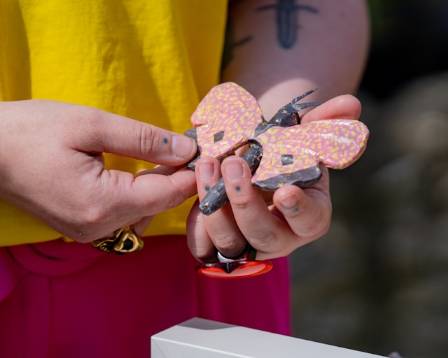
The concept of flight has long been a major focus within the Bionic Learning Network. Building on knowledge gained from earlier projects such as the BionicOpter and eMotionSpheres, researchers developed a new generation of flying robotic insects known as eMotionButterflies.
These artificial butterflies combine extremely lightweight engineering with sophisticated swarm coordination. Designed to imitate real insects as closely as possible, they demonstrate how advanced robotics can replicate both the appearance and behavior of living creatures.
Precision Flight Through an Indoor Positioning System
To enable coordinated movement, the robotic butterflies rely on an indoor tracking network similar to a GPS system.
Ten infrared cameras mounted around the flight area continuously monitor the butterflies using two infrared reference points attached to their wings. Position data collected by the cameras is sent to a central control computer, which manages and synchronizes the movement of all butterflies in real time.
This intelligent communication structure creates a highly efficient monitoring and control network. The technology also serves as a research model for future smart factories, where machines and systems will communicate and coordinate automatically.
Advanced Electronics Enable Natural Wing Movement
To closely reproduce the flight characteristics of real butterflies, each eMotionButterfly is equipped with highly integrated onboard electronics.
These compact systems independently control the movement of each wing with exceptional precision, allowing the robot to perform rapid and complex flight maneuvers. The ability to regulate wing motion individually gives the butterflies a remarkably lifelike appearance while airborne.
A key feature of the design is the slight overlap between the wings. During flapping, this arrangement creates a narrow air channel that improves airflow and generates unique aerodynamic properties. This specialized wing structure helps the artificial butterflies achieve stable and efficient flight.
A Showcase of Miniaturization and Lightweight Engineering
The eMotionButterflies project represents another important milestone within the Bionic Learning Network, particularly in the fields of miniaturization, lightweight design, and functional integration.
Every component has been carefully optimized to occupy the smallest possible space while maintaining maximum functionality. Through intelligent mechanical design and highly compact systems, the butterflies achieve impressive performance using minimal materials.
This efficient use of resources not only reduces overall weight but also enables realistic flight behavior that closely resembles that of natural butterflies.
Exploring the Future of Bionic Robotics
More than just flying machines, eMotionButterflies serve as advanced research platforms for future technologies.
Their combination of intelligent networking, integrated electronics, and ultralight construction provides valuable insights into autonomous systems, swarm intelligence, and energy-efficient design. The project demonstrates how lessons learned from nature can inspire innovative solutions for robotics, automation, and interconnected industrial environments.
By merging biology and engineering, eMotionButterflies showcase the potential of bionics to create machines that are both highly functional and remarkably lifelike.
संबंधित फ़ाइलें

The Benefits of Building Blocks for Child Development
AUTH: Liam Bennett

बेल पेपर के पोषण संबंधी तथ्य और लाभ
AUTH: अंजली

7 Keys to Mastering Urban Style in 2025
AUTH: Jena

20 सबसे लोकप्रिय हस्तनिर्मित होम डेकोर आइटम
AUTH: अरुण
Remarkable AI Trained Robot Dog Climbs Stairs and Bounds Through Dense Forests
AUTH: Thomas Walker

डिजाइनर फैशन ज्वेलरी खरीदने के लिए आवश्यक गाइड
AUTH: कालूराम चौधरी