क्रिएटिव फ़ाइल
Atlantic Puffins: The Colorful “Clowns of the Sea”
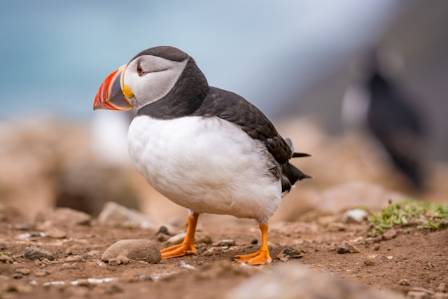
The Atlantic Puffin is one of the most easily recognized seabirds in the world. With its black-and-white feather pattern, bright orange feet, and large colorful beak, this charming bird has become a beloved symbol, especially in Maine. Its unique appearance has even earned it the nickname “clown of the sea.”
Kennedy Rose
निर्माता
फ़ाइल नोट
नीचे पूरा ट्यूटोरियल या लेख पढ़ें।
मॉड्यूल
डिजिटल कला
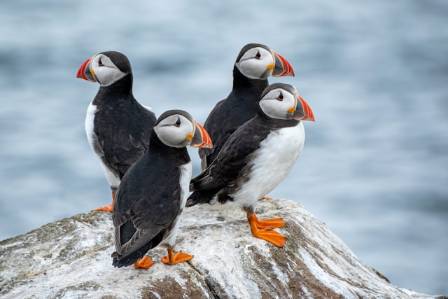
The Atlantic Puffin is one of the most easily recognized seabirds in the world. With its black-and-white feather pattern, bright orange feet, and large colorful beak, this charming bird has become a beloved symbol, especially in Maine. Its unique appearance has even earned it the nickname “clown of the sea.”
Puffins and Their Relationship With Other Seabirds
Atlantic Puffins belong to the alcid family, a group of seabirds that also includes species such as Black Guillemots, Razorbills, and the now-extinct Great Auk.
Alcids play a similar ecological role in the Northern Hemisphere to penguins in the Southern Hemisphere. Both groups are excellent swimmers that use their wings to move underwater while hunting for fish, and both usually live together in large breeding colonies.
However, there is one major difference between them: puffins are capable of flying, while penguins are not.
Where Atlantic Puffins Live and Breed
Atlantic Puffins breed in coastal colonies throughout the North Atlantic region. Their breeding range extends from the northeastern United States and Canada’s Labrador region to parts of Europe.
In North America, they are especially associated with Newfoundland and Labrador, where they are recognized as the provincial bird. In Europe, colonies can be found from the Brittany coast of France all the way to northern Russia, Greenland, and Iceland. Iceland alone is home to approximately 60% of the world’s Atlantic Puffin breeding population.
Maine’s Puffin Colonies
In Maine, Atlantic Puffins return each year to several important breeding sites, including Machias Seal Island, Matinicus Rock, Seal Island, Petit Manan, and Eastern Egg Rock.
Eastern Egg Rock, located about six miles from New Harbor, is one of the most accessible colonies for visitors. Boat tours allow passengers to respectfully travel around the island and observe puffins resting on rocky shores or flying back with fish to feed their chicks.
According to Project Puffin records, more than 1,000 puffins were breeding across Maine’s five established colonies as of 2013.
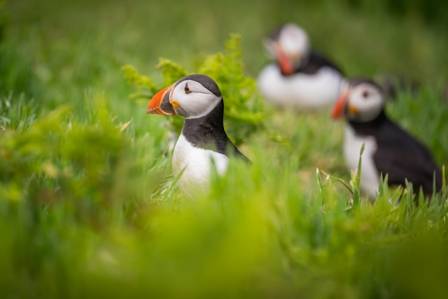
Puffins build their nests inside burrows dug into grassy slopes, cliffs, and islands. Despite their cheerful appearance, nesting puffins produce a deep, unusual groaning sound that seems surprising for such colorful birds.
During the non-breeding season, Atlantic Puffins spend most of their time far offshore in the open ocean, making them rarely visible from land.
The History of Puffins in Maine
Although Atlantic Puffins remain common as a species worldwide, Maine’s populations have experienced serious challenges in the past.
During the 1800s, hunting and the feather trade caused puffins to disappear from several Maine breeding areas. The colonies at Eastern Egg Rock and Seal Island were later restored through Project Puffin, an initiative led by Dr. Stephen Kress.
The restoration methods developed through this project have contributed greatly to seabird conservation efforts and have been used in other parts of the world to help rebuild seabird populations.
Climate Change Creates New Challenges
While hunting and the feather industry are no longer major threats, Atlantic Puffins now face a different problem: climate change.
Research from NOAA has shown that many fish populations in the northeastern ocean region, including the Gulf of Maine, are changing their distribution. Some fish species are moving farther north or into deeper, colder waters.
Important puffin food sources, such as white hake and Atlantic herring, are among the fish affected by these shifts. During the breeding season, when puffins need reliable food supplies to raise their chicks, changes in fish availability may make feeding more difficult.
At the same time, warmer-water species such as butterfish are becoming more common and increasing in size, which may also influence puffin nesting success. Observations from recent summers suggest that these environmental changes are already affecting Atlantic Puffin colonies.
संबंधित फ़ाइलें

Watercolor Flower Tutorial: A Beginner’s Guide to Vibrant Florals
AUTH: Winifred Mae Kingsley

Lujiazui: The Dynamic Hub of China’s Financial Industry
AUTH: Ethan Foster

Coordinating Your Handbag with Your Wardrobe: A Color Styling Guide
AUTH: Edmund Faraday

Cyclists complete Glasgow to Athens challenge and raise close to £100,000
AUTH: Sindre
जापानी पाक परंपराओं के रोचक पहलू
AUTH: स्निग्धा अरोड़ा

Top 5 Reasons Why Traveling by Boat is Truly Amazing
AUTH: Maxwell