Section 1
Bridge Bilingual Classics
Jack London's Short Stories (Vol. XV)
·
Confronting Nature
Jack London
·
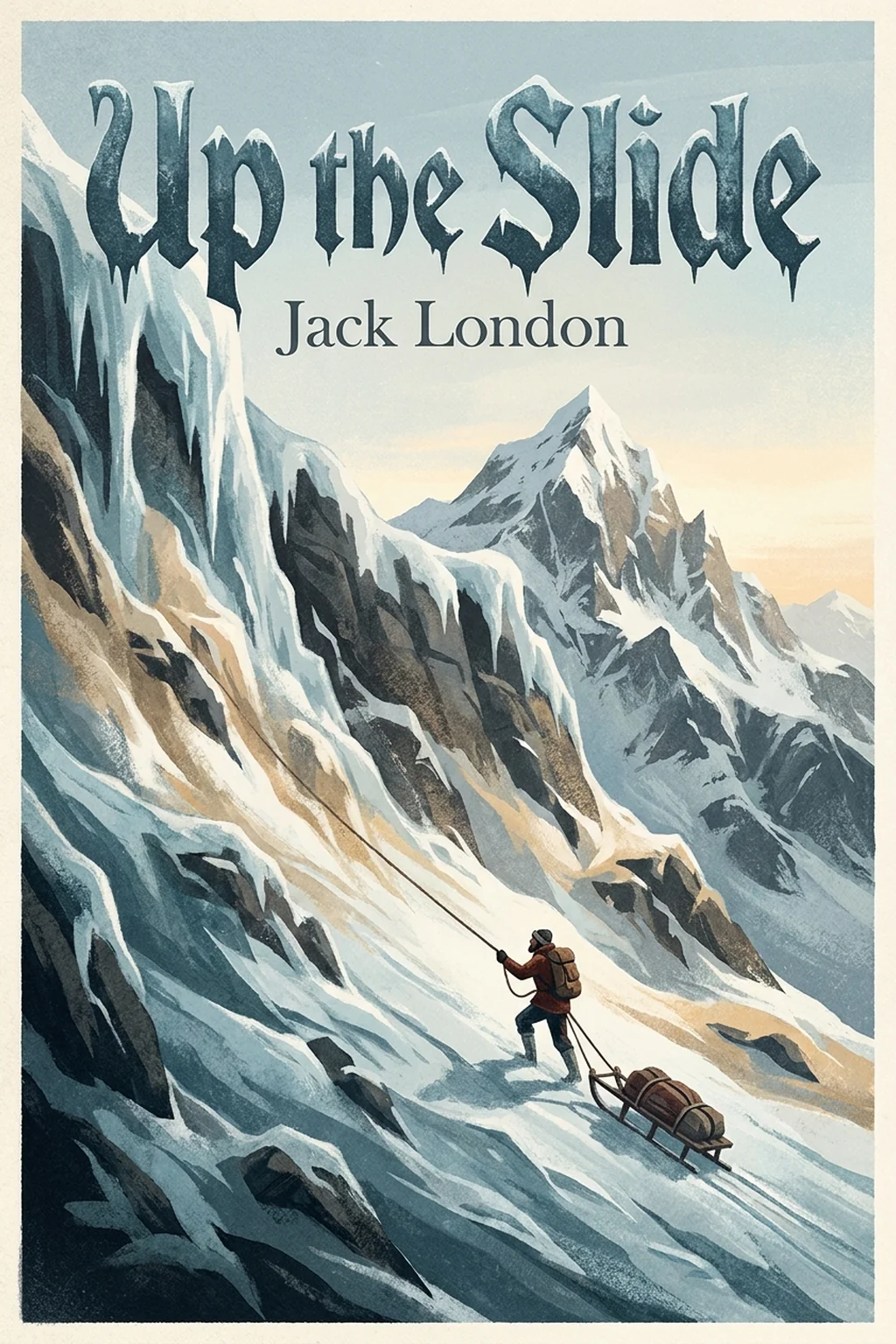
Up The Slide
Up The Slide
When Clay Dilham left the tent to get a sled-load of fire-wood, he expected to be back in half an hour. So he told Swanson, who was cooking the dinner. Swanson and he belonged to different outfits, located about twenty miles apart on the Stuart River; but they had become traveling partners on a trip down the Yukon to Dawson to get the mail.
·
Swanson had laughed when Clay said he would be back in half an hour. It stood to reason, Swanson said, that good, dry fire-wood could not be found so close to Dawson; that whatever fire-wood there was originally had long since been gathered in; that fire-wood would not be selling at forty dollars a cord if any man could go out and get a sled-load and be back in the time Clay expected to make it.
Then it was Clay's turn to laugh as he sprang on the sled and mushed the dogs onto the river-trail. For, coming up from the Siwash village the previous day, he had noticed a small dead pine in an out-of-the-way place which had defied discovery by eyes less sharp than his. And his eyes were both young and sharp, for his seventeenth birthday was just cleared.
A swift ten minutes over the ice brought him to the place, and figuring ten minutes to get the tree and ten minutes to return made him certain that Swanson's dinner would not wait.
Just below Dawson, and rising out of the Yukon itself, towered the great Moosehide Mountain, so named by Lieutenant Schwatka long ere the Klondike became famous. On the river side the mountain was scarred and gullied and gored; and it was up one of these gores or gullies that Clay had seen the tree.
Halting his dogs beneath, on the river ice, he looked up, and after some searching rediscovered it. Being dead, its weather-beaten gray so blended with the gray of rock that a thousand men could pass by and never notice it. Taking root in a cranny, it had grown up, exhausted its bit of soil, and perished. Beneath it the wall fell sheer away for a hundred feet to the river. All one had to do was to sink an ax into the dry trunk a dozen times and it would fall to the ice, and most probably smash conveniently to pieces. This Clay had figured on when confidently limiting the trip to half an hour.
He studied the cliff thoroughly before attempting it. So far as he was concerned, the longest way round was the shortest way to the tree. Twenty feet of nearly perpendicular climbing would bring him to where a slide sloped more gently in. By making a long zigzag across the face of this slide and back again, he would arrive at the pine.
Fastening his ax across his shoulders so that it would not interfere with his movements, he clawed up the broken rock, hand and foot, like a cat, till the twenty feet were cleared, and he could draw breath on the edge of the slide.
The slide was steep and its snow-covered surface slippery. Further, the heel-less, walrus-hide soles of his muclucs were polished by much ice travel, and by his second step he realized how little he could depend upon them for clinging purposes. A slip at that point meant a plunge over the edge and a twenty-foot fall to the ice. A hundred feet farther along, and a slip would mean a fifty-foot fall.
He thrust his mittened hand through the snow to the earth to steady himself, and went on. But he was forced to exercise such care that the first zigzag consumed five minutes. Then, returning across the face of the slide toward the pine, he met with a new difficulty. The slope steepened considerably, so that little snow collected, while bent flat beneath this thin covering were long, dry last-year's grasses.
The surface they presented was glassy as that of his muclucs, and when both surfaces came together his feet shot out and he fell on his face, sliding downward, and convulsively clutching for something to stay himself.
This he succeeded in doing, though he lay quiet for a couple of minutes to get back his nerve. He would have taken off his muclucs and gone at it in his socks, only the cold was thirty below zero, and at such temperature his feet would quickly freeze. So he went on, and after ten minutes of risky work made the safe and solid rock where stood the pine.
A few strokes of the ax felled it into the chasm, and peeping over the edge, he indulged in a laugh at the startled dogs. They were on the verge of bolting when he called aloud to them, soothingly, and they were reassured.
Then he turned about for the back trip. Going down, he knew, was even more dangerous than coming up, but how dangerous he did not realize till he had slipped half a dozen times, and each time saved himself by what appeared to him a miracle. Time and again he ventured upon the slide, and time and again he was balked when he came to the grasses.
He sat down and looked at the treacherous snow-covered slope. It was manifestly impossible for him to make it with a whole body, and he did not wish to arrive at the bottom shattered like the pine-tree.
But while he sat inactive the frost was stealing in on him, and the quick chilling of his body warned him that he could not delay. He must be doing something to keep his blood circulating. If he could not get down by going down, there only remained to him to get down by going up. It was a Herculean task, but it was the only way out of the predicament.
From where he was he could not see the top of the cliff, but he reasoned that the gully in which lay the slide must give inward more and more as it approached the top. From what little he could see, the gully displayed this tendency; and he noticed, also, that the slide extended for many hundreds of feet upward, and that where it ended the rock was well broken up and favorable for climbing. Here and there, at several wide intervals, small masses of rock projected through the snow of the slide itself, giving sufficient stability to the enterprise to encourage him.
So, instead of taking the zigzag which led downward, he made a new one leading upward and crossing the slide at an angle of thirty degrees. The grasses gave him much trouble, and made him long for soft-tanned moosehide moccasins which could make his feet cling like a second pair of hands.
He soon found that thrusting his mittened hands through the snow and clutching the grass-roots was uncertain and unsafe. His mittens were too thick for him to be sure of his grip, so he took them off. But this brought with it new trouble. When he held on to a bunch of roots the snow, coming in contact with his bare warm hand, was melted, so that his hands and the wristbands of his woolen shirt were dripping with water. This the frost was quick to attack, and his fingers were numbed and made worthless.
Then he was forced to seek good footing where he could stand erect unsupported, to put on his mittens, and to thrash his hands against his sides until the heat came back into them.
This constant numbing of his fingers made his progress very slow; but the zigzag came to an end, finally, where the side of the slide was buttressed by perpendicular rock, and he turned back and upward again. As he climbed higher and higher, he found that the slide was wedge-shaped, its rocky buttresses pinching it away as it neared its upper end. Each step increased the depth which seemed to yawn for him.
While beating his hands against his sides he turned and looked down the long slippery slope, and figured, in case he slipped, that he would be flying with the speed of an express-train ere he took the final plunge into the icy bed of the Yukon.
He passed the first outcropping rock, and the second, and at the end of an hour found himself above the third and fully five hundred feet above the river. And here, with the end nearly two hundred feet above him, the pitch of the slide was increasing.
Each step became more difficult and perilous, and he was faint from exertion and from lack of Swanson's dinner. Three or four times he slipped slightly and recovered himself; but, growing careless from exhaustion and the long tension on his nerves, he tried to continue with too great haste, and was rewarded by a double slip of each foot, which tore loose and started him down the slope.
On account of the steepness there was little snow; but what little there was, was displaced by his body, so that he became the nucleus of a young avalanche. He clawed desperately with his hands, but there was little to cling to, and he sped downward faster and faster.
The first and second outcroppings were below him, but he knew that the first was almost out of line, and pinned his hope on the second. Yet the first was just enough in line to catch one of his feet and to whirl him over and head downward on his back.
The shock of this was severe in itself, and the fine snow enveloped him in a blinding, maddening cloud; but he was thinking quickly and clearly of what would happen if he brought up head first against the second outcropping. He twisted himself over on his stomach, thrust both hands out to one side, and pressed them heavily against the flying surface.
This had the effect of a brake, drawing his head and shoulders to the side. In this position he rolled over and over a couple of times, and then, with a quick jerk at the right moment, he got his body the rest of the way round.
And none too soon, for the next moment his feet drove into the outcropping, his legs doubled up, and the wind was driven from his stomach with the abruptness of the stop.
There was much snow down his neck and up his sleeves. At once and with unconcern he shook this out, only to discover, when he looked up to where he must climb again, that he had lost his nerve. He was shaking as if with a palsy, and sick and faint from a frightful nausea.
Fully ten minutes passed by ere he could master these sensations and summon sufficient strength for the weary climb. His legs hurt him and he was limping, and he was conscious of a sore place in his back, where he had fallen on the ax.
In an hour he had regained the point of his tumble, and was contemplating the slide, which so suddenly steepened. It was plain to him that he could not go up with hands and feet alone, and he was beginning to lose his nerve again when he remembered the ax.
Reaching upward the distance of a step, he brushed away the snow, and in the frozen gravel and crumbled rock of the slide chopped a shallow resting-place for his foot. Then he came up a step, reached forward, and repeated the manoeuver, And so, step by step, foot-hole by foot-hole, a tiny speck of toiling life poised like a fly on the mighty face of Moosehide Mountain, he fought his upward way.
Twilight was beginning to fall when he gained the head of the slide and drew himself into the rocky bottom of the gully. At this point the shoulder of the mountain began to bend back toward the crest, and in addition to its being less steep, the rocks afforded better hand-hold and foot-hold. The worst was over, and the best yet to come!
!
The gully opened out into a miniature basin, in which a floor of soil had been deposited, out of which, in turn, a tiny grove of pines had sprung. The trees were all dead, dry and seasoned, having long since exhausted the thin skin of earth.
Clay ran his experienced eye over the timber, and estimated that it would chop up into fifty cords at least. Beyond, the gully closed in and became barren rock again. On every hand was barren rock, so the wonder was small that the trees had escaped the eyes of men. They were only to be discovered as he had discovered them—by climbimg after them.
——
He continued the ascent, and the white moon greeted him when he came out upon the crest of Moosehide Mountain. At his feet, a thousand feet below, sparkled the lights of Dawson.
But the descent on that side was precipitate and dangerous in the uncertain moonshine, and he elected to go down the mountain by its gentler northern flank. In a couple of hours he reached the Yukon at the Siwash village, and took the river-trail back to where he had left the dogs. There he found Swanson, with a fire going, waiting for him to come down.
And though Swanson had a hearty laugh at his expense, nevertheless, a week or so later, in Dawson, there were fifty cords of wood sold at forty dollars a cord, and it was he and Swanson who sold them.
Bald-Face
Jack London submitted this story to nearly a dozen periodicals before giving it to the Aegis. Bald-Face is a bear yarn about a side-hill grizzly whose down-hill-side legs are twice as long as the uphill-side legs.
·
"Talkin' of bear—”
“——”
The Klondike King paused meditatively, and the group on the hotel porch hitched their chairs up closer.
"Talkin' of bear," he went on, "now up in the Northern Country there are various kinds. On the Little Pelly, for instance, they come down that thick in the summer to feed on the salmon that you can't get an Indian or white man to go nigher than a day's journey to the place. And up in the Rampart Mountains there's a curious kind of bear called the 'side-hill grizzly.’ That's because he's traveled on the side-hills ever since the Flood, and the two legs on the down-hill side are twice as long as the two on the up-hill. And he can out-run a jack rabbit when he gets steam up. Dangerous? Catch you? Bless you, no. All a man has to do is to circle down the hill and run the other way. You see, that throws mister bear's long legs up the hill and the short ones down. Yes, he's a mighty peculiar creature, but that wasn't what I started in to tell about.
“”“‘’
"They've got another kind of bear up on the Yukon, and his legs are all right, too. He's called the bald-face grizzly, and he's jest as big as he is bad. It's only the fool white men that think of hunting him. Indians got too much sense. But there's one thing about the bald-face that a man has to learn: he never gives the trail to mortal creature. If you see him comin’, and you value your skin, you get out of his path. If you don't, there's bound to be trouble. If the bald-face met Jehovah Himself on the trail, he'd not give him an inch. O, he's a selfish beggar, take my word for it. But I had to learn all this. Didn't know anything about bear when I went into the country, exceptin' when I was a youngster I'd seen a heap of cinnamons and that little black kind. And they was nothin' to be scared at.
“
"Well, after we'd got settled down on our claim, I went up on the hill lookin' for a likely piece of birch to make an ax-handle out of. But it was pretty hard to find the right kind, and I kept a-goin' and kept a-goin' for nigh on two hours. Wasn't in no hurry to make my choice, you see, for I was headin' down to the Forks, where I was goin' to borrow a log-bit from Old Joe Gee. When I started, I'd put a couple of sour-dough biscuits and some sow-belly in my pocket in case I might get hungry. And I'm tellin' you that lunch came in right handy before I was done with it.
“·
"Bime-by I hit upon the likeliest little birch saplin’, right in the middle of a clump of jack pine. Jest as I raised my hand-ax I happened to cast my eyes down the hill. There was a big bear comin' up, swingin' along on all fours, right in my direction. It was a bald-face, but little I knew then about such kind.
“
“'Jest watch me scare him, ' I says to myself, and I stayed out of sight in the trees.
“‘’
"Well, I waited till he was about a hundred feet off, then out I runs into the open.
“
“'Oof! oof!' I hollered at him, expectin' to see him turn tail like chain lightning.
“‘’
"Turn tail? He jest throwed up his head for one good look and came a comin'.
“
“'Oof! oof!' I hollered, louder'n ever. But he jest came a comin’.
“‘’
“'Consarn you!' I says to myself, gettin' mad. 'I'll make you jump the trail. ’
“‘’‘’
"So I grabs my hat, and wavin' and hollerin' starts down the trail to meet him. A big sugar pine had gone down in a windfall and lay about breast high. I stops jest behind it, old bald-face comin' all the time. It was jest then that fear came to me. I yelled like a Comanche Indian as he raised up to come over the log, and fired my hat full in his face. Then I lit out.
“
"Say! I rounded the end of that log and put down the hill at a two-twenty clip, old bald-face reachin' for me at every jump. At the bottom was a broad, open flat, quarter of a mile to timber and full of nigger-heads. I knew if ever I slipped I was a goner, but I hit only the high places till you couldn't a-seen my trail for smoke. And the old devil snortin' along hot after me. Midway across, he reached for me, jest strikin' the heel of my moccasin with his claw. Tell you I was doin' some tall thinkin' jest then. I knew he had the wind of me and I could never make the brush, so I pulled my little lunch out of my pocket and dropped it on the fly.
“220
"Never looked back till I hit the timber, and then he was mouthing the biscuits in a way which wasn't nice to see, considerin' how close he'd been to me. I never slacked up. No, sir! Jest kept hittin' the trail for all there was in me. But jest as I came around a bend, heelin' it right lively I tell you, what'd I see in middle of the trail before me, and comin' my way, but another bald-face!
“
“'Whoof!' he says when he spotted me, and he came a-runnin.
“‘’
"Instanter I was about and hittin' the back trail twice as fast as I'd come. The way this one was puffin' after me, I'd clean forgot all about the other bald-face. First thing I knew I seen him mosying along kind of easy, wonderin' most likely what had become of me, and if I tasted as good as my lunch. Say! when he seen me he looked real pleased. And then he came a-jumpin' for me.
“
“'Whoof!' he says.
“‘’
“'Whoof !' says the one behind me.
“‘’
"Bang I goes, slap off the trail sideways, a-plungin' and a-clawin through the brush like a wild man. By this time I was clean crazed; thought the whole country was full of bald-faces. Next thing I knows—whop, I comes up against something in a tangle of wild blackberry bushes. Then that something hits me a slap and closes in on me. Another bald-face! And then and there I knew I was gone for sure. But I made up to die game, and of all the rampin' and roarin' and rippin' and tearin' you ever see, that was the worst.
“——
“'My God! O, my wife!' it says. And I looked and it was a man I was hammering into kingdom come.
“‘’
“'Thought you was a bear,' says I.
“‘’
"He kind of caught his breath and looked at me. Then he says, 'Same here.'
“‘’
"Seemed as though he'd been chased by a bald-face, too, and had hid in the blackberries. So that's how we mistook each other.
“
"But by that time the racket on the trail was something terrible, and we didn't wait to explain matters. That afternoon we got Joe Gee and some rifles and came back loaded for bear. Mebbe you won't believe me, but when we got to the spot, there was the two bald-faces lyin' dead. You see, when I jumped out, they came together, and each refused to give trail to the other. So they fought it out.
“·
"Talkin' of bear. As I was sayin’—”
“——”
At the Rainbow's End
I
It was for two reasons that Montana Kid discarded his "chaps" and Mexican spurs, and shook the dust of the Idaho ranges from his feet. In the first place, the encroachments of a steady, sober, and sternly moral civilization had destroyed the primeval status of the western cattle ranges, and refined society turned the cold eye of disfavor upon him and his ilk. In the second place, in one of its cyclopean moments the race had arisen and shoved back its frontier several thousand miles. Thus, with unconscious foresight, did mature society make room for its adolescent members. True, the new territory was mostly barren; but its several hundred thousand square miles of frigidity at least gave breathing space to those who else would have suffocated at home.
·“”
Montana Kid was such a one. Heading for the sea-coast, with a haste several sheriff's posses might possibly have explained, and with more nerve than coin of the realm, he succeeded in shipping from a Puget Sound port, and managed to survive the contingent miseries of steerage sea-sickness and steerage grub. He was rather sallow and drawn, but still his own indomitable self, when he landed on the Dyea beach one day in the spring of the year. Between the cost of dogs, grub, and outfits, and the customs exactions of the two clashing governments, it speedily penetrated to his understanding that the Northland was anything save a poor man's Mecca. So he cast about him in search of quick harvests. Between the beach and the passes were scattered many thousands of passionate pilgrims. These pilgrims Montana Kid proceeded to farm. At first he dealt faro in a pine-board gambling shack; but disagreeable necessity forced him to drop a sudden period into a man's life, and to move on up trail. Then he effected a corner in horseshoe nails, and they circulated at par with legal tender, four to the dollar, till an unexpected consignment of a hundred barrels or so broke the market and forced him to disgorge his stock at a loss. After that he located at Sheep Camp, organized the professional packers, and jumped the freight ten cents a pound in a single day. In token of their gratitude, the packers patronized his faro and roulette layouts and were mulcted cheerfully of their earnings. But his commercialism was of too lusty a growth to be long endured; so they rushed him one night, burned his shanty, divided the bank, and headed him up the trail with empty pockets.
··——·
Ill-luck was his running mate. He engaged with responsible parties to run whisky across the line by way of precarious and unknown trails, lost his Indian guides, and had the very first outfit confiscated by the Mounted Police. Numerous other misfortunes tended to make him bitter of heart and wanton of action, and he celebrated his arrival at Lake Bennett by terrorizing the camp for twenty straight hours. Then a miners' meeting took him in hand, and commanded him to make himself scarce. He had a wholesome respect for such assemblages, and he obeyed in such haste that he inadvertently removed himself at the tail-end of another man's dog team. This was equivalent to horse-stealing in a more mellow clime, so he hit only the high places across Bennett and down Tagish, and made his first camp a full hundred miles to the north.
···
Now it happened that the break of spring was at hand, and many of the principal citizens of Dawson were travelling south on the last ice. These he met and talked with, noted their names and possessions, and passed on. He had a good memory, also a fair imagination; nor was veracity one of his virtues.
II
Dawson, always eager for news, beheld Montana Kid's sled heading down the Yukon, and went out on the ice to meet him. No, he hadn't any newspapers; didn't know whether Durrant was hanged yet, nor who had won the Thanksgiving game; hadn't heard whether the United States and Spain had gone to fighting; didn't know who Dreyfus was; but O'Brien? Hadn't they heard? O'Brien, why, he was drowned in the White Horse; Sitka Charley the only one of the party who escaped. Joe Ladue? Both legs frozen and amputated at the Five Fingers. And Jack Dalton? Blown up on the "Sea Lion" with all hands. And Bettles? Wrecked on the "Carthagina," in Seymour Narrows,—twenty survivors out of three hundred. And Swiftwater Bill? Gone through the rotten ice of Lake LeBarge with six female members of the opera troupe he was convoying. Governor Walsh? Lost with all hands and eight sleds on the Thirty Mile. Devereaux? Who was Devereaux? Oh, the courier! Shot by Indians on Lake Marsh.
·?···“”“”——·
So it went. The word was passed along. Men shouldered in to ask after friends and partners, and in turn were shouldered out, too stunned for blasphemy. By the time Montana Kid gained the bank he was surrounded by several hundred fur-clad miners. When he passed the Barracks he was the centre of a procession. At the Opera House he was the nucleus of an excited mob, each member struggling for a chance to ask after some absent comrade. On every side he was being invited to drink. Never before had the Klondike thus opened its arms to a che-cha-qua. All Dawson was humming. Such a series of catastrophes had never occurred in its history. Every man of note who had gone south in the spring had been wiped out. The cabins vomited forth their occupants. Wild-eyed men hurried down from the creeks and gulches to seek out this man who had told a tale of such disaster. The Russian half-breed wife of Bettles sought the fireplace, inconsolable, and rocked back and forth, and ever and anon flung white wood-ashes upon her raven hair. The flag at the Barracks flopped dismally at half-mast. Dawson mourned its dead.
·
Why Montana Kid did this thing no man may know. Nor beyond the fact that the truth was not in him, can explanation be hazarded. But for five whole days he plunged the land in wailing and sorrow, and for five whole days he was the only man in the Klondike. The country gave him its best of bed and board. The saloons granted him the freedom of their bars. Men sought him continuously. The high officials bowed down to him for further information, and he was feasted at the Barracks by Constantine and his brother officers. And then, one day, Devereaux, the government courier, halted his tired dogs before the gold commissioner's office. Dead? Who said so? Give him a moose steak and he'd show them how dead he was. Why, Governor Walsh was in camp on the Little Salmon, and O'Brien coming in on the first water. Dead? Give him a moose steak and he'd show them.
··
And forthwith Dawson hummed. The Barracks' flag rose to the masthead, and Bettles' wife washed herself and put on clean raiment. The community subtly signified its desire that Montana Kid obliterate himself from the landscape. And Montana Kid obliterated; as usual, at the tail-end of some one else's dog team. Dawson rejoiced when he headed down the Yukon, and wished him godspeed to the ultimate destination of the case-hardened sinner. After that the owner of the dogs bestirred himself, made complaint to Constantine, and from him received the loan of a policeman.
···
III
With Circle City in prospect and the last ice crumbling under his runners, Montana Kid took advantage of the lengthening days and travelled his dogs late and early. Further, he had but little doubt that the owner of the dogs in question had taken his trail, and he wished to make American territory before the river broke. But by the afternoon of the third day it became evident that he had lost in his race with spring. The Yukon was growling and straining at its fetters. Long detours became necessary, for the trail had begun to fall through into the swift current beneath, while the ice, in constant unrest, was thundering apart in great gaping fissures. Through these and through countless airholes, the water began to sweep across the surface of the ice, and by the time he pulled into a woodchopper's cabin on the point of an island, the dogs were being rushed off their feet and were swimming more often than not. He was greeted sourly by the two residents, but he unharnessed and proceeded to cook up.
··
Donald and Davy were fair specimens of frontier inefficients. Canadian-born, city-bred Scots, in a foolish moment they had resigned their counting-house desks, drawn upon their savings, and gone Klondiking. And now they were feeling the rough edge of the country. Grubless, spiritless, with a lust for home in their hearts, they had been staked by the P. C. Company to cut wood for its steamers, with the promise at the end of a passage home. Disregarding the possibilities of the ice-run, they had fittingly demonstrated their inefficiency by their choice of the island on which they located. Montana Kid, though possessing little knowledge of the break-up of a great river, looked about him dubiously, and cast yearning glances at the distant bank where the towering bluffs promised immunity from all the ice of the Northland.
P.C.——·
After feeding himself and dogs, he lighted his pipe and strolled out to get a better idea of the situation. The island, like all its river brethren, stood higher at the upper end, and it was here that Donald and Davy had built their cabin and piled many cords of wood. The far shore was a full mile away, while between the island and the near shore lay a back-channel perhaps a hundred yards across. At first sight of this, Montana Kid was tempted to take his dogs and escape to the mainland, but on closer inspection he discovered a rapid current flooding on top. Below, the river twisted sharply to the west, and in this turn its breast was studded by a maze of tiny islands.
··
"That's where she'll jam," he remarked to himself.
“”
Half a dozen sleds, evidently bound up-stream to Dawson, were splashing through the chill water to the tail of the island. Travel on the river was passing from the precarious to the impossible, and it was nip and tuck with them till they gained the island and came up the path of the wood-choppers toward the cabin. One of them, snow-blind, towed helplessly at the rear of a sled. Husky young fellows they were, rough-garmented and trail-worn, yet Montana Kid had met the breed before and knew at once that it was not his kind.
·
"Hello! How's things up Dawson-way?" queried the foremost, passing his eye over Donald and Davy and settling it upon the Kid.
“”
A first meeting in the wilderness is not characterized by formality. The talk quickly became general, and the news of the Upper and Lower Countries was swapped equitably back and forth. But the little the newcomers had was soon over with, for they had wintered at Minook, a thousand miles below, where nothing was doing. Montana Kid, however, was fresh from Salt Water, and they annexed him while they pitched camp, swamping him with questions concerning the outside, from which they had been cut off for a twelvemonth.
·
A shrieking split, suddenly lifting itself above the general uproar on the river, drew everybody to the bank. The surface water had increased in depth, and the ice, assailed from above and below, was struggling to tear itself from the grip of the shores. Fissures reverberated into life before their eyes, and the air was filled with multitudinous crackling, crisp and sharp, like the sound that goes up on a clear day from the firing line.
From up the river two men were racing a dog team toward them on an uncovered stretch of ice. But even as they looked, the pair struck the water and began to flounder through. Behind, where their feet had sped the moment before, the ice broke up and turned turtle. Through this opening the river rushed out upon them to their waists, burying the sled and swinging the dogs off at right angles in a drowning tangle. But the men stopped their flight to give the animals a fighting chance, and they groped hurriedly in the cold confusion, slashing at the detaining traces with their sheath-knives. Then they fought their way to the bank through swirling water and grinding ice, where, foremost in leaping to the rescue among the jarring fragments, was the Kid.
"Why, blime me, if it ain't Montana Kid!" exclaimed one of the men whom the Kid was just placing upon his feet at the top of the bank. He wore the scarlet tunic of the Mounted Police and jocularly raised his right hand in salute.
“·”
"Got a warrant for you, Kid," he continued, drawing a bedraggled paper from his breast pocket, "an' I 'ope as you'll come along peaceable.”
“”“”
Montana Kid looked at the chaotic river and shrugged his shoulders, and the policeman, following his glance, smiled.
·
"Where are the dogs?" his companion asked.
“”
"Gentlemen," interrupted the policeman, "this 'ere mate o' mine is Jack Sutherland, owner of Twenty-Two Eldorado—”
“·——”
"Not Sutherland of '92?" broke in the snow-blinded Minook man, groping feebly toward him.
“92”
"The same." Sutherland gripped his hand.
“”
"And you?"
“”
"Oh, I'm after your time, but I remember you in my freshman year,—you were doing P. G. work then. Boys," he called, turning half about, "this is Sutherland, Jack Sutherland, erstwhile full-back on the 'Varsity. Come up, you gold-chasers, and fall upon him! Sutherland, this is Greenwich,—played quarter two seasons back.”
“——”“·——”
"Yes, I read of the game," Sutherland said, shaking hands. "And I remember that big run of yours for the first touchdown."
“”“”
Greenwich flushed darkly under his tanned skin and awkwardly made room for another.
"And here's Matthews,—Berkeley man. And we've got some Eastern cracks knocking about, too. Come up, you Princeton men! Come up! This is Sutherland, Jack Sutherland!”
“——·”
Then they fell upon him heavily, carried him into camp, and supplied him with dry clothes and numerous mugs of black tea.
Donald and Davy, overlooked, had retired to their nightly game of crib. Montana Kid followed them with the policeman.
·
"Here, get into some dry togs," he said, pulling them from out his scanty kit. "Guess you'll have to bunk with me, too.”
“”
"Well, I say, you're a good 'un," the policeman remarked as he pulled on the other man's socks. "Sorry I've got to take you back to Dawson, but I only 'ope they won't be 'ard on you.”
“”“”
"Not so fast." The Kid smiled curiously. "We ain't under way yet. When I go I'm going down river, and I guess the chances are you'll go along.”
“”“”
"Not if I know myself—”
“——”
"Come on outside, and I'll show you, then. These damn fools," thrusting a thumb over his shoulder at the two Scots, "played smash when they located here. Fill your pipe, first—this is pretty good plug—and enjoy yourself while you can. You haven't many smokes before you.”
“”“————”
The policeman went with him wonderingly, while Donald and Davy dropped their cards and followed. The Minook men noticed Montana Kid pointing now up the river, now down, and came over.
·
"What's up?" Sutherland demanded.
“”
"Nothing much." Nonchalance sat well upon the Kid. "Just a case of raising hell and putting a chunk under. See that bend down there? That's where she'll jam millions of tons of ice. Then she'll jam in the bends up above, millions of tons. Upper jam breaks first, lower jam holds, pouf!” He dramatically swept the island with his hand. "Millions of tons," he added reflectively.
“”“”“”
"And what of the woodpiles?" Davy questioned.
“”
The Kid repeated his sweeping gestures and Davy wailed, "The labor of months! It canna be! Na, na, lad, it canna be. I doot not it's a jowk. Ay, say that it is," he appealed.
“”
But when the Kid laughed harshly and turned on his heel, Davy flung himself upon the piles and began frantically to toss the cordwood back from the bank.
"Lend a hand, Donald!" he cried. "Can ye no lend a hand? 'T is the labor of months and the passage home!”
“”“”
Donald caught him by the arm and shook him, but he tore free. "Did ye no hear, man? Millions of tons, and the island shall be sweepit clean."
“”
"Straighten yersel' up, man," said Donald. "It's a bit fashed ye are.”
“”“”
But Davy fell upon the cordwood. Donald stalked back to the cabin, buckled on his money belt and Davy's, and went out to the point of the island where the ground was highest and where a huge pine towered above its fellows.
The men before the cabin heard the ringing of his axe and smiled. Greenwich returned from across the island with the word that they were penned in. It was impossible to cross the back-channel. The blind Minook man began to sing, and the rest joined in with—
——
"Wonder if it's true? Does it seem so to you? Seems to me he's lying—Oh, I wonder if it's true?”
“——”
"It's ay sinfu’," Davy moaned, lifting his head and watching them dance in the slanting rays of the sun. "And my guid wood a' going to waste.”
“”
"Oh, I wonder if it's true," was flaunted back.
“”
The noise of the river ceased suddenly. A strange calm wrapped about them. The ice had ripped from the shores and was floating higher on the surface of the river, which was rising. Up it came, swift and silent, for twenty feet, till the huge cakes rubbed softly against the crest of the bank. The tail of the island, being lower, was overrun. Then, without effort, the white flood started down-stream. But the sound increased with the momentum, and soon the whole island was shaking and quivering with the shock of the grinding bergs. Under pressure, the mighty cakes, weighing hundreds of tons, were shot into the air like peas. The frigid anarchy increased its riot, and the men had to shout into one another's ears to be heard. Occasionally the racket from the back channel could be heard above the tumult. The island shuddered with the impact of an enormous cake which drove in squarely upon its point. It ripped a score of pines out by the roots, then swinging around and over, lifted its muddy base from the bottom of the river and bore down upon the cabin, slicing the bank and trees away like a gigantic knife. It seemed barely to graze the corner of the cabin, but the cribbed logs tilted up like matches, and the structure, like a toy house, fell backward in ruin.
“”
"The labor of months! The labor of months, and the passage home!" Davy wailed, while Montana Kid and the policeman dragged him backward from the woodpiles.
“”·
"You'll 'ave plenty o' hoppertunity all in good time for yer passage 'ome," the policeman growled, clouting him alongside the head and sending him flying into safety.
“”
Donald, from the top of the pine, saw the devastating berg sweep away the cordwood and disappear down-stream. As though satisfied with this damage, the ice-flood quickly dropped to its old level and began to slacken its pace. The noise likewise eased down, and the others could hear Donald shouting from his eyrie to look down-stream. As forecast, the jam had come among the islands in the bend, and the ice was piling up in a great barrier which stretched from shore to shore. The river came to a standstill, and the water finding no outlet began to rise. It rushed up till the island was awash, the men splashing around up to their knees, and the dogs swimming to the ruins of the cabin. At this stage it abruptly became stationary, with no perceptible rise or fall.
Montana Kid shook his head. "It's jammed above, and no more's coming down.”
·“”
"And the gamble is, which jam will break first," Sutherland added.
“”
"Exactly," the Kid affirmed. "If the upper jam breaks first, we haven't a chance. Nothing will stand before it.”
“”“”
The Minook men turned away in silence, but soon "Rumsky Ho" floated upon the quiet air, followed by "The Orange and the Black." Room was made in the circle for Montana Kid and the policeman, and they quickly caught the ringing rhythm of the choruses as they drifted on from song to song.
·
"Oh, Donald, will ye no lend a hand?" Davy sobbed at the foot of the tree into which his comrade had climbed. "Oh, Donald, man, will ye no lend a hand?" he sobbed again, his hands bleeding from vain attempts to scale the slippery trunk.
“”“”
But Donald had fixed his gaze up river, and now his voice rang out, vibrant with fear:—
"God Almichty, here she comes!"
“”
Standing knee-deep in the icy water, the Minook men, with Montana Kid and the policeman, gripped hands and raised their voices in the terrible, "Battle Hymn of the Republic." But the words were drowned in the advancing roar.
And to Donald was vouchsafed a sight such as no man may see and live. A great wall of white flung itself upon the island. Trees, dogs, men, were blotted out, as though the hand of God had wiped the face of nature clean. This much he saw, then swayed an instant longer in his lofty perch and hurtled far out into the frozen hell.
——
For work background, reading notes, and source credits, see the book introduction.