Section 1
Bridge Bilingual Classics
Jack London's Short Stories (Vol. XII)
·
Man with Wine
Jack London
·
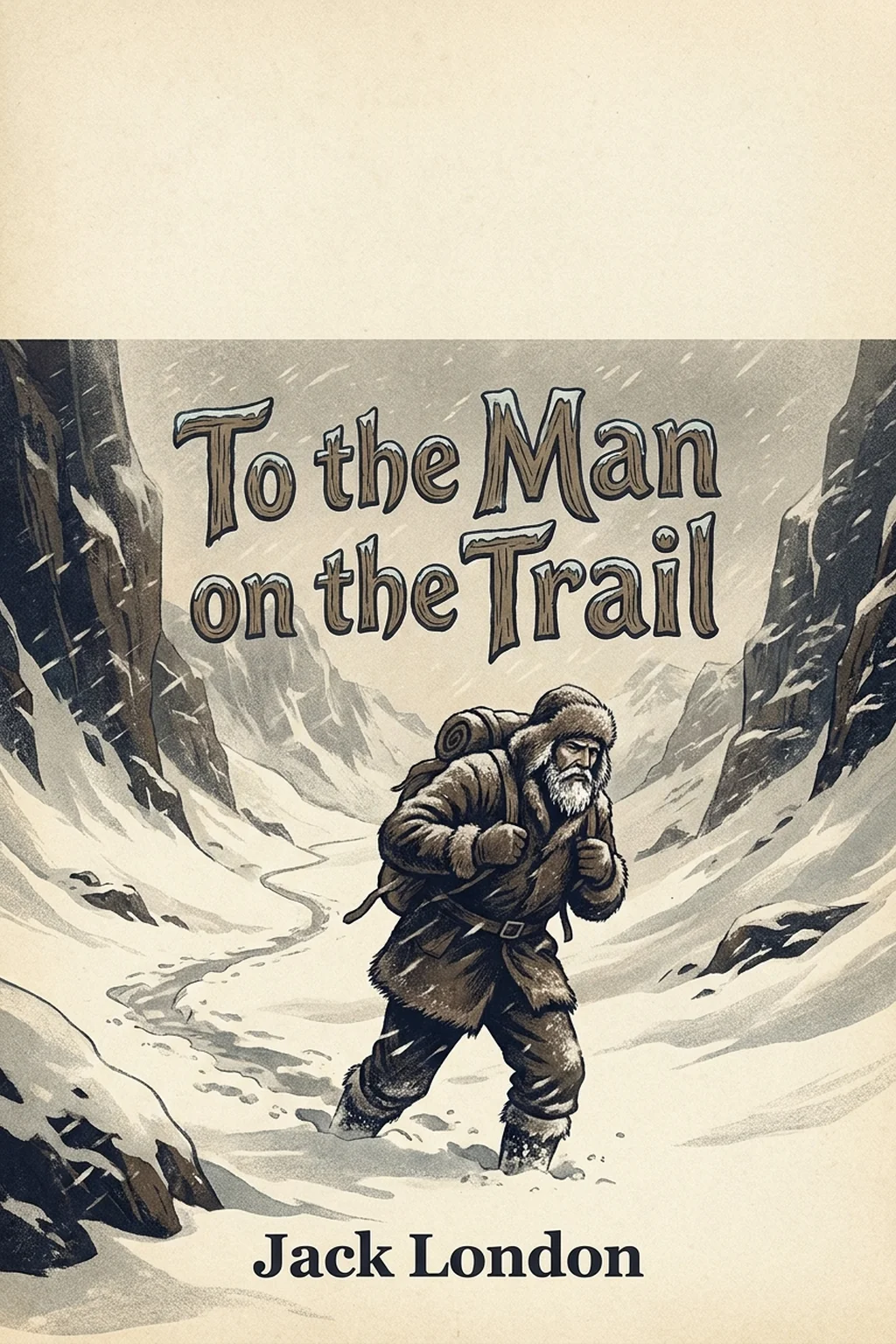
To the Man on the Trail
To the Man on the Trail
"Dump it in."
“”
"But I say, Kid, isn't that going it a little too strong? Whiskey and alcohol's bad enough; but when it comes to brandy and pepper-sauce and—”
“——”
"Dump it in. Who's making this punch, anyway?” And Malemute Kid smiled benignantly through the clouds of steam. "By the time you've been in this country as long as I have, my son, and lived on rabbit-tracks and salmon-belly, you'll learn that Christmas comes only once per annum. And a Christmas without punch is sinking a hole to bedrock with nary a pay-streak.”
“”·“”
"Stack up on that fer a high card," approved Big Jim Belden, who had come down from his claim on Mazy May to spend Christmas, and who, as every one knew, had been living the two months past on straight moose-meat. "Hain't fergot the hooch we-uns made on the Tanana, hev yeh?”
“”··“”
"Well, I guess yes. Boys, it would have done your hearts good to see that whole tribe fighting drunk—and all because of a glorious ferment of sugar and sour dough. That was before your time," Malemute Kid said as he turned to Stanley Prince, a young mining expert who had been in two years. "No white women in the country then, and Mason wanted to get married. Ruth's father was chief of the Tananas, and objected, like the rest of the tribe. Stiff? Why, I used my last pound of sugar; finest work in that line I ever did in my life. You should have seen the chase, down the river and across the portage.”
“——”··“”
"But the squaw?" asked Louis Savoy, the tall French-Canadian, becoming interested; for he had heard of this wild deed, when at Forty Mile the preceding winter.
“”·
Then Malemute Kid, who was a born raconteur, told the unvarnished tale of the Northland Lochinvar. More than one rough adventurer of the North felt his heartstrings draw closer, and experienced vague yearnings for the sunnier pastures of the Southland, where life promised something more than a barren struggle with cold and death.
·
"We struck the Yukon just behind the first ice-run," he concluded, "and the tribe only a quarter of an hour behind. But that saved us; for the second run broke the jam above and shut them out. When they finally got into Nuklukyeto, the whole Post was ready for them. And as to the foregathering, ask Father Roubeau here: he performed the ceremony.”
“”“”
The Jesuit took the pipe from his lips, but could only express his gratification with patriarchal smiles, while Protestant and Catholic vigorously applauded.
"By gar!" ejaculated Louis Savoy, who seemed overcome by the romance of it. "La petite squaw; mon Mason brav. By gar!" Then, as the first tin cups of punch went round, Bettles the Unquenchable sprang to his feet and struck up his favorite drinking song:
“”·“”
"There's Henry Ward Beecher And Sunday-school teachers, All drink of the sassafras root; But you bet all the same, If it had its right name, It's the juice of the forbidden fruit.”
“··”
"O the juice of the forbidden fruit,"
“”
roared out the Bacchanalian chorus,—
"O the juice of the forbidden fruit; But you bet all the same, If it had its right name, It's the juice of the forbidden fruit.”
“”
Malemute Kid's frightful concoction did its work; the men of the camps and trails unbent in its genial glow, and jest and song and tales of past adventure went round the board. Aliens from a dozen lands, they toasted each and all. It was the Englishman, Prince, who pledged "Uncle Sam, the precocious infant of the New World;" the Yankee, Bettles, who drank to "The Queen, God bless her;" and together, Savoy and Meyers, the German trader, clanged their cups to Alsace and Lorraine.
·“”“”
Then Malemute Kid arose, cup in hand, and glanced at the greased-paper window, where the frost stood full three inches thick. "A health to the man on trail this night; may his grub hold out; may his dogs keep their legs; may his matches never miss fire."
·“”
Crack! Crack!—they heard the familiar music of the dogwhip, the whining howl of the Malemutes, and the crunch of a sled as it drew up to the cabin. Conversation languished while they waited the issue.
"An old-timer; cares for his dogs and then himself," whispered Malemute Kid to Prince, as they listened to the snapping jaws and the wolfish snarls and yelps of pain which proclaimed to their practiced ears that the stranger was beating back their dogs while he fed his own.
“”·
Then came the expected knock, sharp and confident, and the stranger entered. Dazzled by the light, he hesitated a moment at the door, giving to all a chance for scrutiny. He was a striking personage, and a most picturesque one, in his Arctic dress of wool and fur. Standing six foot two or three, with proportionate breadth of shoulders and depth of chest, his smooth-shaven face nipped by the cold to a gleaming pink, his long lashes and eyebrows white with ice, and the ear and neck flaps of his great wolf skin cap loosely raised, he seemed, of a verity, the Frost King, just stepped in out of the night. Clasped outside his mackinaw jacket, a beaded belt held two large Colt's revolvers and a hunting-knife, while he carried, in addition to the inevitable dog whip, a smokeless rifle of the largest bore and latest pattern. As he came forward, for all his step was firm and elastic, they could see that fatigue bore heavily upon him.
An awkward silence had fallen, but his hearty "What cheer, my lads?" put them quickly at ease, and the next instant Malemute Kid and he had gripped hands. Though they had never met, each had heard of the other, and the recognition was mutual. A sweeping introduction and a mug of punch were forced upon him before he could explain his errand.
“”·
"How long since that basket-sled, with three men and eight dogs, passed?" he asked.
“”
"An even two days ahead. Are you after them?"
“”
"Yes; my team. Run them off under my very nose, the cusses. I've gained two days on them already,—pick them up on the next run.”
“”
"Reckon they'll show spunk?" asked Belden, in order to keep up the conversation, for Malemute Kid already had the coffee-pot on and was busily frying bacon and moose-meat.
“”·
The stranger significantly tapped his revolvers.
"When 'd yeh leave Dawson?”
“”
"Twelve o'clock.”
“”
"Last night?"—as a matter of course.
“”——
"To-day.”
“”
A murmur of surprise passed round the circle. And well it might; for it was just midnight, and seventy-five miles of rough river trail was not to be sneered at for a twelve hours' run.
The talk soon became impersonal, however, harking back to the trails of childhood. As the young stranger ate of the rude fare, Malemute Kid attentively studied his face. Nor was he long in deciding that it was fair, honest, and open, and that he liked it. Still youthful, the lines had been firmly traced by toil and hardship. Though genial in conversation, and mild when at rest, the blue eyes gave promise of the hard steel-glitter which comes when called into action, especially against odds. The heavy jaw and square-cut chin demonstrated rugged pertinacity and indomitability. Nor, though the attributes of the lion were there, was there wanting the certain softness, the hint of womanliness, which bespoke the emotional nature.
·
"So thet's how me an' the ol' woman got spliced," said Belden, concluding the exciting tale of his courtship. “'Here we be, dad, 'sez she. An' may yeh be damned,' sez he to her, an' then to me, Jim, yeh—yeh git outen them good duds o' yourn; I want a right peart slice o' thet forty acre ploughed 'fore dinner.’ An' then he turns on her an' sez, 'An' yeh, Sal; yeh sail inter them dishes.’ An' then he sort o' sniffled an' kissed her. An' I was thet happy,—but he seen me an' roars out, 'Yeh, Jim!' An' yeh bet I dusted fer the barn.”
“”“‘’‘’‘——’‘’——‘’”
"Any kids waiting for you back in the States?" asked the stranger.
“”
"Nope; Sal died 'fore any come. Thet's why I'm here.” Belden abstractedly began to light his pipe, which had failed to go out, and then brightened up with, "How 'bout yerself, stranger,—married man?”
“”“”
For reply, he opened his watch, slipped it from the thong which served for a chain, and passed it over. Belden pricked up the slush-lamp, surveyed the inside of the case critically, and swearing admiringly to himself, handed it over to Louis Savoy. With numerous "By gars!" he finally surrendered it to Prince, and they noticed that his hands trembled and his eyes took on a peculiar softness. And so it passed from horny hand to horny hand—the pasted photograph of a woman, the clinging kind that such men fancy, with a babe at the breast. Those who had not yet seen the wonder were keen with curiosity; those who had, became silent and retrospective. They could face the pinch of famine, the grip of scurvy, or the quick death by field or flood; but the pictured semblance of a stranger woman and child made women and children of them all.
·“”——
"Never have seen the youngster yet,—he 's a boy, she says, and two years old," said the stranger as he received the treasure back. A lingering moment he gazed upon it, then snapped the case and turned away, but not quick enough to hide the restrained rush of tears.
“——”
Malemute Kid led him to a bunk and bade him turn in.
·
"Call me at four, sharp. Don't fail me," were his last words, and a moment later he was breathing in the heaviness of exhausted sleep.
“”
"By Jove! he's a plucky chap," commented Prince. "Three hours' sleep after seventy-five miles with the dogs, and then the trail again. Who is he, Kid?”
“”“”
"Jack Westondale. Been in going on three years, with nothing but the name of working like a horse, and any amount of bad luck to his credit. I never knew him, but Sitka Charley told me about him."
“··”
"It seems hard that a man with a sweet young wife like his should be putting in his years in this God-forsaken hole, where every year counts two on the outside.”
“”
"The trouble with him is clean grit and stubbornness. He 's cleaned up twice with a stake, but lost it both times.”
“”
Here the conversation was broken off by an uproar from Bettles, for the effect had begun to wear away. And soon the bleak years of monotonous grub and deadening toil were being forgotten in rough merriment. Malemute Kid alone seemed unable to lose himself, and cast many an anxious look at his watch. Once he put on his mittens and beaver-skin cap, and leaving the cabin, fell to rummaging about in the cache.
·
Nor could he wait the hour designated; for he was fifteen minutes ahead of time in rousing his guest. The young giant had stiffened badly, and brisk rubbing was necessary to bring him to his feet. He tottered painfully out of the cabin, to find his dogs harnessed and everything ready for the start. The company wished him good luck and a short chase, while Father Roubeau, hurriedly blessing him, led the stampede for the cabin; and small wonder, for it is not good to face seventy-four degrees below zero with naked ears and hands.
Malemute Kid saw him to the main trail, and there, gripping his hand heartily, gave him advice.
·
"You'll find a hundred pounds of salmon-eggs on the sled," he said. "The dogs will go as far on that as with one hundred and fifty of fish, and you can't get dog-food at Pelly, as you probably expected.” The stranger started, and his eyes flashed, but he did not interrupt. "You can't get an ounce of food for dog or man till you reach Five Fingers, and that 's a stiff two hundred miles. Watch out for open water on the Thirty Mile River, and be sure you take the big cut-off above Le Barge.”
“”“”“”
"How did you know it? Surely the news can't be ahead of me already?”
“”
"I don't know it; and what's more, I don't want to know it. But you never owned that team you're chasing. Sitka Charley sold it to them last spring. But he sized you up to me as square once, and believe him. I've seen your face; I like it. And I've seen—why, damn you, hit the high places for salt water and that wife of yours, and—” Here the Kid unmittened and jerked out his sack.
“·————”
"No; I don't need it," and the tears froze on his cheeks as he convulsively gripped Malemute Kid's hand.
“”·
"Then don't spare the dogs; cut them out of the traces as fast as they drop; buy them, and think they 're cheap at ten dollars a pound. You can get them at Five Fingers, Little Salmon, and the Hootalinqua. And watch out for wet feet," was his parting advice. "Keep a-traveling up to twenty-five, but if it gets below that, build a fire and change your socks.”
“”“”
Fifteen minutes had barely elapsed when the jingle of bells announced new arrivals. The door opened, and a mounted policeman of the Northwest Territory entered, followed by two half-breed dog-drivers. Like Westondale, they were heavily armed and showed signs of fatigue. The half-breeds had been born to the trail, and bore it easily; but the young policeman was badly exhausted. Still, the dogged obstinacy of his race held him to the pace he had set, and would hold him till he dropped in his tracks.
"When did Westondale pull out?" he asked. "He stopped here, didn't he?” This was supererogatory, for the tracks told their own tale too well.
“”“”
Malemute Kid had caught Belden's eye, and he, scenting the wind, replied evasively, "A right part while back."
·“”
"Come, my man; speak up," the policeman admonished.
“”
"Yeh seem to want him right smart. Hez he ben gittin' cantankerous down Dawson way?”
“”
"Held up Harry McFarland's for forty thousand; exchanged it at the P. C. store for a check on Seattle; and who's to stop the cashing of it if we don't overtake him? When did he pull out?”
“·”
Every eye suppressed its excitement, for Malemute Kid had given the cue, and the young officer encountered wooden faces on every hand.
·
Striding over to Prince, he put the question to him. Though it hurt him, gazing into the frank, earnest face of his fellow countryman, he replied inconsequentially on the state of the trail.
Then he espied Father Roubeau, who could not lie. "A quarter of an hour ago," the priest answered; "but he had four hours' rest for himself and dogs.”
“”“”
"Fifteen minutes' start, and he's fresh! My God!” The poor fellow staggered back, half fainting from exhaustion and disappointment, murmuring something about the run from Dawson in ten hours and the dogs being played out.
“”
Malemute Kid forced a mug of punch upon him; then he turned for the door, ordering the dog-drivers to follow. But the warmth and promise of rest were too tempting, and they objected strenuously. The Kid was conversant with their French patois, and followed it anxiously.
·
They swore that the dogs were gone up; that Siwash and Babette would have to be shot before the first mile was covered; that the rest were almost as bad; and that it would be better for all hands to rest up.
"Lend me five dogs?" he asked, turning to Malemute Kid.
“”·
But the Kid shook his head.
"I'll sign a check on Captain Constantine for five thousand,—here's my papers,—I'm authorized to draw at my own discretion.”
“————”
Again the silent refusal.
"Then I'll requisition them in the name of the Queen.”
“”
Smiling incredulously, the Kid glanced at his well-stocked arsenal, and the Englishman, realizing his impotency, turned for the door. But the dog-drivers still objecting, he whirled upon them fiercely, calling them women and curs. The swart face of the older half-breed flushed angrily, as he drew himself up and promised in good, round terms that he would travel his leader off his legs, and would then be delighted to plant him in the snow.
The young officer—and it required his whole will—walked steadily to the door, exhibiting a freshness he did not possess. But they all knew and appreciated his proud effort; nor could he veil the twinges of agony that shot across his face. Covered with frost, the dogs were curled up in the snow, and it was almost impossible to get them to their feet. The poor brutes whined under the stinging lash, for the dog-drivers were angry and cruel; nor till Babette, the leader, was cut from the traces, could they break out the sled and get under way.
"A dirty scoundrel and a liar!" "By gar! him no good!" "A thief!" "Worse than an Indian!" It was evident that they were angry—first, at the way they had been deceived; and second, at the outraged ethics of the Northland, where honesty, above all, was man's prime jewel. "An' we gave the cuss a hand, after knowin' what he'd did.” All eyes were turned accusingly upon Malemute Kid, who rose from the corner where he had been making Babette comfortable, and silently emptied the bowl for a final round of punch. "It's a cold night, boys,—a bitter cold night," was the irrelevant commencement of his defense. "You've all traveled trail, and know what that stands for. Don't jump a dog when he's down. You've only heard one side. A whiter man than Jack Westondale never ate from the same pot nor stretched blanket with you or me. Last fall he gave his whole clean-up, forty thousand, to Joe Castrell, to buy in on Dominion. To-day he'd be a millionaire. But while he stayed behind at Circle City, taking care of his partner with the scurvy, what does Castrell do? Goes into McFarland's, jumps the limit, and drops the whole sack. Found him dead in the snow the next day. And poor Jack laying his plans to go out this winter to his wife and the boy he's never seen. You'll notice he took exactly what his partner lost,—forty thousand. Well, he's gone out; and what are you going to do about it?”
“”“”“”“”——“”·“——”“·——·”
The Kid glanced round the circle of his judges, noted the softening of their faces, then raised his mug aloft. "So a health to the man on trail this night; may his grub hold out; may his dogs keep their legs; may his matches never miss fire. God prosper him; good luck go with him; and—”
“”——”
"Confusion to the Mounted Police!" interpolated Bettles, to the crash of the empty cups.
“”
Dutch Courage
"Just our luck!"
“”
Gus Lafee finished wiping his hands and sullenly threw the towel upon the rocks. His attitude was one of deep dejection. The light seemed gone out of the day and the glory from the golden sun. Even the keen mountain air was devoid of relish, and the early morning no longer yielded its customary zest.
·
"Just our luck!" Gus repeated, this time avowedly for the edification of another young fellow who was busily engaged in sousing his head in the water of the lake.
“”
"What are you grumbling about, anyway?" Hazard Van Dorn lifted a soap-rimmed face questioningly. His eyes were shut. "What's our luck?”
“”·“”
"Look there!" Gus threw a moody glance skyward. "Some duffer's got ahead of us. We've been scooped, that's all!”
“”“”
Hazard opened his eyes, and caught a fleeting glimpse of a white flag waving arrogantly on the edge of a wall of rock nearly a mile above his head. Then his eyes closed with a snap, and his face wrinkled spasmodically. Gus threw him the towel, and uncommiseratingly watched him wipe out the offending soap. He felt too blue himself to take stock in trivialities.
Hazard groaned.
"Does it hurt-much?” Gus queried, coldly, without interest, as if it were no more than his duty to ask after the welfare of his comrade.
“”
"I guess it does," responded the suffering one.
“”
"Soap's pretty strong, eh? —Noticed it myself.”
“”
"'Tisn't the soap. It's—it's that!” He opened his reddened eyes and pointed toward the innocent white little flag. "That's what hurts.”
“——”“”
Gus Lafee did not reply, but turned away to start the fire and begin cooking breakfast. His disappointment and grief were too deep for anything but silence, and Hazard, who felt likewise, never opened his mouth as he fed the horses, nor once laid his head against their arching necks or passed caressing fingers through their manes. The two boys were blind, also, to the manifold glories of Mirror Lake which reposed at their very feet. Nine times, had they chosen to move along its margin the short distance of a hundred yards, could they have seen the sunrise repeated; nine times, from behind as many successive peaks, could they have seen the great orb rear his blazing rim; and nine times, had they but looked into the waters of the lake, could they have seen the phenomena reflected faithfully and vividly. But all the Titanic grandeur of the scene was lost to them. They had been robbed of the chief pleasure of their trip to Yosemite Valley. They had been frustrated in their long-cherished design upon Half Dome, and hence were rendered disconsolate and blind to the beauties and the wonders of the place.
·
Half Dome rears its ice-scarred head fully five thousand feet above the level floor of Yosemite Valley. In the name itself of this great rock lies an accurate and complete description. Nothing more nor less is it than a cyclopean, rounded dome, split in half as cleanly as an apple that is divided by a knife. It is, perhaps, quite needless to state that but one-half remains, hence its name, the other half having been carried away by the great ice-river in the stormy time of the Glacial Period. In that dim day one of those frigid rivers gouged a mighty channel from out the solid rock. This channel to-day is Yosemite Valley. But to return to the Half Dome. On its northeastern side, by circuitous trails and stiff climbing, one may gain the Saddle. Against the slope of the Dome the Saddle leans like a gigantic slab, and from the top of this slab, one thousand feet in length, curves the great circle to the summit of the Dome. A few degrees too steep for unaided climbing, these one thousand feet defied for years the adventurous spirits who fixed yearning eyes upon the crest above.
,
One day, a couple of clear-headed mountaineers had proceeded to insert iron eye-bolts into holes which they drilled into the rock every few feet apart. But when they found themselves three hundred feet above the Saddle, clinging like flies to the precarious wall with on either hand a yawning abyss, their nerves failed them and they abandoned the enterprise. So it remained for an indomitable Scotchman, one George Anderson, finally to achieve the feat. Beginning where they had left off, drilling and climbing for a week, he had at last set foot upon that awful summit and gazed down into the depths where Mirror Lake reposed, nearly a mile beneath.
·
In the years which followed, many bold men took advantage of the huge rope ladder which he had put in place; but one winter ladder, cables and all were carried away by the snow and ice. True, most of the eye-bolts, twisted and bent, remained. But few men had since essayed the hazardous undertaking, and of those few more than one gave up his life on the treacherous heights, and not one succeeded.
But Gus Lafee and Hazard Van Dorn had left the smiling valley-land of California and journeyed into the high Sierras, intent on the great adventure. And thus it was that their disappointment was deep and grievous when they awoke on this morning to receive the forestalling message of the little white flag.
··
"Camped at the foot of the Saddle last night and went up at the first peep of day," Hazard ventured, long after the silent breakfast had been tucked away and the dishes washed.
“”
Gus nodded. It was not in the nature of things that a youth's spirits should long remain at low ebb, and his tongue was beginning to loosen.
"Guess he's down by now, lying in camp and feeling as big as Alexander," the other went on. "And I don't blame him, either; only I wish it were we.”
“”“”
"You can be sure he's down," Gus spoke up at last. "It's mighty warm on that naked rock with the sun beating down on it at this time of year. That was our plan, you know, to go up early and come down early. And any man, sensible enough to get to the top, is bound to have sense enough to do it before the rock gets hot and his hands sweaty.”
“”“”
"And you can be sure he didn't take his shoes with him.” Hazard rolled over on his back and lazily regarded the speck of flag fluttering briskly on the sheer edge of the precipice. "Say!" He sat up with a start. "What's that?”
“”“”“”
A metallic ray of light flashed out from the summit of Half Dome, then a second and a third. The heads of both boys were craned backward on the instant, agog with excitement.
"What a duffer!" Gus cried. "Why didn't he come down when it was cool?”
“”“”
Hazard shook his head slowly, as if the question were too deep for immediate answer and they had better defer judgment.
The flashes continued, and as the boys soon noted, at irregular intervals of duration and disappearance. Now they were long, now short; and again they came and went with great rapidity, or ceased altogether for several moments at a time.
"I have it!" Hazard's face lighted up with the coming of understanding. "I have it! That fellow up there is trying to talk to us. He's flashing the sunlight down to us on a pocket-mirror—dot, dash; dot, dash; don't you see?”
“”“——”
The light also began to break in Gus's face. "Ah, I know! It's what they do in war-time—signaling. They call it heliographing, don't they? Same thing as telegraphing, only it's done without wires. And they use the same dots and dashes, too.”
“——”
"Yes, the Morse alphabet. Wish I knew it."
“”
"Same here. He surely must have something to say to us, or he wouldn't be kicking up all that rumpus.”
“”
Still the flashes came and went persistently, till Gus exclaimed: "That chap's in trouble, that's what's the matter with him! Most likely he's hurt himself or something or other.”
“”
"Go on!" Hazard scouted.
“”
Gus got out the shotgun and fired both barrels three times in rapid succession. A perfect flutter of flashes came back before the echoes had ceased their antics. So unmistakable was the message that even doubting Hazard was convinced that the man who had forestalled them stood in some grave danger.
"Quick, Gus," he cried, "and pack! I'll see to the horses. Our trip hasn't come to nothing, after all. We've got to go right up Half Dome and rescue him. Where's the map? How do we get to the Saddle?”
“”“”
“‘Taking the horse-trail below the Vernal Falls,’” Gus read from the guide-book, “‘one mile of brisk traveling brings the tourist to the world-famed Nevada Fall. Close by, rising up in all its pomp and glory, the Cap of Liberty stands guard—”
“‘’”“‘——”
"Skip all that!" Hazard impatiently interrupted. "The trail's what we want.”
“”“”
"Oh, here it is! 'Following the trail up the side of the fall will bring you to the forks. The left one leads to Little Yosemite Valley, Cloud's Rest, and other points.’”
“‘’”
"Hold on; that'll do! I've got it on the map now," again interrupted Hazard. "From the Cloud's Rest trail a dotted line leads off to Half Dome. That shows the trail's abandoned. We'll have to look sharp to find it. It's a day's journey.”
“”“”
"And to think of all that traveling, when right here we're at the bottom of the Dome!” Gus complained, staring up wistfully at the goal.
“”
"That's because this is Yosemite, and all the more reason for us to hurry. Come on! Be lively, now!”
“”
Well used as they were to trail life, but few minutes sufficed to see the camp equipage on the backs of the packhorses and the boys in the saddle. In the late twilight of that evening they hobbled their animals in a tiny mountain meadow, and cooked coffee and bacon for themselves at the very base of the Saddle. Here, also, before they turned into their blankets, they found the camp of the unlucky stranger who was destined to spend the night on the naked roof of the Dome.
Dawn was brightening into day when the panting lads threw themselves down at the summit of the Saddle and began taking off their shoes. Looking down from the great height, they seemed perched upon the ridge-pole of the world, and even the snow-crowned Sierra peaks seemed beneath them. Directly below, on the one hand, lay Little Yosemite Valley, half a mile deep; on the other hand, Big Yosemite, a mile. Already the sun's rays were striking about the adventurers, but the darkness of night still shrouded the two great gulfs into which they peered. And above them, bathed in the full day, rose only the majestic curve of the Dome.
"What's that for?” Gus asked, pointing to a leather-shielded flask which Hazard was securely fastening in his shirt pocket.
“”
"Dutch courage, of course," was the reply. "We'll need all our nerve in this undertaking, and a little bit more, and," he tapped the flask significantly, "here's the little bit more.”
“”“”“”
"Good idea," Gus commented.
“”
How they had ever come possessed of this erroneous idea, it would be hard to discover; but they were young yet, and there remained for them many uncut pages of life. Believers, also, in the efficacy of whisky as a remedy for snake-bite, they had brought with them a fair supply of medicine-chest liquor. As yet they had not touched it.
"Have some before we start?" Hazard asked.
“”
Gus looked into the gulf and shook his head. "Better wait till we get up higher and the climbing is more ticklish."
“”
Some seventy feet above them projected the first eye-bolt. The winter accumulations of ice had twisted and bent it down till it did not stand more than a bare inch and a half above the rock—a most difficult object to lasso at such a distance. Time and again Hazard coiled his lariat in true cowboy fashion and made the cast, and time and again was he baffled by the elusive peg. Nor could Gus do better. Taking advantage of inequalities in the surface, they scrambled twenty feet up the Dome and found they could rest in a shallow crevice. The cleft side of the Dome was so near that they could look over its edge from the crevice and gaze down the smooth, vertical wall for nearly two thousand feet. It was yet too dark down below for them to see farther.
——
The peg was now fifty feet away, but the path they must cover to get to it was quite smooth, and ran at an inclination of nearly fifty degrees. It seemed impossible, in that intervening space, to find a resting-place. Either the climber must keep going up, or he must slide down; he could not stop. But just here rose the danger. The Dome was sphere-shaped, and if he should begin to slide, his course would be, not to the point from which he had started and where the Saddle would catch him, but off to the south toward Little Yosemite. This meant a plunge of half a mile.
"I'll try it," Gus said simply.
“”
They knotted the two lariats together, so that they had over a hundred feet of rope between them; and then each boy tied an end to his waist.
"If I slide," Gus cautioned, "come in on the slack and brace yourself. If you don't, you'll follow me, that's all!”
“”“”
"Ay, ay!" was the confident response. "Better take a nip before you start?"
“”“”
Gus glanced at the proffered bottle. He knew himself and of what he was capable. "Wait till I make the peg and you join me. All ready?"
“”
"Ay."
“”
He struck out like a cat, on all fours, clawing energetically as he urged his upward progress, his comrade paying out the rope carefully. At first his speed was good, but gradually it dwindled. Now he was fifteen feet from the peg, now ten, now eight-but going, oh, so slowly! Hazard, looking up from his crevice, felt a contempt for him and disappointment in him. It did look easy. Now Gus was five feet away, and after a painful effort, four feet. But when only a yard intervened, he came to a standstill—not exactly a standstill, for, like a squirrel in a wheel, he maintained his position on the face of the Dome by the most desperate clawing.
——
He had failed, that was evident. The question now was, how to save himself. With a sudden, catlike movement he whirled over on his back, caught his heel in a tiny, saucer-shaped depression and sat up. Then his courage failed him. Day had at last penetrated to the floor of the valley, and he was appalled at the frightful distance.
"Go ahead and make it!" Hazard ordered; but Gus merely shook his head.
“”
"Then come down!"
“”
Again he shook his head. This was his ordeal, to sit, nerveless and insecure, on the brink of the precipice. But Hazard, lying safely in his crevice, now had to face his own ordeal, but one of a different nature. When Gus began to slide—as he soon must—would he, Hazard, be able to take in the slack and then meet the shock as the other tautened the rope and darted toward the plunge? It seemed doubtful. And there he lay, apparently safe, but in reality harnessed to death. Then rose the temptation. Why not cast off the rope about his waist? He would be safe at all events. It was a simple way out of the difficulty. There was no need that two should perish. But it was impossible for such temptation to overcome his pride of race, and his own pride in himself and in his honor. So the rope remained about him.
————
"Come down!" he ordered; but Gus seemed to have become petrified.
“”
"Come down," he threatened, "or I'll drag you down!” He pulled on the rope to show he was in earnest.
“”“”
"Don't you dare!” Gus articulated through his clenched teeth.
“”
"Sure I will, if you don't come!” Again he jerked the rope.
“”
With a despairing gurgle Gus started, doing his best to work sideways from the plunge. Hazard, every sense on the alert, almost exulting in his perfect coolness, took in the slack with deft rapidity. Then, as the rope began to tighten, he braced himself. The shock drew him half out of the crevice; but he held firm and served as the center of the circle, while Gus, with the rope as a radius, described the circumference and ended up on the extreme southern edge of the Saddle. A few moments later Hazard was offering him the flask.
"Take some yourself," Gus said.
“”
"No; you. I don't need it.”
“”
"And I'm past needing it.” Evidently Gus was dubious of the bottle and its contents.
“”
Hazard put it away in his pocket. "Are you game," he asked, "or are you going to give it up?"
“”“”
"Never!" Gus protested. "I am game. No Lafee ever showed the white feather yet. And if I did lose my grit up there, it was only for the moment—sort of like seasickness. I'm all right now, and I'm going to the top.”
“”“——”
"Good!" encouraged Hazard. "You lie in the crevice this time, and I'll show you how easy it is.”
“”“”
But Gus refused. He held that it was easier and safer for him to try again, arguing that it was less difficult for his one hundred and sixteen pounds to cling to the smooth rock than for Hazard's one hundred and sixty-five; also that it was easier for one hundred and sixty-five pounds to bring a sliding one hundred and sixteen to a stop than vice versa. And further, that he had the benefit of his previous experience. Hazard saw the justice of this, although it was with great reluctance that he gave in.
Success vindicated Gus's contention. The second time, just as it seemed as if his slide would be repeated, he made a last supreme effort and gripped the coveted peg. By means of the rope, Hazard quickly joined him. The next peg was nearly sixty feet away; but for nearly half that distance the base of some glacier in the forgotten past had ground a shallow furrow. Taking advantage of this, it was easy for Gus to lasso the eye-bolt. And it seemed, as was really the case, that the hardest part of the task was over. True, the curve steepened to nearly sixty degrees above them, but a comparatively unbroken line of eye-bolts, six feet apart, awaited the lads. They no longer had even to use the lasso. Standing on one peg it was child's play to throw the bight of the rope over the next and to draw themselves up to it.
A bronzed and bearded man met them at the top and gripped their hands in hearty fellowship.
"Talk about your Mont Blancs!" he exclaimed, pausing in the midst of greeting them to survey the mighty panorama. "But there's nothing on all the earth, nor over it, nor under it, to compare with this!” Then he recollected himself and thanked them for coming to his aid. No, he was not hurt or injured in any way. Simply because of his own carelessness, just as he had arrived at the top the previous day, he had dropped his climbing rope. Of course it was impossible to descend without it. Did they understand heliographing? No? That was strange! How did they—
“”“”——
"Oh, we knew something was the matter," Gus interrupted, "from the way you flashed when we fired off the shotgun."
“”“”
"Find it pretty cold last night without blankets?" Hazard queried.
“”
"I should say so. I've hardly thawed out yet.”
“”
"Have some of this." Hazard shoved the flask over to him.
“”
The stranger regarded him quite seriously for a moment, then said, "My dear fellow, do you see that row of pegs? Since it is my honest intention to climb down them very shortly, I am forced to decline. No, I don't think I'll have any, though I thank you just the same.”
“”
Hazard glanced at Gus and then put the flask back in his pocket. But when they pulled the doubled rope through the last eye-bolt and set foot on the Saddle, he again drew out the bottle.
"Now that we're down, we don't need it," he remarked, pithily. "And I've about come to the conclusion that there isn't very much in Dutch courage, after all.” He gazed up the great curve of the Dome. "Look at what we've done without it!”
“”“”“”
Several seconds thereafter a party of tourists, gathered at the margin of Mirror Lake, were astounded at the unwonted phenomenon of a whisky flask descending upon them like a comet out of a clear sky; and all the way back to the hotel they marveled greatly at the wonders of nature, especially meteorites.
For work background, reading notes, and source credits, see the book introduction.