Section 1
Bridge Bilingual Classics
Jack London's Short Stories (Vol. XIV)
·
Apostates
Jack London
·
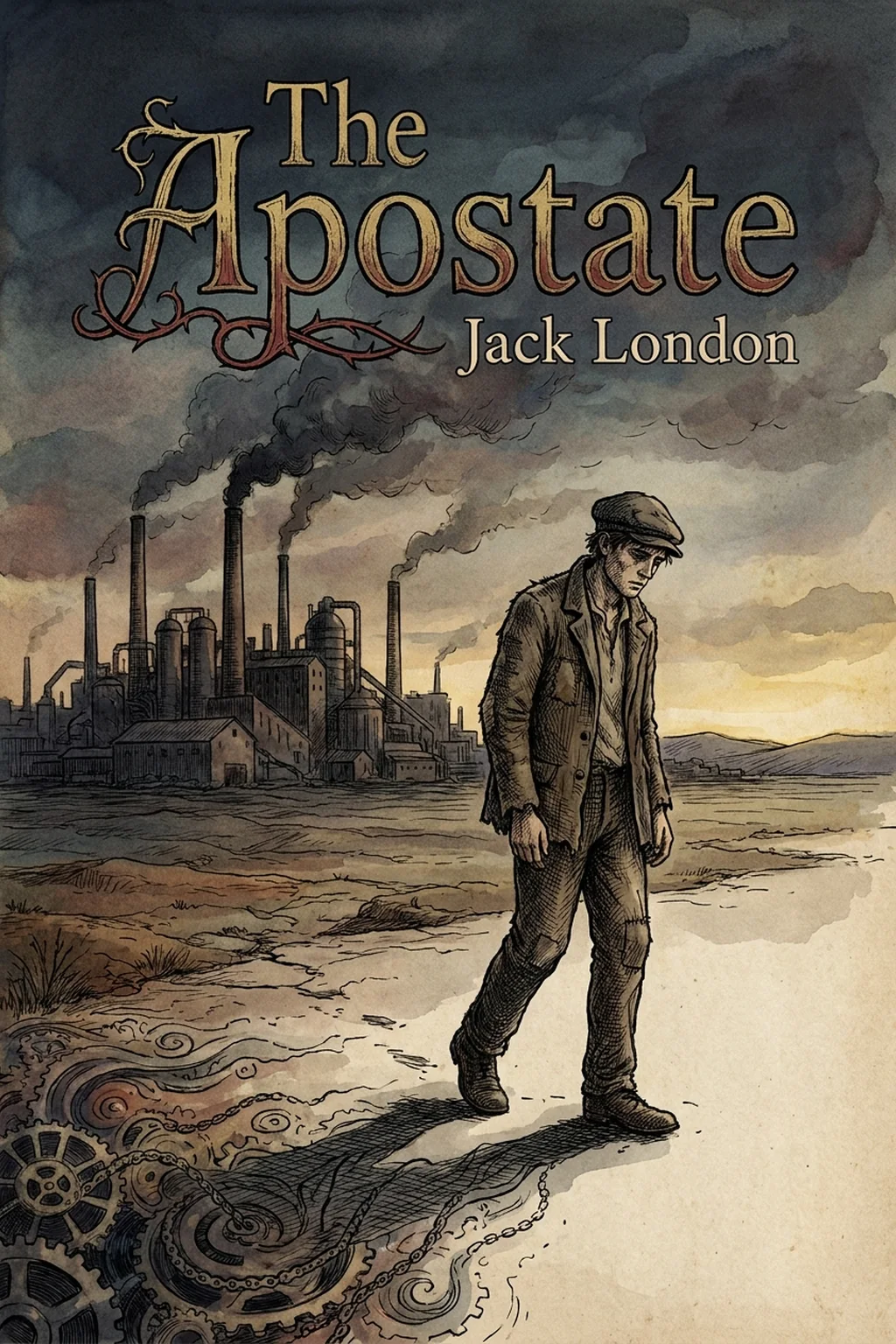
The Apostate
The Apostate
"Now I wake me up to work; I pray the Lord I may not shirk. If I should die before the night, I pray the Lord my work's all right. Amen.”
“”
"If you don't git up, Johnny, I won't give you a bite to eat!”
“”
The threat had no effect on the boy. He clung stubbornly to sleep, fighting for its oblivion as the dreamer fights for his dream. The boy's hands loosely clenched themselves, and he made feeble, spasmodic blows at the air. These blows were intended for his mother, but she betrayed practised familiarity in avoiding them as she shook him roughly by the shoulder. "Lemme 'lone!”
“”
It was a cry that began, muffled, in the deeps of sleep, that swiftly rushed upward, like a wail, into passionate belligerence, and that died away and sank down into an inarticulate whine. It was a bestial cry, as of a soul in torment, filled with infinite protest and pain.
But she did not mind. She was a sad-eyed, tired-faced woman, and she had grown used to this task, which she repeated every day of her life. She got a grip on the bed-clothes and tried to strip them down; but the boy, ceasing his punching, clung to them desperately. In a huddle, at the foot of the bed, he still remained covered. Then she tried dragging the bedding to the floor. The boy opposed her. She braced herself. Hers was the superior weight, and the boy and bedding gave, the former instinctively following the latter in order to shelter against the chill of the room that bit into his body.
As he toppled on the edge of the bed it seemed that he must fall head-first to the floor. But consciousness fluttered up in him. He righted himself and for a moment perilously balanced. Then he struck the floor on his feet. On the instant his mother seized him by the shoulders and shook him. Again his fists struck out, this time with more force and directness. At the same time his eyes opened. She released him. He was awake.
"All right," he mumbled.
“”
She caught up the lamp and hurried out, leaving him in darkness.
"You'll be docked," she warned back to him.
“”
He did not mind the darkness. When he had got into his clothes, he went out into the kitchen. His tread was very heavy for so thin and light a boy. His legs dragged with their own weight, which seemed unreasonable because they were such skinny legs. He drew a broken-bottomed chair to the table.
"Johnny!" his mother called sharply.
“”
He arose as sharply from the chair, and, without a word, went to the sink. It was a greasy, filthy sink. A smell came up from the outlet. He took no notice of it. That a sink should smell was to him part of the natural order, just as it was a part of the natural order that the soap should be grimy with dish-water and hard to lather. Nor did he try very hard to make it lather. Several splashes of the cold water from the running faucet completed the function. He did not wash his teeth. For that matter he had never seen a tooth-brush, nor did he know that there existed beings in the world who were guilty of so great a foolishness as tooth washing.
"You might wash yourself wunst a day without bein' told," his mother complained.
“”
She was holding a broken lid on the pot as she poured two cups of coffee. He made no remark, for this was a standing quarrel between them, and the one thing upon which his mother was hard as adamant. "Wunst" a day it was compulsory that he should wash his face. He dried himself on a greasy towel, damp and dirty and ragged, that left his face covered with shreds of lint.
“”
"I wish we didn't live so far away," she said, as he sat down. "I try to do the best I can. You know that. But a dollar on the rent is such a savin', an' we've more room here. You know that.”
“”“”
He scarcely followed her. He had heard it all before, many times. The range of her thought was limited, and she was ever harking back to the hardship worked upon them by living so far from the mills.
"A dollar means more grub," he remarked sententiously. "I'd sooner do the walkin' an' git the grub.”
“”“”
He ate hurriedly, half chewing the bread and washing the unmasticated chunks down with coffee. The hot and muddy liquid went by the name of coffee. Johnny thought it was coffee—and excellent coffee. That was one of the few of life's illusions that remained to him. He had never drunk real coffee in his life.
——
In addition to the bread, there was a small piece of cold pork. His mother refilled his cup with coffee. As he was finishing the bread, he began to watch if more was forthcoming. She intercepted his questioning glance.
"Now, don't be hoggish, Johnny," was her comment. "You've had your share. Your brothers an' sisters are smaller'n you.”
“”“”
He did not answer the rebuke. He was not much of a talker. Also, he ceased his hungry glancing for more. He was uncomplaining, with a patience that was as terrible as the school in which it had been learned. He finished his coffee, wiped his mouth on the back of his hand, and started to rise.
"Wait a second," she said hastily. "I guess the loaf kin stand you another slice—a thin un.”
“”“——”
There was legerdemain in her actions. With all the seeming of cutting a slice from the loaf for him, she put loaf and slice back in the bread box and conveyed to him one of her own two slices. She believed she had deceived him, but he had noted her sleight-of-hand. Nevertheless, he took the bread shamelessly. He had a philosophy that his mother, what of her chronic sickliness, was not much of an eater anyway.
She saw that he was chewing the bread dry, and reached over and emptied her coffee cup into his.
"Don't set good somehow on my stomach this morning," she explained.
“”
A distant whistle, prolonged and shrieking, brought both of them to their feet. She glanced at the tin alarm-clock on the shelf. The hands stood at half-past five. The rest of the factory world was just arousing from sleep. She drew a shawl about her shoulders, and on her head put a dingy hat, shapeless and ancient.
"We've got to run," she said, turning the wick of the lamp and blowing down the chimney.
“”
They groped their way out and down the stairs. It was clear and cold, and Johnny shivered at the first contact with the outside air. The stars had not yet begun to pale in the sky, and the city lay in blackness. Both Johnny and his mother shuffled their feet as they walked. There was no ambition in the leg muscles to swing the feet clear of the ground.
After fifteen silent minutes, his mother turned off to the right.
"Don't be late," was her final warning from out of the dark that was swallowing her up.
“”
He made no response, steadily keeping on his way. In the factory quarter, doors were opening everywhere, and he was soon one of a multitude that pressed onward through the dark. As he entered the factory gate the whistle blew again. He glanced at the east. Across a ragged sky-line of housetops a pale light was beginning to creep. This much he saw of the day as he turned his back upon it and joined his work gang.
He took his place in one of many long rows of machines. Before him, above a bin filled with small bobbins, were large bobbins revolving rapidly. Upon these he wound the jute-twine of the small bobbins. The work was simple. All that was required was celerity. The small bobbins were emptied so rapidly, and there were so many large bobbins that did the emptying, that there were no idle moments.
He worked mechanically. When a small bobbin ran out, he used his left hand for a brake, stopping the large bobbin and at the same time, with thumb and forefinger, catching the flying end of twine. Also, at the same time, with his right hand, he caught up the loose twine-end of a small bobbin. These various acts with both hands were performed simultaneously and swiftly. Then there would come a flash of his hands as he looped the weaver's knot and released the bobbin. There was nothing difficult about weaver's knots. He once boasted he could tie them in his sleep. And for that matter, he sometimes did, toiling centuries long in a single night at tying an endless succession of weaver's knots.
Some of the boys shirked, wasting time and machinery by not replacing the small bobbins when they ran out. And there was an overseer to prevent this. He caught Johnny's neighbor at the trick, and boxed his ears.
"Look at Johnny there—why ain't you like him?" the overseer wrathfully demanded.
“——”
Johnny's bobbins were running full blast, but he did not thrill at the indirect praise. There had been a time...but that was long ago, very long ago. His apathetic face was expressionless as he listened to himself being held up as a shining example. He was the perfect worker. He knew that. He had been told so, often. It was a commonplace, and besides it didn't seem to mean anything to him any more. From the perfect worker he had evolved into the perfect machine. When his work went wrong, it was with him as with the machine, due to faulty material. It would have been as possible for a perfect nail-die to cut imperfect nails as for him to make a mistake.
——
And small wonder. There had never been a time when he had not been in intimate relationship with machines. Machinery had almost been bred into him, and at any rate he had been brought up on it. Twelve years before, there had been a small flutter of excitement in the loom room of this very mill. Johnny's mother had fainted. They stretched her out on the floor in the midst of the shrieking machines. A couple of elderly women were called from their looms. The foreman assisted. And in a few minutes there was one more soul in the loom room than had entered by the doors. It was Johnny, born with the pounding, crashing roar of the looms in his ears, drawing with his first breath the warm, moist air that was thick with flying lint. He had coughed that first day in order to rid his lungs of the lint; and for the same reason he had coughed ever since.
The boy alongside of Johnny whimpered and sniffed. The boy's face was convulsed with hatred for the overseer who kept a threatening eye on him from a distance; but every bobbin was running full. The boy yelled terrible oaths into the whirling bobbins before him; but the sound did not carry half a dozen feet, the roaring of the room holding it in and containing it like a wall.
Of all this Johnny took no notice. He had a way of accepting things. Besides, things grow monotonous by repetition, and this particular happening he had witnessed many times. It seemed to him as useless to oppose the overseer as to defy the will of a machine. Machines were made to go in certain ways and to perform certain tasks. It was the same with the overseer.
But at eleven o'clock there was excitement in the room. In an apparently occult way the excitement instantly permeated everywhere. The one-legged boy who worked on the other side of Johnny bobbed swiftly across the floor to a bin truck that stood empty. Into this he dived out of sight, crutch and all. The superintendent of the mill was coming along, accompanied by a young man. He was well dressed and wore a starched shirt—a gentleman, in Johnny's classification of men, and also, "the Inspector."
——“”
He looked sharply at the boys as he passed along. Sometimes he stopped and asked questions. When he did so, he was compelled to shout at the top of his lungs, at which moments his face was ludicrously contorted with the strain of making himself heard. His quick eye noted the empty machine alongside of Johnny's, but he said nothing. Johnny also caught his eye, and he stopped abruptly. He caught Johnny by the arm to draw him back a step from the machine; but with an exclamation of surprise he released the arm.
"Pretty skinny," the superintendent laughed anxiously.
“”
"Pipe stems," was the answer. "Look at those legs. The boy's got the rickets—incipient, but he's got them. If epilepsy doesn't get him in the end, it will be because tuberculosis gets him first.”
“”“——”
Johnny listened, but did not understand. Furthermore he was not interested in future ills. There was an immediate and more serious ill that threatened him in the form of the inspector.
"Now, my boy, I want you to tell me the truth," the inspector said, or shouted, bending close to the boy's ear to make him hear. "How old are you?"
“”“”
"Fourteen," Johnny lied, and he lied with the full force of his lungs. So loudly did he lie that it started him off in a dry, hacking cough that lifted the lint which had been settling in his lungs all morning.
“”
"Looks sixteen at least," said the superintendent.
“”
"Or sixty," snapped the inspector.
“”
"He's always looked that way.”
“”
"How long?" asked the inspector, quickly.
“”
"For years. Never gets a bit older."
“”
"Or younger, I dare say. I suppose he's worked here all those years?”
“”
"Off and on—but that was before the new law was passed," the superintendent hastened to add. "Machine idle?" the inspector asked, pointing at the unoccupied machine beside Johnny's, in which the part-filled bobbins were flying like mad.
“——”“”
"Looks that way." The superintendent motioned the overseer to him and shouted in his ear and pointed at the machine. "Machine's idle," he reported back to the inspector.
“”“”
They passed on, and Johnny returned to his work, relieved in that the ill had been averted. But the one-legged boy was not so fortunate. The sharp-eyed inspector haled him out at arm's length from the bin truck. His lips were quivering, and his face had all the expression of one upon whom was fallen profound and irremediable disaster. The overseer looked astounded, as though for the first time he had laid eyes on the boy, while the superintendent's face expressed shock and displeasure.
"I know him," the inspector said. "He's twelve years old. I've had him discharged from three factories inside the year. This makes the fourth.”
“”“”
He turned to the one-legged boy. "You promised me, word and honor, that you'd go to school.”
“”
The one-legged boy burst into tears. "Please, Mr. Inspector, two babies died on us, and we're awful poor.”
“”
"What makes you cough that way?" the inspector demanded, as though charging him with crime.
“”
And as in denial of guilt, the one-legged boy replied: "It ain't nothin’. I jes' caught a cold last week, Mr. Inspector, that's all.”
“”
In the end the one-legged boy went out of the room with the inspector, the latter accompanied by the anxious and protesting superintendent. After that monotony settled down again. The long morning and the longer afternoon wore away and the whistle blew for quitting time. Darkness had already fallen when Johnny passed out through the factory gate. In the interval the sun had made a golden ladder of the sky, flooded the world with its gracious warmth, and dropped down and disappeared in the west behind a ragged sky-line of housetops.
Supper was the family meal of the day—the one meal at which Johnny encountered his younger brothers and sisters. It partook of the nature of an encounter, to him, for he was very old, while they were distressingly young. He had no patience with their excessive and amazing juvenility. He did not understand it. His own childhood was too far behind him. He was like an old and irritable man, annoyed by the turbulence of their young spirits that was to him arrant silliness. He glowered silently over his food, finding compensation in the thought that they would soon have to go to work. That would take the edge off of them and make them sedate and dignified—like him. Thus it was, after the fashion of the human, that Johnny made of himself a yardstick with which to measure the universe.
————
During the meal, his mother explained in various ways and with infinite repetition that she was trying to do the best she could; so that it was with relief, the scant meal ended, that Johnny shoved back his chair and arose. He debated for a moment between bed and the front door, and finally went out the latter. He did not go far. He sat down on the stoop, his knees drawn up and his narrow shoulders drooping forward, his elbows on his knees and the palms of his hands supporting his chin. As he sat there, he did no thinking. He was just resting. So far as his mind was concerned, it was asleep. His brothers and sisters came out, and with other children played noisily about him. An electric globe on the corner lighted their frolics. He was peevish and irritable, that they knew; but the spirit of adventure lured them into teasing him. They joined hands before him, and, keeping time with their bodies, chanted in his face weird and uncomplimentary doggerel. At first he snarled curses at them—curses he had learned from the lips of various foremen. Finding this futile, and remembering his dignity, he relapsed into dogged silence.
——
His brother Will, next to him in age, having just passed his tenth birthday, was the ring-leader. Johnny did not possess particularly kindly feelings toward him. His life had early been embittered by continual giving over and giving way to Will. He had a definite feeling that Will was greatly in his debt and was ungrateful about it. In his own playtime, far back in the dim past, he had been robbed of a large part of that playtime by being compelled to take care of Will. Will was a baby then, and then, as now, their mother had spent her days in the mills. To Johnny had fallen the part of little father and little mother as well.
Will seemed to show the benefit of the giving over and the giving way. He was well-built, fairly rugged, as tall as his elder brother and even heavier. It was as though the life-blood of the one had been diverted into the other's veins. And in spirits it was the same. Johnny was jaded, worn out, without resilience, while his younger brother seemed bursting and spilling over with exuberance.
The mocking chant rose louder and louder. Will leaned closer as he danced, thrusting out his tongue. Johnny's left arm shot out and caught the other around the neck. At the same time he rapped his bony fist to the other's nose. It was a pathetically bony fist, but that it was sharp to hurt was evidenced by the squeal of pain it produced. The other children were uttering frightened cries, while Johnny's sister, Jennie, had dashed into the house.
He thrust Will from him, kicked him savagely on the shins, then reached for him and slammed him face downward in the dirt. Nor did he release him till the face had been rubbed into the dirt several times. Then the mother arrived, an anaemic whirlwind of solicitude and maternal wrath.
"Why can't he leave me alone?" was Johnny's reply to her upbraiding. "Can't he see I'm tired?”
“”“”
"I'm as big as you," Will raged in her arms, his face a mess of tears, dirt, and blood. "I'm as big as you now, an' I'm goin' to git bigger. Then I'll lick you—see if I don't.”
“”“——”
"You ought to be to work, seein' how big you are," Johnny snarled. "That's what's the matter with you. You ought to be to work. An' it's up to your ma to put you to work.”
“”“”
"But he's too young," she protested. "He's only a little boy.”
“”“”
"I was younger'n him when I started to work.”
“”
Johnny's mouth was open, further to express the sense of unfairness that he felt, but the mouth closed with a snap. He turned gloomily on his heel and stalked into the house and to bed. The door of his room was open to let in warmth from the kitchen. As he undressed in the semi-darkness he could hear his mother talking with a neighbor woman who had dropped in. His mother was crying, and her speech was punctuated with spiritless sniffles.
"I can't make out what's gittin' into Johnny," he could hear her say. "He didn't used to be this way. He was a patient little angel.
“”“
"An' he is a good boy," she hastened to defend. "He's worked faithful, an' he did go to work too young. But it wasn't my fault. I do the best I can, I'm sure.”
”“”
Prolonged sniffling from the kitchen, and Johnny murmured to himself as his eyelids closed down, "You betcher life I've worked faithful.”
“”
The next morning he was torn bodily by his mother from the grip of sleep. Then came the meagre breakfast, the tramp through the dark, and the pale glimpse of day across the housetops as he turned his back on it and went in through the factory gate. It was another day, of all the days, and all the days were alike.
And yet there had been variety in his life—at the times he changed from one job to another, or was taken sick. When he was six, he was little mother and father to Will and the other children still younger. At seven he went into the mills—winding bobbins. When he was eight, he got work in another mill. His new job was marvellously easy. All he had to do was to sit down with a little stick in his hand and guide a stream of cloth that flowed past him. This stream of cloth came out of the maw of a machine, passed over a hot roller, and went on its way elsewhere. But he sat always in the one place, beyond the reach of daylight, a gas-jet flaring over him, himself part of the mechanism.
————
He was very happy at that job, in spite of the moist heat, for he was still young and in possession of dreams and illusions. And wonderful dreams he dreamed as he watched the streaming cloth streaming endlessly by. But there was no exercise about the work, no call upon his mind, and he dreamed less and less, while his mind grew torpid and drowsy. Nevertheless, he earned two dollars a week, and two dollars represented the difference between acute starvation and chronic underfeeding.
But when he was nine, he lost his job. Measles was the cause of it. After he recovered, he got work in a glass factory. The pay was better, and the work demanded skill. It was piece-work, and the more skilful he was, the bigger wages he earned. Here was incentive. And under this incentive he developed into a remarkable worker.
It was simple work, the tying of glass stoppers into small bottles. At his waist he carried a bundle of twine. He held the bottles between his knees so that he might work with both hands. Thus, in a sitting position and bending over his own knees, his narrow shoulders grew humped and his chest was contracted for ten hours each day. This was not good for the lungs, but he tied three hundred dozen bottles a day.
The superintendent was very proud of him, and brought visitors to look at him. In ten hours three hundred dozen bottles passed through his hands. This meant that he had attained machine-like perfection. All waste movements were eliminated. Every motion of his thin arms, every movement of a muscle in the thin fingers, was swift and accurate. He worked at high tension, and the result was that he grew nervous. At night his muscles twitched in his sleep, and in the daytime he could not relax and rest. He remained keyed up and his muscles continued to twitch. Also he grew sallow and his lint-cough grew worse. Then pneumonia laid hold of the feeble lungs within the contracted chest, and he lost his job in the glass-works. Now he had returned to the jute mills where he had first begun with winding bobbins. But promotion was waiting for him. He was a good worker. He would next go on the starcher, and later he would go into the loom room. There was nothing after that except increased efficiency.
The machinery ran faster than when he had first gone to work, and his mind ran slower. He no longer dreamed at all, though his earlier years had been full of dreaming. Once he had been in love. It was when he first began guiding the cloth over the hot roller, and it was with the daughter of the superintendent. She was much older than he, a young woman, and he had seen her at a distance only a paltry half-dozen times. But that made no difference. On the surface of the cloth stream that poured past him, he pictured radiant futures wherein he performed prodigies of toil, invented miraculous machines, won to the mastership of the mills, and in the end took her in his arms and kissed her soberly on the brow.
But that was all in the long ago, before he had grown too old and tired to love. Also, she had married and gone away, and his mind had gone to sleep. Yet it had been a wonderful experience, and he used often to look back upon it as other men and women look back upon the time they believed in fairies. He had never believed in fairies nor Santa Claus; but he had believed implicitly in the smiling future his imagination had wrought into the steaming cloth stream.
He had become a man very early in life. At seven, when he drew his first wages, began his adolescence. A certain feeling of independence crept up in him, and the relationship between him and his mother changed. Somehow, as an earner and breadwinner, doing his own work in the world, he was more like an equal with her. Manhood, full-blown manhood, had come when he was eleven, at which time he had gone to work on the night shift for six months. No child works on the night shift and remains a child.
There had been several great events in his life. One of these had been when his mother bought some California prunes. Two others had been the two times when she cooked custard. Those had been events. He remembered them kindly. And at that time his mother had told him of a blissful dish she would sometime make—"floating island," she had called it, "better than custard." For years he had looked forward to the day when he would sit down to the table with floating island before him, until at last he had relegated the idea of it to the limbo of unattainable ideals.
——“”“”
Once he found a silver quarter lying on the sidewalk. That, also, was a great event in his life, withal a tragic one. He knew his duty on the instant the silver flashed on his eyes, before even he had picked it up. At home, as usual, there was not enough to eat, and home he should have taken it as he did his wages every Saturday night. Right conduct in this case was obvious; but he never had any spending of his money, and he was suffering from candy hunger. He was ravenous for the sweets that only on red-letter days he had ever tasted in his life.
He did not attempt to deceive himself. He knew it was sin, and deliberately he sinned when he went on a fifteen-cent candy debauch. Ten cents he saved for a future orgy; but not being accustomed to the carrying of money, he lost the ten cents. This occurred at the time when he was suffering all the torments of conscience, and it was to him an act of divine retribution. He had a frightened sense of the closeness of an awful and wrathful God. God had seen, and God had been swift to punish, denying him even the full wages of sin.
In memory he always looked back upon that event as the one great criminal deed of his life, and at the recollection his conscience always awoke and gave him another twinge. It was the one skeleton in his closet. Also, being so made and circumstanced, he looked back upon the deed with regret. He was dissatisfied with the manner in which he had spent the quarter. He could have invested it better, and, out of his later knowledge of the quickness of God, he would have beaten God out by spending the whole quarter at one fell swoop. In retrospect he spent the quarter a thousand times, and each time to better advantage.
There was one other memory of the past, dim and faded, but stamped into his soul everlasting by the savage feet of his father. It was more like a nightmare than a remembered vision of a concrete thing—more like the race-memory of man that makes him fall in his sleep and that goes back to his arboreal ancestry.
——
This particular memory never came to Johnny in broad daylight when he was wide awake. It came at night, in bed, at the moment that his consciousness was sinking down and losing itself in sleep. It always aroused him to frightened wakefulness, and for the moment, in the first sickening start, it seemed to him that he lay crosswise on the foot of the bed. In the bed were the vague forms of his father and mother. He never saw what his father looked like. He had but one impression of his father, and that was that he had savage and pitiless feet.
His earlier memories lingered with him, but he had no late memories. All days were alike. Yesterday or last year were the same as a thousand years—or a minute. Nothing ever happened. There were no events to mark the march of time. Time did not march. It stood always still. It was only the whirling machines that moved, and they moved nowhere—in spite of the fact that they moved faster.
————
When he was fourteen, he went to work on the starcher. It was a colossal event. Something had at last happened that could be remembered beyond a night's sleep or a week's pay-day. It marked an era. It was a machine Olympiad, a thing to date from. "When I went to work on the starcher," or, "after," or "before I went to work on the starcher," were sentences often on his lips.
“”“”“”
He celebrated his sixteenth birthday by going into the loom room and taking a loom. Here was an incentive again, for it was piece-work. And he excelled, because the clay of him had been moulded by the mills into the perfect machine. At the end of three months he was running two looms, and, later, three and four.
At the end of his second year at the looms he was turning out more yards than any other weaver, and more than twice as much as some of the less skilful ones. And at home things began to prosper as he approached the full stature of his earning power. Not, however, that his increased earnings were in excess of need. The children were growing up. They ate more. And they were going to school, and school-books cost money. And somehow, the faster he worked, the faster climbed the prices of things. Even the rent went up, though the house had fallen from bad to worse disrepair.
He had grown taller; but with his increased height he seemed leaner than ever. Also, he was more nervous. With the nervousness increased his peevishness and irritability. The children had learned by many bitter lessons to fight shy of him. His mother respected him for his earning power, but somehow her respect was tinctured with fear.
There was no joyousness in life for him. The procession of the days he never saw. The nights he slept away in twitching unconsciousness. The rest of the time he worked, and his consciousness was machine consciousness. Outside this his mind was a blank. He had no ideals, and but one illusion; namely, that he drank excellent coffee. He was a work-beast. He had no mental life whatever; yet deep down in the crypts of his mind, unknown to him, were being weighed and sifted every hour of his toil, every movement of his hands, every twitch of his muscles, and preparations were making for a future course of action that would amaze him and all his little world.
It was in the late spring that he came home from work one night aware of unusual tiredness. There was a keen expectancy in the air as he sat down to the table, but he did not notice. He went through the meal in moody silence, mechanically eating what was before him. The children um'd and ah'd and made smacking noises with their mouths. But he was deaf to them.
"D'ye know what you're eatin'?” his mother demanded at last, desperately.
“”
He looked vacantly at the dish before him, and vacantly at her.
"Floatin' island," she announced triumphantly.
“”
"Oh," he said.
“”
"Floating island!" the children chorussed loudly.
“”
"Oh," he said. And after two or three mouthfuls, he added, "guess I ain't hungry to-night.”
“”“”
He dropped the spoon, shoved back his chair, and arose wearily from the table.
"An' I guess I'll go to bed.”
“”
His feet dragged more heavily than usual as he crossed the kitchen floor. Undressing was a Titan's task, a monstrous futility, and he wept weakly as he crawled into bed, one shoe still on. He was aware of a rising, swelling something inside his head that made his brain thick and fuzzy. His lean fingers felt as big as his wrist, while in the ends of them was a remoteness of sensation vague and fuzzy like his brain. The small of his back ached intolerably. All his bones ached. He ached everywhere. And in his head began the shrieking, pounding, crashing, roaring of a million looms. All space was filled with flying shuttles. They darted in and out, intricately, amongst the stars. He worked a thousand looms himself, and ever they speeded up, faster and faster, and his brain unwound, faster and faster, and became the thread that fed the thousand flying shuttles.
He did not go to work next morning. He was too busy weaving colossally on the thousand looms that ran inside his head. His mother went to work, but first she sent for the doctor. It was a severe attack of la grippe, he said. Jennie served as nurse and carried out his instructions.
It was a very severe attack, and it was a week before Johnny dressed and tottered feebly across the floor. Another week, the doctor said, and he would be fit to return to work. The foreman of the loom room visited him on Sunday afternoon, the first day of his convalescence. The best weaver in the room, the foreman told his mother. His job would be held for him. He could come back to work a week from Monday.
"Why don't you thank 'im, Johnny?" his mother asked anxiously.
“”
"He's ben that sick he ain't himself yet," she explained apologetically to the visitor.
“”
Johnny sat hunched up and gazing steadfastly at the floor. He sat in the same position long after the foreman had gone. It was warm outdoors, and he sat on the stoop in the afternoon. Sometimes his lips moved. He seemed lost in endless calculations.
Next morning, after the day grew warm, he took his seat on the stoop. He had pencil and paper this time with which to continue his calculations, and he calculated painfully and amazingly.
"What comes after millions?" he asked at noon, when Will came home from school. "An' how d'ye work 'em?”
“”“”
That afternoon finished his task. Each day, but without paper and pencil, he returned to the stoop. He was greatly absorbed in the one tree that grew across the street. He studied it for hours at a time, and was unusually interested when the wind swayed its branches and fluttered its leaves. Throughout the week he seemed lost in a great communion with himself. On Sunday, sitting on the stoop, he laughed aloud, several times, to the perturbation of his mother, who had not heard him laugh in years.
Next morning, in the early darkness, she came to his bed to rouse him. He had had his fill of sleep all week, and awoke easily. He made no struggle, nor did he attempt to hold on to the bedding when she stripped it from him. He lay quietly, and spoke quietly.
"It ain't no use, ma.”
“”
"You'll be late," she said, under the impression that he was still stupid with sleep.
“”
"I'm awake, ma, an' I tell you it ain't no use. You might as well lemme alone. I ain't goin' to git up.”
“”
"But you'll lose your job!" she cried.
“”
"I ain't goin' to git up," he repeated in a strange, passionless voice.
“”
She did not go to work herself that morning. This was sickness beyond any sickness she had ever known. Fever and delirium she could understand; but this was insanity. She pulled the bedding up over him and sent Jennie for the doctor.
When that person arrived, Johnny was sleeping gently, and gently he awoke and allowed his pulse to be taken.
"Nothing the matter with him," the doctor reported. "Badly debilitated, that's all. Not much meat on his bones.”
“”“”
"He's always been that way," his mother volunteered.
“”
"Now go 'way, ma, an' let me finish my snooze.”
“”
Johnny spoke sweetly and placidly, and sweetly and placidly he rolled over on his side and went to sleep.
At ten o'clock he awoke and dressed himself. He walked out into the kitchen, where he found his mother with a frightened expression on her face.
"I'm goin' away, ma," he announced, "an' I jes' want to say good-by.” She threw her apron over her head and sat down suddenly and wept. He waited patiently.
“”“”
"I might a-known it," she was sobbing.
“”
"Where?" she finally asked, removing the apron from her head and gazing up at him with a stricken face in which there was little curiosity.
“”
"I don't know—anywhere.”
“——”
As he spoke, the tree across the street appeared with dazzling brightness on his inner vision. It seemed to lurk just under his eyelids, and he could see it whenever he wished.
"An' your job?" she quavered.
“”
"I ain't never goin' to work again.”
“”
"My God, Johnny!" she wailed, "don't say that!”
“”“”
What he had said was blasphemy to her. As a mother who hears her child deny God, was Johnny's mother shocked by his words.
"What's got into you, anyway?" she demanded, with a lame attempt at imperativeness.
“”
"Figures," he answered. "Jes' figures. I've ben doin' a lot of figurin' this week, an' it's most surprisin’.”
“”“”
"I don't see what that's got to do with it," she sniffled.
“”
Johnny smiled patiently, and his mother was aware of a distinct shock at the persistent absence of his peevishness and irritability.
"I'll show you," he said. "I'm plum' tired out. What makes me tired? Moves. I've ben movin' ever since I was born. I'm tired of movin’, an' I ain't goin' to move any more. Remember when I worked in the glass-house? I used to do three hundred dozen a day. Now I reckon I made about ten different moves to each bottle. That's thirty-six thousan' moves a day. Ten days, three hundred an' sixty thousan' moves a day. One month, one million an' eighty thousan' moves. Chuck out the eighty thousan’”—he spoke with the complacent beneficence of a philanthropist—"chuck out the eighty thousan', that leaves a million moves a month—twelve million moves a year.
“”“”————“——
"At the looms I'm movin' twic'st as much. That makes twenty-five million moves a year, an' it seems to me I've ben a movin' that way 'most a million years.
“
"Now this week I ain't moved at all. I ain't made one move in hours an' hours. I tell you it was swell, jes' settin' there, hours an' hours, an' doin' nothin’. I ain't never ben happy before. I never had any time. I've ben movin' all the time. That ain't no way to be happy. An' I ain't goin' to do it any more. I'm jes' goin' to set, an' set, an' rest, an' rest, and then rest some more.”
“”
"But what's goin' to come of Will an' the children?" she asked despairingly.
“”
"That's it, 'Will an' the children,’” he repeated.
“”
But there was no bitterness in his voice. He had long known his mother's ambition for the younger boy, but the thought of it no longer rankled. Nothing mattered any more. Not even that.
"I know, ma, what you've ben plannin' for Will—keepin' him in school to make a bookkeeper out of him. But it ain't no use, I've quit. He's got to go to work.”
“——”
"An' after I have brung you up the way I have," she wept, starting to cover her head with the apron and changing her mind.
“”
"You never brung me up," he answered with sad kindliness. "I brung myself up, ma, an' I brung up Will. He's bigger'n me, an' heavier, an' taller. When I was a kid, I reckon I didn't git enough to eat. When he come along an' was a kid, I was workin' an' earnin' grub for him too. But that's done with. Will can go to work, same as me, or he can go to hell, I don't care which. I'm tired. I'm goin' now. Ain't you goin' to say good-by?”
“”“”
She made no reply. The apron had gone over her head again, and she was crying. He paused a moment in the doorway.
"I'm sure I done the best I knew how," she was sobbing.
“”
He passed out of the house and down the street. A wan delight came into his face at the sight of the lone tree. "Jes' ain't goin' to do nothin’," he said to himself, half aloud, in a crooning tone. He glanced wistfully up at the sky, but the bright sun dazzled and blinded him.
“”
It was a long walk he took, and he did not walk fast. It took him past the jute-mill. The muffled roar of the loom room came to his ears, and he smiled. It was a gentle, placid smile. He hated no one, not even the pounding, shrieking machines. There was no bitterness in him, nothing but an inordinate hunger for rest.
The houses and factories thinned out and the open spaces increased as he approached the country. At last the city was behind him, and he was walking down a leafy lane beside the railroad track. He did not walk like a man. He did not look like a man. He was a travesty of the human. It was a twisted and stunted and nameless piece of life that shambled like a sickly ape, arms loose-hanging, stoop-shouldered, narrow-chested, grotesque and terrible.
He passed by a small railroad station and lay down in the grass under a tree. All afternoon he lay there. Sometimes he dozed, with muscles that twitched in his sleep. When awake, he lay without movement, watching the birds or looking up at the sky through the branches of the tree above him. Once or twice he laughed aloud, but without relevance to anything he had seen or felt.
After twilight had gone, in the first darkness of the night, a freight train rumbled into the station. When the engine was switching cars on to the side-track, Johnny crept along the side of the train. He pulled open the side-door of an empty box-car and awkwardly and laboriously climbed in. He closed the door. The engine whistled. Johnny was lying down, and in the darkness he smiled.
Li-Wan, the Fair
"The sun sinks, Canim, and the heat of the day is gone!"
“”
So called Li Wan to the man whose head was hidden beneath the squirrel-skin robe, but she called softly, as though divided between the duty of waking him and the fear of him awake. For she was afraid of this big husband of hers, who was like unto none of the men she had known. The moose-meat sizzled uneasily, and she moved the frying-pan to one side of the red embers. As she did so she glanced warily at the two Hudson Bay dogs dripping eager slaver from their scarlet tongues and following her every movement. They were huge, hairy fellows, crouched to leeward in the thin smoke-wake of the fire to escape the swarming myriads of mosquitoes. As Li Wan gazed down the steep to where the Klondike flung its swollen flood between the hills, one of the dogs bellied its way forward like a worm, and with a deft, catlike stroke of the paw dipped a chunk of hot meat out of the pan to the ground. But Li Wan caught him from out the tail of her eye, and he sprang back with a snap and a snarl as she rapped him over the nose with a stick of firewood.
"Nay, Olo," she laughed, recovering the meat without removing her eye from him. "Thou art ever hungry, and for that thy nose leads thee into endless troubles."
“”“”
But the mate of Olo joined him, and together they defied the woman. The hair on their backs and shoulders bristled in recurrent waves of anger, and the thin lips writhed and lifted into ugly wrinkles, exposing the flesh-tearing fangs, cruel and menacing. Their very noses serrulated and shook in brute passion, and they snarled as the wolves snarl, with all the hatred and malignity of the breed impelling them to spring upon the woman and drag her down.
"And thou, too, Bash, fierce as thy master and never at peace with the hand that feeds thee! This is not thy quarrel, so that be thine! and that!"
“”
As she cried, she drove at them with the firewood, but they avoided the blows and refused to retreat. They separated and approached her from either side, crouching low and snarling. Li Wan had struggled with the wolf-dog for mastery from the time she toddled among the skin-bales of the teepee, and she knew a crisis was at hand. Bash had halted, his muscles stiff and tense for the spring; Olo was yet creeping into striking distance.
Grasping two blazing sticks by the charred ends, she faced the brutes. The one held back, but Bash sprang, and she met him in mid-air with the flaming weapon. There were sharp yelps of pain and swift odors of burning hair and flesh as he rolled in the dirt and the woman ground the fiery embers into his mouth. Snapping wildly, he flung himself sidewise out of her reach and in a frenzy of fear scrambled for safety. Olo, on the other side, had begun his retreat, when Li Wan reminded him of her primacy by hurling a heavy stick of wood into his ribs. Then the pair retreated under a rain of firewood, and on the edge of the camp fell to licking their wounds and whimpering by turns and snarling.
Li Wan blew the ashes off the meat and sat down again. Her heart had not gone up a beat, and the incident was already old, for this was the routine of life. Canim had not stirred during the disorder, but instead had set up a lusty snoring.
"Come, Canim!" she called. "The heat of the day is gone, and the trail waits for our feet."
“”“”
The squirrel-skin robe was agitated and cast aside by a brown arm. Then the man's eyelids fluttered and drooped again.
"His pack is heavy," she thought, "and he is tired with the work of the morning."
“”“”
A mosquito stung her on the neck, and she daubed the unprotected spot with wet clay from a ball she had convenient to hand. All morning, toiling up the divide and enveloped in a cloud of the pests, the man and woman had plastered themselves with the sticky mud, which, drying in the sun, covered their faces with masks of clay. These masks, broken in divers places by the movement of the facial muscles, had constantly to be renewed, so that the deposit was irregular of depth and peculiar of aspect.
Li Wan shook Canim gently but with persistence till he roused and sat up. His first glance was to the sun, and after consulting the celestial timepiece he hunched over to the fire and fell-to ravenously on the meat. He was a large Indian fully six feet in height, deep-chested and heavy-muscled, and his eyes were keener and vested with greater mental vigor than the average of his kind. The lines of will had marked his face deeply, and this, coupled with a sternness and primitiveness, advertised a native indomitability, unswerving of purpose, and prone, when thwarted, to sullen cruelty.
"To-morrow, Li Wan, we shall feast.” He sucked a marrow-bone clean and threw it to the dogs. "We shall have flapjacks fried in bacon grease, and sugar, which is more toothsome—”
“”“——”
"Flapjacks?" she questioned, mouthing the word curiously.
“”
"Ay," Canim answered with superiority; "and I shall teach you new ways of cookery. Of these things I speak you are ignorant, and of many more things besides. You have lived your days in a little corner of the earth and know nothing. But I,"—he straightened himself and looked at her pridefully,—"I am a great traveller, and have been all places, even among the white people, and I am versed in their ways, and in the ways of many peoples. I am not a tree, born to stand in one place always and know not what there be over the next hill; for I am Canim, the Canoe, made to go here and there and to journey and quest up and down the length and breadth of the world."
“”“”————“”
She bowed her head humbly. "It is true. I have eaten fish and meat and berries all my days and lived in a little corner of the earth. Nor did I dream the world was so large until you stole me from my people and I cooked and carried for you on the endless trails." She looked up at him suddenly. "Tell me, Canim, does this trail ever end?"
“”“”
"Nay," he answered. "My trail is like the world; it never ends. My trail is the world, and I have travelled it since the time my legs could carry me, and I shall travel it until I die. My father and my mother may be dead, but it is long since I looked upon them, and I do not care. My tribe is like your tribe. It stays in the one place—which is far from here,—but I care naught for my tribe, for I am Canim, the Canoe!”
“”“————”
"And must I, Li Wan, who am weary, travel always your trail until I die?"
“”
"You, Li Wan, are my wife, and the wife travels the husband's trail wheresoever it goes. It is the law. And were it not the law, yet would it be the law of Canim, who is lawgiver unto himself and his.”
“”
She bowed her head again, for she knew no other law than that man was the master of woman.
"Be not in haste," Canim cautioned her, as she began to strap the meagre camp outfit to her pack. "The sun is yet hot, and the trail leads down and the footing is good."
“”“”
She dropped her work obediently and resumed her seat.
Canim regarded her with speculative interest. "You do not squat on your hams like other women," he remarked.
“”
"No," she answered. "It never came easy. It tires me, and I cannot take my rest that way."
“”“”
"And why is it your feet point not straight before you?"
“”
"I do not know, save that they are unlike the feet of other women."
“”
A satisfied light crept into his eyes, but otherwise he gave no sign.
"Like other women, your hair is black; but have you ever noticed that it is soft and fine, softer and finer than the hair of other women?"
“”
"I have noticed," she answered shortly, for she was not pleased at such cold analysis of her sex-deficiencies.
“”
"It is a year, now, since I took you from your people," he went on, "and you are nigh as shy and afraid of me as when first I looked upon you. How does this thing be?"
“”“”
Li Wan shook her head. "I am afraid of you, Canim, you are so big and strange. And further, before you looked upon me even, I was afraid of all the young men. I do not know... I cannot say...only it seemed, somehow, as though I should not be for them, as though..."
“………………”
"Ay," he encouraged, impatient at her faltering.
“”
"As though they were not my kind."
“”
"Not your kind?" he demanded slowly. "Then what is your kind?"
“”“”
"I do not know, I..." She shook her head in a bewildered manner. "I cannot put into words the way I felt. It was strangeness in me. I was unlike other maidens, who sought the young men slyly. I could not care for the young men that way. It would have been a great wrong, it seemed, and an ill deed."
“……”“”
"What is the first thing you remember?" Canim asked with abrupt irrelevance.
“”
"Pow-Wah-Kaan, my mother.”
“”
"And naught else before Pow-Wah-Kaan?”
“”
"Naught else."
“”
But Canim, holding her eyes with his, searched her secret soul and saw it waver.
"Think, and think hard, Li Wan!" he threatened.
“”
She stammered, and her eyes were piteous and pleading, but his will dominated her and wrung from her lips the reluctant speech.
"But it was only dreams, Canim, ill dreams of childhood, shadows of things not real, visions such as the dogs, sleeping in the sun-warmth, behold and whine out against.”
“”
"Tell me," he commanded, "of the things before Pow-Wah-Kaan, your mother.”
“”“”
"They are forgotten memories," she protested. "As a child I dreamed awake, with my eyes open to the day, and when I spoke of the strange things I saw I was laughed at, and the other children were afraid and drew away from me. And when I spoke of the things I saw to Pow-Wah-Kaan, she chided me and said they were evil; also she beat me. It was a sickness, I believe, like the falling-sickness that comes to old men; and in time I grew better and dreamed no more. And now... I cannot remember”—she brought her hand in a confused manner to her forehead—"they are there, somewhere, but I cannot find them, only..."
“”“……”————“……”
"Only," Canim repeated, holding her.
“”
"Only one thing. But you will laugh at its foolishness, it is so unreal."
“”
"Nay, Li Wan. Dreams are dreams. They may be memories of other lives we have lived. I was once a moose. I firmly believe I was once a moose, what of the things I have seen in dreams, and heard."
“”
Strive as he would to hide it, a growing anxiety was manifest, but Li Wan, groping after the words with which to paint the picture, took no heed.
"I see a snow-tramped space among the trees," she began, "and across the snow the sign of a man where he has dragged himself heavily on hand and knee. And I see, too, the man in the snow, and it seems I am very close to him when I look. He is unlike real men, for he has hair on his face, much hair, and the hair of his face and head is yellow like the summer coat of the weasel. His eyes are closed, but they open and search about. They are blue like the sky, and look into mine and search no more. And his hand moves, slow, as from weakness, and I feel..."
“”“……”
"Ay," Canim whispered hoarsely. "You feel—?”
“”“——?"
"No! no!" she cried in haste. "I feel nothing. Did I say 'feel'? I did not mean it. It could not be that I should mean it. I see, and I see only, and that is all I see—a man in the snow, with eyes like the sky, and hair like the weasel. I have seen it many times, and always it is the same—a man in the snow—”
“”“‘’——————”
"And do you see yourself?" he asked, leaning forward and regarding her intently. "Do you ever see yourself and the man in the snow?"
“”“”
"Why should I see myself? Am I not real?"
“
His muscles relaxed and he sank back, an exultant satisfaction in his eyes which he turned from her so that she might not see.
"I will tell you, Li Wan," he spoke decisively; "you were a little bird in some life before, a little moose-bird, when you saw this thing, and the memory of it is with you yet. It is not strange. I was once a moose, and my father's father afterward became a bear—so said the shaman, and the shaman cannot lie. Thus, on the Trail of the Gods we pass from life to life, and the gods know only and understand. Dreams and the shadows of dreams be memories, nothing more, and the dog, whining asleep in the sun-warmth, doubtless sees and remembers things gone before. Bash, there, was a warrior once. I do firmly believe he was once a warrior.”
“”“——”
Canim tossed a bone to the brute and got upon his feet. "Come, let us begone. The sun is yet hot, but it will get no cooler."
“”
"And these white people, what are they like?" Li Wan made bold to ask.
“”
"Like you and me," he answered, "only they are less dark of skin. You will be among them ere the day is dead."
“”“”
Canim lashed the sleeping-robe to his one-hundred-and-fifty-pound pack, smeared his face with wet clay, and sat down to rest till Li Wan had finished loading the dogs. Olo cringed at sight of the club in her hand, and gave no trouble when the bundle of forty pounds and odd was strapped upon him. But Bash was aggrieved and truculent, and could not forbear to whimper and snarl as he was forced to receive the burden. He bristled his back and bared his teeth as she drew the straps tight, the while throwing all the malignancy of his nature into the glances shot at her sideways and backward. And Canim chuckled and said, "Did I not say he was once a very great warrior?"
15040“”
"These furs will bring a price," he remarked as he adjusted his head-strap and lifted his pack clear of the ground. "A big price. The white men pay well for such goods, for they have no time to hunt and are soft to the cold. Soon shall we feast, Li Wan, as you have feasted never in all the lives you have lived before."
“”“”
She grunted acknowledgment and gratitude for her lord's condescension, slipped into the harness, and bent forward to the load.
"The next time I am born, I would be born a white man," he added, and swung off down the trail which dived into the gorge at his feet.
“”
The dogs followed close at his heels, and Li Wan brought up the rear. But her thoughts were far away, across the Ice Mountains to the east, to the little corner of the earth where her childhood had been lived. Ever as a child, she remembered, she had been looked upon as strange, as one with an affliction. Truly she had dreamed awake and been scolded and beaten for the remarkable visions she saw, till, after a time, she had outgrown them. But not utterly. Though they troubled her no more waking, they came to her in her sleep, grown woman that she was, and many a night of nightmare was hers, filled with fluttering shapes, vague and meaningless. The talk with Canim had excited her, and down all the twisted slant of the divide she harked back to the mocking fantasies of her dreams.
"Let us take breath," Canim said, when they had tapped midway the bed of the main creek.
“”
He rested his pack on a jutting rock, slipped the head-strap, and sat down. Li Wan joined him, and the dogs sprawled panting on the ground beside them. At their feet rippled the glacial drip of the hills, but it was muddy and discolored, as if soiled by some commotion of the earth.
"Why is this?" Li Wan asked.
“”
"Because of the white men who work in the ground. Listen!" He held up his hand, and they heard the ring of pick and shovel, and the sound of men's voices. "They are made mad by gold, and work without ceasing that they may find it. Gold? It is yellow and comes from the ground, and is considered of great value. It is also a measure of price."
“”“”
But Li Wan's roving eyes had called her attention from him. A few yards below and partly screened by a clump of young spruce, the tiered logs of a cabin rose to meet its overhanging roof of dirt. A thrill ran through her, and all her dream-phantoms roused up and stirred about uneasily.
"Canim," she whispered in an agony of apprehension. "Canim, what is that?"
“”“”
"The white man's teepee, in which he eats and sleeps.”
“”
She eyed it wistfully, grasping its virtues at a glance and thrilling again at the unaccountable sensations it aroused. "It must be very warm in time of frost," she said aloud, though she felt that she must make strange sounds with her lips.
“”
She felt impelled to utter them, but did not, and the next instant Canim said, "It is called a cabin."
“”
Her heart gave a great leap. The sounds! the very sounds! She looked about her in sudden awe. How should she know that strange word before ever she heard it? What could be the matter? And then with a shock, half of fear and half of delight, she realized that for the first time in her life there had been sanity and significance in the promptings of her dreams.
"Cabin." she repeated to herself. "Cabin." An incoherent flood of dream-stuff welled up and up till her head was dizzy and her heart seemed bursting. Shadows, and looming bulks of things, and unintelligible associations fluttered and whirled about, and she strove vainly with her consciousness to grasp and hold them. For she felt that there, in that welter of memories, was the key of the mystery; could she but grasp and hold it, all would be clear and plain—
“”“”——
O Canim! O Pow-Wah-Kaan! O shades and shadows, what was that?
She turned to Canim, speechless and trembling, the dream-stuff in mad, overwhelming riot. She was sick and fainting, and could only listen to the ravishing sounds which proceeded from the cabin in a wonderful rhythm.
"Hum, fiddle," Canim vouchsafed.
“”
But she did not hear him, for in the ecstasy she was experiencing, it seemed at last that all things were coming clear. Now! now! she thought. A sudden moisture swept into her eyes, and the tears trickled down her cheeks. The mystery was unlocking, but the faintness was overpowering her. If only she could hold herself long enough! If only—but the landscape bent and crumpled up, and the hills swayed back and forth across the sky as she sprang upright and screamed, "Daddy! Daddy!" Then the sun reeled, and darkness smote her, and she pitched forward limp and headlong among the rocks.
——“”
Canim looked to see if her neck had been broken by the heavy pack, grunted his satisfaction, and threw water upon her from the creek. She came to slowly, with choking sobs, and sat up.
"It is not good, the hot sun on the head," he ventured.
“”
And she answered, "No, it is not good, and the pack bore upon me hard."
“”
"We shall camp early, so that you may sleep long and win strength," he said gently. "And if we go now, we shall be the quicker to bed."
“”“”
Li Wan said nothing, but tottered to her feet in obedience and stirred up the dogs. She took the swing of his pace mechanically, and followed him past the cabin, scarce daring to breathe. But no sounds issued forth, though the door was open and smoke curling upward from the sheet-iron stovepipe.
They came upon a man in the bend of the creek, white of skin and blue of eye, and for a moment Li Wan saw the other man in the snow. But she saw dimly, for she was weak and tired from what she had undergone. Still, she looked at him curiously, and stopped with Canim to watch him at his work. He was washing gravel in a large pan, with a circular, tilting movement; and as they looked, giving a deft flirt, he flashed up the yellow gold in a broad streak across the bottom of the pan.
"Very rich, this creek," Canim told her, as they went on. "Sometime I will find such a creek, and then I shall be a big man."
“”“”
Cabins and men grew more plentiful, till they came to where the main portion of the creek was spread out before them. It was the scene of a vast devastation. Everywhere the earth was torn and rent as though by a Titan's struggles. Where there were no upthrown mounds of gravel, great holes and trenches yawned, and chasms where the thick rime of the earth had been peeled to bed-rock. There was no worn channel for the creek, and its waters, dammed up, diverted, flying through the air on giddy flumes, trickling into sinks and low places, and raised by huge water-wheels, were used and used again a thousand times. The hills had been stripped of their trees, and their raw sides gored and perforated by great timber-slides and prospect holes. And over all, like a monstrous race of ants, was flung an army of men—mud-covered, dirty, dishevelled men, who crawled in and out of the holes of their digging, crept like big bugs along the flumes, and toiled and sweated at the gravel-heaps which they kept in constant unrest—men, as far as the eye could see, even to the rims of the hilltops, digging, tearing, and scouring the face of nature.
——
Li Wan was appalled at the tremendous upheaval. "Truly, these men are mad," she said to Canim.
“”
"Small wonder. The gold they dig after is a great thing," he replied. "It is the greatest thing in the world."
“”“”
For hours they threaded the chaos of greed, Canim eagerly intent, Li Wan weak and listless. She knew she had been on the verge of disclosure, and she felt that she was still on the verge of disclosure, but the nervous strain she had undergone had tired her, and she passively waited for the thing, she knew not what, to happen. From every hand her senses snatched up and conveyed to her innumerable impressions, each of which became a dull excitation to her jaded imagination. Somewhere within her, responsive notes were answering to the things without, forgotten and undreamed—of correspondences were being renewed; and she was aware of it in an incurious way, and her soul was troubled, but she was not equal to the mental exultation necessary to transmute and understand. So she plodded wearily on at the heels of her lord, content to wait for that which she knew, somewhere, somehow, must happen.
After undergoing the mad bondage of man, the creek finally returned to its ancient ways, all soiled and smirched from its toil, and coiled lazily among the broad flats and timbered spaces where the valley widened to its mouth. Here the "pay" ran out, and men were loth to loiter with the lure yet beyond. And here, as Li Wan paused to prod Olo with her staff, she heard the mellow silver of a woman's laughter.
“”
Before a cabin sat a woman, fair of skin and rosy as a child, dimpling with glee at the words of another woman in the doorway. But the woman who sat shook about her great masses of dark, wet hair which yielded up its dampness to the warm caresses of the sun.
For an instant Li Wan stood transfixed. Then she was aware of a blinding flash, and a snap, as though something gave way; and the woman before the cabin vanished, and the cabin and the tall spruce timber, and the jagged sky-line, and Li Wan saw another woman, in the shine of another sun, brushing great masses of black hair, and singing as she brushed. And Li Wan heard the words of the song, and understood, and was a child again. She was smitten with a vision, wherein all the troublesome dreams merged and became one, and shapes and shadows took up their accustomed round, and all was clear and plain and real. Many pictures jostled past, strange scenes, and trees, and flowers, and people; and she saw them and knew them all.
"When you were a little bird, a little moose-bird," Canim said, his eyes upon her and burning into her.
“”
"When I was a little moose-bird," she whispered, so faint and low he scarcely heard. And she knew she lied, as she bent her head to the strap and took the swing of the trail.
“”
And such was the strangeness of it, the real now became unreal. The mile tramp and the pitching of camp by the edge of the stream seemed like a passage in a nightmare. She cooked the meat, fed the dogs, and unlashed the packs as in a dream, and it was not until Canim began to sketch his next wandering that she became herself again.
"The Klondike runs into the Yukon," he was saying; "a mighty river, mightier than the Mackenzie, of which you know. So we go, you and I, down to Fort o' Yukon. With dogs, in time of winter, it is twenty sleeps. Then we follow the Yukon away into the west—one hundred sleeps, two hundred—I have never heard. It is very far. And then we come to the sea. You know nothing of the sea, so let me tell you. As the lake is to the island, so the sea is to the land; all the rivers run to it, and it is without end. I have seen it at Hudson Bay; I have yet to see it in Alaska. And then we may take a great canoe upon the sea, you and I, Li Wan, or we may follow the land into the south many a hundred sleeps. And after that I do not know, save that I am Canim, the Canoe, wanderer and far-journeyer over the earth!”
“”“20——100200——”
She sat and listened, and fear ate into her heart as she pondered over this plunge into the illimitable wilderness. "It is a weary way," was all she said, head bowed on knee in resignation.
“”
Then it was a splendid thought came to her, and at the wonder of it she was all aglow. She went down to the stream and washed the dried clay from her face. When the ripples died away, she stared long at her mirrored features; but sun and weather-beat had done their work, and, what of roughness and bronze, her skin was not soft and dimpled as a child's. But the thought was still splendid and the glow unabated as she crept in beside her husband under the sleeping-robe.
She lay awake, staring up at the blue of the sky and waiting for Canim to sink into the first deep sleep. When this came about, she wormed slowly and carefully away, tucked the robe around him, and stood up. At her second step, Bash growled savagely. She whispered persuasively to him and glanced at the man. Canim was snoring profoundly. Then she turned, and with swift, noiseless feet sped up the back trail.
Mrs. Evelyn Van Wyck was just preparing for bed. Bored by the duties put upon her by society, her wealth, and widowed blessedness, she had journeyed into the Northland and gone to housekeeping in a cosey cabin on the edge of the diggings. Here, aided and abetted by her friend and companion, Myrtle Giddings, she played at living close to the soil, and cultivated the primitive with refined abandon.
···
She strove to get away from the generations of culture and parlor selection, and sought the earth-grip her ancestors had forfeited. Likewise she induced mental states which she fondly believed to approximate those of the stone-folk, and just now, as she put up her hair for the pillow, she was indulging her fancy with a palaeolithic wooing. The details consisted principally of cave-dwellings and cracked marrow-bones, intersprinkled with fierce carnivora, hairy mammoths, and combats with rude flaked knives of flint; but the sensations were delicious. And as Evelyn Van Wyck fled through the sombre forest aisles before the too arduous advances of her slant-browed, skin-clad wooer, the door of the cabin opened, without the courtesy of a knock, and a skin-clad woman, savage and primitive, came in.
··
"Mercy!"
“”
With a leap that would have done credit to a cave-woman, Miss Giddings landed in safety behind the table. But Mrs. Van Wyck held her ground. She noticed that the intruder was laboring under a strong excitement, and cast a swift glance backward to assure herself that the way was clear to the bunk, where the big Colt's revolver lay beneath a pillow.
·
"Greeting, O Woman of the Wondrous Hair," said Li Wan.
“”
But she said it in her own tongue, the tongue spoken in but a little corner of the earth, and the women did not understand.
·
"Shall I go for help?" Miss Giddings quavered.
“”
"The poor creature is harmless, I think," Mrs. Van Wyck replied. "And just look at her skin-clothes, ragged and trail-worn and all that. They are certainly unique. I shall buy them for my collection. Get my sack, Myrtle, please, and set up the scales.”
“”·“”
Li Wan followed the shaping of the lips, but the words were unintelligible, and then, and for the first time, she realized, in a moment of suspense and indecision, that there was no medium of communication between them.
And at the passion of her dumbness she cried out, with arms stretched wide apart, "O Woman, thou art sister of mine!"
“”
The tears coursed down her cheeks as she yearned toward them, and the break in her voice carried the sorrow she could not utter. But Miss Giddings was trembling, and even Mrs. Van Wyck was disturbed.
·
"I would live as you live. Thy ways are my ways, and our ways be one. My husband is Canim, the Canoe, and he is big and strange, and I am afraid. His trail is all the world and never ends, and I am weary. My mother was like you, and her hair was as thine, and her eyes. And life was soft to me then, and the sun warm."
“”
She knelt humbly, and bent her head at Mrs. Van Wyck's feet. But Mrs. Van Wyck drew away, frightened at her vehemence.
·
Li Wan stood up, panting for speech. Her dumb lips could not articulate her overmastering consciousness of kind.
"Trade? you trade?" Mrs. Van Wyck questioned, slipping, after the fashion of the superior peoples, into pigeon tongue.
“”·
She touched Li Wan's ragged skins to indicate her choice, and poured several hundreds of gold into the blower. She stirred the dust about and trickled its yellow lustre temptingly through her fingers. But Li Wan saw only the fingers, milk-white and shapely, tapering daintily to the rosy, jewel-like nails. She placed her own hand alongside, all work-worn and calloused, and wept.
Mrs. Van Wyck misunderstood. "Gold," she encouraged. "Good gold! You trade? You changee for changee?" And she laid her hand again on Li Wan's skin garments.
·“”“”
"How much? You sell? How much?" she persisted, running her hand against the way of the hair so that she might make sure of the sinew-thread seam.
“”
But Li Wan was deaf as well, and the woman's speech was without significance. Dismay at her failure sat upon her. How could she identify herself with these women? For she knew they were of the one breed, blood-sisters among men and the women of men. Her eyes roved wildly about the interior, taking in the soft draperies hanging around, the feminine garments, the oval mirror, and the dainty toilet accessories beneath. And the things haunted her, for she had seen like things before; and as she looked at them her lips involuntarily formed sounds which her throat trembled to utter. Then a thought flashed upon her, and she steadied herself. She must be calm. She must control herself, for there must be no misunderstanding this time, or else,—and she shook with a storm of suppressed tears and steadied herself again.
——
She put her hand on the table. "Table," she clearly and distinctly enunciated. "Table," she repeated.
“”“”
She looked at Mrs. Van Wyck, who nodded approbation. Li Wan exulted, but brought her will to bear and held herself steady. "Stove" she went on. "Stove."
·“”“”
And at every nod of Mrs. Van Wyck, Li Wan's excitement mounted. Now stumbling and halting, and again in feverish haste, as the recrudescence of forgotten words was fast or slow, she moved about the cabin, naming article after article. And when she paused finally, it was in triumph, with body erect and head thrown back, expectant, waiting.
·
"Cat," Mrs. Van Wyck, laughing, spelled out in kindergarten fashion. "I—see—the—cat—catch—the—rat.”
“”·“———————”
Li Wan nodded her head seriously. They were beginning to understand her at last, these women. The blood flushed darkly under her bronze at the thought, and she smiled and nodded her head still more vigorously.
Mrs. Van Wyck turned to her companion. "Received a smattering of mission education somewhere, I fancy, and has come to show it off."
·“”
"Of course," Miss Giddings tittered. "Little fool! We shall lose our sleep with her vanity."
“”“”
"All the same I want that jacket. If it is old, the workmanship is good—a most excellent specimen.” She returned to her visitor. "Changee for changee? You! Changee for changee? How much? Eh? How much, you?"
“——”·“”
"Perhaps she'd prefer a dress or something," Miss Giddings suggested.
“”
Mrs. Van Wyck went up to Li Wan and made signs that she would exchange her wrapper for the jacket. And to further the transaction, she took Li Wan's hand and placed it amid the lace and ribbons of the flowing bosom, and rubbed the fingers back and forth so they might feel the texture. But the jewelled butterfly which loosely held the fold in place was insecurely fastened, and the front of the gown slipped to the side, exposing a firm white breast, which had never known the lip-clasp of a child.
·
Mrs. Van Wyck coolly repaired the mischief; but Li Wan uttered a loud cry, and ripped and tore at her skin-shirt till her own breast showed firm and white as Evelyn Van Wyck's. Murmuring inarticulately and making swift signs, she strove to establish the kinship.
·
"A half-breed," Mrs. Van Wyck commented. "I thought so from her hair."
“”·“”
Miss Giddings made a fastidious gesture. "Proud of her father's white skin. It's beastly! Do give her something, Evelyn, and make her go.”
“”
But the other woman sighed. "Poor creature, I wish I could do something for her."
“”
A heavy foot crunched the gravel without. Then the cabin door swung wide, and Canim stalked in. Miss Giddings saw a vision of sudden death, and screamed; but Mrs. Van Wyck faced him composedly.
·
"What do you want?" she demanded.
“”
"How do?"Canim answered suavely and directly, pointing at the same time to Li Wan.
“”
"Um my wife."
“”
He reached out for her, but she waved him back.
"Speak, Canim! Tell them that I am—”
“——”
"Daughter of Pow-Wah-Kaan? Nay, of what is it to them that they should care? Better should I tell them thou art an ill wife, given to creeping from thy husband's bed when sleep is heavy in his eyes.”
“”
Again he reached out for her, but she fled away from him to Mrs. Van Wyck, at whose feet she made frenzied appeal, and whose knees she tried to clasp. But the lady stepped back and gave permission with her eyes to Canim. He gripped Li Wan under the shoulders and raised her to her feet. She fought with him, in a madness of despair, till his chest was heaving with the exertion, and they had reeled about over half the room.
·
"Let me go, Canim," she sobbed.
“”
But he twisted her wrist till she ceased to struggle. "The memories of the little moose-bird are overstrong and make trouble," he began.
“”
"I know! I know!" she broke in. "I see the man in the snow, and as never before I see him crawl on hand and knee. And I, who am a little child, am carried on his back. And this is before Pow-Wah-Kaan and the time I came to live in a little corner of the earth.”
“”“”
"You know," he answered, forcing her toward the door; "but you will go with me down the Yukon and forget."
“”“”
"Never shall I forget! So long as my skin is white shall I remember!" She clutched frantically at the door-post and looked a last appeal to Mrs. Evelyn Van Wyck.
“”··
"Then will I teach thee to forget, I, Canim, the Canoe!"
“”
As he spoke he pulled her fingers clear and passed out with her upon the trail.
Mauki
He weighed one hundred and ten pounds. His hair was kinky and negroid, and he was black. He was peculiarly black. He was neither blue-black nor purple-black, but plum-black. His name was Mauki, and he was the son of a chief. He had three tambos. Tambo is Melanesian for taboo, and is first cousin to that Polynesian word. Mauki's three tambos were as follows: First, he must never shake hands with a woman, nor have a woman's hand touch him or any of his personal belongings; secondly, he must never eat clams nor any food from a fire in which clams had been cooked; thirdly, he must never touch a crocodile, nor travel in a canoe that carried any part of a crocodile even if as large as a tooth.
“”“”
Of a different black were his teeeth, which were deep black, or, perhaps better, lamp-black. They had been made so in a single night, by his mother, who had compressed about them a powdered mineral which was dug from the landslide back of Port Adams. Port Adams is a salt-water village on Malaita, and Malaita is the most savage island in the Solomons—so savage that no traders or planters have yet gained a foothold on it; while, from the time of the earliest bêche-de-mer fishers and sandalwood traders down to the latest labor recruiters equipped with automatic rifles and gasolene engines, scores of white adventurers have been passed out by tomahawks and soft-nosed Snider bullets. So Malaita remains today, in the twentieth century, the stamping ground of the labor recruiters, who farm its coasts for laborers who engage and contract themselves to toil on the plantations of the neighboring and more civilized islands for a wage of thirty dollars a year. The natives of those neighboring and more civilized islands have themselves become too civilized to work on plantations.
——
Mauki's ears were pierced, not in one place, nor two places, but in a couple of dozen places. In one of the smaller holes he carried a clay pipe. The larger holes were too large for such use. The bowl of the pipe would have fallen through. In fact, in the largest hole in each ear he habitually wore round wooden plugs that were an even four inches in diameter. Roughly speaking, the circumference of said holes was twelve and one-half inches. Mauki was catholic in his tastes. In the various smaller holes he carried such things as empty rifle cartridges, horseshoe nails, copper screws, pieces of string, braids of sennit, strips of green leaf, and, in the cool of the day, scarlet hibiscus flowers. From which it will be seen that pockets were not necessary to his well-being. Besides, pockets were impossible, for his only wearing apparel consisted of a piece of calico several inches wide. A pocket knife he wore in his hair, the blade snapped down on a kinky lock. His most prized possession was the handle of a china cup, which he suspended from a ring of turtle-shell, which, in turn, was passed through the partition-cartilage of his nose.
But in spite of embellishments, Mauki had a nice face. It was really a pretty face, viewed by any standard, and for a Melanesian it was a remarkably good-looking face. Its one fault was its lack of strength. It was softly effeminate, almost girlish. The features were small, regular, and delicate. The chin was weak, and the mouth was weak. There was no strength nor character in the jaws, forehead, and nose. In the eyes only could be caught any hint of the unknown quantities that were so large a part of his make-up and that other persons could not understand. These unknown quantities were pluck, pertinacity, fearlessness, imagination, and cunning; and when they found expression in some consistent and striking action, those about him were astounded.
Mauki's father was chief over the village at Port Adams, and thus, by birth a salt-water man, Mauki was half amphibian. He knew the way of the fishes and oysters, and the reef was an open book to him. Canoes, also, he knew. He learned to swim when he was a year old. At seven years he could hold his breath a full minute and swim straight down to bottom through thirty feet of water. And at seven years he was stolen by the bushmen, who cannot even swim and who are afraid of salt water. Thereafter Mauki saw the sea only from a distance, through rifts in the jungle and from open spaces on the high mountain sides. He became the slave of old Fanfoa, head chief over a score of scattered bush-villages on the range-lips of Malaita, the smoke of which, on calm mornings, is about the only evidence the seafaring white men have of the teeming interior population. For the whites do not penetrate Malaita. They tried it once, in the days when the search was on for gold, but they always left their heads behind to grin from the smoky rafters of the bushmen's huts.
When Mauki was a young man of seventeen, Fanfoa got out of tobacco. He got dreadfully out of tobacco. It was hard times in all his villages. He had been guilty of a mistake. Suo was a harbor so small that a large schooner could not swing at anchor in it. It was surrounded by mangroves that overhung the deep water. It was a trap, and into the trap sailed two white men in a small ketch. They were after recruits, and they possessed much tobacco and trade goods, to say nothing of three rifles and plenty of ammunition. Now there were no salt-water men living at Suo, and it was there that the bushmen could come down to the sea. The ketch did a splendid traffic. It signed on twenty recruits the first day. Even old Fanfoa signed on. And that same day the score of new recruits chopped off the two white men's head, killed the boat's crew, and burned the ketch. Thereafter, and for three months, there was tobacco and trade goods in plenty and to spare in all the bush villages. Then came the man-of-war that threw shells for miles into the hills, frightening the people out of their villages and into the deeper bush. Next the man-of-war sent landing parties ashore. The villages were all burned, along with the tobacco and trade stuff.
,
The cocoanuts and bananas were chopped down, the taro gardens uprooted, and the pigs and chickens killed.
It taught Fanfoa a lesson, but in the meantime he was out of tobacco. Also, his young men were too frightened to sign on with the recruiting vessels. That was why Fanfoa ordered his slave, Mauki, to be carried down and signed on for half a case of tobacco advance, along with knives, axes, calico, and beads, which he would pay for with his toil on the plantations. Mauki was sorely frightened when they brought him on board the schooner. He was a lamb led to the slaughter. White men were ferocious creatures. They had to be, or else they would not make a practice of venturing along the Malaita coast and into all harbors, two on a schooner, when each schooner carried from fifteen to twenty blacks as boat's crew, and often as high as sixty or seventy black recruits. In addition to this, there was always the danger of the shore population, the sudden attack and the cutting off of the schooner and all hands. Truly, white men must be terrible. Besides, they were possessed of such devil-devils—rifles that shot very rapidly many times, things of iron and brass that made the schooners go when there was no wind, and boxes that talked and laughed just as men talked and laughed.
——
Ay, and he had heard of one white man whose particular devil-devil was so powerful that he could take out all his teeth and put them back at will.
Down into the cabin they took Mauki. On deck, the one white man kept guard with two revolvers in his belt. In the cabin the other white man sat with a book before him, in which he inscribed strange marks and lines. He looked at Mauki as though he had been a pig or a fowl, glanced under the hollows of his arms, and wrote in the book. Then he held out the writing stick and Mauki just barely touched it with his hand, in so doing pledging himself to toil for three years on the plantations of the Moongleam Soap Company. It was not explained to him that the will of the ferocious white men would be used to enforce the pledge, and that, behind all, for the same use, was all the power and all the warships of Great Britain.
Other blacks there were on board, from unheard-of far places, and when the white man spoke to them, they tore the long feather from Mauki's hair, cut that same hair short, and wrapped about his waist a lava-lava of bright yellow calico.
After many days on the schooner, and after beholding more land and islands than he had ever dreamed of, he was landed on New Georgia, and put to work in the field clearing jungle and cutting cane grass. For the first time he knew what work was. Even as a slave to Fanfoa he had not worked like this. And he did not like work. It was up at dawn and in at dark, on two meals a day. And the food was tiresome. For weeks at a time they were given nothing but sweet potatoes to eat, and for weeks at a time it would be nothing but rice. He cut out the cocoanut from the shells day after day; and for long days and weeks he fed the fires that smoked the copra, till his eyes got sore and he was set to felling trees. He was a good axe-man, and later he was put in the bridge-building gang. Once, he was punished by being put in the road-building gang. At times he served as boat's crew in the whale boats, when they brought in copra from distant beaches or when the white men went out to dynamite fish.
,
Among other things he learned bêche-de-mer English, with which he could talk with all white men, and with all recruits who otherwise would have talked in a thousand different dialects. Also, he learned certain things about the white men, principally that they kept their word. If they told a boy he was going to receive a stick of tobacco, he got it. If they told a boy they would knock seven bells out of him if he did a certain thing, when he did that thing, seven bells invariably were knocked out of him. Mauki did not know what seven bells were, but they occurred in bêche-de-mer, and he imagined them to be the blood and teeth that sometimes accompanied the process of knocking out seven bells. One other thing he learned: no boy was struck or punished unless he did wrong. Even when the white men were drunk, as they were frequently, they never struck unless a rule had been broken.
,————
Mauki did not like the plantation. He hated work, and he was the son of a chief. Furthermore, it was ten years since he had been stolen from Port Adams by Fanfoa, and he was homesick. He was even homesick for the slavery under Fanfoa. So he ran away. He struck back into the bush, with the idea of working southward to the beach and stealing a canoe in which to go home to Port Adams.
But the fever got him, and he was captured and brought back more dead than alive.
A second time he ran away, in the company of two Malaita boys. They got down the coast twenty miles, and were hidden in the hut of a Malaita freeman, who dwelt in that village. But in the dead of night two white men came, who were not afraid of all the village people and who knocked seven bells out of the three runaways, tied them like pigs, and tossed them into the whale boat. But the man in whose house they had hidden—seven times seven bells must have been knocked out of him from the way the hair, skin, and teeth flew, and he was discouraged for the rest of his natural life from harboring runaway laborers.
——
For a year Mauki toiled on. Then he was made a house-boy, and had good food and easy times, with light work in keeping the house clean and serving the white men with whiskey and beer at all hours of the day and most hours of the night. He liked it, but he liked Port Adams more. He had two years longer to serve, but two years were too long for him in the throes of homesickness. He had grown wiser with his year of service, and, being now a house-boy, he had opportunity. He had the cleaning of the rifles, and he knew where the key to the store room was hung. He planned to escape, and one night ten Malaita boys and one boy from San Cristoval sneaked from the barracks and dragged one of the whale boats down to the beach. It was Mauki who supplied the key that opened the padlock on the boat, and it was Mauki who equipped the boat with a dozen Winchesters, an immense amount of ammunition, a case of dynamite with detonators and fuse, and ten cases of tobacco.
The northwest monsoon was blowing, and they fled south in the night time, hiding by day on detached and uninhabited islets, or dragging their whale boat into the bush on the large islands. Thus they gained Guadalcanar, skirted halfway along it, and crossed the Indispensable Straits to Florida Island. It was here that they killed the San Cristoval boy, saving his head and cooking and eating the rest of him. The Malaita coast was only twenty miles away, but the last night a strong current and baffling winds prevented them from gaining across. Daylight found them still several miles from their goal. But daylight brought a cutter, in which were two white men, who were not afraid of eleven Malaita men armed with twelve rifles. Mauki and his companions were carried back to Tulagi, where lived the great white master of all the white men. And the great white master held a court, after which, one by one, the runaways were tied up and given twenty lashes each, and sentenced to a fine of fifteen dollars. They were sent back to New Georgia, where the white men knocked seven bells out of them all around and put them to work. But Mauki was no longer house-boy. He was put in the road-making gang. The fine of fifteen dollars had been paid by the white men from whom he had run away, and he was told that he would have to work it out, which meant six months' additional toil. Further, his share of the stolen tobacco earned him another year of toil.
Port Adams was now three years and a half away, so he stole a canoe one night, hid on the islets in Manning Straits, passed through the Straits, and began working along the eastern coast of Ysabel, only to be captured, two-thirds of the way along, by the white men on Meringe Lagoon. After a week, he escaped from them and took to the bush. There were no bush natives on Ysabel, only salt-water men, who were all Christians. The white men put up a reward of five-hundred sticks of tobacco, and every time Mauki ventured down to the sea to steal a canoe he was chased by the salt-water men. Four months of this passed, when, the reward having been raised to a thousand sticks, he was caught and sent back to New Georgia and the road-building gang. Now a thousand sticks are worth fifty dollars, and Mauki had to pay the reward himself, which required a year and eight months' labor. So Port Adams was now five years away.
His homesickness was greater than ever, and it did not appeal to him to settle down and be good, work out his four years, and go home. The next time, he was caught in the very act of running away. His case was brought before Mr. Haveby, the island manager of the Moongleam Soap Company, who adjudged him an incorrigible. The Company had plantations on the Santa Cruz Islands, hundreds of miles across the sea, and there it sent its Solomon Islands' incorrigibles. And there Mauki was sent, though he never arrived. The schooner stopped at Santa Anna, and in the night Mauki swam ashore, where he stole two rifles and a case of tobacco from the trader and got away in a canoe to Cristoval. Malaita was now to the north, fifty or sixty miles away. But when he attempted the passage, he was caught by a light gale and driven back to Santa Anna, where the trader clapped him in irons and held him against the return of the schooner from Santa Cruz. The two rifles the trader recovered, but the case of tobacco was charged up to Mauki at the rate of another year. The sum of years he now owed the Company was six.
On the way back to New Georgia, the schooner dropped anchor in Marau Sound, which lies at the southeastern extremity of Guadalcanar. Mauki swam ashore with handcuffs on his wrists and got away to the bush. The schooner went on, but the Moongleam trader ashore offered a thousand sticks, and to him Mauki was brought by the bushmen with a year and eight months tacked on to his account. Again, and before the schooner called in, he got away, this time in a whale boat accompanied by a case of the trader's tobacco. But a northwest gale wrecked him upon Ugi, where the Christian natives stole his tobacco and turned him over to the Moongleam trader who resided there. The tobacco the natives stole meant another year for him, and the tale was now eight years and a half.
,
"We'll send him to Lord Howe," said Mr. Haveby. "Bunster is there, and we'll let the situation settled between them. It will be a case, I imagine, of Mauki getting Bunster, or Bunster getting Mauki, and good riddance in either event.”
“”“”
If one leaves Meringe Lagoon, on Ysabel, and steers a course due north, magnetic, at the end of one hundred and fifty miles he will lift the pounded coral beaches of Lord Howe above the sea. Lord Howe is a ring of land some one hundred and fifty miles in circumference, several hundred yards wide at its widest, and towering in places to a height of ten feet above sea level. Inside this ring of sand is a mighty lagoon studded with coral patches. Lord Howe belongs to the Solomons neither geographically nor ethnologically. It is an atoll, while the Solomons are high islands; and its people and language are Polynesian, while the inhabitants of the Solomons are Melanesian.
Lord Howe has been populated by the westward Polynesian drift which continues to this day, big outrigger canoes being washed upon its beaches by the southeast trade. That there has been a slight Melanesian drift in the period of the northwest monsoon, is also evident.
Nobody ever comes to Lord Howe, or Ontong-Java as it is sometimes called. Thomas Cook & Son do not sell tickets to it, and tourists do not dream of its existence. Not even a white missionary has landed on its shore. Its five thousand natives are as peaceable as they are primitive. Yet they were not always peaceable. The Sailing Directions speak of them as hostile and treacherous. But the men who compile the Sailing Directions have never heard of the change that was worked in the hearts of the inhabitants, who, not many years ago, cut off a big bark and killed all hands with the exception of the second mate. The survivor carried the news to his brothers. The captains of three trading schooners returned with him to Lord Howe. They sailed their vessels right into the lagoon and proceeded to preach the white man's gospel that only white men shall kill white men and that the lesser breeds must keep hands off. The schooners sailed up and down the lagoon, harrying and destroying. There was no escape from the narrow sand-circle, no bush to which to flee. The men were shot down at sight, and there was no avoiding being sighted. The villages were burned, the canoes smashed, the chickens and pigs killed, and the precious cocoanut trees chopped down. For a month this continued, when the schooner sailed away; but the fear of the white man had been seared into the souls of the islanders and never again were they rash enough to harm one.
·
Max Bunster was the one white man on Lord Howe, trading in the pay of the ubiquitous Moongleam Soap Company. And the Company billeted him on Lord Howe, because, next to getting rid of him, it was the most out-of-the-way place to be found. That the Company did not get rid of him was due to the difficulty of finding another man to take his place. He was a strapping big German, with something wrong in his brain. Semi-madness would be a charitable statement of his condition. He was a bully and a coward, and a thrice-bigger savage than any savage on the island.
·
Being a coward, his brutality was of the cowardly order. When he first went into the Company's employ, he was stationed on Savo. When a consumptive colonial was sent to take his place, he beat him up with his fists and sent him off a wreck in the schooner that brought him.
Mr. Haveby next selected a young Yorkshire giant to relieve Bunster. The Yorkshire man had a reputation as a bruiser and preferred fighting to eating. But Bunster wouldn't fight. He was a regular little lamb—for ten days, at the end of which time the Yorkshire man was prostrated by a combined attack of dysentery and fever. Then Bunster went for him, among other things getting him down and jumping on him a score or so of times. Afraid of what would happen when his victim recovered, Bunster fled away in a cutter to Guvutu, where he signalized himself by beating up a young Englishman already crippled by a Boer bullet through both hips.
Then it was that Mr. Haveby sent Bunster to Lord Howe, the falling-off place. He celebrated his landing by mopping up half a case of gin and by thrashing the elderly and wheezy mate of the schooner which had brought him. When the schooner departed, he called the kanakas down to the beach and challenged them to throw him in a wrestling bout, promising a case of tobacco to the one who succeeded. Three kanakas he threw, but was promptly thrown by a fourth, who, instead of receiving the tobacco, got a bullet through his lungs.
And so began Bunster's reign on Lord Howe. Three thousand people lived in the principal village; but it was deserted, even in broad day, when he passed through. Men, women, and children fled before him. Even the dogs and pigs got out of the way, while the king was not above hiding under a mat. The two prime ministers lived in terror of Bunster, who never discussed any moot subject, but struck out with his fists instead.
And to Lord Howe came Mauki, to toil for Bunster for eight long years and a half. There was no escaping from Lord Howe. For better or worse, Bunster and he were tied together. Bunster weighed two hundred pounds. Mauki weighed one hundred and ten. Bunster was a degenerate brute. But Mauki was a primitive savage. While both had wills and ways of their own.
Mauki had no idea of the sort of master he was to work for. He had had no warnings, and he had concluded as a matter of course that Bunster would be like other white men, a drinker of much whiskey, a ruler and a lawgiver who always kept his word and who never struck a boy undeserved. Bunster had the advantage. He knew all about Mauki, and gloated over the coming into possession of him. The last cook was suffering from a broken arm and a dislocated shoulder, so Bunster made Mauki cook and general house-boy. And Mauki soon learned that there were white men and white men. On the very day the schooner departed he was ordered to buy a chicken from Samisee, the native Tongan missionary. But Samisee had sailed across the lagoon and would not be back for three days. Mauki returned with the information. He climbed the steep stairway (the house stood on piles twelve feet above the sand), and entered the living room to report. The trader demanded the chicken. Mauki opened his mouth to explain the missionary's absence. But Bunster did not care for explanations. He struck out with his fist. The blow caught Mauki on the mouth and lifted him into the air. Clear through the doorway he flew, across the narrow veranda, breaking the top railing, and down to the ground.
His lips were a contused, shapeless mass, and his mouth was full of blood and broken teeth.
"That'll teach you that back talk don't go with me," the trader shouted, purple with rage, peering down at him over the broken railing.
“”
Mauki had never met a white man like this, and he resolved to walk small and never offend. He saw the boat boys knocked about, and one of them put in irons for three days with nothing to eat for the crime of breaking a rowlock while pulling. Then, too, he heard the gossip of the village and learned why Bunster had taken a third wife—by force, as was well known. The first and second wives lay in the graveyard, under the white coral sand, with slabs of coral rock at head and feet. They had died, it was said, from beatings he had given them. The third wife was certainly ill-used, as Mauki could see for himself.
————
But there was no way by which to avoid offending the white man who seemed offended with life. When Mauki kept silent, he was struck and called a sullen brute. When he spoke, he was struck for giving back talk. When he was grave, Bunster accused him of plotting and gave him a thrashing in advance; and when he strove to be cheerful and to smile, he was charged with sneering at his lord and master and given a taste of stick. Bunster was a devil.
The village would have done for him, had it not remembered the lesson of the three schooners. It might have done for him anyway, if there had been a bush to which to flee. As it was, the murder of the white men, of any white man, would bring a man-of-war that would kill the offenders and chop down the precious cocoanut trees. Then there were the boat boys, with minds fully made up to drown him by accident at the first opportunity to capsize the cutter. Only Bunster saw to it that the boat did not capsize.
Mauki was of a different breed, and escape being impossible while Bunster lived, he was resolved to get the white man. The trouble was that he could never find a chance. Bunster was always on guard. Day and night his revolvers were ready to hand. He permitted nobody to pass behind his back, as Mauki learned after having been knocked down several times. Bunster knew that he had more to fear from the good-natured, even sweet-faced, Malaita boy than from the entire population of Lord Howe; and it gave added zest to the programme of torment he was carrying out. And Mauki walked small, accepted his punishments, and waited.
,
All other white men had respected his tambos, but not so Bunster.
Mauki's weekly allowance of tobacco was two sticks. Bunster passed them to his woman and ordered Mauki to receive them from her hand. But this could not be, and Mauki went without his tobacco. In the same way he was made to miss many a meal, and to go hungry many a day. He was ordered to make chowder out of the big clams that grew in the lagoon. This he could not do, for clams were tambo. Six times in succession he refused to touch the clams, and six times he was knocked senseless. Bunster knew that the boy would die first, but called his refusal mutiny, and would have killed him had there been another cook to take his place.
One of the trader's favorite tricks was to catch Mauki's kinky locks and bat his head against the wall. Another trick was to catch Mauki unawares and thrust the live end of a cigar against his flesh. This Bunster called vaccination, and Mauki was vaccinated a number of times a week. Once, in a rage, Bunster ripped the cup handle from Mauki's nose, tearing the hole clear out of the cartilage.
"Oh, what a mug!" was his comment, when he surveyed the damage he had wrought.
“”
The skin of a shark is like sandpaper, but the skin of a ray fish is like a rasp. In the South Seas the natives use it as a wood file in smoothing down canoes and paddles. Bunster had a mitten made of ray fish skin. The first time he tried it on Mauki, with one sweep of the hand it fetched the skin off his back from neck to armpit. Bunster was delighted. He gave his wife a taste of the mitten, and tried it out thoroughly on the boat boys. The prime ministers came in for a stroke each, and they had to grin and take it for a joke.
"Laugh, damn you, laugh!" was the cue he gave.
“”
Mauki came in for the largest share of the mitten. Never a day passed without a caress from it. There were times when the loss of so much cuticle kept him awake at night, and often the half-healed surface was raked raw afresh by the facetious Mr. Bunster. Mauki continued his patient wait, secure in the knowledge that sooner or later his time would come. And he knew just what he was going to do, down to the smallest detail, when the time did come.
One morning Bunster got up in a mood for knocking seven bells out of the universe. He began on Mauki, and wound up on Mauki, in the interval knocking down his wife and hammering all the boat boys. At breakfast he called the coffee slops and threw the scalding contents of the cup into Mauki's face. By ten o'clock Bunster was shivering with ague, and half an hour later he was burning with fever. It was no ordinary attack. It quickly became pernicious, and developed into black-water fever. The days passed, and he grew weaker and weaker, never leaving his bed. Mauki waited and watched, the while his skin grew intact once more. He ordered the boys to beach the cutter, scrub her bottom, and give her a general overhauling. They thought the order emanated from Bunster, and they obeyed. But Bunster at the time was lying unconscious and giving no orders. This was Mauki's chance, but still he waited.
When the worst was past, and Bunster lay convalescent and conscious, but weak as a baby, Mauki packed his few trinkets, including the china cup handle, into his trade box. Then he went over to the village and interviewed the king and his two prime ministers.
,
"This fella Bunster, him good fella you like too much?" he asked.
“”
They explained in one voice that they liked the trader not at all. The ministers poured forth a recital of all the indignities and wrongs that had been heaped upon them. The king broke down and wept. Mauki interrupted rudely.
"You savve me—me big fella marster my country. You no like 'm this fella white marster. Me no like 'm. Plenty good you put hundred cocoanut, two hundred cocoanut, three hundred cocoanut along cutter. Him finish, you go sleep 'm good fella. Altogether kanaka sleep 'm good fella. Bime by big fella noise along house, you no savve hear 'm that fella noise. You altogether sleep strong fella too much.”
“——”
In like manner Mauki interviewed the boat boys. Then he ordered Bunster's wife to return to her family house. Had she refused, he would have been in a quandary, for his tambo would not have permitted him to lay hands on her.
The house deserted, he entered the sleeping room, where the trader lay in a doze. Mauki first removed the revolvers, then placed the ray fish mitten on his hand. Bunster's first warning was a stroke of the mitten that removed the skin the full length of his nose.
"Good fella, eh?" Mauki grinned, between two strokes, one of which swept the forehead bare and the other of which cleaned off one side of his face. "Laugh, damn you, laugh."
“”“”
Mauki did his work throughly, and the kanakas, hiding in their houses, heard the "big fella noise" that Bunster made and continued to make for an hour or more.
“”
When Mauki was done, he carried the boat compass and all the rifles and ammunition down to the cutter, which he proceeded to ballast with cases of tobacco. It was while engaged in this that a hideous, skinless thing came out of the house and ran screaming down the beach till it fell in the sand and mowed and gibbered under the scorching sun. Mauki looked toward it and hesitated. Then he went over and removed the head, which he wrapped in a mat and stowed in the stern locker of the cutter.
So soundly did the kanakas sleep through that long hot day that they did not see the cutter run out through the passage and head south, close-hauled on the southeast trade. Nor was the cutter ever sighted on that long tack to the shores of Ysabel, and during the tedious head-beat from there to Malaita. He landed at Port Adams with a wealth of rifles and tobacco such as no one man had ever possessed before. But he did not stop there. He had taken a white man's head, and only the bush could shelter him. So back he went to the bush villages, where he shot old Fanfoa and half a dozen of the chief men, and made himself the chief over all the villages. When his father died, Mauki's brother ruled in Port Adams, and joined together, salt-water men and bushmen, the resulting combination was the strongest of the ten score fighting tribes of Malaita.
More than his fear of the British government was Mauki's fear of the all-powerful Moongleam Soap Company; and one day a message came up to him in the bush, reminding him that he owed the Company eight and one-half years of labor. He sent back a favorable answer, and then appeared the inevitable white man, the captain of the schooner, the only white man during Mauki's reign, who ventured the bush and came out alive. This man not only came out, but he brought with him seven hundred and fifty dollars in gold sovereigns—the money price of eight years and a half of labor plus the cost price of certain rifles and cases of tobacco.
——
Mauki no longer weighs one hundred and ten pounds. His stomach is three times its former girth, and he has four wives. He has many other things—rifles and revolvers, the handle of a china cup, and an excellent collection of bushmen's heads. But more precious than the entire collection is another head, perfectly dried and cured, with sandy hair and a yellowish beard, which is kept wrapped in the finest of fibre lava-lavas. When Mauki goes to war with villages beyond his realm, he invariably gets out this head, and alone in his grass palace, contemplates it long and solemnly. At such times the hush of death falls on the village, and not even a pickaninny dares make a noise. The head is esteemed the most powerful devil-devil on Malaita, and to the possession of it is ascribed all of Mauki's greatness.
——
For work background, reading notes, and source credits, see the book introduction.