Section 1
Bridge Bilingual Classics
Jack London's Short Stories (Vol. XIII)
·
An Ode to Life
Jack London
·
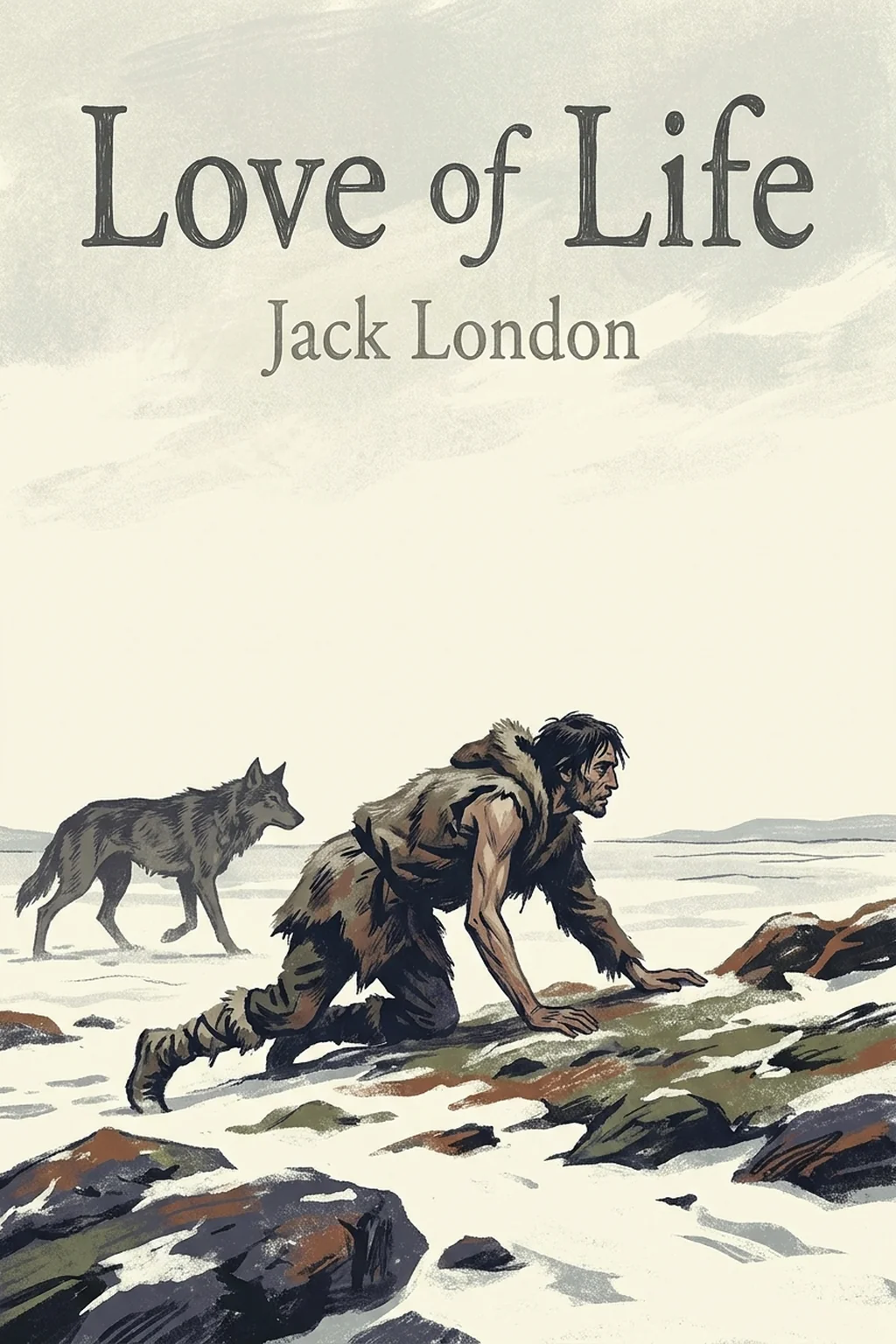
Love of Life
Love of Life
"This out of all will remain— They have lived and have tossed: So much of the game will be gain, Though the gold of the dice has been lost.”
“——”
THEY limped painfully down the bank, and once the foremost of the two men staggered among the rough-strewn rocks. They were tired and weak, and their faces had the drawn expression of patience which comes of hardship long endured. They were heavily burdened with blanket packs which were strapped to their shoulders. Head-straps, passing across the forehead, helped support these packs. Each man carried a rifle. They walked in a stooped posture, the shoulders well forward, the head still farther forward, the eyes bent upon the ground.
"I wish we had just about two of them cartridges that's layin' in that cache of ourn," said the second man.
“”
His voice was utterly and drearily expressionless. He spoke without enthusiasm; and the first man, limping into the milky stream that foamed over the rocks, vouchsafed no reply.
The other man followed at his heels. They did not remove their foot-gear, though the water was icy cold—so cold that their ankles ached and their feet went numb. In places the water dashed against their knees, and both men staggered for footing.
——
The man who followed slipped on a smooth boulder, nearly fell, but recovered himself with a violent effort, at the same time uttering a sharp exclamation of pain. He seemed faint and dizzy and put out his free hand while he reeled, as though seeking support against the air. When he had steadied himself he stepped forward, but reeled again and nearly fell. Then he stood still and looked at the other man, who had never turned his head.
The man stood still for fully a minute, as though debating with himself. Then he called out:
"I say, Bill, I've sprained my ankle.”
“”
Bill staggered on through the milky water. He did not look around. The man watched him go, and though his face was expressionless as ever, his eyes were like the eyes of a wounded deer.
The other man limped up the farther bank and continued straight on without looking back. The man in the stream watched him. His lips trembled a little, so that the rough thatch of brown hair which covered them was visibly agitated. His tongue even strayed out to moisten them.
"Bill!" he cried out.
“”
It was the pleading cry of a strong man in distress, but Bill's head did not turn. The man watched him go, limping grotesquely and lurching forward with stammering gait up the slow slope toward the soft sky-line of the low-lying hill. He watched him go till he passed over the crest and disappeared. Then he turned his gaze and slowly took in the circle of the world that remained to him now that Bill was gone.
Near the horizon the sun was smouldering dimly, almost obscured by formless mists and vapors, which gave an impression of mass and density without outline or tangibility. The man pulled out his watch, the while resting his weight on one leg. It was four o'clock, and as the season was near the last of July or first of August,—he did not know the precise date within a week or two,—he knew that the sun roughly marked the northwest. He looked to the south and knew that somewhere beyond those bleak hills lay the Great Bear Lake; also, he knew that in that direction the Arctic Circle cut its forbidding way across the Canadian Barrens. This stream in which he stood was a feeder to the Coppermine River, which in turn flowed north and emptied into Coronation Gulf and the Arctic Ocean. He had never been there, but he had seen it, once, on a Hudson Bay Company chart.
————
Again his gaze completed the circle of the world about him. It was not a heartening spectacle. Everywhere was soft sky-line. The hills were all low-lying. There were no trees, no shrubs, no grasses—naught but a tremendous and terrible desolation that sent fear swiftly dawning into his eyes.
——
"Bill!" he whispered, once and twice; "Bill!"
“”“”
He cowered in the midst of the milky water, as though the vastness were pressing in upon him with overwhelming force, brutally crushing him with its complacent awfulness. He began to shake as with an ague-fit, till the gun fell from his hand with a splash. This served to rouse him. He fought with his fear and pulled himself together, groping in the water and recovering the weapon. He hitched his pack farther over on his left shoulder, so as to take a portion of its weight from off the injured ankle. Then he proceeded, slowly and carefully, wincing with pain, to the bank.
He did not stop. With a desperation that was madness, unmindful of the pain, he hurried up the slope to the crest of the hill over which his comrade had disappeared—more grotesque and comical by far than that limping, jerking comrade. But at the crest he saw a shallow valley, empty of life. He fought with his fear again, overcame it, hitched the pack still farther over on his left shoulder, and lurched on down the slope.
——
The bottom of the valley was soggy with water, which the thick moss held, spongelike, close to the surface. This water squirted out from under his feet at every step, and each time he lifted a foot the action culminated in a sucking sound as the wet moss reluctantly released its grip. He picked his way from muskeg to muskeg, and followed the other man's footsteps along and across the rocky ledges which thrust like islets through the sea of moss.
Though alone, he was not lost. Farther on he knew he would come to where dead spruce and fir, very small and weazened, bordered the shore of a little lake, the TITCHIN-NICHILIE, in the tongue of the country, the "land of little sticks." And into that lake flowed a small stream, the water of which was not milky. There was rush-grass on that stream—this he remembered well—but no timber, and he would follow it till its first trickle ceased at a divide. He would cross this divide to the first trickle of another stream, flowing to the west, which he would follow until it emptied into the river Dease, and here he would find a cache under an upturned canoe and piled over with many rocks. And in this cache would be ammunition for his empty gun, fish-hooks and lines, a small net—all the utilities for the killing and snaring of food. Also, he would find flour,—not much,—a piece of bacon, and some beans.
”“""——————————
Bill would be waiting for him there, and they would paddle away south down the Dease to the Great Bear Lake. And south across the lake they would go, ever south, till they gained the Mackenzie. And south, still south, they would go, while the winter raced vainly after them, and the ice formed in the eddies, and the days grew chill and crisp, south to some warm Hudson Bay Company post, where timber grew tall and generous and there was grub without end.
These were the thoughts of the man as he strove onward. But hard as he strove with his body, he strove equally hard with his mind, trying to think that Bill had not deserted him, that Bill would surely wait for him at the cache. He was compelled to think this thought, or else there would not be any use to strive, and he would have lain down and died. And as the dim ball of the sun sank slowly into the northwest he covered every inch—and many times—of his and Bill's flight south before the downcoming winter. And he conned the grub of the cache and the grub of the Hudson Bay Company post over and over again. He had not eaten for two days; for a far longer time he had not had all he wanted to eat. Often he stooped and picked pale muskeg berries, put them into his mouth, and chewed and swallowed them. A muskeg berry is a bit of seed enclosed in a bit of water. In the mouth the water melts away and the seed chews sharp and bitter. The man knew there was no nourishment in the berries, but he chewed them patiently with a hope greater than knowledge and defying experience.
At nine o'clock he stubbed his toe on a rocky ledge, and from sheer weariness and weakness staggered and fell. He lay for some time, without movement, on his side. Then he slipped out of the pack-straps and clumsily dragged himself into a sitting posture. It was not yet dark, and in the lingering twilight he groped about among the rocks for shreds of dry moss. When he had gathered a heap he built a fire,—a smouldering, smudgy fire,—and put a tin pot of water on to boil.
————
He unwrapped his pack and the first thing he did was to count his matches. There were sixty-seven. He counted them three times to make sure. He divided them into several portions, wrapping them in oil paper, disposing of one bunch in his empty tobacco pouch, of another bunch in the inside band of his battered hat, of a third bunch under his shirt on the chest. This accomplished, a panic came upon him, and he unwrapped them all and counted them again. There were still sixty-seven.
He dried his wet foot-gear by the fire. The moccasins were in soggy shreds. The blanket socks were worn through in places, and his feet were raw and bleeding. His ankle was throbbing, and he gave it an examination. It had swollen to the size of his knee. He tore a long strip from one of his two blankets and bound the ankle tightly. He tore other strips and bound them about his feet to serve for both moccasins and socks. Then he drank the pot of water, steaming hot, wound his watch, and crawled between his blankets.
He slept like a dead man. The brief darkness around midnight came and went. The sun arose in the northeast—at least the day dawned in that quarter, for the sun was hidden by gray clouds.
——
At six o'clock he awoke, quietly lying on his back. He gazed straight up into the gray sky and knew that he was hungry. As he rolled over on his elbow he was startled by a loud snort, and saw a bull caribou regarding him with alert curiosity. The animal was not mere than fifty feet away, and instantly into the man's mind leaped the vision and the savor of a caribou steak sizzling and frying over a fire. Mechanically he reached for the empty gun, drew a bead, and pulled the trigger. The bull snorted and leaped away, his hoofs rattling and clattering as he fled across the ledges.
The man cursed and flung the empty gun from him. He groaned aloud as he started to drag himself to his feet. It was a slow and arduous task.
His joints were like rusty hinges. They worked harshly in their sockets, with much friction, and each bending or unbending was accomplished only through a sheer exertion of will. When he finally gained his feet, another minute or so was consumed in straightening up, so that he could stand erect as a man should stand.
He crawled up a small knoll and surveyed the prospect. There were no trees, no bushes, nothing but a gray sea of moss scarcely diversified by gray rocks, gray lakelets, and gray streamlets. The sky was gray. There was no sun nor hint of sun. He had no idea of north, and he had forgotten the way he had come to this spot the night before. But he was not lost. He knew that. Soon he would come to the land of the little sticks. He felt that it lay off to the left somewhere, not far—possibly just over the next low hill.
——
He went back to put his pack into shape for travelling. He assured himself of the existence of his three separate parcels of matches, though he did not stop to count them. But he did linger, debating, over a squat moose-hide sack. It was not large. He could hide it under his two hands. He knew that it weighed fifteen pounds,—as much as all the rest of the pack,—and it worried him. He finally set it to one side and proceeded to roll the pack. He paused to gaze at the squat moose-hide sack. He picked it up hastily with a defiant glance about him, as though the desolation were trying to rob him of it; and when he rose to his feet to stagger on into the day, it was included in the pack on his back.
————
He bore away to the left, stopping now and again to eat muskeg berries. His ankle had stiffened, his limp was more pronounced, but the pain of it was as nothing compared with the pain of his stomach. The hunger pangs were sharp. They gnawed and gnawed until he could not keep his mind steady on the course he must pursue to gain the land of little sticks. The muskeg berries did not allay this gnawing, while they made his tongue and the roof of his mouth sore with their irritating bite.
He came upon a valley where rock ptarmigan rose on whirring wings from the ledges and muskegs. Ker—ker—ker was the cry they made. He threw stones at them, but could not hit them. He placed his pack on the ground and stalked them as a cat stalks a sparrow. The sharp rocks cut through his pants' legs till his knees left a trail of blood; but the hurt was lost in the hurt of his hunger. He squirmed over the wet moss, saturating his clothes and chilling his body; but he was not aware of it, so great was his fever for food. And always the ptarmigan rose, whirring, before him, till their ker—ker—ker became a mock to him, and he cursed them and cried aloud at them with their own cry.
“————”“————”
Once he crawled upon one that must have been asleep. He did not see it till it shot up in his face from its rocky nook. He made a clutch as startled as was the rise of the ptarmigan, and there remained in his hand three tail-feathers. As he watched its flight he hated it, as though it had done him some terrible wrong. Then he returned and shouldered his pack.
As the day wore along he came into valleys or swales where game was more plentiful. A band of caribou passed by, twenty and odd animals, tantalizingly within rifle range. He felt a wild desire to run after them, a certitude that he could run them down. A black fox came toward him, carrying a ptarmigan in his mouth. The man shouted. It was a fearful cry, but the fox, leaping away in fright, did not drop the ptarmigan.
Late in the afternoon he followed a stream, milky with lime, which ran through sparse patches of rush-grass. Grasping these rushes firmly near the root, he pulled up what resembled a young onion-sprout no larger than a shingle-nail. It was tender, and his teeth sank into it with a crunch that promised deliciously of food. But its fibers were tough. It was composed of stringy filaments saturated with water, like the berries, and devoid of nourishment. He threw off his pack and went into the rush-grass on hands and knees, crunching and munching, like some bovine creature.
He was very weary and often wished to rest—to lie down and sleep; but he was continually driven on—not so much by his desire to gain the land of little sticks as by his hunger. He searched little ponds for frogs and dug up the earth with his nails for worms, though he knew in spite that neither frogs nor worms existed so far north.
————
He looked into every pool of water vainly, until, as the long twilight came on, he discovered a solitary fish, the size of a minnow, in such a pool. He plunged his arm in up to the shoulder, but it eluded him. He reached for it with both hands and stirred up the milky mud at the bottom. In his excitement he fell in, wetting himself to the waist. Then the water was too muddy to admit of his seeing the fish, and he was compelled to wait until the sediment had settled.
The pursuit was renewed, till the water was again muddied. But he could not wait.
He unstrapped the tin bucket and began to bale the pool. He baled wildly at first, splashing himself and flinging the water so short a distance that it ran back into the pool. He worked more carefully, striving to be cool, though his heart was pounding against his chest and his hands were trembling. At the end of half an hour the pool was nearly dry. Not a cupful of water remained. And there was no fish. He found a hidden crevice among the stones through which it had escaped to the adjoining and larger pool—a pool which he could not empty in a night and a day. Had he known of the crevice, he could have closed it with a rock at the beginning and the fish would have been his.
——
Thus he thought, and crumpled up and sank down upon the wet earth. At first he cried softly to himself, then he cried loudly to the pitiless desolation that ringed him around; and for a long time after he was shaken by great dry sobs.
He built a fire and warmed himself by drinking quarts of hot water, and made camp on a rocky ledge in the same fashion he had the night before. The last thing he did was to see that his matches were dry and to wind his watch. The blankets were wet and clammy. His ankle pulsed with pain. But he knew only that he was hungry, and through his restless sleep he dreamed of feasts and banquets and of food served and spread in all imaginable ways.
He awoke chilled and sick. There was no sun. The gray of earth and sky had become deeper, more profound. A raw wind was blowing, and the first flurries of snow were whitening the hilltops. The air about him thickened and grew white while he made a fire and boiled more water. It was wet snow, half rain, and the flakes were large and soggy. At first they melted as soon as they came in contact with the earth, but ever more fell, covering the ground, putting out the fire, spoiling his supply of moss-fuel.
This was a signal for him to strap on his pack and stumble onward, he knew not where. He was not concerned with the land of little sticks, nor with Bill and the cache under the upturned canoe by the river Dease. He was mastered by the verb "to eat." He was hunger-mad. He took no heed of the course he pursued, so long as that course led him through the swale bottoms. He felt his way through the wet snow to the watery muskeg berries, and went by feel as he pulled up the rush-grass by the roots. But it was tasteless stuff and did not satisfy. He found a weed that tasted sour and he ate all he could find of it, which was not much, for it was a creeping growth, easily hidden under the several inches of snow.
““
He had no fire that night, nor hot water, and crawled under his blanket to sleep the broken hunger-sleep. The snow turned into a cold rain. He awakened many times to feel it falling on his upturned face. Day came—a gray day and no sun. It had ceased raining. The keenness of his hunger had departed. Sensibility, as far as concerned the yearning for food, had been exhausted. There was a dull, heavy ache in his stomach, but it did not bother him so much. He was more rational, and once more he was chiefly interested in the land of little sticks and the cache by the river Dease.
——
He ripped the remnant of one of his blankets into strips and bound his bleeding feet. Also, he recinched the injured ankle and prepared himself for a day of travel. When he came to his pack, he paused long over the squat moose-hide sack, but in the end it went with him.
The snow had melted under the rain, and only the hilltops showed white. The sun came out, and he succeeded in locating the points of the compass, though he knew now that he was lost. Perhaps, in his previous days' wanderings, he had edged away too far to the left. He now bore off to the right to counteract the possible deviation from his true course.
Though the hunger pangs were no longer so exquisite, he realized that he was weak. He was compelled to pause for frequent rests, when he attacked the muskeg berries and rush-grass patches. His tongue felt dry and large, as though covered with a fine hairy growth, and it tasted bitter in his mouth. His heart gave him a great deal of trouble. When he had travelled a few minutes it would begin a remorseless thump, thump, thump, and then leap up and away in a painful flutter of beats that choked him and made him go faint and dizzy.
In the middle of the day he found two minnows in a large pool. It was impossible to bale it, but he was calmer now and managed to catch them in his tin bucket. They were no longer than his little finger, but he was not particularly hungry. The dull ache in his stomach had been growing duller and fainter. It seemed almost that his stomach was dozing. He ate the fish raw, masticating with painstaking care, for the eating was an act of pure reason. While he had no desire to eat, he knew that he must eat to live.
In the evening he caught three more minnows, eating two and saving the third for breakfast. The sun had dried stray shreds of moss, and he was able to warm himself with hot water. He had not covered more than ten miles that day; and the next day, travelling whenever his heart permitted him, he covered no more than five miles. But his stomach did not give him the slightest uneasiness. It had gone to sleep. He was in a strange country, too, and the caribou were growing more plentiful, also the wolves. Often their yelps drifted across the desolation, and once he saw three of them slinking away before his path.
Another night; and in the morning, being more rational, he untied the leather string that fastened the squat moose-hide sack. From its open mouth poured a yellow stream of coarse gold-dust and nuggets. He roughly divided the gold in halves, caching one half on a prominent ledge, wrapped in a piece of blanket, and returning the other half to the sack. He also began to use strips of the one remaining blanket for his feet. He still clung to his gun, for there were cartridges in that cache by the river Dease.
This was a day of fog, and this day hunger awoke in him again. He was very weak and was afflicted with a giddiness which at times blinded him. It was no uncommon thing now for him to stumble and fall; and stumbling once, he fell squarely into a ptarmigan nest. There were four newly hatched chicks, a day old—little specks of pulsating life no more than a mouthful; and he ate them ravenously, thrusting them alive into his mouth and crunching them like egg-shells between his teeth. The mother ptarmigan beat about him with great outcry. He used his gun as a club with which to knock her over, but she dodged out of reach. He threw stones at her and with one chance shot broke a wing. Then she fluttered away, running, trailing the broken wing, with him in pursuit.
——
The little chicks had no more than whetted his appetite. He hopped and bobbed clumsily along on his injured ankle, throwing stones and screaming hoarsely at times; at other times hopping and bobbing silently along, picking himself up grimly and patiently when he fell, or rubbing his eyes with his hand when the giddiness threatened to overpower him.
The chase led him across swampy ground in the bottom of the valley, and he came upon footprints in the soggy moss. They were not his own—he could see that. They must be Bill's. But he could not stop, for the mother ptarmigan was running on. He would catch her first, then he would return and investigate. He exhausted the mother ptarmigan; but he exhausted himself. She lay panting on her side. He lay panting on his side, a dozen feet away, unable to crawl to her. And as he recovered she recovered, fluttering out of reach as his hungry hand went out to her. The chase was resumed. Night settled down and she escaped. He stumbled from weakness and pitched head foremost on his face, cutting his cheek, his pack upon his back. He did not move for a long while; then he rolled over on his side, wound his watch, and lay there until morning.
——
Another day of fog. Half of his last blanket had gone into foot-wrappings. He failed to pick up Bill's trail. It did not matter. His hunger was driving him too compellingly—only—only he wondered if Bill, too, were lost. By midday the irk of his pack became too oppressive. Again he divided the gold, this time merely spilling half of it on the ground. In the afternoon he threw the rest of it away, there remaining to him only the half-blanket, the tin bucket, and the rifle.
————
An hallucination began to trouble him. He felt confident that one cartridge remained to him. It was in the chamber of the rifle and he had overlooked it. On the other hand, he knew all the time that the chamber was empty. But the hallucination persisted. He fought it off for hours, then threw his rifle open and was confronted with emptiness. The disappointment was as bitter as though he had really expected to find the cartridge.
He plodded on for half an hour, when the hallucination arose again. Again he fought it, and still it persisted, till for very relief he opened his rifle to unconvince himself. At times his mind wandered farther afield, and he plodded on, a mere automaton, strange conceits and whimsicalities gnawing at his brain like worms. But these excursions out of the real were of brief duration, for ever the pangs of the hunger-bite called him back. He was jerked back abruptly once from such an excursion by a sight that caused him nearly to faint. He reeled and swayed, doddering like a drunken man to keep from falling. Before him stood a horse. A horse! He could not believe his eyes. A thick mist was in them, intershot with sparkling points of light. He rubbed his eyes savagely to clear his vision, and beheld, not a horse, but a great brown bear. The animal was studying him with bellicose curiosity.
The man had brought his gun halfway to his shoulder before he realized. He lowered it and drew his hunting-knife from its beaded sheath at his hip. Before him was meat and life. He ran his thumb along the edge of his knife. It was sharp. The point was sharp. He would fling himself upon the bear and kill it. But his heart began its warning thump, thump, thump. Then followed the wild upward leap and tattoo of flutters, the pressing as of an iron band about his forehead, the creeping of the dizziness into his brain.
His desperate courage was evicted by a great surge of fear. In his weakness, what if the animal attacked him? He drew himself up to his most imposing stature, gripping the knife and staring hard at the bear. The bear advanced clumsily a couple of steps, reared up, and gave vent to a tentative growl. If the man ran, he would run after him; but the man did not run. He was animated now with the courage of fear. He, too, growled, savagely, terribly, voicing the fear that is to life germane and that lies twisted about life's deepest roots.
The bear edged away to one side, growling menacingly, himself appalled by this mysterious creature that appeared upright and unafraid. But the man did not move. He stood like a statue till the danger was past, when he yielded to a fit of trembling and sank down into the wet moss.
He pulled himself together and went on, afraid now in a new way. It was not the fear that he should die passively from lack of food, but that he should be destroyed violently before starvation had exhausted the last particle of the endeavor in him that made toward surviving. There were the wolves. Back and forth across the desolation drifted their howls, weaving the very air into a fabric of menace that was so tangible that he found himself, arms in the air, pressing it back from him as it might be the walls of a wind-blown tent.
Now and again the wolves, in packs of two and three, crossed his path. But they sheered clear of him. They were not in sufficient numbers, and besides they were hunting the caribou, which did not battle, while this strange creature that walked erect might scratch and bite.
In the late afternoon he came upon scattered bones where the wolves had made a kill. The debris had been a caribou calf an hour before, squawking and running and very much alive. He contemplated the bones, clean-picked and polished, pink with the cell-life in them which had not yet died. Could it possibly be that he might be that ere the day was done! Such was life, eh? A vain and fleeting thing. It was only life that pained. There was no hurt in death. To die was to sleep. It meant cessation, rest. Then why was he not content to die?
But he did not moralize long. He was squatting in the moss, a bone in his mouth, sucking at the shreds of life that still dyed it faintly pink. The sweet meaty taste, thin and elusive almost as a memory, maddened him. He closed his jaws on the bones and crunched. Sometimes it was the bone that broke, sometimes his teeth. Then he crushed the bones between rocks, pounded them to a pulp, and swallowed them. He pounded his fingers, too, in his haste, and yet found a moment in which to feel surprise at the fact that his fingers did not hurt much when caught under the descending rock.
Came frightful days of snow and rain. He did not know when he made camp, when he broke camp. He travelled in the night as much as in the day. He rested wherever he fell, crawled on whenever the dying life in him flickered up and burned less dimly. He, as a man, no longer strove. It was the life in him, unwilling to die, that drove him on. He did not suffer. His nerves had become blunted, numb, while his mind was filled with weird visions and delicious dreams.
But ever he sucked and chewed on the crushed bones of the caribou calf, the least remnants of which he had gathered up and carried with him. He crossed no more hills or divides, but automatically followed a large stream which flowed through a wide and shallow valley. He did not see this stream nor this valley. He saw nothing save visions. Soul and body walked or crawled side by side, yet apart, so slender was the thread that bound them.
He awoke in his right mind, lying on his back on a rocky ledge. The sun was shining bright and warm. Afar off he heard the squawking of caribou calves. He was aware of vague memories of rain and wind and snow, but whether he had been beaten by the storm for two days or two weeks he did not know.
For some time he lay without movement, the genial sunshine pouring upon him and saturating his miserable body with its warmth. A fine day, he thought. Perhaps he could manage to locate himself. By a painful effort he rolled over on his side. Below him flowed a wide and sluggish river. Its unfamiliarity puzzled him. Slowly he followed it with his eyes, winding in wide sweeps among the bleak, bare hills, bleaker and barer and lower-lying than any hills he had yet encountered. Slowly, deliberately, without excitement or more than the most casual interest, he followed the course of the strange stream toward the sky-line and saw it emptying into a bright and shining sea. He was still unexcited. Most unusual, he thought, a vision or a mirage—more likely a vision, a trick of his disordered mind. He was confirmed in this by sight of a ship lying at anchor in the midst of the shining sea. He closed his eyes for a while, then opened them. Strange how the vision persisted! Yet not strange. He knew there were no seas or ships in the heart of the barren lands, just as he had known there was no cartridge in the empty rifle.
——
He heard a snuffle behind him—a half-choking gasp or cough. Very slowly, because of his exceeding weakness and stiffness, he rolled over on his other side. He could see nothing near at hand, but he waited patiently. Again came the snuffle and cough, and outlined between two jagged rocks not a score of feet away he made out the gray head of a wolf. The sharp ears were not pricked so sharply as he had seen them on other wolves; the eyes were bleared and bloodshot, the head seemed to droop limply and forlornly. The animal blinked continually in the sunshine. It seemed sick. As he looked, it snuffled and coughed again.
——
This, at least, was real, he thought, and turned on the other side so that he might see the reality of the world which had been veiled from him before by the vision. But the sea still shone in the distance and the ship was plainly discernible. Was it reality, after all? He closed his eyes for a long while and thought, and then it came to him. He had been making north by east, away from the Dease Divide and into the Coppermine Valley. This wide and sluggish river was the Coppermine. That shining sea was the Arctic Ocean. That ship was a whaler, strayed east, far east, from the mouth of the Mackenzie, and it was lying at anchor in Coronation Gulf. He remembered the Hudson Bay Company chart he had seen long ago, and it was all clear and reasonable to him.
He sat up and turned his attention to immediate affairs. He had worn through the blanket-wrappings, and his feet were shapeless lumps of raw meat. His last blanket was gone. Rifle and knife were both missing. He had lost his hat somewhere, with the bunch of matches in the band, but the matches against his chest were safe and dry inside the tobacco pouch and oil paper. He looked at his watch. It marked eleven o'clock and was still running. Evidently he had kept it wound.
He was calm and collected. Though extremely weak, he had no sensation of pain. He was not hungry. The thought of food was not even pleasant to him, and whatever he did was done by his reason alone. He ripped off his pants' legs to the knees and bound them about his feet. Somehow he had succeeded in retaining the tin bucket. He would have some hot water before he began what he foresaw was to be a terrible journey to the ship.
His movements were slow. He shook as with a palsy. When he started to collect dry moss, he found he could not rise to his feet. He tried again and again, then contented himself with crawling about on hands and knees. Once he crawled near to the sick wolf. The animal dragged itself reluctantly out of his way, licking its chops with a tongue which seemed hardly to have the strength to curl. The man noticed that the tongue was not the customary healthy red. It was a yellowish brown and seemed coated with a rough and half-dry mucus.
After he had drunk a quart of hot water the man found he was able to stand, and even to walk as well as a dying man might be supposed to walk. Every minute or so he was compelled to rest. His steps were feeble and uncertain, just as the wolf's that trailed him were feeble and uncertain; and that night, when the shining sea was blotted out by blackness, he knew he was nearer to it by no more than four miles.
Throughout the night he heard the cough of the sick wolf, and now and then the squawking of the caribou calves. There was life all around him, but it was strong life, very much alive and well, and he knew the sick wolf clung to the sick man's trail in the hope that the man would die first. In the morning, on opening his eyes, he beheld it regarding him with a wistful and hungry stare. It stood crouched, with tail between its legs, like a miserable and woe-begone dog. It shivered in the chill morning wind, and grinned dispiritedly when the man spoke to it in a voice that achieved no more than a hoarse whisper.
The sun rose brightly, and all morning the man tottered and fell toward the ship on the shining sea. The weather was perfect. It was the brief Indian Summer of the high latitudes. It might last a week. Tomorrow or next day it might be gone.
In the afternoon the man came upon a trail. It was of another man, who did not walk, but who dragged himself on all fours. The man thought it might be Bill, but he thought in a dull, uninterested way. He had no curiosity. In fact, sensation and emotion had left him. He was no longer susceptible to pain. Stomach and nerves had gone to sleep. Yet the life that was in him drove him on. He was very weary, but it refused to die. It was because it refused to die that he still ate muskeg berries and minnows, drank his hot water, and kept a wary eye on the sick wolf.
He followed the trail of the other man who dragged himself along, and soon came to the end of it—a few fresh-picked bones where the soggy moss was marked by the foot-pads of many wolves. He saw a squat moose-hide sack, mate to his own, which had been torn by sharp teeth. He picked it up, though its weight was almost too much for his feeble fingers. Bill had carried it to the last. Ha! ha! He would have the laugh on Bill. He would survive and carry it to the ship in the shining sea. His mirth was hoarse and ghastly, like a raven's croak, and the sick wolf joined him, howling lugubriously. The man ceased suddenly. How could he have the laugh on Bill if that were Bill; if those bones, so pinky-white and clean, were Bill?
——
He turned away. Well, Bill had deserted him; but he would not take the gold, nor would he suck Bill's bones. Bill would have, though, had it been the other way around, he mused as he staggered on. He came to a pool of water. Stooping over in quest of minnows, he jerked his head back as though he had been stung. He had caught sight of his reflected face. So horrible was it that sensibility awoke long enough to be shocked. There were three minnows in the pool, which was too large to drain; and after several ineffectual attempts to catch them in the tin bucket he forbore. He was afraid, because of his great weakness, that he might fall in and drown. It was for this reason that he did not trust himself to the river astride one of the many drift-logs which lined its sand-spits. That day he decreased the distance between him and the ship by three miles; the next day by two—for he was crawling now as Bill had crawled; and the end of the fifth day found the ship still seven miles away and him unable to make even a mile a day. Still the Indian Summer held on, and he continued to crawl and faint, turn and turn about; and ever the sick wolf coughed and wheezed at his heels. His knees had become raw meat like his feet, and though he padded them with the shirt from his back it was a red track he left behind him on the moss and stones. Once, glancing back, he saw the wolf licking hungrily his bleeding trail, and he saw sharply what his own end might be—unless—unless he could get the wolf. Then began as grim a tragedy of existence as was ever played—a sick man that crawled, a sick wolf that limped, two creatures dragging their dying carcasses across the desolation and hunting each other's lives.
————————
Had it been a well wolf, it would not have mattered so much to the man; but the thought of going to feed the maw of that loathsome and all but dead thing was repugnant to him. He was finicky. His mind had begun to wander again, and to be perplexed by hallucinations, while his lucid intervals grew rarer and shorter.
He was awakened once from a faint by a wheeze close in his ear. The wolf leaped lamely back, losing its footing and falling in its weakness. It was ludicrous, but he was not amused. Nor was he even afraid. He was too far gone for that. But his mind was for the moment clear, and he lay and considered. The ship was no more than four miles away. He could see it quite distinctly when he rubbed the mists out of his eyes, and he could see the white sail of a small boat cutting the water of the shining sea. But he could never crawl those four miles. He knew that, and was very calm in the knowledge. He knew that he could not crawl half a mile. And yet he wanted to live. It was unreasonable that he should die after all he had undergone. Fate asked too much of him. And, dying, he declined to die. It was stark madness, perhaps, but in the very grip of Death he defied Death and refused to die.
He closed his eyes and composed himself with infinite precaution. He steeled himself to keep above the suffocating languor that lapped like a rising tide through all the wells of his being. It was very like a sea, this deadly languor, that rose and rose and drowned his consciousness bit by bit. Sometimes he was all but submerged, swimming through oblivion with a faltering stroke; and again, by some strange alchemy of soul, he would find another shred of will and strike out more strongly.
Without movement he lay on his back, and he could hear, slowly drawing near and nearer, the wheezing intake and output of the sick wolf's breath. It drew closer, ever closer, through an infinitude of time, and he did not move. It was at his ear. The harsh dry tongue grated like sandpaper against his cheek. His hands shot out—or at least he willed them to shoot out. The fingers were curved like talons, but they closed on empty air. Swiftness and certitude require strength, and the man had not this strength.
——
The patience of the wolf was terrible. The man's patience was no less terrible. For half a day he lay motionless, fighting off unconsciousness and waiting for the thing that was to feed upon him and upon which he wished to feed. Sometimes the languid sea rose over him and he dreamed long dreams; but ever through it all, waking and dreaming, he waited for the wheezing breath and the harsh caress of the tongue.
He did not hear the breath, and he slipped slowly from some dream to the feel of the tongue along his hand. He waited. The fangs pressed softly; the pressure increased; the wolf was exerting its last strength in an effort to sink teeth in the food for which it had waited so long. But the man had waited long, and the lacerated hand closed on the jaw. Slowly, while the wolf struggled feebly and the hand clutched feebly, the other hand crept across to a grip. Five minutes later the whole weight of the man's body was on top of the wolf. The hands had not sufficient strength to choke the wolf, but the face of the man was pressed close to the throat of the wolf and the mouth of the man was full of hair. At the end of half an hour the man was aware of a warm trickle in his throat. It was not pleasant. It was like molten lead being forced into his stomach, and it was forced by his will alone. Later the man rolled over on his back and slept.
There were some members of a scientific expedition on the whale-ship BEDFORD. From the deck they remarked a strange object on the shore. It was moving down the beach toward the water. They were unable to classify it, and, being scientific men, they climbed into the whale-boat alongside and went ashore to see. And they saw something that was alive but which could hardly be called a man. It was blind, unconscious. It squirmed along the ground like some monstrous worm. Most of its efforts were ineffectual, but it was persistent, and it writhed and twisted and went ahead perhaps a score of feet an hour.
“”
Three weeks afterward the man lay in a bunk on the whale-ship BEDFORD, and with tears streaming down his wasted cheeks told who he was and what he had undergone. He also babbled incoherently of his mother, of sunny Southern California, and a home among the orange groves and flowers.
“”
The days were not many after that when he sat at table with the scientific men and ship's officers. He gloated over the spectacle of so much food, watching it anxiously as it went into the mouths of others. With the disappearance of each mouthful an expression of deep regret came into his eyes. He was quite sane, yet he hated those men at mealtime. He was haunted by a fear that the food would not last. He inquired of the cook, the cabin-boy, the captain, concerning the food stores. They reassured him countless times; but he could not believe them, and pried cunningly about the lazarette to see with his own eyes.
It was noticed that the man was getting fat. He grew stouter with each day. The scientific men shook their heads and theorized. They limited the man at his meals, but still his girth increased and he swelled prodigiously under his shirt.
The sailors grinned. They knew. And when the scientific men set a watch on the man, they knew too. They saw him slouch forward after breakfast, and, like a mendicant, with outstretched palm, accost a sailor. The sailor grinned and passed him a fragment of sea biscuit. He clutched it avariciously, looked at it as a miser looks at gold, and thrust it into his shirt bosom. Similar were the donations from other grinning sailors.
The scientific men were discreet. They let him alone. But they privily examined his bunk. It was lined with hardtack; the mattress was stuffed with hardtack; every nook and cranny was filled with hardtack. Yet he was sane. He was taking precautions against another possible famine—that was all. He would recover from it, the scientific men said; and he did, ere the BEDFORD'S anchor rumbled down in San Francisco Bay.
——“”
(The End.)
Koolau the Leper
"Because we are sick they take away our liberty. We have obeyed the law. We have done no wrong. And yet they would put us in prison. Molokai is a prison. That you know. Niuli, there, his sister was sent to Molokai seven years ago. He has not seen her since. Nor will he ever see her. She must stay there until she dies. This is not her will. It is not Niuli's will. It is the will of the white men who rule the land. And who are these white men?
“
"We know. We have it from our fathers and our fathers' fathers. They came like lambs, speaking softly. Well might they speak softly, for we were many and strong, and all the islands were ours. As I say, they spoke softly. They were of two kinds. The one kind asked our permission, our gracious permission, to preach to us the word of God. The other kind asked our permission, our gracious permission, to trade with us. That was the beginning. Today all the islands are theirs, all the land, all the cattle—everything is theirs. They that preached the word of God and they that preached the word of Rum have fore-gathered and become great chiefs. They live like kings in houses of many rooms, with multitudes of servants to care for them. They who had nothing have everything, and if you, or I, or any Kanaka be hungry, they sneer and say, 'Well, why don't you work? There are the plantations.’
“——“’
Koolau paused. He raised one hand, and with gnarled and twisted fingers lifted up the blazing wreath of hibiscus that crowned his black hair. The moonlight bathed the scene in silver. It was a night of peace, though those who sat about him and listened had all the seeming of battle-wrecks. Their faces were leonine. Here a space yawned in a face where should have been a nose, and there an arm-stump showed where a hand had rotted off. They were men and women beyond the pale, the thirty of them, for upon them had been placed the mark of the beast.
They sat, flower-garlanded, in the perfumed, luminous night, and their lips made uncouth noises and their throats rasped approval of Koolau's speech. They were creatures who once had been men and women. But they were men and women no longer. They were monsters—in face and form grotesque caricatures of everything human. They were hideously maimed and distorted, and had the seeming of creatures that had been racked in millenniums of hell. Their hands, when they possessed them, were like harpy claws. Their faces were the misfits and slips, crushed and bruised by some mad god at play in the machinery of life. Here and there were features which the mad god had smeared half away, and one woman wept scalding tears from twin pits of horror, where her eyes once had been. Some were in pain and groaned from their chests. Others coughed, making sounds like the tearing of tissue. Two were idiots, more like huge apes marred in the making, until even an ape were an angel. They mowed and gibbered in the moonlight, under crowns of drooping, golden blossoms. One, whose bloated ear-lobe flapped like a fan upon his shoulder, caught up a gorgeous flower of orange and scarlet and with it decorated the monstrous ear that flip-flapped with his every movement.
——
And over these things Koolau was king. And this was his kingdom,—a flower-throttled gorge, with beetling cliffs and crags, from which floated the blattings of wild goats. On three sides the grim walls rose, festooned in fantastic draperies of tropic vegetation and pierced by cave-entrances—the rocky lairs of Koolau's subjects. On the fourth side the earth fell away into a tremendous abyss, and, far below, could be seen the summits of lesser peaks and crags, at whose bases foamed and rumbled the Pacific surge. In fine weather a boat could land on the rocky beach that marked the entrance of Kalalau Valley, but the weather must be very fine. And a cool-headed mountaineer might climb from the beach to the head of Kalalau Valley, to this pocket among the peaks where Koolau ruled; but such a mountaineer must be very cool of head, and he must know the wild-goat trails as well. The marvel was that the mass of human wreckage that constituted Koolau's people should have been able to drag its helpless misery over the giddy goat-trails to this inaccessible spot.
————
"Brothers," Koolau began.
“”
But one of the mowing, apelike travesties emitted a wild shriek of madness, and Koolau waited while the shrill cachination was tossed back and forth among the rocky walls and echoed distantly through the pulseless night.
"Brothers, is it not strange? Ours was the land, and behold, the land is not ours. What did these preachers of the word of God and the word of Rum give us for the land? Have you received one dollar, as much as one dollar, any one of you, for the land? Yet it is theirs, and in return they tell us we can go to work on the land, their land, and that what we produce by our toil shall be theirs. Yet in the old days we did not have to work. Also, when we are sick, they take away our freedom."
“”
"Who brought the sickness, Koolau?" demanded Kiloliana, a lean and wiry man with a face so like a laughing faun's that one might expect to see the cloven hoofs under him. They were cloven, it was true, but the cleavages were great ulcers and livid putrefactions. Yet this was Kiloliana, the most daring climber of them all, the man who knew every goat-trail and who had led Koolau and his wretched followers into the recesses of Kalalau.
“”
"Ay, well questioned," Koolau answered. "Because we would not work the miles of sugar-cane where once our horses pastured, they brought the Chinese slaves from overseas. And with them came the Chinese sickness—that which we suffer from and because of which they would imprison us on Molokai. We were born on Kauai. We have been to the other islands, some here and some there, to Oahu, to Maui, to Hawaii, to Honolulu. Yet always did we come back to Kauai. Why did we come back? There must be a reason. Because we love Kauai. We were born here. Here we have lived. And here shall we die—unless—unless—there be weak hearts amongst us. Such we do not want. They are fit for Molokai. And if there be such, let them not remain. Tomorrow the soldiers land on the shore. Let the weak hearts go down to them. They will be sent swiftly to Molokai. As for us, we shall stay and fight. But know that we will not die. We have rifles. You know the narrow trails where men must creep, one by one. I, alone, Koolau, who was once a cowboy on Niihau, can hold the trail against a thousand men. Here is Kapalei, who was once a judge over men and a man with honour, but who is now a hunted rat, like you and me. Hear him. He is wise.”
“”“————————”
Kapalei arose. Once he had been a judge. He had gone to college at Punahou. He had sat at meat with lords and chiefs and the high representatives of alien powers who protected the interests of traders and missionaries. Such had been Kapalei. But now, as Koolau had said, he was a hunted rat, a creature outside the law, sunk so deep in the mire of human horror that he was above the law as well as beneath it. His face was featureless, save for gaping orifices and for the lidless eyes that burned under hairless brows.
"Let us not make trouble," he began. "We ask to be left alone. But if they do not leave us alone, then is the trouble theirs and the penalty. My fingers are gone, as you see." He held up his stumps of hands that all might see. "Yet have I the joint of one thumb left, and it can pull a trigger as firmly as did its lost neighbour in the old days. We love Kauai. Let us live here, or die here, but do not let us go to the prison of Molokai. The sickness is not ours. We have not sinned. The men who preached the word of God and the word of Rum brought the sickness with the coolie slaves who work the stolen land. I have been a judge. I know the law and the justice, and I say to you it is unjust to steal a man's land, to make that man sick with the Chinese sickness, and then to put that man in prison for life.”
“”“”“”
"Life is short, and the days are filled with pain," said Koolau. "Let us drink and dance and be happy as we can."
“”“”
From one of the rocky lairs calabashes were produced and passed round. The calabashes were filled with the fierce distillation of the root of the ti-plant; and as the liquid fire coursed through them and mounted to their brains, they forgot that they had once been men and women, for they were men and women once more. The woman who wept scalding tears from open eye-pits was indeed a woman apulse with life as she plucked the strings of an ukulele and lifted her voice in a barbaric love-call such as might have come from the dark forest-depths of the primeval world. The air tingled with her cry, softly imperious and seductive. Upon a mat, timing his rhythm to the woman's song Kiloliana danced. It was unmistakable. Love danced in all his movements, and, next, dancing with him on the mat, was a woman whose heavy hips and generous breast gave the lie to her disease-corroded face. It was a dance of the living dead, for in their disintegrating bodies life still loved and longed. Ever the woman whose sightless eyes ran scalding tears chanted her love-cry, ever the dancers of love danced in the warm night, and ever the calabashes went around till in all their brains were maggots crawling of memory and desire. And with the woman on the mat danced a slender maid whose face was beautiful and unmarred, but whose twisted arms that rose and fell marked the disease's ravage. And the two idiots, gibbering and mouthing strange noises, danced apart, grotesque, fantastic, travestying love as they themselves had been travestied by life.
But the woman's love-cry broke midway, the calabashes were lowered, and the dancers ceased, as all gazed into the abyss above the sea, where a rocket flared like a wan phantom through the moonlit air.
"It is the soldiers," said Koolau. "Tomorrow there will be fighting. It is well to sleep and be prepared."
“”“”
The lepers obeyed, crawling away to their lairs in the cliff, until only Koolau remained, sitting motionless in the moonlight, his rifle across his knees, as he gazed far down to the boats landing on the beach.
The far head of Kalalau Valley had been well chosen as a refuge. Except Kiloliana, who knew back-trails up the precipitous walls, no man could win to the gorge save by advancing across a knife-edged ridge. This passage was a hundred yards in length. At best, it was a scant twelve inches wide. On either side yawned the abyss. A slip, and to right or left the man would fall to his death. But once across he would find himself in an earthly paradise. A sea of vegetation laved the landscape, pouring its green billows from wall to wall, dripping from the cliff-lips in great vine-masses, and flinging a spray of ferns and air-plants in to the multitudinous crevices. During the many months of Koolau's rule, he and his followers had fought with this vegetable sea. The choking jungle, with its riot of blossoms, had been driven back from the bananas, oranges, and mangoes that grew wild. In little clearings grew the wild arrowroot; on stone terraces, filled with soil scrapings, were the taro patches and the melons; and in every open space where the sunshine penetrated were papaya trees burdened with their golden fruit.
Koolau had been driven to this refuge from the lower valley by the beach. And if he were driven from it in turn, he knew of gorges among the jumbled peaks of the inner fastnesses where he could lead his subjects and live. And now he lay with his rifle beside him, peering down through a tangled screen of foliage at the soldiers on the beach. He noted that they had large guns with them, from which the sunshine flashed as from mirrors. The knife-edged passage lay directly before him. Crawling upward along the trail that led to it he could see tiny specks of men. He knew they were not the soldiers, but the police. When they failed, then the soldiers would enter the game.
He affectionately rubbed a twisted hand along his rifle barrel and made sure that the sights were clean. He had learned to shoot as a wild-cattle hunter on Niihau, and on that island his skill as a marksman was unforgotten. As the toiling specks of men grew nearer and larger, he estimated the range, judged the deflection of the wind that swept at right angles across the line of fire, and calculated the chances of overshooting marks that were so far below his level. But he did not shoot. Not until they reached the beginning of the passage did he make his presence known. He did not disclose himself, but spoke from the thicket.
"What do you want?" he demanded.
“”
"We want Koolau, the leper," answered the man who led the native police, himself a blue-eyed American.
“”
"You must go back," Koolau said.
“”
He knew the man, a deputy sheriff, for it was by him that he had been harried out of Niihau, across Kauai, to Kalalau Valley, and out of the valley to the gorge.
"Who are you?" the sheriff asked.
“”
"I am Koolau, the leper," was the reply.
“”
"Then come out. We want you. Dead or alive, there is a thousand dollars on your head. You cannot escape."
“”
Koolau laughed aloud in the thicket.
"Come out!" the sheriff commanded, and was answered by silence.
“”
He conferred with the police, and Koolau saw that they were preparing to rush him.
"Koolau," the sheriff called. "Koolau, I am coming across to get you."
“”“”
"Then look first and well about you at the sun and sea and sky, for it will be the last time you behold them."
“”
"That's all right, Koolau," the sheriff said soothingly. "I know you're a dead shot. But you won't shoot me. I have never done you any wrong.”
“”“”
Koolau grunted in the thicket.
"I say, you know, I've never done you any wrong, have I?" the sheriff persisted.
“”
"You do me wrong when you try to put me in prison," was the reply. "And you do me wrong when you try for the thousand dollars on my head. If you will live, stay where you are."
“”“”
"I've got to come across and get you. I'm sorry. But it is my duty.”
“”
"You will die before you get across."
“”
The sheriff was no coward. Yet was he undecided. He gazed into the gulf on either side and ran his eyes along the knife-edge he must travel. Then he made up his mind.
"Koolau," he called.
“”
But the thicket remained silent.
"Koolau, don't shoot. I am coming.”
“”
The sheriff turned, gave some orders to the police, then started on his perilous way. He advanced slowly. It was like walking a tight rope. He had nothing to lean upon but the air. The lava rock crumbled under his feet, and on either side the dislodged fragments pitched downward through the depths. The sun blazed upon him, and his face was wet with sweat. Still he advanced, until the halfway point was reached.
"Stop!" Koolau commanded from the thicket. "One more step and I shoot."
“”“”
The sheriff halted, swaying for balance as he stood poised above the void. His face was pale, but his eyes were determined. He licked his dry lips before he spoke.
"Koolau, you won't shoot me. I know you won't.”
“”
He started once more. The bullet whirled him half about. On his face was an expression of querulous surprise as he reeled to the fall. He tried to save himself by throwing his body across the knife-edge; but at that moment he knew death. The next moment the knife-edge was vacant. Then came the rush, five policemen, in single file, with superb steadiness, running along the knife-edge. At the same instant the rest of the posse opened fire on the thicket. It was madness. Five times Koolau pulled the trigger, so rapidly that his shots constituted a rattle. Changing his position and crouching low under the bullets that were biting and singing through the bushes, he peered out. Four of the police had followed the sheriff. The fifth lay across the knife-edge still alive. On the farther side, no longer firing, were the surviving police. On the naked rock there was no hope for them. Before they could clamber down Koolau could have picked off the last man. But he did not fire, and, after a conference, one of them took off a white undershirt and waved it as a flag. Followed by another, he advanced along the knife-edge to their wounded comrade. Koolau gave no sign, but watched them slowly withdraw and become specks as they descended into the lower valley.
Two hours later, from another thicket, Koolau watched a body of police trying to make the ascent from the opposite side of the valley. He saw the wild goats flee before them as they climbed higher and higher, until he doubted his judgment and sent for Kiloliana, who crawled in beside him.
"No, there is no way," said Kiloliana.
“”
"The goats?" Koolau questioned.
“”
"They come over from the next valley, but they cannot pass to this. There is no way. Those men are not wiser than goats. They may fall to their deaths. Let us watch."
“”
"They are brave men," said Koolau. "Let us watch."
“”“”
Side by side they lay among the morning-glories, with the yellow blossoms of the hau dropping upon them from overhead, watching the motes of men toil upward, till the thing happened, and three of them, slipping, rolling, sliding, dashed over a cliff-lip and fell sheer half a thousand feet.
Kiloliana chuckled.
"We will be bothered no more," he said.
“”
"They have war guns," Koolau made answer. "The soldiers have not yet spoken."
“”“”
In the drowsy afternoon, most of the lepers lay in their rock dens asleep. Koolau, his rifle on his knees, fresh-cleaned and ready, dozed in the entrance to his own den. The maid with the twisted arms lay below in the thicket and kept watch on the knife-edge passage. Suddenly Koolau was startled wide awake by the sound of an explosion on the beach. The next instant the atmosphere was incredibly rent asunder. The terrible sound frightened him. It was as if all the gods had caught the envelope of the sky in their hands and were ripping it apart as a woman rips apart a sheet of cotton cloth. But it was such an immense ripping, growing swiftly nearer. Koolau glanced up apprehensively, as if expecting to see the thing. Then high up on the cliff overhead the shell burst in a fountain of black smoke. The rock was shattered, the fragments falling to the foot of the cliff.
Koolau passed his hand across his sweaty brow. He was terribly shaken. He had had no experience with shell-fire, and this was more dreadful than anything he had imagined.
"One," said Kapahei, suddenly bethinking himself to keep count.
“”
A second and a third shell flew screaming over the top of the wall, bursting beyond view. Kapahei methodically kept the count. The lepers crowded into the open space before the caves. At first they were frightened, but as the shells continued their flight overhead the leper folk became reassured and began to admire the spectacle.
The two idiots shrieked with delight, prancing wild antics as each air-tormenting shell went by. Koolau began to recover his confidence. No damage was being done. Evidently they could not aim such large missiles at such long range with the precision of a rifle.
But a change came over the situation. The shells began to fall short. One burst below in the thicket by the knife-edge. Koolau remembered the maid who lay there on watch, and ran down to see. The smoke was still rising from the bushes when he crawled in. He was astounded. The branches were splintered and broken. Where the girl had lain was a hole in the ground. The girl herself was in shattered fragments. The shell had burst right on her.
First peering out to make sure no soldiers were attempting the passage, Koolau started back on the run for the caves. All the time the shells were moaning, whining, screaming by, and the valley was rumbling and reverberating with the explosions. As he came in sight of the caves, he saw the two idiots cavorting about, clutching each other's hands with their stumps of fingers. Even as he ran, Koolau saw a spout of black smoke rise from the ground, near to the idiots. They were flung apart bodily by the explosion. One lay motionless, but the other was dragging himself by his hands toward the cave. His legs trailed out helplessly behind him, while the blood was pouring from his body. He seemed bathed in blood, and as he crawled he cried like a little dog. The rest of the lepers, with the exception of Kapahei, had fled into the caves.
"Seventeen," said Kapahei. "Eighteen," he added.
“”“”
This last shell had fairly entered into one of the caves. The explosion caused the caves to empty. But from the particular cave no one emerged. Koolau crept in through the pungent, acrid smoke. Four bodies, frightfully mangled, lay about. One of them was the sightless woman whose tears till now had never ceased.
Outside, Koolau found his people in a panic and already beginning to climb the goat-trail that led out of the gorge and on among the jumbled heights and chasms. The wounded idiot, whining feebly and dragging himself along on the ground by his hands, was trying to follow. But at the first pitch of the wall his helplessness overcame him and he fell back.
"It would be better to kill him," said Koolau to Kapahei, who still sat in the same place.
“”
"Twenty-two," Kapahei answered. "Yes, it would be a wise thing to kill him. Twenty-three—twenty-four.”
“”“——”
The idiot whined sharply when he saw the rifle levelled at him. Koolau hesitated, then lowered the gun.
"It is a hard thing to do," he said.
“”
"You are a fool, twenty-six, twenty-seven," said Kapahei. "Let me show you."
“”“”
He arose, and with a heavy fragment of rock in his hand, approached the wounded thing. As he lifted his arm to strike, a shell burst full upon him, relieving him of the necessity of the act and at the same time putting an end to his count.
Koolau was alone in the gorge. He watched the last of his people drag their crippled bodies over the brow of the height and disappear. Then he turned and went down to the thicket where the maid had keen killed. The shell-fire still continued, but he remained; for far below he could see the soldiers climbing up. A shell burst twenty feet away. Flattening himself into the earth, he heard the rush of the fragments above his body. A shower of hau blossoms rained upon him. He lifted his head to peer down the trail, and sighed. He was very much afraid. Bullets from rifles would not have worried him, but this shell-fire was abominable. Each time a shell shrieked by he shivered and crouched; but each time he lifted his head again to watch the trail.
At last the shells ceased. This, he reasoned, was because the soldiers were drawing near. They crept along the trail in single file, and he tried to count them until he lost track. At any rate, there were a hundred or so of them—all come after Koolau the leper. He felt a fleeting prod of pride. With war guns and rifles, police and soldiers, they came for him, and he was only one man, a crippled wreck of a man at that. They offered a thousand dollars for him, dead or alive. In all his life he had never possessed that much money. The thought was a bitter one. Kapahei had been right. He, Koolau, had done no wrong. Because the haoles wanted labour with which to work the stolen land, they had brought in the Chinese coolies, and with them had come the sickness. And now, because he had caught the sickness, he was worth a thousand dollars—but not to himself. It was his worthless carcass, rotten with disease or dead from a bursting shell, that was worth all that money.
————
When the soldiers reached the knife-edged passage, he was prompted to warn them. But his gaze fell upon the body of the murdered maid, and he kept silent. When six had ventured on the knife-edge, he opened fire. Nor did he cease when the knife-edge was bare. He emptied his magazine, reloaded, and emptied it again. He kept on shooting. All his wrongs were blazing in his brain, and he was in a fury of vengeance. All down the goat-trail the soldiers were firing, and though they lay flat and sought to shelter themselves in the shallow inequalities of the surface, they were exposed marks to him. Bullets whistled and thudded about him, and an occasional ricochet sang sharply through the air. One bullet ploughed a crease through his scalp, and a second burned across his shoulder-blade without breaking the skin.
It was a massacre, in which one man did the killing. The soldiers began to retreat, helping along their wounded. As Koolau picked them off he became aware of the smell of burnt meat. He glanced about him at first, and then discovered that it was his own hands. The heat of the rifle was doing it. The leprosy had destroyed most of the nerves in his hands. Though his flesh burned and he smelled it, there was no sensation.
He lay in the thicket, smiling, until he remembered the war guns. Without doubt they would open upon him again, and this time upon the very thicket from which he had inflicted the danger. Scarcely had he changed his position to a nook behind a small shoulder of the wall where he had noted that no shells fell, than the bombardment recommenced. He counted the shells. Sixty more were thrown into the gorge before the war-guns ceased. The tiny area was pitted with their explosions, until it seemed impossible that any creature could have survived. So the soldiers thought, for, under the burning afternoon sun, they climbed the goat-trail again. And again the knife-edged passage was disputed, and again they fell back to the beach.
For two days longer Koolau held the passage, though the soldiers contented themselves with flinging shells into his retreat. Then Pahau, a leper boy, came to the top of the wall at the back of the gorge and shouted down to him that Kiloliana, hunting goats that they might eat, had been killed by a fall, and that the women were frightened and knew not what to do. Koolau called the boy down and left him with a spare gun with which to guard the passage. Koolau found his people disheartened. The majority of them were too helpless to forage food for themselves under such forbidding circumstances, and all were starving. He selected two women and a man who were not too far gone with the disease, and sent them back to the gorge to bring up food and mats. The rest he cheered and consoled until even the weakest took a hand in building rough shelters for themselves.
But those he had dispatched for food did not return, and he started back for the gorge. As he came out on the brow of the wall, half a dozen rifles cracked. A bullet tore through the fleshy part of his shoulder, and his cheek was cut by a sliver of rock where a second bullet smashed against the cliff. In the moment that this happened, and he leaped back, he saw that the gorge was alive with soldiers. His own people had betrayed him. The shell-fire had been too terrible, and they had preferred the prison of Molokai.
Koolau dropped back and unslung one of his heavy cartridge-belts. Lying among the rocks, he allowed the head and shoulders of the first soldier to rise clearly into view before pulling trigger. Twice this happened, and then, after some delay, in place of a head and shoulders a white flag was thrust above the edge of the wall.
"What do you want?" he demanded.
“”
"I want you, if you are Koolau the leper," came the answer.
“”
Koolau forgot where he was, forgot everything, as he lay and marvelled at the strange persistence of these haoles who would have their will though the sky fell in. Aye, they would have their will over all men and all things, even though they died in getting it. He could not but admire them, too, what of that will in them that was stronger than life and that bent all things to their bidding. He was convinced of the hopelessness of his struggle. There was no gainsaying that terrible will of the haoles. Though he killed a thousand, yet would they rise like the sands of the sea and come upon him, ever more and more. They never knew when they were beaten. That was their fault and their virtue. It was where his own kind lacked. He could see, now, how the handful of the preachers of God and the preachers of Rum had conquered the land. It was because—
——
"Well, what have you got to say? Will you come with me?"
“”
It was the voice of the invisible man under the white flag. There he was, like any haole, driving straight toward the end determined.
"Let us talk," said Koolau.
“”
The man's head and shoulders arose, then his whole body. He was a smooth-faced, blue-eyed youngster of twenty-five, slender and natty in his captain's uniform. He advanced until halted, then seated himself a dozen feet away.
"You are a brave man," said Koolau wonderingly. "I could kill you like a fly."
“”“”
"No, you couldn't," was the answer.
“”
"Why not?"
“”
"Because you are a man, Koolau, though a bad one. I know your story. You kill fairly."
“”
Koolau grunted, but was secretly pleased.
"What have you done with my people?" he demanded. "The boy, the two women, and the man?"
“”“”
"They gave themselves up, as I have now come for you to do."
“”
Koolau laughed incredulously.
"I am a free man," he announced. "I have done no wrong. All I ask is to be left alone. I have lived free, and I shall die free. I will never give myself up."
“”“”
"Then your people are wiser than you," answered the young captain. "Look—they are coming now.”
“”“——”
Koolau turned and watched the remnant of his band approach. Groaning and sighing, a ghastly procession, it dragged its wretchedness past. It was given to Koolau to taste a deeper bitterness, for they hurled imprecations and insults at him as they went by; and the panting hag who brought up the rear halted, and with skinny, harpy-claws extended, shaking her snarling death's head from side to side, she laid a curse upon him. One by one they dropped over the lip-edge and surrendered to the hiding soldiers.
"You can go now," said Koolau to the captain. "I will never give myself up. That is my last word. Good-bye.”
“”“”
The captain slipped over the cliff to his soldiers. The next moment, and without a flag of truce, he hoisted his hat on his scabbard, and Koolau's bullet tore through it. That afternoon they shelled him out from the beach, and as he retreated into the high inaccessible pockets beyond, the soldiers followed him.
For six weeks they hunted him from pocket to pocket, over the volcanic peaks and along the goat-trails. When he hid in the lantana jungle, they formed lines of beaters, and through lantana jungle and guava scrub they drove him like a rabbit. But ever he turned and doubled and eluded. There was no cornering him. When pressed too closely, his sure rifle held them back and they carried their wounded down the goat-trails to the beach. There were times when they did the shooting as his brown body showed for a moment through the underbrush. Once, five of them caught him on an exposed goat-trail between pockets. They emptied their rifles at him as he limped and climbed along his dizzy way. Afterwards they found bloodstains and knew that he was wounded. At the end of six weeks they gave up. The soldiers and police returned to Honolulu, and Kalalau Valley was left to him for his own, though head-hunters ventured after him from time to time and to their own undoing.
Two years later, and for the last time, Koolau crawled into a thicket and lay down among the ti-leaves and wild ginger blossoms. Free he had lived, and free he was dying. A slight drizzle of rain began to fall, and he drew a ragged blanket about the distorted wreck of his limbs. His body was covered with an oilskin coat. Across his chest he laid his Mauser rifle, lingering affectionately for a moment to wipe the dampness from the barrel. The hand with which he wiped had no fingers left upon it with which to pull the trigger.
He closed his eyes, for, from the weakness in his body and the fuzzy turmoil in his brain, he knew that his end was near. Like a wild animal he had crept into hiding to die. Half-conscious, aimless and wandering, he lived back in his life to his early manhood on Niihau. As life faded and the drip of the rain grew dim in his ears it seemed to him that he was once more in the thick of the horse-breaking, with raw colts rearing and bucking under him, his stirrups tied together beneath, or charging madly about the breaking corral and driving the helping cowboys over the rails. The next instant, and with seeming naturalness, he found himself pursuing the wild bulls of the upland pastures, roping them and leading them down to the valleys. Again the sweat and dust of the branding pen stung his eyes and bit his nostrils.
All his lusty, whole-bodied youth was his, until the sharp pangs of impending dissolution brought him back. He lifted his monstrous hands and gazed at them in wonder. But how? Why? Why should the wholeness of that wild youth of his change to this? Then he remembered, and once again, and for a moment, he was Koolau, the leper. His eyelids fluttered wearily down and the drip of the rain ceased in his ears. A prolonged trembling set up in his body. This, too, ceased. He half-lifted his head, but it fell back. Then his eyes opened, and did not close. His last thought was of his Mauser, and he pressed it against his chest with his folded, fingerless hands.
Jan, the Unrepentant
"For there's never a law of God or man Runs north of Fifty-three.”
“”
Jan rolled over, clawing and kicking. He was fighting hand and foot now, and he fought grimly, silently. Two of the three men who hung upon him, shouted directions to each other, and strove to curb the short, hairy devil who would not curb. The third man howled. His finger was between Jan's teeth.
"Quit yer tantrums, Jan, an' ease up!" panted Red Bill, getting a strangle-hold on Jan's neck. "Why on earth can't yeh hang decent and peaceable?”
“”·“”
But Jan kept his grip on the third man's finger, and squirmed over the floor of the tent, into the pots and pans.
"Youah no gentleman, suh," reproved Mr. Taylor, his body following his finger, and endeavoring to accommodate itself to every jerk of Jan's head. "You hev killed Mistah Gordon, as brave and honorable a gentleman as ever hit the trail aftah the dogs. Youah a murderah, suh, and without honah."
“”“·”
"An' yer no comrade," broke in Red Bill. "If you was, you'd hang 'thout rampin' around an' roarin’. Come on, Jan, there's a good fellow. Don't give us no more trouble. Jes' quit, an' we'll hang yeh neat and handy, an' be done with it.”
“”·“”
"Steady, all!" Lawson, the sailorman, bawled. "Jam his head into the bean pot and batten down."
“”“”
"But my fingah, suh," Mr. Taylor protested.
“”
"Leggo with y'r finger, then! Always in the way!”
“”
"But I can't, Mistah Lawson. It's in the critter's gullet, and nigh chewed off as 't is.”
“·”
"Stand by for stays!" As Lawson gave the warning, Jan half lifted himself, and the struggling quartet floundered across the tent into a muddle of furs and blankets. In its passage it cleared the body of a man, who lay motionless, bleeding from a bullet-wound in the neck.
“”
All this was because of the madness which had come upon Jan—the madness which comes upon a man who has stripped off the raw skin of earth and grovelled long in primal nakedness, and before whose eyes rises the fat vales of the homeland, and into whose nostrils steals the whiff of bay, and grass, and flower, and new-turned soil. Through five frigid years Jan had sown the seed. Stuart River, Forty Mile, Circle City, Koyokuk, Kotzebue, had marked his bleak and strenuous agriculture, and now it was Nome that bore the harvest,—not the Nome of golden beaches and ruby sands, but the Nome of ’97, before Anvil City was located, or Eldorado District organized. John Gordon was a Yankee, and should have known better. But he passed the sharp word at a time when Jan's blood- shot eyes blazed and his teeth gritted in torment. And because of this, there was a smell of saltpetre in the tent, and one lay quietly, while the other fought like a cornered rat, and refused to hang in the decent and peacable manner suggested by his comrades.
————·
"If you will allow me, Mistah Lawson, befoah we go further in this rumpus, I would say it wah a good idea to pry this hyer varmint's teeth apart. Neither will he bite off, nor will he let go. He has the wisdom of the sarpint, suh, the wisdom of the sarpint.”
“·”
"Lemme get the hatchet to him!" vociferated the sailor. "Lemme get the hatchet!" He shoved the steel edge close to Mr. Taylor's finger and used the man's teeth as a fulcrum. Jan held on and breathed through his nose, snorting like a grampus. "Steady, all! Now she takes it!"
“”“”“”
"Thank you, suh; it is a powerful relief." And Mr. Taylor proceeded to gather into his arms the victim's wildly waving legs.
“”
But Jan upreared in his Berserker rage; bleeding, frothing, cursing; five frozen years thawing into sudden hell. They swayed backward and forward, panted, sweated, like some cyclopean, many-legged monster rising from the lower deeps. The slush-lamp went over, drowned in its own fat, while the midday twilight scarce percolated through the dirty canvas of the tent.
"For the love of Gawd, Jan, get yer senses back!" pleaded Red Bill. "We ain't goin' to hurt yeh, 'r kill yeh, 'r anythin' of that sort. Jes' want to hang yeh, that's all, an' you a-messin' round an' rampagin' somethin' terrible. To think of travellin' trail together an' then bein' treated this-a way. Wouldn't 'bleeved it of yeh, Jan!"
“”·“”
"He's got too much steerage-way. Grab holt his legs, Taylor, and heave'm over!”
“”
"Yes, suh, Mistah Lawson. Do you press youah weight above, after I give the word." The Kentuckian groped about him in the murky darkness. "Now, suh, now is the accepted time!"
“·”“”
There was a great surge, and a quarter of a ton of human flesh tottered and crashed to its fall against the side-wall. Pegs drew and guy-ropes parted, and the tent, collapsing, wrapped the battle in its greasy folds.
"Yer only makin' it harder fer yerself," Red Bill continued, at the same time driving both his thumbs into a hairy throat, the possessor of which he had pinned down. "You've made nuisance enough a' ready, an' it'll take half the day to get things straightened when we've strung yeh up.”
“”·“”
"I'll thank you to leave go, suh," spluttered Mr. Taylor.
“”
Red Bill grunted and loosed his grip, and the twain crawled out into the open. At the same instant Jan kicked clear of the sailor, and took to his heels across the snow.
·
"Hi! you lazy devils! Buck! Bright! Sic'm! Pull 'm down!" sang out Lawson, lunging through the snow after the fleeing man. Buck and Bright, followed by the rest of the dogs, outstripped him and rapidly overhauled the murderer.
“”
There was no reason that these men should do this; no reason for Jan to run away; no reason for them to attempt to prevent him. On the one hand stretched the barren snow-land; on the other, the frozen sea. With neither food nor shelter, he could not run far. All they had to do was to wait till he wandered back to the tent, as he inevitably must, when the frost and hunger laid hold of him. But these men did not stop to think. There was a certain taint of madness running in the veins of all of them. Besides, blood had been spilled, and upon them was the blood-lust, thick and hot. "Vengeance is mine," saith the Lord, and He saith it in temperate climes where the warm sun steals away the energies of men. But in the Northland they have discovered that prayer is only efficacious when backed by muscle, and they are accustomed to doing things for themselves. God is everywhere, they have heard, but he flings a shadow over the land for half the year that they may not find him; so they grope in darkness, and it is not to be wondered that they often doubt, and deem the Decalogue out of gear.
“”
Jan ran blindly, reckoning not of the way of his feet, for he was mastered by the verb "to live." To live! To exist! Buck flashed gray through the air, but missed. The man struck madly at him, and stumbled. Then the white teeth of Bright closed on his mackinaw jacket, and he pitched into the snow. TO LIVE! TO EXIST! He fought wildly as ever, the centre of a tossing heap of men and dogs. His left hand gripped a wolf-dog by the scruff of the back, while the arm was passed around the neck of Lawson. Every struggle of the dog helped to throttle the hapless sailor. Jan's right hand was buried deep in the curling tendrils of Red Bill's shaggy head, and beneath all, Mr. Taylor lay pinned and helpless. It was a deadlock, for the strength of his madness was prodigious; but suddenly, without apparent reason, Jan loosed his various grips and rolled over quietly on his back. His adversaries drew away a little, dubious and disconcerted. Jan grinned viciously.
——“”·
"Mine friends," he said, still grinning, "you haf asked me to be politeful, und now I am politeful. Vot piziness vood you do mit me?"
“”“”
"That's right, Jan. Be ca'm," soothed Red Bill. "I knowed you'd come to yer senses afore long. Jes' be ca'm now, an' we'll do the trick with neatness and despatch.”
“”·“”
"Vot piziness? Vot trick?"
“”
"The hangin'. An' yeh oughter thank yer lucky stars for havin' a man what knows his business. I've did it afore now, more'n once, down in the States, an' I can do it to a T.”
“”
"Hang who? Me?"
“”
"Yep."
“”
"Ha! ha! Shust hear der man speak foolishness! Gif me a hand, Bill, und I vill get up und be hung." He crawled stiffly to his feet and looked about him. "Herr Gott! listen to der man! He vood hang me! Ho! ho! ho! I tank not! Yes, I tank not!"
“”“”
"And I tank yes, you swab," Lawson spoke up mockingly, at the same time cutting a sled-lashing and coiling it up with ominous care. "Judge Lynch holds court this day."
“”“”
"Von liddle while." Jan stepped back from the proffered noose. "I haf somedings to ask und to make der great proposition. Kentucky, you know about der Shudge Lynch?"
“”“”
"Yes, suh. It is an institution of free men and of gentlemen, and it is an ole one and time-honored. Corruption may wear the robe of magistracy, suh, but Judge Lynch can always be relied upon to give justice without court fees. I repeat, suh, without court fees. Law may be bought and sold, but in this enlightened land justice is free as the air we breathe, strong as the licker we drink, prompt as—”
“——”
"Cut it short! Find out what the beggar wants," interrupted Lawson, spoiling the peroration.
“”
"Vell, Kentucky, tell me dis: von man kill von odder man, Shudge Lynch hang dot man?”
“”
"If the evidence is strong enough—yes, suh.”
“——”
"An' the evidence in this here case is strong enough to hang a dozen men, Jan," broke in Red Bill.
“”·
"Nefer you mind, Bill. I talk mit you next. Now von anodder ding I ask Kentucky. If Shudge Lynch hang not der man, vot den?"
“”
"If Judge Lynch does not hang the man, then the man goes free, and his hands are washed clean of blood. And further, suh, our great and glorious constitution has said, to wit: that no man may twice be placed in jeopardy of his life for one and the same crime, or words to that effect.”
“”
"Unt dey can't shoot him, or hit him mit a club over der head alongside, or do nodings more mit him?”
“”
"No, suh."
“”
"Goot! You hear vot Kentucky speaks, all you noddleheads? Now I talk mit Bill. You know der piziness, Bill, und you hang me up brown, eh? Vot you say?"
“”
“'Betcher life, an', Jan, if yeh don't give no more trouble ye'll be almighty proud of the job. I'm a connesoor.”
“”
"You haf der great head, Bill, und know somedings or two. Und you know two und one makes tree—ain't it?”
“——”
Bill nodded.
"Und when you haf two dings, you haf not tree dings—ain't it? Now you follow mit me close und I show you. It takes tree dings to hang. First ding, you haf to haf der man. Goot! I am der man. Second ding, you haf to haf der rope. Lawson haf der rope. Goot! Und tird ding, you haf to haf someding to tie der rope to. Sling your eyes over der landscape und find der tird ding to tie der rope to? Eh? Vot you say?”
“——”
Mechanically they swept the ice and snow with their eyes. It was a homogeneous scene, devoid of contrasts or bold contours, dreary, desolate, and monotonous,—the ice-packed sea, the slow slope of the beach, the background of low-lying hills, and over all thrown the endless mantle of snow. "No trees, no bluffs, no cabins, no telegraph poles, nothin'," moaned Red Bill; "nothin' respectable enough nor big enough to swing the toes of a five-foot man clear o' the ground. I give it up.” He looked yearningly at that portion of Jan's anatomy which joins the head and shoulders. "Give it up," he repeated sadly to Lawson. "Throw the rope down. Gawd never intended this here country for livin' purposes, an' that's a cold frozen fact.”
——“”·“”“”“”
Jan grinned triumphantly. "I tank I go mit der tent und haf a smoke."
“”
"Ostensiblee y'r correct, Bill, me son," spoke up Lawson; "but y'r a dummy, and you can lay to that for another cold frozen fact. Takes a sea farmer to learn you landsmen things. Ever hear of a pair of shears? Then clap y'r eyes to this.”
“”“”
The sailor worked rapidly. From the pile of dunnage where they had pulled up the boat the preceding fall, he unearthed a pair of long oars. These he lashed together, at nearly right angles, close to the ends of the blades. Where the handles rested he kicked holes through the snow to the sand. At the point of intersection he attached two guy-ropes, making the end of one fast to a cake of beach-ice. The other guy he passed over to Red Bill. "Here, me son, lay holt o' that and run it out.”
·“”
And to his horror, Jan saw his gallows rise in the air. "No! no!" he cried, recoiling and putting up his fists. "It is not goot! I vill not hang! Come, you noddleheads! I vill lick you, all together, von after der odder! I vill blay hell! I vill do eferydings! Und I vill die pefore I hang!"
“”“”
The sailor permitted the two other men to clinch with the mad creature. They rolled and tossed about furiously, tearing up snow and tundra, their fierce struggle writing a tragedy of human passion on the white sheet spread by nature. And ever and anon a hand or foot of Jan emerged from the tangle, to be gripped by Lawson and lashed fast with rope-yarns. Pawing, clawing, blaspheming, he was conquered and bound, inch by inch, and drawn to where the inexorable shears lay like a pair of gigantic dividers on the snow. Red Bill adjusted the noose, placing the hangman's knot properly under the left ear. Mr. Taylor and Lawson tailed onto the running-guy, ready at the word to elevate the gallows. Bill lingered, contemplating his work with artistic appreciation.
·
"Herr Gott! Vood you look at it!"
“”
The horror in Jan's voice caused the rest to desist. The fallen tent had uprisen, and in the gathering twilight it flapped ghostly arms about and titubated toward them drunkenly. But the next instant John Gordon found the opening and crawled forth.
·
"What the flaming—!” For the moment his voice died away in his throat as his eyes took in the tableau. "Hold on! I'm not dead!" he cried out, coming up to the group with stormy countenance.
“——”“”
"Allow me, Mistah Gordon, to congratulate you upon youah escape," Mr. Taylor ventured. "A close shave, suh, a powahful close shave."
“·”“”
"Congratulate hell! I might have been dead and rotten and no thanks to you, you—!” And thereat John Gordon delivered himself of a vigorous flood of English, terse, intensive, denunciative, and composed solely of expletives and adjectives.
“——”·
"Simply creased me," he went on when he had eased himself sufficiently. "Ever crease cattle, Taylor?"
“”“”
"Yes, suh, many a time down in God's country.”
“”
"Just so. That's what happened to me. Bullet just grazed the base of my skull at the top of the neck. Stunned me but no harm done.” He turned to the bound man. "Get up, Jan. I'm going to lick you to a standstill or you're going to apologize. The rest of you lads stand clear.”
“”“”
"I tank not. Shust tie me loose und you see," replied Jan, the Unrepentant, the devil within him still unconquered. "Und after as I lick you, I take der rest of der noddleheads, von after der odder, altogedder!"
“”“”
What Life Means to Me
I was born in the working-class. Early I discovered enthusiasm, ambition, and ideals; and to satisfy these became the problem of my child-life. My environment was crude and rough and raw. I had no outlook, but an uplook rather. My place in society was at the bottom. Here life offered nothing but sordidness and wretchedness, both of the flesh and the spirit; for here flesh and spirit were alike starved and tormented.
Above me towered the colossal edifice of society, and to my mind the only way out was up. Into this edifice I early resolved to climb. Up above, men wore black clothes and boiled shirts, and women dressed in beautiful gowns. Also, there were good things to eat, and there was plenty to eat. This much for the flesh. Then there were the things of the spirit. Up above me, I knew, were unselfishnesses of the spirit, clean and noble thinking, keen intellectual living. I knew all this because I read "Seaside Library" novels, in which, with the exception of the villains and adventuresses, all men and women thought beautiful thoughts, spoke a beautiful tongue, and performed glorious deeds. In short, as I accepted the rising of the sun, I accepted that up above me was all that was fine and noble and gracious, all that gave decency and dignity to life, all that made life worth living and that remunerated one for his travail and misery.
But it is not particularly easy for one to climb up out of the working-class—especially if he is handicapped by the possession of ideals and illusions. I lived on a ranch in California, and was hard put to find the ladder whereby to climb. I early inquired the rate of interest on invested money, and worried my child's brain into an understanding of the virtues and excellences of that remarkable invention of man, compound interest. Further, I ascertained the current rates of wages for workers of all ages, and the cost of living. From all this data I concluded that if I began immediately and worked and saved until I was fifty years of age, I could then stop working and enter into participation in a fair portion of the delights and goodnesses that would then be open to me higher up in society. Of course, I resolutely determined not to marry, while I quite forgot to consider at all that great rock of disaster in the working-class world—sickness.
————————
But the life that was in me demanded more than a meagre existence of scraping and scrimping. Also, at ten years of age, I became a newsboy on the streets of a city, and found myself with a changed uplook. All about me were still the same sordidness and wretchedness, and up above me was still the same paradise waiting to be gained; but the ladder whereby to climb was a different one. It was now the ladder of business. Why save my earnings and invest in government bonds, when, by buying two newspapers for five cents, with a turn of the wrist I could sell them for ten cents and double my capital? The business ladder was the ladder for me, and I had a vision of myself becoming a bald-headed and successful merchant prince.
Alas for visions! When I was sixteen I had already earned the title of "prince." But this title was given me by a gang of cut-throats and thieves, by whom I was called "The Prince of the Oyster Pirates." And at that time I had climbed the first rung of the business ladder. I was a capitalist. I owned a boat and a complete oyster-pirating outfit. I had begun to exploit my fellow-creatures. I had a crew of one man. As captain and owner I took two-thirds of the spoils, and gave the crew one-third, though the crew worked just as hard as I did and risked just as much his life and liberty.
“”“”
This one rung was the height I climbed up the business ladder. One night I went on a raid amongst the Chinese fishermen. Ropes and nets were worth dollars and cents. It was robbery, I grant, but it was precisely the spirit of capitalism. The capitalist takes away the possessions of his fellow-creatures by means of a rebate, or of a betrayal of trust, or by the purchase of senators and supreme-court judges. I was merely crude. That was the only difference. I used a gun.
But my crew that night was one of those inefficients against whom the capitalist is wont to fulminate, because, forsooth, such inefficients increase expenses and reduce dividends. My crew did both. What of his carelessness he set fire to the big mainsail and totally destroyed it. There weren't any dividends that night, and the Chinese fishermen were richer by the nets and ropes we did not get. I was bankrupt, unable just then to pay sixty-five dollars for a new mainsail. I left my boat at anchor and went off on a bay-pirate boat on a raid up the Sacramento River. While away on this trip, another gang of bay pirates raided my boat. They stole everything, even the anchors; and later on, when I recovered the drifting hulk, I sold it for twenty dollars. I had slipped back the one rung I had climbed, and never again did I attempt the business ladder.
6520
From then on I was mercilessly exploited by other capitalists. I had the muscle, and they made money out of it while I made but a very indifferent living out of it. I was a sailor before the mast, a longshoreman, a roustabout; I worked in canneries, and factories, and laundries; I mowed lawns, and cleaned carpets, and washed windows. And I never got the full product of my toil. I looked at the daughter of the cannery owner, in her carriage, and knew that it was my muscle, in part, that helped drag along that carriage on its rubber tyres. I looked at the son of the factory owner, going to college, and knew that it was my muscle that helped, in part, to pay for the wine and good fellowship he enjoyed.
But I did not resent this. It was all in the game. They were the strong. Very well, I was strong. I would carve my way to a place amongst them and make money out of the muscles of other men. I was not afraid of work. I loved hard work. I would pitch in and work harder than ever and eventually become a pillar of society.
And just then, as luck would have it, I found an employer that was of the same mind. I was willing to work, and he was more than willing that I should work. I thought I was learning a trade. In reality, I had displaced two men. I thought he was making an electrician out of me; as a matter of fact, he was making fifty dollars per month out of me. The two men I had displaced had received forty dollars each per month; I was doing the work of both for thirty dollars per month.
504030
This employer worked me nearly to death. A man may love oysters, but too many oysters will disincline him toward that particular diet. And so with me. Too much work sickened me. I did not wish ever to see work again. I fled from work. I became a tramp, begging my way from door to door, wandering over the United States and sweating bloody sweats in slums and prisons.
I had been born in the working-class, and I was now, at the age of eighteen, beneath the point at which I had started. I was down in the cellar of society, down in the subterranean depths of misery about which it is neither nice nor proper to speak. I was in the pit, the abyss, the human cesspool, the shambles and the charnel-house of our civilization. This is the part of the edifice of society that society chooses to ignore. Lack of space compels me here to ignore it, and I shall say only that the things I there saw gave me a terrible scare.
I was scared into thinking. I saw the naked simplicities of the complicated civilization in which I lived. Life was a matter of food and shelter. In order to get food and shelter men sold things. The merchant sold shoes, the politician sold his manhood, and the representative of the people, with exceptions, of course, sold his trust; while nearly all sold their honour. Women, too, whether on the street or in the holy bond of wedlock, were prone to sell their flesh. All things were commodities, all people bought and sold. The one commodity that labour had to sell was muscle. The honour of labour had no price in the marketplace. Labour had muscle, and muscle alone, to sell.
But there was a difference, a vital difference. Shoes and trust and honour had a way of renewing themselves. They were imperishable stocks. Muscle, on the other hand, did not renew. As the shoe merchant sold shoes, he continued to replenish his stock. But there was no way of replenishing the labourer's stock of muscle. The more he sold of his muscle, the less of it remained to him. It was his one commodity, and each day his stock of it diminished. In the end, if he did not die before, he sold out and put up his shutters. He was a muscle bankrupt, and nothing remained to him but to go down into the cellar of society and perish miserably.
I learned, further, that brain was likewise a commodity. It, too, was different from muscle. A brain seller was only at his prime when he was fifty or sixty years old, and his wares were fetching higher prices than ever. But a labourer was worked out or broken down at forty-five or fifty. I had been in the cellar of society, and I did not like the place as a habitation. The pipes and drains were unsanitary, and the air was bad to breathe. If I could not live on the parlour floor of society, I could, at any rate, have a try at the attic. It was true, the diet there was slim, but the air at least was pure. So I resolved to sell no more muscle, and to become a vendor of brains.
Then began a frantic pursuit of knowledge. I returned to California and opened the books. While thus equipping myself to become a brain merchant, it was inevitable that I should delve into sociology. There I found, in a certain class of books, scientifically formulated, the simple sociological concepts I had already worked out for myself. Other and greater minds, before I was born, had worked out all that I had thought and a vast deal more. I discovered that I was a socialist.
The socialists were revolutionists, inasmuch as they struggled to overthrow the society of the present, and out of the material to build the society of the future. I, too, was a socialist and a revolutionist. I joined the groups of working-class and intellectual revolutionists, and for the first time came into intellectual living. Here I found keen-flashing intellects and brilliant wits; for here I met strong and alert-brained, withal horny-handed, members of the working-class; unfrocked preachers too wide in their Christianity for any congregation of Mammon-worshippers; professors broken on the wheel of university subservience to the ruling class and flung out because they were quick with knowledge which they strove to apply to the affairs of mankind.
Here I found, also, warm faith in the human, glowing idealism, sweetnesses of unselfishness, renunciation, and martyrdom—all the splendid, stinging things of the spirit. Here life was clean, noble, and alive. Here life rehabilitated itself, became wonderful and glorious; and I was glad to be alive. I was in touch with great souls who exalted flesh and spirit over dollars and cents, and to whom the thin wail of the starved slum child meant more than all the pomp and circumstance of commercial expansion and world empire. All about me were nobleness of purpose and heroism of effort, and my days and nights were sunshine and starshine, all fire and dew, with before my eyes, ever burning and blazing, the Holy Grail, Christ's own Grail, the warm human, long-suffering and maltreated, but to be rescued and saved at the last.
——
And I, poor foolish I, deemed all this to be a mere foretaste of the delights of living I should find higher above me in society. I had lost many illusions since the day I read "Seaside Library" novels on the California ranch. I was destined to lose many of the illusions I still retained.
As a brain merchant I was a success. Society opened its portals to me. I entered right in on the parlour floor, and my disillusionment proceeded rapidly. I sat down to dinner with the masters of society, and with the wives and daughters of the masters of society. The women were gowned beautifully, I admit; but to my naive surprise I discovered that they were of the same clay as all the rest of the women I had known down below in the cellar. "The colonel's lady and Judy O'Grady were sisters under their skins”—and gowns.
“·”——
It was not this, however, so much as their materialism, that shocked me. It is true, these beautifully gowned, beautiful women prattled sweet little ideals and dear little moralities; but in spite of their prattle the dominant key of the life they lived was materialistic. And they were so sentimentally selfish! They assisted in all kinds of sweet little charities, and informed one of the fact, while all the time the food they ate and the beautiful clothes they wore were bought out of dividends stained with the blood of child labour, and sweated labour, and of prostitution itself. When I mentioned such facts, expecting in my innocence that these sisters of Judy O'Grady would at once strip off their blood-dyed silks and jewels, they became excited and angry, and read me preachments about the lack of thrift, the drink, and the innate depravity that caused all the misery in society's cellar. When I mentioned that I couldn't quite see that it was the lack of thrift, the intemperance, and the depravity of a half-starved child of six that made it work twelve hours every night in a Southern cotton mill, these sisters of Judy O'Grady attacked my private life and called me an "agitator"—as though that, forsooth, settled the argument.
··“”——
Nor did I fare better with the masters themselves. I had expected to find men who were clean, noble, and alive, whose ideals were clean, noble, and alive. I went about amongst the men who sat in the high places—the preachers, the politicians, the business men, the professors, and the editors. I ate meat with them, drank wine with them, automobiled with them, and studied them. It is true, I found many that were clean and noble; but with rare exceptions, they were not alive. I do verily believe I could count the exceptions on the fingers of my two hands. Where they were not alive with rottenness, quick with unclean life, there were merely the unburied dead—clean and noble, like well-preserved mummies, but not alive. In this connection I may especially mention the professors I met, the men who live up to that decadent university ideal, "the passionless pursuit of passionless intelligence."
————“”
I met men who invoked the name of the Prince of Peace in their diatribes against war, and who put rifles in the hands of Pinkertons with which to shoot down strikers in their own factories. I met men incoherent with indignation at the brutality of prize-fighting, and who, at the same time, were parties to the adulteration of food that killed each year more babies than even red-handed Herod had killed.
I talked in hotels and clubs and homes and Pullmans, and steamer-chairs with captains of industry, and marvelled at how little travelled they were in the realm of intellect. On the other hand, I discovered that their intellect, in the business sense, was abnormally developed. Also, I discovered that their morality, where business was concerned, was nil.
This delicate, aristocratic-featured gentleman, was a dummy director and a tool of corporations that secretly robbed widows and orphans. This gentleman, who collected fine editions and was an especial patron of literature, paid blackmail to a heavy-jowled, black-browed boss of a municipal machine. This editor, who published patent medicine advertisements and did not dare print the truth in his paper about said patent medicines for fear of losing the advertising, called me a scoundrelly demagogue because I told him that his political economy was antiquated and that his biology was contemporaneous with Pliny.
This senator was the tool and the slave, the little puppet of a gross, uneducated machine boss; so was this governor and this supreme court judge; and all three rode on railroad passes. This man, talking soberly and earnestly about the beauties of idealism and the goodness of God, had just betrayed his comrades in a business deal. This man, a pillar of the church and heavy contributor to foreign missions, worked his shop girls ten hours a day on a starvation wage and thereby directly encouraged prostitution. This man, who endowed chairs in universities, perjured himself in courts of law over a matter of dollars and cents. And this railroad magnate broke his word as a gentleman and a Christian when he granted a secret rebate to one of two captains of industry locked together in a struggle to the death.
It was the same everywhere, crime and betrayal, betrayal and crime—men who were alive, but who were neither clean nor noble, men who were clean and noble, but who were not alive. Then there was a great, hopeless mass, neither noble nor alive, but merely clean. It did not sin positively nor deliberately; but it did sin passively and ignorantly by acquiescing in the current immorality and profiting by it. Had it been noble and alive it would not have been ignorant, and it would have refused to share in the profits of betrayal and crime.
——
I discovered that I did not like to live on the parlour floor of society. Intellectually I was as bored. Morally and spiritually I was sickened. I remembered my intellectuals and idealists, my unfrocked preachers, broken professors, and clean-minded, class-conscious working-men. I remembered my days and nights of sunshine and starshine, where life was all a wild sweet wonder, a spiritual paradise of unselfish adventure and ethical romance. And I saw before me, ever blazing and burning, the Holy Grail.
So I went back to the working-class, in which I had been born and where I belonged. I care no longer to climb. The imposing edifice of society above my head holds no delights for me. It is the foundation of the edifice that interests me. There I am content to labour, crowbar in hand, shoulder to shoulder with intellectuals, idealists, and class-conscious working-men, getting a solid pry now and again and setting the whole edifice rocking. Some day, when we get a few more hands and crowbars to work, we'll topple it over, along with all its rotten life and unburied dead, its monstrous selfishness and sodden materialism. Then we'll cleanse the cellar and build a new habitation for mankind, in which there will be no parlour floor, in which all the rooms will be bright and airy, and where the air that is breathed will be clean, noble, and alive.
Such is my outlook. I look forward to a time when man shall progress upon something worthier and higher than his stomach, when there will be a finer incentive to impel men to action than the incentive of today, which is the incentive of the stomach. I retain my belief in the nobility and excellence of the human. I believe that spiritual sweetness and unselfishness will conquer the gross gluttony of today. And last of all, my faith is in the working-class. As some Frenchman has said, "The stairway of time is ever echoing with the wooden shoe going up, the polished boot descending."
“”
NEWTON, IOWA.
November 1905.
190511
That Spot
I don't think much of Stephen Mackaye any more, though I used to swear by him. I know that in those days I loved him more than my own brother. If ever I meet Stephen Mackaye again, I shall not be responsible for my actions. It passes beyond me that a man with whom I shared food and blanket, and with whom I mushed over the Chilcoot Trail, should turn out the way he did. I always sized Steve up as a square man, a kindly comrade, without an iota of anything vindictive or malicious in his nature. I shall never trust my judgment in men again. Why, I nursed that man through typhoid fever; we starved together on the headwaters of the Stewart; and he saved my life on the Little Salmon. And now, after the years we were together, all I can say of Stephen Mackaye is that he is the meanest man I ever knew.
···
We started for the Klondike in the fall rush of 1897, and we started too late to get over Chilcoot Pass before the freeze-up. We packed our outfit on our backs part way over, when the snow began to fly, and then we had to buy dogs in order to sled it the rest of the way. That was how we came to get that Spot. Dogs were high, and we paid one hundred and ten dollars for him. He looked worth it. I say LOOKED, because he was one of the finest-appearing dogs I ever saw. He weighed sixty pounds, and he had all the lines of a good sled animal. We never could make out his breed. He wasn't husky, nor Malemute, nor Hudson Bay; he looked like all of them and he didn't look like any of them; and on top of it all he had some of the white man's dog in him, for on one side, in the thick of the mixed yellow-brown-red-and-dirty-white that was his prevailing colour, there was a spot of coal-black as big as a water-bucket. That was why we called him Spot.
1897110“”
He was a good looker all right. When he was in condition his muscles stood out in bunches all over him. And he was the strongest-looking brute I ever saw in Alaska, also the most intelligent-looking. To run your eyes over him, you'd think he could outpull three dogs of his own weight. Maybe he could, but I never saw it. His intelligence didn't run that way. He could steal and forage to perfection; he had an instinct that was positively gruesome for divining when work was to be done and for making a sneak accordingly; and for getting lost and not staying lost he was nothing short of inspired. But when it came to work, the way that intelligence dribbled out of him and left him a mere clot of wobbling, stupid jelly would make your heart bleed.
There are times when I think it wasn't stupidity. Maybe, like some men I know, he was too wise to work. I shouldn't wonder if he put it all over us with that intelligence of his. Maybe he figured it all out and decided that a licking now and again and no work was a whole lot better than work all the time and no licking. He was intelligent enough for such a computation. I tell you, I've sat and looked into that dog's eyes till the shivers ran up and down my spine and the marrow crawled like yeast, what of the intelligence I saw shining out. I can't express myself about that intelligence. It is beyond mere words. I saw it, that's all. At times it was like gazing into a human soul, to look into his eyes; and what I saw there frightened me and started all sorts of ideas in my own mind of reincarnation and all the rest. I tell you I sensed something big in that brute's eyes; there was a message there, but I wasn't big enough myself to catch it. Whatever it was (I know I'm making a fool of myself)—whatever it was, it baffled me. I can't give an inkling of what I saw in that brute's eyes; it wasn't light, it wasn't colour; it was something that moved, away back, when the eyes themselves weren't moving. And I guess I didn't see it move either; I only sensed that it moved. It was an expression—that's what it was—and I got an impression of it. No; it was different from a mere expression; it was more than that. I don't know what it was, but it gave me a feeling of kinship just the same. Oh, no, not sentimental kinship. It was, rather, a kinship of equality. Those eyes never pleaded like a deer's eyes. They challenged. No, it wasn't defiance. It was just a calm assumption of equality. And I don't think it was deliberate. My belief is that it was unconscious on his part. It was there because it was there, and it couldn't help shining out. No, I don't mean shine. It didn't shine; it MOVED. I know I'm talking rot, but if you'd looked into that animal's eyes the way I have, you'd understand. Steve was affected the same way I was. Why, I tried to kill that Spot once—he was no good for anything; and I fell down on it. I led him out into the brush, and he came along slow and unwilling. He knew what was going on. I stopped in a likely place, put my foot on the rope, and pulled my big Colt's. And that dog sat down and looked at me. I tell you he didn't plead. He just looked. And I saw all kinds of incomprehensible things moving, yes, MOVING, in those eyes of his. I didn't really see them move; I thought I saw them, for, as I said before, I guess I only sensed them. And I want to tell you right now that it got beyond me. It was like killing a man, a conscious, brave man, who looked calmly into your gun as much as to say, "Who's afraid?”
)————————,“”
Then, too, the message seemed so near that, instead of pulling the trigger quick, I stopped to see if I could catch the message. There it was, right before me, glimmering all around in those eyes of his. And then it was too late. I got scared. I was trembly all over, and my stomach generated a nervous palpitation that made me seasick. I just sat down and looked at the dog, and he looked at me, till I thought I was going crazy. Do you want to know what I did? I threw down the gun and ran back to camp with the fear of God in my heart. Steve laughed at me. But I notice that Steve led Spot into the woods, a week later, for the same purpose, and that Steve came back alone, and a little later Spot drifted back, too.
At any rate, Spot wouldn't work. We paid a hundred and ten dollars for him from the bottom of our sack, and he wouldn't work. He wouldn't even tighten the traces. Steve spoke to him the first time we put him in harness, and he sort of shivered, that was all. Not an ounce on the traces. He just stood still and wobbled, like so much jelly. Steve touched him with the whip. He yelped, but not an ounce. Steve touched him again, a bit harder, and he howled—the regular long wolf howl. Then Steve got mad and gave him half a dozen, and I came on the run from the tent.
110——
I told Steve he was brutal with the animal, and we had some words—the first we'd ever had. He threw the whip down in the snow and walked away mad. I picked it up and went to it. That Spot trembled and wobbled and cowered before ever I swung the lash, and with the first bite of it he howled like a lost soul. Next he lay down in the snow. I started the rest of the dogs, and they dragged him along while I threw the whip into him. He rolled over on his back and bumped along, his four legs waving in the air, himself howling as though he was going through a sausage machine. Steve came back and laughed at me, and I apologized for what I'd said.
——
There was no getting any work out of that Spot; and to make up for it, he was the biggest pig-glutton of a dog I ever saw. On top of that, he was the cleverest thief. There was no circumventing him. Many a breakfast we went without our bacon because Spot had been there first. And it was because of him that we nearly starved to death up the Stewart. He figured out the way to break into our meat-cache, and what he didn't eat, the rest of the team did. But he was impartial. He stole from everybody. He was a restless dog, always very busy snooping around or going somewhere. And there was never a camp within five miles that he didn't raid. The worst of it was that they always came back on us to pay his board bill, which was just, being the law of the land; but it was mighty hard on us, especially that first winter on the Chilcoot, when we were busted, paying for whole hams and sides of bacon that we never ate. He could fight, too, that Spot. He could do everything but work. He never pulled a pound, but he was the boss of the whole team. The way he made those dogs stand around was an education. He bullied them, and there was always one or more of them fresh-marked with his fangs. But he was more than a bully. He wasn't afraid of anything that walked on four legs; and I've seen him march, single-handed into a strange team, without any provocation whatever, and put the kibosh on the whole outfit. Did I say he could eat? I caught him eating the whip once. That's straight. He started in at the lash, and when I caught him he was down to the handle, and still going.
,
But he was a good looker. At the end of the first week we sold him for seventy-five dollars to the Mounted Police. They had experienced dog-drivers, and we knew that by the time he'd covered the six hundred miles to Dawson he'd be a good sled-dog. I say we KNEW, for we were just getting acquainted with that Spot. A little later we were not brash enough to know anything where he was concerned. A week later we woke up in the morning to the dangdest dog-fight we'd ever heard. It was that Spot come back and knocking the team into shape. We ate a pretty depressing breakfast, I can tell you; but cheered up two hours afterward when we sold him to an official courier, bound in to Dawson with government despatches. That Spot was only three days in coming back, and, as usual, celebrated his arrival with a roughhouse.
We spent the winter and spring, after our own outfit was across the pass, freighting other people's outfits; and we made a fat stake. Also, we made money out of Spot. If we sold him once, we sold him twenty times. He always came back, and no one asked for their money. We didn't want the money. We'd have paid handsomely for any one to take him off our hands for keeps. We had to get rid of him, and we couldn't give him away, for that would have been suspicious. But he was such a fine looker that we never had any difficulty in selling him. "Unbroke," we'd say, and they'd pay any old price for him. We sold him as low as twenty-five dollars, and once we got a hundred and fifty for him. That particular party returned him in person, refused to take his money back, and the way he abused us was something awful. He said it was cheap at the price to tell us what he thought of us; and we felt he was so justified that we never talked back. But to this day I've never quite regained all the old self-respect that was mine before that man talked to me.
“”25150
When the ice cleared out of the lakes and river, we put our outfit in a Lake Bennett boat and started for Dawson. We had a good team of dogs, and of course we piled them on top the outfit. That Spot was along—there was no losing him; and a dozen times, the first day, he knocked one or another of the dogs overboard in the course of fighting with them. It was close quarters, and he didn't like being crowded.
——
"What that dog needs is space," Steve said the second day. "Let's maroon him.”
“”“”
We did, running the boat in at Caribou Crossing for him to jump ashore. Two of the other dogs, good dogs, followed him; and we lost two whole days trying to find them. We never saw those two dogs again; but the quietness and relief we enjoyed made us decide, like the man who refused his hundred and fifty, that it was cheap at the price. For the first time in months Steve and I laughed and whistled and sang. We were as happy as clams. The dark days were over. The nightmare had been lifted. That Spot was gone.
150
Three weeks later, one morning, Steve and I were standing on the river-bank at Dawson. A small boat was just arriving from Lake Bennett. I saw Steve give a start, and heard him say something that was not nice and that was not under his breath. Then I looked; and there, in the bow of the boat, with ears pricked up, sat Spot. Steve and I sneaked immediately, like beaten curs, like cowards, like absconders from justice. It was this last that the lieutenant of police thought when he saw us sneaking. He surmised that there were law-officers in the boat who were after us. He didn't wait to find out, but kept us in sight, and in the M. & M. saloon got us in a corner. We had a merry time explaining, for we refused to go back to the boat and meet Spot; and finally he held us under guard of another policeman while he went to the boat. After we got clear of him, we started for the cabin, and when we arrived, there was that Spot sitting on the stoop waiting for us. Now how did he know we lived there? There were forty thousand people in Dawson that summer, and how did he savve our cabin out of all the cabins? How did he know we were in Dawson, anyway? I leave it to you. But don't forget what I said about his intelligence and that immortal something I have seen glimmering in his eyes.
M.& M
There was no getting rid of him any more. There were too many people in Dawson who had bought him up on Chilcoot, and the story got around. Half a dozen times we put him on board steamboats going down the Yukon; but he merely went ashore at the first landing and trotted back up the bank. We couldn't sell him, we couldn't kill him (both Steve and I had tried), and nobody else was able to kill him. He bore a charmed life. I've seen him go down in a dogfight on the main street with fifty dogs on top of him, and when they were separated, he'd appear on all his four legs, unharmed, while two of the dogs that had been on top of him would be lying dead.
I saw him steal a chunk of moose-meat from Major Dinwiddie's cache so heavy that he could just keep one jump ahead of Mrs. Dinwiddie's squaw cook, who was after him with an axe. As he went up the hill, after the squaw gave up, Major Dinwiddie himself came out and pumped his Winchester into the landscape. He emptied his magazine twice, and never touched that Spot. Then a policeman came along and arrested him for discharging firearms inside the city limits. Major Dinwiddie paid his fine, and Steve and I paid him for the moose-meat at the rate of a dollar a pound, bones and all. That was what he paid for it. Meat was high that year.
I am only telling what I saw with my own eyes. And now I'll tell you something also. I saw that Spot fall through a water-hole. The ice was three and a half feet thick, and the current sucked him under like a straw. Three hundred yards below was the big water-hole used by the hospital. Spot crawled out of the hospital water-hole, licked off the water, bit out the ice that had formed between his toes, trotted up the bank, and whipped a big Newfoundland belonging to the Gold Commissioner.
In the fall of 1898, Steve and I poled up the Yukon on the last water, bound for Stewart River. We took the dogs along, all except Spot. We figured we'd been feeding him long enough. He'd cost us more time and trouble and money and grub than we'd got by selling him on the Chilcoot—especially grub. So Steve and I tied him down in the cabin and pulled our freight. We camped that night at the mouth of Indian River, and Steve and I were pretty facetious over having shaken him. Steve was a funny cuss, and I was just sitting up in the blankets and laughing when a tornado hit camp. The way that Spot walked into those dogs and gave them what-for was hair-raising. Now how did he get loose? It's up to you. I haven't any theory. And how did he get across the Klondike River? That's another facer. And anyway, how did he know we had gone up the Yukon? You see, we went by water, and he couldn't smell our tracks. Steve and I began to get superstitious about that dog. He got on our nerves, too; and, between you and me, we were just a mite afraid of him.
1898——
The freeze-up came on when we were at the mouth of Henderson Creek, and we traded him off for two sacks of flour to an outfit that was bound up White River after copper. Now that whole outfit was lost. Never trace nor hide nor hair of men, dogs, sleds, or anything was ever found. They dropped clean out of sight. It became one of the mysteries of the country. Steve and I plugged away up the Stewart, and six weeks afterward that Spot crawled into camp. He was a perambulating skeleton, and could just drag along; but he got there. And what I want to know is, who told him we were up the Stewart? We could have gone to a thousand other places. How did he know? You tell me, and I'll tell you.
No losing him. At the Mayo he started a row with an Indian dog. The buck who owned the dog took a swing at Spot with an axe, missed him, and killed his own dog. Talk about magic and turning bullets aside—I, for one, consider it a blamed sight harder to turn an axe aside with a big buck at the other end of it. And I saw him do it with my own eyes. That buck didn't want to kill his own dog. You've got to show me.
——
I told you about Spot breaking into our meat cache. It was nearly the death of us. There wasn't any more meat to be killed, and meat was all we had to live on. The moose had gone back several hundred miles and the Indians with them. There we were. Spring was on, and we had to wait for the river to break. We got pretty thin before we decided to eat the dogs, and we decided to eat Spot first. Do you know what that dog did? He sneaked. Now how did he know our minds were made up to eat him? We sat up nights laying for him, but he never came back, and we ate the other dogs. We ate the whole team.
And now for the sequel. You know what it is when a big river breaks up and a few billion tons of ice go out, jamming and milling and grinding. Just in the thick of it, when the Stewart went out, rumbling and roaring, we sighted Spot out in the middle. He'd got caught as he was trying to cross up above somewhere. Steve and I yelled and shouted and ran up and down the bank, tossing our hats in the air. Sometimes we'd stop and hug each other, we were that boisterous, for we saw Spot's finish. He didn't have a chance in a million. He didn't have any chance at all. After the ice-run, we got into a canoe and paddled down to the Yukon, and down the Yukon to Dawson, stopping to feed up for a week at the cabins at the mouth of Henderson Creek. And as we came in to the bank at Dawson, there sat that Spot, waiting for us, his ears pricked up, his tail wagging, his mouth smiling, extending a hearty welcome to us. Now how did he get out of that ice? How did he know we were coming to Dawson, to the very hour and minute, to be out there on the bank waiting for us?
The more I think of that Spot, the more I am convinced that there are things in this world that go beyond science. On no scientific grounds can that Spot be explained. It's psychic phenomena, or mysticism, or something of that sort, I guess, with a lot of Theosophy thrown in. The Klondike is a good country. I might have been there yet, and become a millionaire, if it hadn't been for Spot. He got on my nerves. I stood him for two years altogether, and then I guess my stamina broke. It was the summer of 1899 when I pulled out. I didn't say anything to Steve. I just sneaked. But I fixed it up all right. I wrote Steve a note, and enclosed a package of "rough-on-rats," telling him what to do with it. I was worn down to skin and bone by that Spot, and I was that nervous that I'd jump and look around when there wasn't anybody within hailing distance. But it was astonishing the way I recuperated when I got quit of him. I got back twenty pounds before I arrived in San Francisco, and by the time I'd crossed the ferry to Oakland I was my old self again, so that even my wife looked in vain for any change in me.
1899“”20
Steve wrote to me once, and his letter seemed irritated. He took it kind of hard because I'd left him with Spot. Also, he said he'd used the "rough-on-rats," per directions, and that there was nothing doing. A year went by. I was back in the office and prospering in all ways—even getting a bit fat. And then Steve arrived. He didn't look me up. I read his name in the steamer list, and wondered why. But I didn't wonder long. I got up one morning and found that Spot chained to the gate-post and holding up the milkman. Steve went north to Seattle, I learned, that very morning. I didn't put on any more weight. My wife made me buy him a collar and tag, and within an hour he showed his gratitude by killing her pet Persian cat. There is no getting rid of that Spot. He will be with me until I die, for he'll never die. My appetite is not so good since he arrived, and my wife says I am looking peaked. Last night that Spot got into Mr. Harvey's hen-house (Harvey is my next-door neighbour) and killed nineteen of his fancy-bred chickens. I shall have to pay for them. My neighbours on the other side quarrelled with my wife and then moved out. Spot was the cause of it. And that is why I am disappointed in Stephen Mackaye. I had no idea he was so mean a man.
“”——·
For work background, reading notes, and source credits, see the book introduction.