Section 1
Bridge Bilingual Classics
Jack London's Short Stories (Vol. XVI)
·
Because of Love
Jack London
·
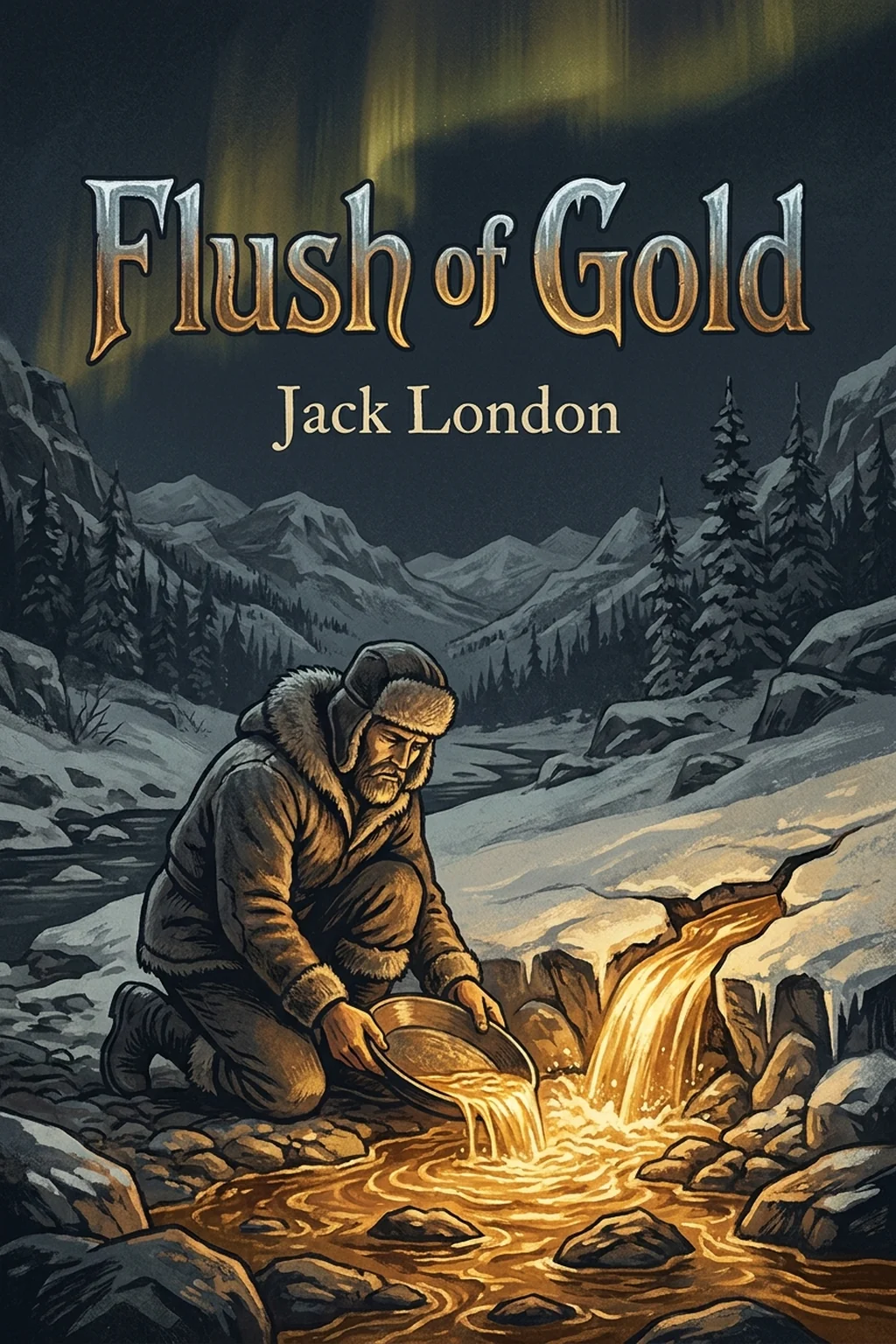
Flush of Gold
Flush of Gold
Lon McFane was a bit grumpy, what of losing his tobacco pouch, or else he might have told me, before we got to it, something about the cabin at Surprise Lake. All day, turn and turn about, we had spelled each other at going to the fore and breaking trail for the dogs. It was heavy snowshoe work, and did not tend to make a man voluble, yet Lon McFane might have found breath enough at noon, when we stopped to boil coffee, with which to tell me. But he didn't. Surprise Lake? it was Surprise Cabin to me. I had never heard of it before. I confess I was a bit tired. I had been looking for Lon to stop and make camp any time for an hour; but I had too much pride to suggest making camp or to ask him his intentions; and yet he was my man, lured at a handsome wage to mush my dogs for me and to obey my commands. I guess I was a bit grumpy myself. He said nothing, and I was resolved to ask nothing, even if we tramped on all night.
··“”
We came upon the cabin abruptly. For a week of trail we had met no one, and, in my mind, there had been little likelihood of meeting any one for a week to come. And yet there it was, right before my eyes, a cabin, with a dim light in the window and smoke curling up from the chimney.
"Why didn't you tell me—” I began, but was interrupted by Lon, who muttered—
“——”
"Surprise Lake—it lies up a small feeder half a mile on. It's only a pond.”
“——”
"Yes, but the cabin—who lives in it?”
“——”
"A woman," was the answer, and the next moment Lon had rapped on the door, and a woman's voice bade him enter.
“”
"Have you seen Dave recently?" she asked.
“”
"Nope," Lon answered carelessly. "I've been in the other direction, down Circle City way. Dave's up Dawson way, ain't he?”
“”“”
The woman nodded, and Lon fell to unharnessing the dogs, while I unlashed the sled and carried the camp outfit into the cabin. The cabin was a large, one-room affair, and the woman was evidently alone in it. She pointed to the stove, where water was already boiling, and Lon set about the preparation of supper, while I opened the fish-bag and fed the dogs. I looked for Lon to introduce us, and was vexed that he did not, for they were evidently old friends.
"You are Lon McFane, aren't you?” I heard her ask him. "Why, I remember you now. The last time I saw you it was on a steamboat, wasn't it? I remember...”
“·”“……”
Her speech seemed suddenly to be frozen by the spectacle of dread which, I knew, from the tenor I saw mounting in her eyes, must be on her inner vision. To my astonishment, Lon was affected by her words and manner. His face showed desperate, for all his voice sounded hearty and genial, as he said—
"The last time we met was at Dawson, Queen's Jubilee, or Birthday, or something—don't you remember?—the canoe races in the river, and the obstacle races down the main street?”
“————”
The terror faded out of her eyes and her whole body relaxed. "Oh, yes, I do remember," she said. "And you won one of the canoe races."
“”“”
"How's Dave been makin' it lately? Strikin' it as rich as ever, I suppose?" Lon asked, with apparent irrelevance.
“”
She smiled and nodded, and then, noticing that I had unlashed the bed roll, she indicated the end of the cabin where I might spread it. Her own bunk, I noticed, was made up at the opposite end.
"I thought it was Dave coming when I heard your dogs," she said.
“”
After that she said nothing, contenting herself with watching Lon's cooking operations, and listening the while as for the sound of dogs along the trail. I lay back on the blankets and smoked and watched. Here was mystery; I could make that much out, but no more could I make out. Why in the deuce hadn't Lon given me the tip before we arrived? I looked at her face, unnoticed by her, and the longer I looked the harder it was to take my eyes away. It was a wonderfully beautiful face, unearthly, I may say, with a light in it or an expression or something "that was never on land or sea." Fear and terror had completely vanished, and it was a placidly beautiful face—if by "placid" one can characterize that intangible and occult something that I cannot say was a radiance or a light any more than I can say it was an expression.
“”——“”
Abruptly, as if for the first time, she became aware of my presence.
"Have you seen Dave recently?" she asked me. It was on the tip of my tongue to say "Dave who?" when Lon coughed in the smoke that arose from the sizzling bacon. The bacon might have caused that cough, but I took it as a hint and left my question unasked. "No, I haven't," I answered. "I'm new in this part of the country—”
“”“”“”“——”
"But you don't mean to say," she interrupted, "that you've never heard of Dave—of Big Dave Walsh?”
“”“——·”
"You see," I apologised, "I'm new in the country. I've put in most of my time in the Lower Country, down Nome way.”
“”“”
"Tell him about Dave," she said to Lon.
“”
Lon seemed put out, but he began in that hearty, genial manner that I had noticed before. It seemed a shade too hearty and genial, and it irritated me.
"Oh, Dave is a fine man," he said. "He's a man, every inch of him, and he stands six feet four in his socks. His word is as good as his bond. The man lies who ever says Dave told a lie, and that man will have to fight with me, too, as well—if there's anything left of him when Dave gets done with him. For Dave is a fighter. Oh, yes, he's a scrapper from way back. He got a grizzly with a '38 popgun. He got clawed some, but he knew what he was doin’. He went into the cave on purpose to get that grizzly. 'Fraid of nothing. Free an' easy with his money, or his last shirt an' match when out of money. Why, he drained Surprise Lake here in three weeks an' took out ninety thousand, didn't he?” She flushed and nodded her head proudly. Through his recital she had followed every word with keenest interest. "An' I must say," Lon went on, "that I was disappointed sore on not meeting Dave here to-night.”
“”“——”“”“”
Lon served supper at one end of the table of whip-sawed spruce, and we fell to eating. A howling of the dogs took the woman to the door. She opened it an inch and listened.
"Where is Dave Walsh?" I asked, in an undertone.
“·”
"Dead," Lon answered. "In hell, maybe. I don't know. Shut up.”
“”“”
"But you just said that you expected to meet him here to-night," I challenged.
“”
"Oh, shut up, can't you," was Lon's reply, in the same cautious undertone.
“”
The woman had closed the door and was returning, and I sat and meditated upon the fact that this man who told me to shut up received from me a salary of two hundred and fifty dollars a month and his board.
——
Lon washed the dishes, while I smoked and watched the woman. She seemed more beautiful than ever—strangely and weirdly beautiful, it is true. After looking at her steadfastly for five minutes, I was compelled to come back to the real world and to glance at Lon McFane. This enabled me to know, without discussion, that the woman, too, was real. At first I had taken her for the wife of Dave Walsh; but if Dave Walsh were dead, as Lon had said, then she could be only his widow.
——···
It was early to bed, for we faced a long day on the morrow; and as Lon crawled in beside me under the blankets, I ventured a question.
"That woman's crazy, isn't she?”
“”
"Crazy as a loon," he answered.
“”
And before I could formulate my next question, Lon McFane, I swear, was off to sleep. He always went to sleep that way—just crawled into the blankets, closed his eyes, and was off, a demure little heavy breathing rising on the air. Lon never snored.
·——
And in the morning it was quick breakfast, feed the dogs, load the sled, and hit the trail. We said good-bye as we pulled out, and the woman stood in the doorway and watched us off. I carried the vision of her unearthly beauty away with me, just under my eyelids, and all I had to do, any time, was to close them and see her again. The way was unbroken, Surprise Lake being far off the travelled trails, and Lon and I took turn about at beating down the feathery snow with our big, webbed shoes so that the dogs could travel. "But you said you expected to meet Dave Walsh at the cabin," trembled on the tip of my tongue a score of times. I did not utter it. I could wait until we knocked off in the middle of the day. And when the middle of the day came, we went right on, for, as Lon explained, there was a camp of moose hunters at the forks of the Teelee, and we could make there by dark. But we didn't make there by dark, for Bright, the lead-dog, broke his shoulder-blade, and we lost an hour over him before we shot him. Then, crossing a timber jam on the frozen bed of the Teelee, the sled suffered a wrenching capsize, and it was a case of make camp and repair the runner. I cooked supper and fed the dogs while Lon made the repairs, and together we got in the night's supply of ice and firewood. Then we sat on our blankets, our moccasins steaming on upended sticks before the fire, and had our evening smoke.
“·”“”
"You didn't know her?" Lon queried suddenly. I shook my head.
“”
"You noticed the colour of her hair and eyes and her complexion, well, that's where she got her name—she was like the first warm glow of a golden sunrise. She was called Flush of Gold. Ever heard of her?”
“——”
Somewhere I had a confused and misty remembrance of having heard the name, yet it meant nothing to me. "Flush of Gold," I repeated; "sounds like the name of a dance-house girl.” Lon shook his head. "No, she was a good woman, at least in that sense, though she sinned greatly just the same."
——“”“”“”
"But why do you speak always of her in the past tense, as though she were dead?"
“”
"Because of the darkness on her soul that is the same as the darkness of death. The Flush of Gold that I knew, that Dawson knew, and that Forty Mile knew before that, is dead. That dumb, lunatic creature we saw last night was not Flush of Gold."
“”
"And Dave?" I queried.
“”
"He built that cabin," Lon answered, "He built it for her… and for himself. He is dead. She is waiting for him there. She half believes he is not dead. But who can know the whim of a crazed mind? Maybe she wholly believes he is not dead. At any rate, she waits for him there in the cabin he built. Who would rouse the dead? Then who would rouse the living that are dead? Not I, and that is why I let on to expect to meet Dave Walsh there last night. I'll bet a stack that I'da been more surprised than she if I had met him there last night.”
“”“……·”
"I do not understand," I said. "Begin at the beginning, as a white man should, and tell me the whole tale."
“”“”
And Lon began. "Victor Chauvet was an old Frenchman—born in the south of France. He came to California in the days of gold. He was a pioneer. He found no gold, but, instead, became a maker of bottled sunshine—in short, a grape-grower and wine-maker. Also, he followed gold excitements. That is what brought him to Alaska in the early days, and over the Chilcoot and down the Yukon long before the Carmack strike. The old town site of Ten Mile was Chauvet's. He carried the first mail into Arctic City. He staked those coal-mines on the Porcupine a dozen years ago. He grubstaked Loftus into the Nippennuck Country. Now it happened that Victor Chauvet was a good Catholic, loving two things in this world, wine and woman. Wine of all kinds he loved, but of woman, only one, and she was the mother of Marie Chauvet.”
“·————··”
Here I groaned aloud, having meditated beyond self-control over the fact that I paid this man two hundred and fifty dollars a month.
"What's the matter now?" he demanded.
“”
"Matter?"I complained. "I thought you were telling the story of Flush of Gold. I don't want a biography of your old French wine-bibber.”
“”“”
Lon calmly lighted his pipe, took one good puff, then put the pipe aside. "And you asked me to begin at the beginning," he said.
“”
"Yes," said I; "the beginning."
“”“”
"And the beginning of Flush of Gold is the old French wine-bibber, for he was the father of Marie Chauvet, and Marie Chauvet was the Flush of Gold. What more do you want? Victor Chauvet never had much luck to speak of. He managed to live, and to get along, and to take good care of Marie, who resembled the one woman he had loved. He took very good care of her. Flush of Gold was the pet name he gave her. Flush of Gold Creek was named after her—Flush of Gold town site, too. The old man was great on town sites, only he never landed them.
“···——
"Now, honestly," Lon said, with one of his lightning changes, "you've seen her, what do you think of her—of her looks, I mean? How does she strike your beauty sense?”
“”“——”
"She is remarkably beautiful," I said. "I never saw anything like her in my life. In spite of the fact, last night, that I guessed she was mad, I could not keep my eyes off of her. It wasn't curiosity. It was wonder, sheer wonder, she was so strangely beautiful.”
“”“”
"She was more strangely beautiful before the darkness fell upon her," Lon said softly. "She was truly the Flush of Cold. She turned all men's hearts...and heads. She recalls, with an effort, that I once won a canoe race at Dawson—I, who once loved her, and was told by her of her love for me. It was her beauty that made all men love her. She'd 'a’ got the apple from Paris, on application, and there wouldn't have been any Trojan War, and to top it off she'd have thrown Paris down. And now she lives in darkness, and she who was always fickle, for the first time is constant—and constant to a shade, to a dead man she does not realize is dead.
“”“……————
"And this is the way it was. You remember what I said last night of Dave Walsh—Big Dave Walsh? He was all that I said, and more, many times more. He came into this country in the late eighties—that's a pioneer for you. He was twenty years old then. He was a young bull. When he was twenty-five he could lift clear of the ground thirteen fifty-pound sacks of flour. At first, each fall of the year, famine drove him out. It was a lone land in those days. No river steamboats, no grub, nothing but salmon bellies and rabbit tracks. But after famine chased him out three years, he said he'd had enough of being chased; and the next year he stayed. He lived on straight meat when he was lucky enough to get it; he ate eleven dogs that winter; but he stayed. And the next winter he stayed, and the next. He never did leave the country again. He was a bull, a great bull. He could kill the strongest man in the country with hard work. He could outpack a Chilcat Indian, he could outpaddle a Stick, and he could travel all day with wet feet when the thermometer registered fifty below zero, and that's going some, I tell you, for vitality. You'd freeze your feet at twenty-five below if you wet them and tried to keep on.
“·——·——
"Dave Walsh was a bull for strength. And yet he was soft and easy-natured. Anybody could do him, the latest short-horn in camp could lie his last dollar out of him. 'But it doesn't worry me,' he had a way of laughing off his softness; 'it doesn't keep me awake nights.’ Now don't get the idea that he had no backbone. You remember about the bear he went after with the popgun. When it came to fighting Dave was the blamedest ever. He was the limit, if by that I may describe his unlimitedness when he got into action, he was easy and kind with the weak, but the strong had to give trail when he went by. And he was a man that men liked, which is the finest word of all, a man's man.
“·‘’,‘’
"Dave never took part in the big stampede to Dawson when Carmack made the Bonanza strike. You see, Dave was just then over on Mammon Creek strikin' it himself. He discovered Mammon Creek. Cleaned eighty-four thousand up that winter, and opened up the claim so that it promised a couple of hundred thousand for the next winter. Then, summer bein' on and the ground sloshy, he took a trip up the Yukon to Dawson to see what Carmack's strike looked like. And there he saw Flush of Gold. I remember the night. I shall always remember. It was something sudden, and it makes one shiver to think of a strong man with all the strength withered out of him by one glance from the soft eyes of a weak, blond, female creature like Flush of Gold. It was at her dad's cabin, old Victor Chauvet's. Some friend had brought Dave along to talk over town sites on Mammon Creek. But little talking did he do, and what he did was mostly gibberish. I tell you the sight of Flush of Gold had sent Dave clean daffy. Old Victor Chauvet insisted after Dave left that he had been drunk. And so he had. He was drunk, but Flush of Gold was the strong drink that made him so.
“··
"That settled it, that first glimpse he caught of her. He did not start back down the Yukon in a week, as he had intended. He lingered on a month, two months, all summer. And we who had suffered understood, and wondered what the outcome would be. Undoubtedly, in our minds, it seemed that Flush of Gold had met her master. And why not? There was romance sprinkled all over Dave Walsh. He was a Mammon King, he had made the Mammon Creek strike; he was an old sour dough, one of the oldest pioneers in the land—men turned to look at him when he went by, and said to one another in awed undertones, 'There goes Dave Walsh.' And why not? He stood six feet four; he had yellow hair himself that curled on his neck; and he was a bull—a yellow-maned bull just turned thirty-one.
“·——‘·’——
"And Flush of Gold loved him, and, having danced him through a whole summer's courtship, at the end their engagement was made known. The fall of the year was at hand, Dave had to be back for the winter's work on Mammon Creek, and Flush of Gold refused to be married right away. Dave put Dusky Burns in charge of the Mammon Creek claim, and himself lingered on in Dawson. Little use. She wanted her freedom a while longer; she must have it, and she would not marry until next year. And so, on the first ice, Dave Walsh went alone down the Yukon behind his dogs, with the understanding that the marriage would take place when he arrived on the first steamboat of the next year.
“··
"Now Dave was as true as the Pole Star, and she was as false as a magnetic needle in a cargo of loadstone. Dave was as steady and solid as she was fickle and fly-away, and in some way Dave, who never doubted anybody, doubted her. It was the jealousy of his love, perhaps, and maybe it was the message ticked off from her soul to his; but at any rate Dave was worried by fear of her inconstancy. He was afraid to trust her till the next year, he had so to trust her, and he was pretty well beside himself. Some of it I got from old Victor Chauvet afterwards, and from all that I have pieced together I conclude that there was something of a scene before Dave pulled north with his dogs. He stood up before the old Frenchman, with Flush of Gold beside him, and announced that they were plighted to each other. He was very dramatic, with fire in his eyes, old Victor said. He talked something about 'until death do us part'; and old Victor especially remembered that at one place Dave took her by the shoulder with his great paw and almost shook her as he said: 'Even unto death are you mine, and I would rise from the grave to claim you.' Old Victor distinctly remembered those words 'Even unto death are you mine, and I would rise from the grave to claim you.' And he told me afterwards that Flush of Gold was pretty badly frightened, and that he afterwards took Dave to one side privately and told him that that wasn't the way to hold Flush of Gold—that he must humour her and gentle her if he wanted to keep her.
“·‘’‘’‘’——
"There is no discussion in my mind but that Flush of Gold was frightened. She was a savage herself in her treatment of men, while men had always treated her as a soft and tender and too utterly-utter something that must not be hurt. She didn't know what harshness was...until Dave Walsh, standing his six feet four, a big bull, gripped her and pawed her and assured her that she was his until death, and then some. And besides, in Dawson, that winter, was a music-player—one of those macaroni-eating, greasy-tenor-Eye-talian-dago propositions—and Flush of Gold lost her heart to him. Maybe it was only fascination—I don't know. Sometimes it seems to me that she really did love Dave Walsh. Perhaps it was because he had frightened her with that even-unto-death, rise-from-the-grave stunt of his that she in the end inclined to the dago music-player. But it is all guesswork, and the facts are, sufficient. He wasn't a dago; he was a Russian count—this was straight; and he wasn't a professional piano-player or anything of the sort. He played the violin and the piano, and he sang—sang well—but it was for his own pleasure and for the pleasure of those he sang for. He had money, too—and right here let me say that Flush of Gold never cared a rap for money. She was fickle, but she was never sordid.
“……·——————·‘’————————
"But to be getting along. She was plighted to Dave, and Dave was coming up on the first steamboat to get her—that was the summer of '98, and the first steamboat was to be expected the middle of June. And Flush of Gold was afraid to throw Dave down and face him afterwards. It was all planned suddenly. The Russian music-player, the Count, was her obedient slave. She planned it, I know. I learned as much from old Victor afterwards. The Count took his orders from her, and caught that first steamboat down. It was the Golden Rocket. And so did Flush of Gold catch it. And so did I. I was going to Circle City, and I was flabbergasted when I found Flush of Gold on board. I didn't see her name down on the passenger list. She was with the Count fellow all the time, happy and smiling, and I noticed that the Count fellow was down on the list as having his wife along. There it was, stateroom, number, and all. The first I knew that he was married, only I didn't see anything of the wife...unless Flush of Gold was so counted. I wondered if they'd got married ashore before starting. There'd been talk about them in Dawson, you see, and bets had been laid that the Count fellow had cut Dave out.
“——……
"I talked with the purser. He didn't know anything more about it than I did; he didn't know Flush of Gold, anyway, and besides, he was almost rushed to death. You know what a Yukon steamboat is, but you can't guess what the Golden Rocket was when it left Dawson that June of 1898. She was a hummer. Being the first steamer out, she carried all the scurvy patients and hospital wrecks. Then she must have carried a couple of millions of Klondike dust and nuggets, to say nothing of a packed and jammed passenger list, deck passengers galore, and bucks and squaws and dogs without end. And she was loaded down to the guards with freight and baggage. There was a mountain of the same on the fore-lower-deck, and each little stop along the way added to it. I saw the box come aboard at Teelee Portage, and I knew it for what it was, though I little guessed the joker that was in it. And they piled it on top of everything else on the fore-lower-deck, and they didn't pile it any too securely either. The mate expected to come back to it again, and then forgot about it. I thought at the time that there was something familiar about the big husky dog that climbed over the baggage and freight and lay down next to the box. And then we passed the Glendale, bound up for Dawson. As she saluted us, I thought of Dave on board of her and hurrying to Dawson to Flush of Gold. I turned and looked at her where she stood by the rail. Her eyes were bright, but she looked a bit frightened by the sight of the other steamer, and she was leaning closely to the Count fellow as for protection. She needn't have leaned so safely against him, and I needn't have been so sure of a disappointed Dave Walsh arriving at Dawson. For Dave Walsh wasn't on the Glendale. There were a lot of things I didn't know, but was soon to know—for instance, that the pair were not yet married. Inside half an hour preparations for the marriage took place. What of the sick men in the main cabin, and of the crowded condition of the Golden Rocket, the likeliest place for the ceremony was found forward, on the lower deck, in an open space next to the rail and gang-plank and shaded by the mountain of freight with the big box on top and the sleeping dog beside it. There was a missionary on board, getting off at Eagle City, which was the next step, so they had to use him quick. That's what they'd planned to do, get married on the boat.
“——··——
"But I've run ahead of the facts. The reason Dave Walsh wasn't on the Glendale was because he was on the Golden Rocket. It was this way. After loiterin' in Dawson on account of Flush of Gold, he went down to Mammon Creek on the ice. And there he found Dusky Burns doing so well with the claim, there was no need for him to be around. So he put some grub on the sled, harnessed the dogs, took an Indian along, and pulled out for Surprise Lake. He always had a liking for that section. Maybe you don't know how the creek turned out to be a four-flusher; but the prospects were good at the time, and Dave proceeded to build his cabin and hers. That's the cabin we slept in. After he finished it, he went off on a moose hunt to the forks of the Teelee, takin' the Indian along.
“··
"And this is what happened. Came on a cold snap. The juice went down forty, fifty, sixty below zero. I remember that snap—I was at Forty Mile; and I remember the very day. At eleven o'clock in the morning the spirit thermometer at the N.A.T.& T. Company's store went down to seventy-five below zero. And that morning, near the forks of the Teelee, Dave Walsh was out after moose with that blessed Indian of his. I got it all from the Indian afterwards—we made a trip over the ice together to Dyea. That morning Mr. Indian broke through the ice and wet himself to the waist. Of course he began to freeze right away. The proper thing was to build a fire. But Dave Walsh was a bull. It was only half a mile to camp, where a fire was already burning. What was the good of building another? He threw Mr. Indian over his shoulder—and ran with him—half a mile—with the thermometer at seventy-five below. You know what that means. Suicide. There's no other name for it. Why, that buck Indian weighed over two hundred himself, and Dave ran half a mile with him. Of course he froze his lungs. Must have frozen them near solid. It was a tomfool trick for any man to do. And anyway, after lingering horribly for several weeks, Dave Walsh died.
“——N.A.T.&T.·——·——————·
"The Indian didn't know what to do with the corpse. Ordinarily he'd have buried him and let it go at that. But he knew that Dave Walsh was a big man, worth lots of money, a hi-yu skookum chief. Likewise he'd seen the bodies of other hi-yu skookums carted around the country like they were worth something. So he decided to take Dave's body to Forty Mile, which was Dave's headquarters. You know how the ice is on the grass roots in this country—well, the Indian planted Dave under a foot of soil—in short, he put Dave on ice. Dave could have stayed there a thousand years and still been the same old Dave. You understand—just the same as a refrigerator. Then the Indian brings over a whipsaw from the cabin at Surprise Lake and makes lumber enough for the box. Also, waiting for the thaw, he goes out and shoots about ten thousand pounds of moose. This he keeps on ice, too. Came the thaw. The Teelee broke. He built a raft and loaded it with the meat, the big box with Dave inside, and Dave's team of dogs, and away they went down the Teelee.
“·——————
"The raft got caught on a timber jam and hung up two days. It was scorching hot weather, and Mr. Indian nearly lost his moose meat. So when he got to Teelee Portage he figured a steamboat would get to Forty Mile quicker than his raft. He transferred his cargo, and there you are, fore-lower deck of the Golden Rocket, Flush of Gold being married, and Dave Walsh in his big box casting the shade for her. And there's one thing I clean forgot. No wonder I thought the husky dog that came aboard at Teelee Portage was familiar. It was Pee-lat, Dave Walsh's lead-dog and favourite—a terrible fighter, too. He was lying down beside the box.
“·——
"Flush of Gold caught sight of me, called me over, shook hands with me, and introduced me to the Count. She was beautiful. I was as mad for her then as ever. She smiled into my eyes and said I must sign as one of the witnesses. And there was no refusing her. She was ever a child, cruel as children are cruel. Also, she told me she was in possession of the only two bottles of champagne in Dawson—or that had been in Dawson the night before; and before I knew it I was scheduled to drink her and the Count's health. Everybody crowded round, the captain of the steamboat, very prominent, trying to ring in on the wine, I guess. It was a funny wedding. On the upper deck the hospital wrecks, with various feet in the grave, gathered and looked down to see. There were Indians all jammed in the circle, too, big bucks, and their squaws and kids, to say nothing of about twenty-five snarling wolf-dogs. The missionary lined the two of them up and started in with the service. And just then a dog-fight started, high up on the pile of freight—Pee-lat lying beside the big box, and a white-haired brute belonging to one of the Indians. The fight wasn't explosive at all. The brutes just snarled at each other from a distance—tapping at each other long-distance, you know, saying dast and dassent, dast and dassent. The noise was rather disturbing, but you could hear the missionary's voice above it.
“——————
"There was no particularly easy way of getting at the two dogs, except from the other side of the pile. But nobody was on that side—everybody watching the ceremony, you see. Even then everything might have been all right if the captain hadn't thrown a club at the dogs. That was what precipitated everything. As I say, if the captain hadn't thrown that club, nothing might have happened.
“——
"The missionary had just reached the point where he was saying 'In sickness and in health,' and 'Until death do us part.' And just then the captain threw the club. I saw the whole thing. It landed on Pee-lat, and at that instant the white brute jumped him. The club caused it. Their two bodies struck the box, and it began to slide, its lower end tilting down. It was a long oblong box, and it slid down slowly until it reached the perpendicular, when it came down on the run. The onlookers on that side the circle had time to get out from under. Flush of Gold and the Count, on the opposite side of the circle, were facing the box; the missionary had his back to it. The box must have fallen ten feet straight up and down, and it hit end on.
“‘’‘’
"Now mind you, not one of us knew that Dave Walsh was dead. We thought he was on the Glendale, bound for Dawson. The missionary had edged off to one side, and so Flush of Gold faced the box when it struck. It was like in a play. It couldn't have been better planned. It struck on end, and on the right end; the whole front of the box came off; and out swept Dave Walsh on his feet, partly wrapped in a blanket, his yellow hair flying and showing bright in the sun. Right out of the box, on his feet, he swept upon Flush of Gold. She didn't know he was dead, but it was unmistakable, after hanging up two days on a timber jam, that he was rising all right from the dead to claim her. Possibly that is what she thought. At any rate, the sight froze her. She couldn't move. She just sort of wilted and watched Dave Walsh coming for her! And he got her. It looked almost as though he threw his arms around her, but whether or not this happened, down to the deck they went together. We had to drag Dave Walsh's body clear before we could get hold of her. She was in a faint, but it would have been just as well if she had never come out of that faint; for when she did, she fell to screaming the way insane people do. She kept it up for hours, till she was exhausted. Oh, yes, she recovered. You saw her last night, and know how much recovered she is. She is not violent, it is true, but she lives in darkness. She believes that she is waiting for Dave Walsh, and so she waits in the cabin he built for her. She is no longer fickle. It is nine years now that she has been faithful to Dave Walsh, and the outlook is that she'll be faithful to him to the end.”
“·····”
Lon McFane pulled down the top of the blankets and prepared to crawl in.
·
"We have her grub hauled to her each year," he added, "and in general keep an eye on her. Last night was the first time she ever recognized me, though."
“”“”
"Who are the we?" I asked.
“”
"Oh," was the answer, "the Count and old Victor Chauvet and me. Do you know, I think the Count is the one to be really sorry for. Dave Walsh never did know that she was false to him. And she does not suffer. Her darkness is merciful to her."
“”“·”·”
I lay silently under the blankets for the space of a minute.
"Is the Count still in the country?" I asked.
“”
But there was a gentle sound of heavy breathing, and I knew Lon McFane was asleep.
·
In the Forest of the North
A weary journey beyond the last scrub timber and straggling copses, into the heart of the Barrens where the niggard North is supposed to deny the Earth, are to be found great sweeps of forests and stretches of smiling land. But this the world is just beginning to know. The world's explorers have known it, from time to time, but hitherto they have never returned to tell the world.
The Barrens—well, they are the Barrens, the bad lands of the Arctic, the deserts of the Circle, the bleak and bitter home of the musk-ox and the lean plains wolf. So Avery Van Brunt found them, treeless and cheerless, sparsely clothed with moss and lichens, and altogether uninviting. At least so he found them till he penetrated to the white blank spaces on the map, and came upon undreamed-of rich spruce forests and unrecorded Eskimo tribes. It had been his intention, (and his bid for fame), to break up these white blank spaces and diversify them with the black markings of mountain-chains, sinks and basins, and sinuous river courses; and it was with added delight that he came to speculate upon the possibilities of timber belts and native villages.
——·
Avery Van Brunt, or, in full distinction, Professor A. Van Brunt of the Geological Survey, was second in command of the expedition, and first in command of the sub-expedition which he had led on a side tour of some half a thousand miles up one of the branches of the Thelon and which he was now leading into one of his unrecorded villages. At his back plodded eight men, two of them French-Canadian voyageurs, and the remainder strapping Crees from Manitoba-way. He, alone, was full-blooded Saxon, and his blood was pounding fiercely through his veins to the traditions of his race. Clive and Hastings, Drake and Raleigh, Hengest and Horsa, walked with him. First of all men of his breed was he to enter this lone Northland village, and at the thought an exultancy came upon him, an exaltation, and his followers noted that his leg-weariness fell from him and that he insensibly quickened the pace.
··
The village emptied itself, and a motley crowd trooped out to meet him, men in the forefront, with bows and spears clutched menacingly, and women and children faltering timidly in the rear. Van Brunt lifted his right arm and made the universal peace sign, a sign which all peoples know, and the villagers answered in peace. But to his chagrin, a skin-clad man ran forward and thrust out his hand with a familiar "Hello." He was a bearded man, with cheeks and brow bronzed to copper-brown, and in him Van Brunt knew his kind.
“”
"Who are you?" he asked, gripping the extended hand. "Andrée?”
“”“”
"Who's Andrée?" the man asked back.
“”
Van Brunt looked at him more sharply. "By George, you've been here some time.”
“”
"Five years," the man answered, a dim flicker of pride in his eyes. "But come on, let's talk.”
“”“”
"Let them camp alongside of me," he answered Van Brunt's glance at his party. "Old Tantlatch will take care of them. Come on."
“”“”
He swung off in a long stride, Van Brunt following at his heels through the village. In irregular fashion, wherever the ground favored, the lodges of moose hide were pitched. Van Brunt ran his practised eye over them and calculated.
"Two hundred, not counting the young ones," he summed up.
“”
The man nodded. "Pretty close to it. But here's where I live, out of the thick of it, you know—more privacy and all that. Sit down. I'll eat with you when your men get something cooked up. I've forgotten what tea tastes like.... Five years and never a taste or smell.... Any tobacco?... Ah, thanks, and a pipe? Good. Now for a fire-stick and we'll see if the weed has lost its cunning.”
“——………………”
He scratched the match with the painstaking care of the woodsman, cherished its young flame as though there were never another in all the world, and drew in the first mouthful of smoke. This he retained meditatively for a time, and blew out through his pursed lips slowly and caressingly. Then his face seemed to soften as he leaned back, and a soft blur to film his eyes. He sighed heavily, happily, with immeasurable content, and then said suddenly:
"God! But that tastes good!"
“”
Van Brunt nodded sympathetically. "Five years, you say?"
“”
"Five years." The man sighed again. "And you, I presume, wish to know about it, being naturally curious, and this a sufficiently strange situation, and all that. But it's not much. I came in from Edmonton after musk-ox, and like Pike and the rest of them, had my mischances, only I lost my party and outfit. Starvation, hardship, the regular tale, you know, sole survivor and all that, till I crawled into Tantlatch's, here, on hand and knee.”
“”“
"Five years," Van Brunt murmured retrospectively, as though turning things over in his mind.
“”
"Five years on February last. I crossed the Great Slave early in May—”
“——”
"And you are...Fairfax?" Van Brunt interjected.
“……”
The man nodded.
"Let me see...John, I think it is, John Fairfax."
“……·”
"How did you know?" Fairfax queried lazily, half-absorbed in curling smoke-spirals upward in the quiet air.
“”
"The papers were full of it at the time. Prevanche—”
“——”
"Prevanche!" Fairfax sat up, suddenly alert. "He was lost in the Smoke Mountains."
“”“”
"Yes, but he pulled through and came out."
“”
Fairfax settled back again and resumed his smoke-spirals. "I am glad to hear it," he remarked reflectively. "Prevanche was a bully fellow if he did have ideas about head-straps, the beggar. And he pulled through? Well, I'm glad.”
“”“”
Five years...the phrase drifted recurrently through Van Brunt's thought, and somehow the face of Emily Southwaithe seemed to rise up and take form before him. Five years... A wedge of wild-fowl honked low overhead and at sight of the encampment veered swiftly to the north into the smouldering sun. Van Brunt could not follow them. He pulled out his watch. It was an hour past midnight. The northward clouds flushed bloodily, and rays of sombre-red shot southward, firing the gloomy woods with a lurid radiance. The air was in breathless calm, not a needle quivered, and the least sounds of the camp were distinct and clear as trumpet calls. The Crees and voyageurs felt the spirit of it and mumbled in dreamy undertones, and the cook unconsciously subdued the clatter of pot and pan. Somewhere a child was crying, and from the depths of the forest, like a silver thread, rose a woman's voice in mournful chant: "O-o-o-o-o-o-a-haa-ha-a-ha-aa-a-a, O-o-o-o-o-o-a-ha-a-ha-a.”
……·……“……………………”
Van Brunt shivered and rubbed the backs of his hands briskly.
"And they gave me up for dead?" his companion asked slowly.
“”
"Well, you never came back, so your friends—”
“——”
"Promptly forgot." Fairfax laughed harshly, defiantly.
“”
"Why didn't you come out?”
“”
"Partly disinclination, I suppose, and partly because of circumstances over which I had no control. You see, Tantlatch, here, was down with a broken leg when I made his acquaintance,—a nasty fracture,—and I set it for him and got him into shape. I stayed some time, getting my strength back. I was the first white man he had seen, and of course I seemed very wise and showed his people no end of things. Coached them up in military tactics, among other things, so that they conquered the four other tribal villages, (which you have not yet seen), and came to rule the land. And they naturally grew to think a good deal of me, so much so that when I was ready to go they wouldn't hear of it. Were most hospitable, in fact. Put a couple of guards over me and watched me day and night. And then Tantlatch offered me inducements,—in a sense, inducements,—so to say, and as it didn't matter much one way or the other, I reconciled myself to remaining.”
“————————”
"I knew your brother at Freiburg. I am Van Brunt."
“”
Fairfax reached forward impulsively and shook his hand. "You were Billy's friend, eh? Poor Billy! He spoke of you often.”
“”
"Rum meeting place, though," he added, casting an embracing glance over the primordial landscape and listening for a moment to the woman's mournful notes. "Her man was clawed by a bear, and she's taking it hard.”
“”“”
"Beastly life!" Van Brunt grimaced his disgust. "I suppose, after five years of it, civilization will be sweet? What do you say?"
“”“”
Fairfax's face took on a stolid expression. "Oh, I don't know. At least they're honest folk and live according to their lights. And then they are amazingly simple. No complexity about them, no thousand and one subtle ramifications to every single emotion they experience. They love, fear, hate, are angered, or made happy, in common, ordinary, and unmistakable terms. It may be a beastly life, but at least it is easy to live. No philandering, no dallying. If a woman likes you, she'll not be backward in telling you so. If she hates you, she'll tell you so, and then, if you feel inclined, you can beat her, but the thing is, she knows precisely what you mean, and you know precisely what she means. No mistakes, no misunderstandings. It has its charm, after civilization's fitful fever. Comprehend?”
“”
"No, it's a pretty good life," he continued, after a pause; "good enough for me, and I intend to stay with it."
“”“”
Van Brunt lowered his head in a musing manner, and an imperceptible smile played on his mouth. No philandering, no dallying, no misunderstanding. Fairfax also was taking it hard, he thought, just because Emily Southwaithe had been mistakenly clawed by a bear. And not a bad sort of a bear, either, was Carlton Southwaithe.
··
"But you are coming along with me," Van Brunt said deliberately.
“”
"No, I'm not.”
“”
"Yes, you are."
“”
"Life's too easy here, I tell you." Fairfax spoke with decision. "I understand everything, and I am understood. Summer and winter alternate like the sun flashing through the palings of a fence, the seasons are a blur of light and shade, and time slips by, and life slips by, and then...a wailing in the forest, and the dark. Listen!"
“”“……”
He held up his hand, and the silver thread of the woman's sorrow rose through the silence and the calm. Fairfax joined in softly.
"O-o-o-o-o-o-a-haa-ha-a-ha-aa-a-a, O-o-o-o-o-o-a-ha-a-ha-a," he sang. "Can't you hear it? Can't you see it? The women mourning.—the funeral chant.—my hair white-locked and patriarchal.—my skins wrapped in rude splendor about me.—my hunting-spear by my side. And who shall say it is not well?”
“……………………”“————————”
Van Brunt looked at him coolly. "Fairfax, you are a damned fool. Five years of this is enough to knock any man, and you are in an unhealthy, morbid condition. Further, Carlton Southwaithe is dead."
“·”
Van Brunt filled his pipe and lighted it, the while watching slyly and with almost professional interest. Fairfax's eyes flashed on the instant, his fists clenched, he half rose up, then his muscles relaxed and he seemed to brood. Michael, the cook, signalled that the meal was ready, but Van Brunt motioned back to delay. The silence hung heavy, and he fell to analyzing the forest scents, the odors of mould and rotting vegetation, the resiny smells of pine cones and needles, the aromatic savors of many camp-smokes. Twice Fairfax looked up, but said nothing, and then:
"And...Emily...?"
“…………?"
"Three years a widow; still a widow."
“”
Another long silence settled down, to be broken by Fairfax finally with a naïve smile. "I guess you're right, Van Brunt. I'll go along.”
“”
"I knew you would." Van Brunt laid his hand on Fairfax's shoulder. "Of course, one cannot know, but I imagine—for one in her position—she has had offers—”
“”“——————”
"When do you start?" Fairfax interrupted.
“”
"After the men have had some sleep. Which reminds me, Michael is getting angry, so come and eat."
“”
After supper, when the Crees and voyageurs had rolled into their blankets, snoring, the two men lingered by the dying fire. There was much to talk about,—wars and politics and explorations, the doings of men and the happening of things, mutual friends, marriages, deaths,—five years of history for which Fairfax clamored.
————
"So the Spanish fleet was bottled up in Santiago," Van Brunt was saying, when a young woman stepped lightly before him and stood by Fairfax's side. She looked swiftly into his face, then turned a troubled gaze upon Van Brunt.
“”
"Chief Tantlatch's daughter, sort of princess," Fairfax explained, with an honest flush. "One of the inducements, in short, to make me stay. Thom, this is Van Brunt, friend of mine."
“”“”
Van Brunt held out his hand, but the woman maintained a rigid repose quite in keeping with her general appearance. Not a line of her face softened, not a feature unbent. She looked him straight in the eyes, her own piercing, questioning, searching.
"Precious lot she understands," Fairfax laughed. "Her first introduction, you know. But as you were saying, with the Spanish fleet bottled up in Santiago?"
“”“”
Thom crouched down by her husband's side, motionless as a bronze statue, only her eyes flashing from face to face in ceaseless search. And Avery Van Brunt, as he talked on and on, felt a nervousness under the dumb gaze. In the midst of his most graphic battle descriptions, he would become suddenly conscious of the black eyes burning into him, and would stumble and flounder till he could catch the gait and go again. Fairfax, hands clasped round knees, pipe out, absorbed, spurred him on when he lagged, and repictured the world he thought he had forgotten.
·
One hour passed, and two, and Fairfax rose reluctantly to his feet. "And Cronje was cornered, eh? Well, just wait a moment till I run over to Tantlatch. He'll be expecting you, and I'll arrange for you to see him after breakfast. That will be all right, won't it?”
“””
He went off between the pines, and Van Brunt found himself staring into Thom's warm eyes. Five years, he mused, and she can't be more than twenty now. A most remarkable creature. Being Eskimo, she should have a little flat excuse for a nose, and lo, it is neither broad nor flat, but aquiline, with nostrils delicately and sensitively formed as any fine lady's of a whiter breed—the Indian strain somewhere, be assured, Avery Van Brunt. And, Avery Van Brunt, don't be nervous, she won't eat you; she's only a woman, and not a bad-looking one at that. Oriental rather than aborigine. Eyes large and fairly wide apart, with just the faintest hint of Mongol obliquity. Thom, you're an anomaly. You're out of place here among these Eskimos, even if your father is one. Where did your mother come from? or your grandmother? And Thom, my dear, you're a beauty, a frigid, frozen little beauty with Alaskan lava in your blood, and please don't look at me that way.
——·
He laughed and stood up. Her insistent stare disconcerted him. A dog was prowling among the grub-sacks. He would drive it away and place them into safety against Fairfax's return. But Thom stretched out a detaining hand and stood up, facing him.
"You?" she said, in the Arctic tongue which differs little from Greenland to Point Barrow. "You?"
“”“”
And the swift expression of her face demanded all for which "you" stood, his reason for existence, his presence there, his relation to her husband—everything.
“”——
"Brother," he answered in the same tongue, with a sweeping gesture to the south. "Brothers we be, your man and I."
“”“”
She shook her head. "It is not good that you be here."
“”
"After one sleep I go."
“”
"And my man?" she demanded, with tremulous eagerness.
“”
Van Brunt shrugged his shoulders. He was aware of a certain secret shame, of an impersonal sort of shame, and an anger against Fairfax. And he felt the warm blood in his face as he regarded the young savage. She was just a woman. That was all—a woman. The whole sordid story over again, over and over again, as old as Eve and young as the last new love-light.
——
"My man! My man! My man!" she was reiterating vehemently, her face passionately dark, and the ruthless tenderness of the Eternal Woman, the Mate-Woman, looking out at him from her eyes.
“”
"Thom," he said gravely, in English, "you were born in the Northland forest, and you have eaten fish and meat, and fought with frost and famine, and lived simply all the days of your life. And there are many things, indeed not simple, which you do not know and cannot come to understand. You do not know what it is to long for the fleshpots afar, you cannot understand what it is to yearn for a fair woman's face. And the woman is fair, Thom, the woman is nobly fair. You have been woman to this man, and you have been your all, but your all is very little, very simple. Too little and too simple, and he is an alien man. Him you have never known, you can never know. It is so ordained. You held him in your arms, but you never held his heart, this man with his blurring seasons and his dreams of a barbaric end. Dreams and dream-dust, that is what he has been to you. You clutched at form and gripped shadow, gave yourself to a man and bedded with the wraith of a man. In such manner, of old, did the daughters of men whom the gods found fair. And, Thom, Thom, I should not like to be John Fairfax in the night-watches of the years to come, in the night-watches, when his eyes shall see, not the sun-gloried hair of the woman by his side, but the dark tresses of a mate forsaken in the forests of the North.”
“”“·”
Though she did not understand, she had listened with intense attention, as though life hung on his speech. But she caught at her husband's name and cried out in Eskimo:—
"Yes! Yes! Fairfax! My man!"
“”
"Poor little fool, how could he be your man?"
“”
But she could not understand his English tongue, and deemed that she was being trifled with. The dumb, insensate anger of the Mate-Woman flamed in her face, and it almost seemed to the man as though she crouched panther-like for the spring.
He cursed softly to himself and watched the fire fade from her face and the soft luminous glow of the appealing woman spring up, of the appealing woman who foregoes strength and panoplies herself wisely in her weakness.
"He is my man," she said gently. "Never have I known other. It cannot be that I should ever know other. Nor can it be that he should go from me."
“”“”
"Who has said he shall go from thee?" he demanded sharply, half in exasperation, half in impotence.
“”
"It is for thee to say he shall not go from me," she answered softly, a half-sob in her throat.
“”
Van Brunt kicked the embers of the fire savagely and sat down.
"It is for thee to say. He is my man. Before all women he is my man. Thou art big, thou art strong, and behold, I am very weak. See, I am at thy feet. It is for thee to deal with me. It is for thee."
“”
"Get up!" He jerked her roughly erect and stood up himself. "Thou art a woman. Wherefore the dirt is no place for thee, nor the feet of any man."
“”“
"He is my man."
“”
"Then Jesus forgive all men!" Van Brunt cried out passionately.
“”
"He is my man," she repeated monotonously, beseechingly.
“”
"He is my brother," he answered.
“”
"My father is Chief Tantlatch. He is a power over five villages. I will see that the five villages be searched for thy choice of all maidens, that thou mayest stay here by thy brother, and dwell in comfort."
“”
"After one sleep I go."
“”
"And my man?"
“”
"Thy man comes now. Behold!"
“”
From among the gloomy spruces came the light carolling of Fairfax's voice.
As the day is quenched by a sea of fog, so his song smote the light out of her face. "It is the tongue of his own people," she said; "the tongue of his own people."
“”“”
She turned, with the free movement of a lithe young animal, and made off into the forest.
"It's all fixed," Fairfax called as he came up. "His regal highness will receive you after breakfast."
“”“”
"Have you told him?" Van Brunt asked.
“”
"No. Nor shall I tell him till we're ready to pull out.”
“”
Van Brunt looked with moody affection over the sleeping forms of his men.
"I shall be glad when we are a hundred leagues upon our way," he said.
“”
Thom raised the skin-flap of her father's lodge. Two men sat with him, and the three looked at her with swift interest. But her face betokened nothing as she entered and took seat quietly, without speech. Tantlatch drummed with his knuckles on a spear-heft across his knees, and gazed idly along the path of a sun-ray which pierced a lacing-hole and flung a glittering track across the murky atmosphere of the lodge. To his right, at his shoulder, crouched Chugungatte, the shaman. Both were old men, and the weariness of many years brooded in their eyes. But opposite them sat Keen, a young man and chief favorite in the tribe. He was quick and alert of movement, and his black eyes flashed from face to face in ceaseless scrutiny and challenge.
Silence reigned in the place. Now and again camp noises penetrated, and from the distance, faint and far, like the shadows of voices, came the wrangling of boys in thin shrill tones. A dog thrust his head into the entrance and blinked wolfishly at them for a space, the slaver dripping from his ivory-white fangs. After a time he growled tentatively, and then, awed by the immobility of the human figures, lowered his head and grovelled away backward. Tantlatch glanced apathetically at his daughter.
"And thy man, how is it with him and thee?"
“”
"He sings strange songs," Thom made answer, "and there is a new look on his face."
“”“”
"So? He hath spoken?"
“”
"Nay, but there is a new look on his face, a new light in his eyes, and with the New-Comer he sits by the fire, and they talk and talk, and the talk is without end.”
“”
Chugungatte whispered in his master's ear, and Keen leaned forward from his hips.
"There be something calling him from afar," she went on, "and he seems to sit and listen, and to answer, singing, in his own people's tongue.”
“”“”
Again Chugungatte whispered and Keen leaned forward, and Thom held her speech till her father nodded his head that she might proceed.
"It be known to thee, O Tantlatch, that the wild goose and the swan and the little ringed duck be born here in the low-lying lands. It be known that they go away before the face of the frost to unknown places. And it be known, likewise, that always do they return when the sun is in the land and the waterways are free. Always do they return to where they were born, that new life may go forth. The land calls to them and they come. And now there is another land that calls, and it is calling to my man,—the land where he was born,—and he hath it in mind to answer the call. Yet is he my man. Before all women is he my man.”
“————”
"Is it well, Tantlatch? Is it well?" Chugungatte demanded, with the hint of menace in his voice.
“”
"Ay, it is well!" Keen cried boldly. "The land calls to its children, and all lands call their children home again. As the wild goose and the swan and the little ringed duck are called, so is called this Stranger Man who has lingered with us and who now must go. Also there be the call of kind. The goose mates with the goose, nor does the swan mate with the little ringed duck. It is not well that the swan should mate with the little ringed duck. Nor is it well that stranger men should mate with the women of our villages. Wherefore I say the man should go, to his own kind, in his own land."
“”“”
"He is my own man," Thom answered, "and he is a great man."
“”“”
"Ay, he is a great man." Chugungatte lifted his head with a faint recrudescence of youthful vigor. "He is a great man, and he put strength in thy arm, O Tantlatch, and gave thee power, and made thy name to be feared in the land, to be feared and to be respected. He is very wise, and there be much profit in his wisdom. To him are we beholden for many things,—for the cunning in war and the secrets of the defence of a village and a rush in the forest, for the discussion in council and the undoing of enemies by word of mouth and the hard-sworn promise, for the gathering of game and the making of traps and the preserving of food, for the curing of sickness and mending of hurts of trail and fight. Thou, Tantlatch, wert a lame old man this day, were it not that the Stranger Man came into our midst and attended on thee. And ever, when in doubt on strange questions, have we gone to him, that out of his wisdom he might make things clear, and ever has he made things clear. And there be questions yet to arise, and needs upon his wisdom yet to come, and we cannot bear to let him go. It is not well that we should let him go.”
“”“——”
Tantlatch continued to drum on the spear-haft, and gave no sign that he had heard. Thom studied his face in vain, and Chugungatte seemed to shrink together and droop down as the weight of years descended upon him again.
"No man makes my kill." Keen smote his breast a valorous blow. "I make my own kill. I am glad to live when I make my own kill. When I creep through the snow upon the great moose, I am glad. And when I draw the bow, so, with my full strength, and drive the arrow fierce and swift and to the heart, I am glad. And the meat of no man's kill tastes as sweet as the meat of my kill. I am glad to live, glad in my own cunning and strength, glad that I am a doer of things, a doer of things for myself. Of what other reason to live than that? Why should I live if I delight not in myself and the things I do? And it is because I delight and am glad that I go forth to hunt and fish, and it is because I go forth to hunt and fish that I grow cunning and strong. The man who stays in the lodge by the fire grows not cunning and strong. He is not made happy in the eating of my kill, nor is living to him a delight. He does not live. And so I say it is well this Stranger Man should go. His wisdom does not make us wise. If he be cunning, there is no need that we be cunning. If need arise, we go to him for his cunning. We eat the meat of his kill, and it tastes unsweet. We merit by his strength, and in it there is no delight. We do not live when he does our living for us. We grow fat and like women, and we are afraid to work, and we forget how to do things for ourselves. Let the man go, O Tantlatch, that we may be men! I am Keen, a man, and I make my own kill!”
“”“”
Tantlatch turned a gaze upon him in which seemed the vacancy of eternity. Keen waited the decision expectantly; but the lips did not move, and the old chief turned toward his daughter.
"That which be given cannot be taken away," she burst forth. "I was but a girl when this Stranger Man, who is my man, came among us. And I knew not men, or the ways of men, and my heart was in the play of girls, when thou, Tantlatch, thou and none other, didst call me to thee and press me into the arms of the Stranger Man. Thou and none other, Tantlatch; and as thou didst give me to the man, so didst thou give the man to me. He is my man. In my arms has he slept, and from my arms he cannot be taken."
“”“”
"It were well, O Tantlatch," Keen followed quickly, with a significant glance at Thom, "it were well to remember that that which be given cannot be taken away."
“”“”
Chugungatte straightened up. "Out of thy youth, Keen, come the words of thy mouth. As for ourselves, O Tantlatch, we be old men and we understand. We, too, have looked into the eyes of women and felt our blood go hot with strange desires. But the years have chilled us, and we have learned the wisdom of the council, the shrewdness of the cool head and hand, and we know that the warm heart be over-warm and prone to rashness. We know that Keen found favor in thy eyes. We know that Thom was promised him in the old days when she was yet a child. And we know that the new days came, and the Stranger Man, and that out of our wisdom and desire for welfare was Thom lost to Keen and the promise broken.”
“”
The old shaman paused, and looked directly at the young man.
"And be it known that I, Chugungatte, did advise that the promise be broken."
“”
"Nor have I taken other woman to my bed," Keen broke in. "And I have builded my own fire, and cooked my own food, and ground my teeth in my loneliness."
“”“”
Chugungatte waved his hand that he had not finished. "I am an old man and I speak from understanding. It be good to be strong and grasp for power. It be better to forego power that good come out of it. In the old days I sat at thy shoulder, Tantlatch, and my voice was heard over all in the council, and my advice taken in affairs of moment. And I was strong and held power. Under Tantlatch I was the greatest man. Then came the Stranger Man, and I saw that he was cunning and wise and great. And in that he was wiser and greater than I, it was plain that greater profit should arise from him than from me. And I had thy ear, Tantlatch, and thou didst listen to my words, and the Stranger Man was given power and place and thy daughter, Thom. And the tribe prospered under the new laws in the new days, and so shall it continue to prosper with the Stranger Man in our midst. We be old men, we two, O Tantlatch, thou and I, and this be an affair of head, not heart. Hear my words, Tantlatch! Hear my words! The man remains!" There was a long silence. The old chief pondered with the massive certitude of God, and Chugungatte seemed to wrap himself in the mists of a great antiquity. Keen looked with yearning upon the woman, and she, unnoting, held her eyes steadfastly upon her father's face. The wolf-dog shoved the flap aside again, and plucking courage at the quiet, wormed forward on his belly. He sniffed curiously at Thom's listless hand, cocked ears challengingly at Chugungatte, and hunched down upon his haunches before Tantlatch. The spear rattled to the ground, and the dog, with a frightened yell, sprang sideways, snapping in mid-air, and on the second leap cleared the entrance.
“”
Tantlatch looked from face to face, pondering each one long and carefully. Then he raised his head, with rude royalty, and gave judgment in cold and even tones: "The man remains. Let the hunters be called together. Send a runner to the next village with word to bring on the fighting men. I shall not see the New-Comer. Do thou, Chugungatte, have talk with him. Tell him he may go at once, if he would go in peace. And if fight there be, kill, kill, kill, to the last man; but let my word go forth that no harm befall our man,—the man whom my daughter hath wedded. It is well.”
“——”
Chugungatte rose and tottered out; Thom followed; but as Keen stooped to the entrance the voice of Tantlatch stopped him.
"Keen, it were well to hearken to my word. The man remains. Let no harm befall him."
“”
Because of Fairfax's instructions in the art of war, the tribesmen did not hurl themselves forward boldly and with clamor. Instead, there was great restraint and self-control, and they were content to advance silently, creeping and crawling from shelter to shelter. By the river bank, and partly protected by a narrow open space, crouched the Crees and voyageurs. Their eyes could see nothing, and only in vague ways did their ears hear, but they felt the thrill of life which ran through the forest, the indistinct, indefinable movement of an advancing host.
"Damn them," Fairfax muttered. "They've never faced powder, but I taught them the trick.”
“”“”
Avery Van Brunt laughed, knocked the ashes out of his pipe, and put it carefully away with the pouch, and loosened the hunting-knife in its sheath at his hip.
·
"Wait," he said. "We'll wither the face of the charge and break their hearts.”
“”“”
"They'll rush scattered if they remember my teaching.”
“”
"Let them. Magazine rifles were made to pump. We'll—good! First blood! Extra tobacco, Loon!”
“——”
Loon, a Cree, had spotted an exposed shoulder and with a stinging bullet apprised its owner of his discovery.
"If we can tease them into breaking forward," Fairfax muttered,—"if we can only tease them into breaking forward."
“”“”
Van Brunt saw a head peer from behind a distant tree, and with a quick shot sent the man sprawling to the ground in a death struggle. Michael potted a third, and Fairfax and the rest took a hand, firing at every exposure and into each clump of agitated brush. In crossing one little swale out of cover, five of the tribesmen remained on their faces, and to the left, where the covering was sparse, a dozen men were struck. But they took the punishment with sullen steadiness, coming on cautiously, deliberately, without haste and without lagging.
Ten minutes later, when they were quite close, all movement was suspended, the advance ceased abruptly, and the quietness that followed was portentous, threatening. Only could be seen the green and gold of the woods, and undergrowth, shivering and trembling to the first faint puffs of the day-wind. The wan white morning sun mottled the earth with long shadows and streaks of light. A wounded man lifted his head and crawled painfully out of the swale, Michael following him with his rifle but forbearing to shoot. A whistle ran along the invisible line from left to right, and a flight of arrows arched through the air.
"Get ready," Van Brunt commanded, a new metallic note in his voice. "Now!"
“”“”
They broke cover simultaneously. The forest heaved into sudden life. A great yell went up, and the rifles barked back sharp defiance. Tribesmen knew their deaths in mid-leap, and as they fell, their brothers surged over them in a roaring, irresistible wave. In the forefront of the rush, hair flying and arms swinging free, flashing past the tree-trunks, and leaping the obstructing logs, came Thom. Fairfax sighted on her and almost pulled trigger ere he knew her.
"The woman! Don't shoot!" he cried. "See! She is unarmed!"
“”“”
The Crees never heard, nor Michael and his brother voyageur, nor Van Brunt, who was keeping one shell continuously in the air. But Thom bore straight on, unharmed, at the heels of a skin-clad hunter who had veered in before her from the side. Fairfax emptied his magazine into the men to right and left of her, and swung his rifle to meet the big hunter. But the man, seeming to recognize him, swerved suddenly aside and plunged his spear into the body of Michael. On the moment Thom had one arm passed around her husband's neck, and twisting half about, with voice and gesture was splitting the mass of charging warriors. A score of men hurled past on either side, and Fairfax, for a brief instant's space, stood looking upon her and her bronze beauty, thrilling, exulting, stirred to unknown deeps, visioning strange things, dreaming, immortally dreaming. Snatches and scraps of old-world philosophies and new-world ethics floated through his mind, and things wonderfully concrete and woefully incongruous—hunting scenes, stretches of sombre forest, vastnesses of silent snow, the glittering of ballroom lights, great galleries and lecture halls, a fleeting shimmer of glistening test-tubes, long rows of book-lined shelves, the throb of machinery and the roar of traffic, a fragment of forgotten song, faces of dear women and old chums, a lonely watercourse amid upstanding peaks, a shattered boat on a pebbly strand, quiet moonlit fields, fat vales, the smell of hay....
,——……
A hunter, struck between the eyes with a rifle-ball, pitched forward lifeless, and with the momentum of his charge slid along the ground. Fairfax came back to himself. His comrades, those that lived, had been swept far back among the trees beyond. He could hear the fierce "Hia! Hia!" of the hunters as they closed in and cut and thrust with their weapons of bone and ivory. The cries of the stricken men smote him like blows. He knew the fight was over, the cause was lost, but all his race traditions and race loyalty impelled him into the welter that he might die at least with his kind.
“”
"My man! My man!" Thom cried. "Thou art safe!"
“”“”
He tried to struggle on, but her dead weight clogged his steps.
"There is no need! They are dead, and life be good!"
“”
She held him close around the neck and twined her limbs about his till he tripped and stumbled, reeled violently to recover footing, tripped again, and fell backward to the ground. His head struck a jutting root, and he was half-stunned and could struggle but feebly. In the fall she had heard the feathered swish of an arrow darting past, and she covered his body with hers, as with a shield, her arms holding him tightly, her face and lips pressed upon his neck.
Then it was that Keen rose up from a tangled thicket a score of feet away. He looked about him with care. The fight had swept on and the cry of the last man was dying away. There was no one to see. He fitted an arrow to the string and glanced at the man and woman. Between her breast and arm the flesh of the man's side showed white. Keen bent the bow and drew back the arrow to its head. Twice he did so, calmly and for certainty, and then drove the bone-barbed missile straight home to the white flesh, gleaming yet more white in the dark-armed, dark-breasted embrace.
When God Laughs
"The gods, the gods are stronger; time Falls down before them, all men's knees Bow, all men's prayers and sorrows climb Like incense toward them; yea, for these Are gods, Felise.”
“”
Carquinez had relaxed finally. He stole a glance at the rattling windows, looked upward at the beamed roof, and listened for a moment to the savage roar of the southeaster as it caught the bungalow in its bellowing jaws. Then he held his glass between him and the fire and laughed for joy through the golden wine.
"It is beautiful," he said. "It is sweetly sweet. It is a woman's wine and it was made for gray-robed saints to drink.”
“”“”
"We grow it on our own warm hills," I said, with pardonable California pride. "You rode up yesterday through the vines from which it was made."
“”“”
It was worth while to get Carquinez to loosen up. Nor was he ever really himself until he felt the mellow warmth of the vine singing in his blood. He was an artist, it is true, always an artist; but somehow, sober the high pitch and lilt went out of his thought-processes and he was prone to be as deadly dull as a British Sunday—not dull as other men are dull, but dull when measured by the sprightly wight that Monte Carquinez was when he was really himself.
——·
From all this it must not be inferred that Carquinez, who is my dear friend and dearer comrade, was a sot. Far from it. He rarely erred. As I have said, he was an artist. He knew when he had enough, and enough, with him, was equilibrium—the equilibrium that is yours and mine when we are sober.
——
His was a wise and instinctive temperateness that savored of the Greek. Yet he was far from Greek. "I am Aztec, I am Inca, I am Spaniard," I have heard him say. And in truth he looked it, a compound of strange and ancient races, what of his swarthy skin and the asymmetry and primitiveness of his features. His eyes, under massively arched brows, were wide apart and black with the blackness that is barbaric, while before them was perpetually falling down a great black mop of hair through which he gazed like a roguish satyr from a thicket. He invariably wore a soft flannel shirt under his velvet-corduroy jacket, and his necktie was red. This latter stood for the red flag (he had once lived with the socialists of Paris), and it symbolized the blood and brotherhood of man. Also, he had never been known to wear anything on his head save a leather-banded sombrero. It was even rumored that he had been born with this particular piece of headgear. And in my experience it was provocative of nothing short of sheer delight to see that Mexican sombrero hailing a cab in Piccadilly or storm-tossed in the crush for the New York Elevated.
“”
As I have said, Carquinez was made quick by wine—"as the clay was made quick when God breathed the breath of life into it," was his way of saying it. I confess that he was blasphemously intimate with God; and I must add that there was no blasphemy in him. He was at all times honest, and, because he was compounded of paradoxes, greatly misunderstood by those who did not know him. He could be as elementally raw at times as a screaming savage; and at other times as delicate as a maid, as subtle as a Spaniard. And—well, was he not Aztec? Inca? Spaniard?
——“”——
And now I must ask pardon for the space I have given him. (He is my friend, and I love him.) The house was shaking to the storm, as he drew closer to the fire and laughed at it through his wine. He looked at me, and by the added lustre of his eye, and by the alertness of it, I knew that at last he was pitched in his proper key.
"And so you think you've won out against the gods?" he demanded.
“”
"Why the gods?"
“”
"Whose will but theirs has put satiety upon man?" he cried.
“”
"And whence the will in me to escape satiety?" I asked triumphantly.
“”
"Again the gods," he laughed. "It is their game we play. They deal and shuffle all the cards… and take the stakes. Think not that you have escaped by fleeing from the mad cities. You with your vine-clad hills, your sunsets and your sunrises, your homely fare and simple round of living!
“”“……
"I've watched you ever since I came. You have not won. You have surrendered. You have made terms with the enemy. You have made confession that you are tired. You have flown the white flag of fatigue. You have nailed up a notice to the effect that life is ebbing down in you. You have run away from life. You have played a trick, shabby trick. You have balked at the game. You refuse to play. You have thrown your cards under the table and run away to hide, here amongst your hills.”
“”
He tossed his straight hair back from his flashing eyes, and scarcely interrupted to roll a long, brown, Mexican cigarette.
"But the gods know. It is an old trick. All the generations of man have tried it...and lost. The gods know how to deal with such as you. To pursue is to possess, and to possess is to be sated. And so you, in your wisdom, have refused any longer to pursue. You have elected surcease. Very well. You will become sated with surcease. You say you have escaped satiety! You have merely bartered it for senility. And senility is another name for satiety. It is satiety's masquerade. Bah!”
“”
"But look at me!" I cried.
“”
Carquinez was ever a demon for haling one's soul out and making rags and tatters of it.
He looked me witheringly up and down.
"You see no signs," I challenged.
“”
"Decay is insidious," he retorted. "You are rotten ripe."
“”“”
I laughed and forgave him for his very deviltry. But he refused to be forgiven.
"Do I not know?" he asked. "The gods always win. I have watched men play for years what seemed a winning game. In the end they lost."
“”“”
"Don't you ever make mistake?" I asked.
“”
He blew many meditative rings of smoke before replying.
"Yes, I was nearly fooled, once. Let me tell you. There was Marvin Fiske. You remember him? And his Dantesque face and poet's soul singing his chant of the flesh, the very priest of Love? And there was Ethel Baird, whom also you must remember.”
“··”
"A warm saint," I said.
“”
"That is she! Holy as Love, and sweeter! Just a woman, made for love; and yet—how shall I say?—drenched through with holiness as your own air here is with the perfume of flowers. Well, they married. They played a hand with the gods—”
“——————”
"And they won, they gloriously won!" I broke in.
“”
Carquinez looked at me pityingly, and his voice was like a funeral bell.
"They lost. They supremely, colossally lost."
“”
"But the world believes otherwise," I ventured coldly.
“”
"The world conjectures. The world sees only the face of things. But I know. Has it ever entered your mind to wonder why she took the veil, buried herself in that dolorous convent of the living dead?"
“”
"Because she loved him so, and when he died..."
“……”
Speech was frozen on my lips by Carquinez's sneer.
"A pat answer," he said, "machine-made like a piece of cotton-drill. The world's judgment! And much the world knows about it. Like you, she fled from life. She was beaten. She flung out the white flag of fatigue. And no beleaguered city ever flew that flag in such bitterness and tears.
“”“”
"Now I shall tell you the whole tale, and you must believe me, for I know. They had pondered the problem of satiety. They loved Love. They knew to the uttermost farthing the value of Love. They loved him so well that they were fain to keep him always, warm and athrill in their hearts. They welcomed his coming; they feared to have him depart.
“
"Love was desire, they held, a delicious pain. He was ever seeking easement, and when he found that for which he sought, he died. Love denied was Love alive; Love granted was Love deceased. Do you follow me? They saw it was not the way of life to be hungry for what it has. To eat and still be hungry—man has never accomplished that feat. The problem of satiety. That is it. To have and to keep the sharp famine-edge of appetite at the groaning board. This was their problem, for they loved Love. Often did they discuss it, with all Love's sweet ardors brimming in their eyes; his ruddy blood spraying their cheeks; his voice playing in and out with their voices, now hiding as a tremolo in their throats, and again shading a tone with that ineffable tenderness which he alone can utter. "How do I know all this? I saw—much. More I learned from her diary. This I found in it, from Fiona Macleod: 'For, truly, that wandering voice, that twilight-whisper, that breath so dewy-sweet, that flame-winged lute-player whom none sees but for a moment, in a rainbow-shimmer of joy, or a sudden lightning-flare of passion, this exquisite mystery we call Amor, comes, to some rapt visionaries at least, not with a song upon the lips that all may hear, or with blithe viol of public music, but as one wrought by ecstasy, dumbly eloquent with desire.’
“——“——·“”
"How to keep the flame-winged lute-player with his dumb eloquence of desire? To feast him was to lose him. Their love for each other was a great love. Their granaries were overflowing with plenitude; yet they wanted to keep the sharp famine-edge of their love undulled.
“
"Nor were they lean little fledglings theorizing on the threshold of Love. They were robust and realized souls. They had loved before, with others, in the days before they met; and in those days they had throttled Love with caresses, and killed him with kisses, and buried him in the pit of satiety.
“
"They were not cold wraiths, this man and woman. They were warm human. They had no Saxon soberness in their blood. The color of it was sunset-red. They glowed with it. Temperamentally theirs was the French joy in the flesh. They were idealists, but their idealism was Gallic. It was not tempered by the chill and sombre fluid that for the English serves as blood. There was no stoicism about them. They were Americans, descended out of the English, and yet the refraining and self-denying of the English spirit-groping were not theirs.
“
"They were all this that I have said, and they were made for joy, only they achieved a concept. A curse on concepts! They played with logic, and this was their logic.—But first let me tell you of a talk we had one night. It was of Gautier's Madeline de Maupin. You remember the maid? She kissed once, and once only, and kisses she would have no more. Not that she found kisses were not sweet, but that she feared with repetition they would cloy. Satiety again! She tried to play without stakes against the gods. Now this is contrary to a rule of the game the gods themselves have made. Only the rules are not posted over the table. Mortals must play in order to learn the rules.
“——·
"Well, to the logic. The man and the woman argued thus: Why kiss once only? If to kiss once were wise, was it not wiser to kiss not at all? Thus could they keep Love alive. Fasting, he would knock forever at their hearts.
“
"Perhaps it was out of their heredity that they achieved this unholy concept. The breed will out, and sometimes most fantastically. Thus in them did cursed Albion array herself a scheming wanton, a bold, cold-calculating, and artful hussy. After all, I do not know. But this I know: it was out of their inordinate desire for joy that they forewent joy.
“
"As he said (I read it long afterward in one of his letters to her): 'To hold you in my arms, close, and yet not close. To yearn for you, and never to have you, and so always to have you.' And she: 'For you to be always just beyond my reach. To be ever attaining you, and yet never attaining you, and for this to last forever, always fresh and new, and always with the first flush upon us.'
“‘’‘’
"That is not the way they said it. On my lips their love-philosophy is mangled. And who am I to delve into their soul-stuff? I am a frog, on the dank edge of a great darkness, gazing goggle-eyed at the mystery and wonder of their flaming souls.
“
"And they were right, as far as they went. Everything is good… as long as it is unpossessed. Satiety and possession are Death's horses; they run in span.
“……”
“'And time could only tutor us to eke Our rapture's warmth with custom's afterglow.’
“‘’
"They got that from a sonnet of Alfred Austin's. It was called 'Love's Wisdom.’ It was the one kiss of Madeline de Maupin. How did it run?
“··
“'Kiss we and part; no further can we go; And better death than we from high to low Should dwindle, or decline from strong to weak.'
“‘’
"But they were wiser. They would not kiss and part. They would not kiss at all, and thus they planned to stay at Love's topmost peak. They married. You were in England at the time. And never was there such a marriage. They kept their secret to themselves. I did not know, then. Their rapture's warmth did not cool. Their love burned with increasing brightness. Never was there anything like it. The time passed, the months, the years, and ever the flame-winged lute-player grew more resplendent.
“
"Everybody marvelled. They became the wonderful lovers, and they were greatly envied. Sometimes women pitied her because she was childless; it is the form the envy of such creatures takes.
“
"And I did not know their secret. I pondered and I marvelled. As first I had expected, subconsciously I imagine, the passing of their love. Then I became aware that it was Time that passed and Love that remained. Then I became curious. What was their secret? What were the magic fetters with which they bound Love to them? How did they hold the graceless elf? What elixir of eternal love had they drunk together as had Tristram and Iseult of old time? And whose hand had brewed the fairy drink?
“
"As I say, I was curious, and I watched them. They were love-mad. They lived in an unending revel of Love. They made a pomp and ceremonial of it. They saturated themselves in the art and poetry of Love. No, they were not neurotics. They were sane and healthy, and they were artists. But they had accomplished the impossible. They had achieved deathless desire.”
“”
"And I? I saw much of them and their everlasting miracle of Love. I puzzled and wondered, and then one day—”
“——”
Carquinez broke off abruptly and asked, "Have you ever read, 'Love's Waiting Time'?”
“”
I shook my head.
"Page wrote it—Curtis Hidden Page, I think. Well, it was that bit of verse that gave me the clue. One day, in the window-seat near the big piano—you remember how she could play? She used to laugh, sometimes, and doubt whether it was for them I came, or for the music. She called me a 'music-sot,' once, a 'sound-debauchee.’ What a voice he had! When he sang I believed in immortality, my regard for the gods grew almost patronizing, and I devised ways and means whereby I surely could outwit them and their tricks.
“——··——‘’‘’
"It was a spectacle for God, that man and woman, years married, and singing love-songs with a freshness virginal as new-born Love himself, with a ripeness and wealth of ardor that young lovers can never know. Young lovers were pale and anaemic beside that long-married pair. To see them, all fire and flame and tenderness, at a trembling distance, lavishing caresses of eye and voice with every action, through every silence—their love driving them toward each other, and they withholding like fluttering moths, each to the other a candle-flame, and revolving each about the other in the mad gyrations of an amazing orbit-flight! It seemed, in obedience to some great law of physics, more potent than gravitation and more subtle, that they must corporeally melt each into each there before my very eyes. Small wonder they were called the wonderful lovers.
“——
"I have wandered. Now to the clue. One day in the window-seat I found a book of verse. It opened of itself, betraying long habit, to 'Love's Waiting Time.’ The page was thumbed and limp with overhandling, and there I read:—
“
“‘So sweet it is to stand but just apart, To know each other better, and to keep The soft, delicious sense of two that touch... O love, not yet!... Sweet, let us keep our love Wrapped round with sacred mystery awhile, Waiting the secret of the coming years, That come not yet, not yet...sometime...not yet...
“‘…………………………
Oh, yet a little while our love may grow!
When it has blossomed it will haply die.
Feed it with lipless kisses, let it sleep, Bedded in dead denial yet some while...
……
Oh, yet a little while, a little while.’
’
"I folded the book on my thumb and sat there silent and without moving for a long time. I was stunned by the clearness of vision the verse had imparted to me. It was illumination. It was like a bolt of God's lightning in the Pit. They would keep Love, the fickle sprite, the forerunner of young life—young life that is imperative to be born!
“——
"I conned the lines over in my mind—'Not yet, sometime'—'O Love, not yet'—'Feed it with lipless kisses, let it sleep.' And I laughed aloud, ha! ha! I saw with white vision their blameless souls. They were children. They did not understand. They played with Nature's fire and bedded with a naked sword. They laughed at the gods. They would stop the cosmic sap. They had invented a system, and brought it to the gaming-table of life, and expected to win out. 'Beware!' I cried. 'The gods are behind the table. They make new rules for every system that is devised. You have no chance to win.'
“——‘’——‘’——‘’‘’‘’
"But I did not so cry to them. I waited. They would learn that their system was worthless and throw it away. They would be content with whatever happiness the gods gave them and not strive to wrest more away.
“
"I watched. I said nothing. The months continued to come and go, and still the famine-edge of their love grew the sharper. Never did they dull it with a permitted love-clasp. They ground and whetted it on self-denial, and sharper and sharper it grew. This went on until even I doubted. Did the gods sleep? I wondered. Or were they dead? I laughed to myself. The man and the woman had made a miracle. They had outwitted God. They had shamed the flesh, and blackened the face of the good Earth Mother. They had played with her fire and not been burned. They were immune. They were themselves gods, knowing good from evil and tasting not. 'Was this the way gods came to be?' I asked myself. 'I am a frog,' I said. 'But for my mud-ridded eyes I should have been blinded by the brightness of this wonder I have witnessed. I have puffed myself up with my wisdom and passed judgment upon gods.’
“‘’‘’‘’
"Yet even in this, my latest wisdom, I was wrong. They were not gods. They were man and woman—soft clay that sighed and thrilled shot through with desire, thumbed with strange weaknesses which the gods have not.”
“——
Carquinez broke from his narrative to roll another cigarette and to laugh harshly. It was not a pretty laugh; it was like the mockery of a devil, and it rose over and rode the roar of the storm that came muffled to our ears from the crashing outside world.
"I am a frog," he said apologetically. "How were they to understand? They were artists, not biologists. They knew the clay of the studio, but they did not know the clay of which they themselves were made. But this I will say—they played high. Never was there such a game before, and I doubt me if there will ever be such a game again.
“”“”“”——
"Never was lovers' ecstasy like theirs. They had not killed Love with kisses. They had quickened him with denial. And by denial they drove him on till he was all aburst with desire. And the flame-winged luteplayer fanned them with his warm wings till they were all but swooning. It was the very delirium of Love, and it continued undiminished and increasing through the weeks and months.
“
"They longed and yearned, with all the fond pangs and sweet delicious agonies, with an intensity never felt by lovers before nor since.
“
"And then one day the drowsy gods ceased nodding. They aroused and looked at the man and woman who had made a mock of them. And the man and woman looked into each other's eyes one morning and knew that something was gone. It was the flame-winged one. He had fled, silently, in the night, from their anchorites' board.
“
"They looked into each other's eyes and knew that they did not care. Desire was dead. Do you understand? Desire was dead. And they had never kissed. Not once had they kissed. Love was gone. They would never yearn and burn again. For them there was nothing left—no more tremblings and flutterings and delicious anguishes, no more throbbing and pulsing, and sighing and song. Desire was dead. It had died in the night, on a couch cold and unattended; nor had they witnessed its passing. They learned it for the first time in each other's eyes.
“——
"The gods may not be kind, but they are often merciful. They had twirled the little ivory ball and swept the stakes from the table. All that remained was the man and woman gazing into each other's cold eyes. And then he died. That was the mercy. Within the week Marvin Fiske was dead—you remember the accident. And in her diary, written at this time, I long afterward read Mitchell Kennerly's:—
“·——·——
'There was not a single hour we might have kissed and did not kiss.'
‘’
"Oh, the irony of it!" I cried out.
“”
And Carquinez, in the firelight a veritable Mephistopheles in velvet jacket, fixed me with his black eyes.
"And they won, you said? The world's judgment! I have told you, and I know. They won as you are winning, here in your hills.”
“
"But you," I demanded hotly; "you with your orgies of sound and sense, with your mad cities and madder frolics—bethink you that you win?”
“”“——”
He shook his head slowly. "Because you, with your sober bucolic regime, lose, is no reason that I should win. We never win. Sometimes we think we win. That is a little pleasantry of the gods."
“”
Keesh, Son of Keesh
"Thus will I give six blankets, warm and double; six files, large and hard; six Hudson Bay knives, keen-edged and long; two canoes, the work of Mogum, The Maker of Things; ten dogs, heavy-shouldered and strong in the harness; and three guns—the trigger of one be broken, but it is a good gun and can doubtless be mended.”
“——”
Keesh paused and swept his eyes over the circle of intent faces. It was the time of the Great Fishing, and he was bidding to Gnob for Su-Su his daughter. The place was the St. George Mission by the Yukon, and the tribes had gathered for many a hundred miles. From north, south, east, and west they had come, even from Tozikakat and far Tana-naw.
"And further, O Gnob, thou art chief of the Tana-naw; and I, Keesh, the son of Keesh, am chief of the Thlunget. Wherefore, when my seed springs from the loins of thy daughter, there shall be a friendship between the tribes, a great friendship, and Tana-naw and Thlunget shall be brothers of the blood in the time to come. What I have said I will do, that will I do. And how is it with you, O Gnob, in this matter?”
“”
Gnob nodded his head gravely, his gnarled and age-twisted face inscrutably masking the soul that dwelt behind. His narrow eyes burned like twin coals through their narrow slits, as he piped in a high-cracked voice, "But that is not all."
“”
"What more?" Keesh demanded. "Have I not offered full measure? Was there ever yet a Tana-naw maiden who fetched so great a price? Then name her!”
“”“”
An open snicker passed round the circle, and Keesh knew that he stood in shame before these people.
"Nay, nay, good Keesh, thou dost not understand." Gnob made a soft, stroking gesture. "The price is fair. It is a good price. Nor do I question the broken trigger. But that is not all. What of the man?"
“”“”
"Ay, what of the man?" the circle snarled.
“”
"It is said," Gnob's shrill voice piped, "it is said that Keesh does not walk in the way of his fathers. It is said that he has wandered into the dark, after strange gods, and that he is become afraid."
“”“”
The face of Keesh went dark. "It is a lie!" he thundered. "Keesh is afraid of no man!"
“”“”
"It is said," old Gnob piped on, "that he has harkened to the speech of the white man up at the Big House, and that he bends head to the white man's god, and, moreover, that blood is displeasing to the white man's god.”
“”“”
Keesh dropped his eyes, and his hands clenched passionately. The savage circle laughed derisively, and in the ear of Gnob whispered Madwan, the shaman, high-priest of the tribe and maker of medicine.
The shaman poked among the shadows on the rim of the firelight and roused up a slender young boy, whom he brought face to face with Keesh; and in the hand of Keesh he thrust a knife.
Gnob leaned forward. "Keesh! O Keesh! Darest thou to kill a man? Behold! This be Kitz-noo, a slave. Strike, O Keesh, strike with the strength of thy arm!”
“”
The boy trembled and waited the stroke. Keesh looked at him, and thoughts of Mr. Brown's higher morality floated through his mind, and strong upon him was a vision of the leaping flames of Mr. Brown's particular brand of hell-fire. The knife fell to the ground, and the boy sighed and went out beyond the firelight with shaking knees. At the feet of Gnob sprawled a wolf-dog, which bared its gleaming teeth and prepared to spring after the boy. But the shaman ground his foot into the brute's body, and so doing, gave Gnob an idea.
"And then, O Keesh, what wouldst thou do, should a man do this thing to you?"—as he spoke, Gnob held a ribbon of salmon to White Fang, and when the animal attempted to take it, smote him sharply on the nose with a stick. "And afterward, O Keesh, wouldst thou do thus?"—White Fang was cringing back on his belly and fawning to the hand of Gnob.
“”——“”——
"Listen!"—leaning on the arm of Madwan, Gnob had risen to his feet. "I am very old, and because I am very old I will tell thee things. Thy father, Keesh, was a mighty man. And he did love the song of the bowstring in battle, and these eyes have beheld him cast a spear till the head stood out beyond a man's body. But thou art unlike. Since thou left the Raven to worship the Wolf, thou art become afraid of blood, and thou makest thy people afraid. This is not good. For behold, when I was a boy, even as Kitz-noo there, there was no white man in all the land. But they came, one by one, these white men, till now they are many. And they are a restless breed, never content to rest by the fire with a full belly and let the morrow bring its own meat. A curse was laid upon them, it would seem, and they must work it out in toil and hardship.”
“”“”
Keesh was startled. A recollection of a hazy story told by Mr. Brown of one Adam, of old time, came to him, and it seemed that Mr. Brown had spoken true.
"So they lay hands upon all they behold, these white men, and they go everywhere and behold all things. And ever do more follow in their steps, so that if nothing be done they will come to possess all the land and there will be no room for the tribes of the Raven. Wherefore it is meet that we fight with them till none are left. Then will we hold the passes and the land, and perhaps our children and our children's children shall flourish and grow fat. There is a great struggle to come, when Wolf and Raven shall grapple; but Keesh will not fight, nor will he let his people fight. So it is not well that he should take to him my daughter. Thus have I spoken, I, Gnob, chief of the Tana-naw.”
“”
"But the white men are good and great," Keesh made answer. "The white men have taught us many things. The white men have given us blankets and knives and guns, such as we have never made and never could make. I remember in what manner we lived before they came. I was unborn then, but I have it from my father. When we went on the hunt we must creep so close to the moose that a spear-cast would cover the distance. To-day we use the white man's rifle, and farther away than can a child's cry be heard. We ate fish and meat and berries—there was nothing else to eat—and we ate without salt. How many be there among you who care to go back to the fish and meat without salt?”
“”“————”
It would have sunk home, had not Madwan leaped to his feet ere silence could come. "And first a question to thee, Keesh. The white man up at the Big House tells you that it is wrong to kill. Yet do we not know that the white men kill? Have we forgotten the great fight on the Koyokuk? or the great fight at Nuklukyeto, where three white men killed twenty of the Tozikakats? Do you think we no longer remember the three men of the Tana-naw that the white man Macklewrath killed? Tell me, O Keesh, why does the Shaman Brown teach you that it is wrong to fight, when all his brothers fight?”
“”
"Nay, nay, there is no need to answer," Gnob piped, while Keesh struggled with the paradox. "It is very simple. The Good Man Brown would hold the Raven tight whilst his brothers pluck the feathers." He raised his voice. "But so long as there is one Tana-naw to strike a blow, or one maiden to bear a man-child, the Raven shall not be plucked!”
“”“”“”
Gnob turned to a husky young man across the fire. "And what sayest thou, Makamuk, who art brother to Su-Su?”
“”
Makamuk came to his feet. A long face-scar lifted his upper lip into a perpetual grin which belied the glowing ferocity of his eyes. "This day," he began with cunning irrelevance, "I came by the Trader Macklewrath's cabin. And in the door I saw a child laughing at the sun. And the child looked at me with the Trader Macklewrath's eyes, and it was frightened. The mother ran to it and quieted it. The mother was Ziska, the Thlunget woman.”
“”“”
A snarl of rage rose up and drowned his voice, which he stilled by turning dramatically upon Keesh with outstretched arm and accusing finger.
"So? You give your women away, you Thlunget, and come to the Tana-naw for more? But we have need of our women, Keesh; for we must breed men, many men, against the day when the Raven grapples with the Wolf.”
“”
Through the storm of applause, Gnob's voice shrilled clear. "And thou, Nossabok, who art her favorite brother?"
“”
The young fellow was slender and graceful, with the strong aquiline nose and high brows of his type; but from some nervous affliction the lid of one eye drooped at odd times in a suggestive wink. Even as he arose it so drooped and rested a moment against his cheek. But it was not greeted with the accustomed laughter. Every face was grave. "I, too, passed by the Trader Macklewrath's cabin," he rippled in soft, girlish tones, wherein there was much of youth and much of his sister. "And I saw Indians with the sweat running into their eyes and their knees shaking with weariness—I say, I saw Indians groaning under the logs for the store which the Trader Macklewrath is to build. And with my eyes I saw them chopping wood to keep the Shaman Brown's Big House warm through the frost of the long nights. This be squaw work. Never shall the Tana-naw do the like. We shall be blood brothers to men, not squaws; and the Thlunget be squaws.”
“”“——”
A deep silence fell, and all eyes centred on Keesh. He looked about him carefully, deliberately, full into the face of each grown man. "So," he said passionlessly. And "So," he repeated. Then turned on his heel without further word and passed out into the darkness.
“”“”
Wading among sprawling babies and bristling wolf-dogs, he threaded the great camp, and on its outskirts came upon a woman at work by the light of a fire. With strings of bark stripped from the long roots of creeping vines, she was braiding rope for the Fishing. For some time, without speech, he watched her deft hands bringing law and order out of the unruly mass of curling fibres. She was good to look upon, swaying there to her task, strong-limbed, deep-chested, and with hips made for motherhood. And the bronze of her face was golden in the flickering light, her hair blue-black, her eyes jet.
"O Su-Su," he spoke finally, "thou hast looked upon me kindly in the days that have gone and in the days yet young—”
“”“——”
"I looked kindly upon thee for that thou wert chief of the Thlunget," she answered quickly, "and because thou wert big and strong."
“”“”
"Ay—”
“——”
"But that was in the old days of the Fishing," she hastened to add, "before the Shaman Brown came and taught thee ill things and led thy feet on strange trails."
“”“”
"But I would tell thee the—”
“——”
She held up one hand in a gesture which reminded him of her father. "Nay, I know already the speech that stirs in thy throat, O Keesh, and I make answer now. It so happeneth that the fish of the water and the beasts of the forest bring forth after their kind. And this is good. Likewise it happeneth to women. It is for them to bring forth their kind, and even the maiden, while she is yet a maiden, feels the pang of the birth, and the pain of the breast, and the small hands at the neck. And when such feeling is strong, then does each maiden look about her with secret eyes for the man—for the man who shall be fit to father her kind. So have I felt. So did I feel when I looked upon thee and found thee big and strong, a hunter and fighter of beasts and men, well able to win meat when I should eat for two, well able to keep danger afar off when my helplessness drew nigh. But that was before the day the Shaman Brown came into the land and taught thee—”
“————”
"But it is not right, Su-Su. I have it on good word—”
“——”
"It is not right to kill. I know what thou wouldst say. Then breed thou after thy kind, the kind that does not kill; but come not on such quest among the Tana-naw. For it is said in the time to come, that the Raven shall grapple with the Wolf. I do not know, for this be the affair of men; but I do know that it is for me to bring forth men against that time.”
“”
"Su-Su," Keesh broke in, "thou must hear me—”
“”“——”
"A man would beat me with a stick and make me hear," she sneered. "But thou...here!" She thrust a bunch of bark into his hand. "I cannot give thee myself, but this, yes. It looks fittest in thy hands. It is squaw work, so braid away."
“”“……”“”
He flung it from him, the angry blood pounding a muddy path under his bronze.
"One thing more," she went on. "There be an old custom which thy father and mine were not strangers to. When a man falls in battle, his scalp is carried away in token. Very good. But thou, who have forsworn the Raven, must do more. Thou must bring me, not scalps, but heads, two heads, and then will I give thee, not bark, but a brave-beaded belt, and sheath, and long Russian knife. Then will I look kindly upon thee once again, and all will be well.”
“”“”
"So," the man pondered. "So." Then he turned and passed out through the light.
“”“”
"Nay, O Keesh!" she called after him. "Not two heads, but three at least!"
“”“”
But Keesh remained true to his conversion, lived uprightly, and made his tribespeople obey the gospel as propounded by the Rev. Jackson Brown. Through all the time of the Fishing he gave no heed to the Tana-naw, nor took notice of the sly things which were said, nor of the laughter of the women of the many tribes. After the Fishing, Gnob and his people, with great store of salmon, sun-dried and smoke-cured, departed for the Hunting on the head reaches of the Tana-naw. Keesh watched them go, but did not fail in his attendance at Mission service, where he prayed regularly and led the singing with his deep bass voice.
·
The Rev. Jackson Brown delighted in that deep bass voice, and because of his sterling qualities deemed him the most promising convert. Macklewrath doubted this. He did not believe in the efficacy of the conversion of the heathen, and he was not slow in speaking his mind. But Mr. Brown was a large man, in his way, and he argued it out with such convincingness, all of one long fall night, that the trader, driven from position after position, finally announced in desperation, "Knock out my brains with apples, Brown, if I don't become a convert myself, if Keesh holds fast, true blue, for two years!” Mr. Brown never lost an opportunity, so he clinched the matter on the spot with a virile hand-grip, and thenceforth the conduct of Keesh was to determine the ultimate abiding-place of Macklewrath's soul.
··“”
But there came news one day, after the winter's rime had settled down over the land sufficiently for travel. A Tana-naw man arrived at the St. George Mission in quest of ammunition and bringing information that Su-Su had set eyes on Nee-Koo, a nervy young hunter who had bid brilliantly for her by old Gnob's fire. It was at about this time that the Rev. Jackson Brown came upon Keesh by the wood-trail which leads down to the river. Keesh had his best dogs in the harness, and shoved under the sled-lashings was his largest and finest pair of snow-shoes.
·
"Where goest thou, O Keesh? Hunting?" Mr. Brown asked, falling into the Indian manner.
“”
Keesh looked him steadily in the eyes for a full minute, then started up his dogs. Then again, turning his deliberate gaze upon the missionary, he answered, "No; I go to hell."
“”
In an open space, striving to burrow into the snow as though for shelter from the appalling desolateness, huddled three dreary lodges. Ringed all about, a dozen paces away, was the sombre forest. Overhead there was no keen, blue sky of naked space, but a vague, misty curtain, pregnant with snow, which had drawn between. There was no wind, no sound, nothing but the snow and silence. Nor was there even the general stir of life about the camp; for the hunting party had run upon the flank of the caribou herd and the kill had been large. Thus, after the period of fasting had come the plenitude of feasting, and thus, in broad daylight, they slept heavily under their roofs of moosehide.
By a fire, before one of the lodges, five pairs of snow-shoes stood on end in their element, and by the fire sat Su-Su. The hood of her squirrel-skin parka was about her hair, and well drawn up around her throat; but her hands were unmittened and nimbly at work with needle and sinew, completing the last fantastic design on a belt of leather faced with bright scarlet cloth. A dog, somewhere at the rear of one of the lodges, raised a short, sharp bark, then ceased as abruptly as it had begun. Once, her father, in the lodge at her back, gurgled and grunted in his sleep. "Bad dreams," she smiled to herself. "He grows old, and that last joint was too much."
“”“”
She placed the last bead, knotted the sinew, and replenished the fire. Then, after gazing long into the flames, she lifted her head to the harsh crunch-crunch of a moccasined foot against the flinty snow granules. Keesh was at her side, bending slightly forward to a load which he bore upon his back. This was wrapped loosely in a soft-tanned moosehide, and he dropped it carelessly into the snow and sat down. They looked at each other long and without speech.
"It is a far fetch, O Keesh," she said at last, "a far fetch from St. George Mission by the Yukon."
“”“”
"Ay," he made answer, absently, his eyes fixed keenly upon the belt and taking note of its girth. "But where is the knife?" he demanded.
“”“”
"Here." She drew it from inside her parka and flashed its naked length in the firelight. "It is a good knife."
“”“”
"Give it me!" he commanded.
“”
"Nay, O Keesh," she laughed. "It may be that thou wast not born to wear it."
“”“”
"Give it me!" he reiterated, without change of tone. "I was so born."
“”“”
But her eyes, glancing coquettishly past him to the moosehide, saw the snow about it slowly reddening. "It is blood, Keesh?" she asked.
“”
"Ay, it is blood. But give me the belt and the long Russian knife."
“”
She felt suddenly afraid, but thrilled when he took the belt roughly from her, thrilled to the roughness. She looked at him softly, and was aware of a pain at the breast and of small hands clutching her throat.
"It was made for a smaller man," he remarked grimly, drawing in his abdomen and clasping the buckle at the first hole.
“”
Su-Su smiled, and her eyes were yet softer. Again she felt the soft hands at her throat. He was good to look upon, and the belt was indeed small, made for a smaller man; but what did it matter? She could make many belts.
"But the blood?" she asked, urged on by a hope new-born and growing. "The blood, Keesh? Is it...are they...heads?"
“”“…………”
"Ay."
“”
"They must be very fresh, else would the blood be frozen."
“”
"Ay, it is not cold, and they be fresh, quite fresh."
“”
"Oh, Keesh!" Her face was warm and bright. "And for me?"
“”“”
"Ay; for thee."
“”
He took hold of a corner of the hide, flirted it open, and rolled the heads out before her.
"Three," he whispered savagely; "nay, four at least."
“”“”
But she sat transfixed. There they lay—the soft-featured Nee-Koo; the gnarled old face of Gnob; Makamuk, grinning at her with his lifted upper lip; and lastly, Nossabok, his eyelid, up to its old trick, drooped on his girlish cheek in a suggestive wink. There they lay, the firelight flashing upon and playing over them, and from each of them a widening circle dyed the snow to scarlet.
——
Thawed by the fire, the white crust gave way beneath the head of Gnob, which rolled over like a thing alive, spun around, and came to rest at her feet. But she did not move. Keesh, too, sat motionless, his eyes unblinking, centred steadfastly upon her.
Once, in the forest, an overburdened pine dropped its load of snow, and the echoes reverberated hollowly down the gorge; but neither stirred. The short day had been waning fast, and darkness was wrapping round the camp when White Fang trotted up toward the fire. He paused to reconnoitre, but not being driven back, came closer. His nose shot swiftly to the side, nostrils a-tremble and bristles rising along the spine; and straight and true, he followed the sudden scent to his master's head. He sniffed it gingerly at first and licked the forehead with his red lolling tongue. Then he sat abruptly down, pointed his nose up at the first faint star, and raised the long wolf-howl.
This brought Su-Su to herself. She glanced across at Keesh, who had unsheathed the Russian knife and was watching her intently. His face was firm and set, and in it she read the law. Slipping back the hood of her parka, she bared her neck and rose to her feet. There she paused and took a long look about her, at the rimming forest, at the faint stars in the sky, at the camp, at the snow-shoes in the snow—a last long comprehensive look at life. A light breeze stirred her hair from the side, and for the space of one deep breath she turned her head and followed it around until she met it full-faced.
——
Then she thought of her children, ever to be unborn, and she walked over to Keesh and said, "I am ready."
“”
For work background, reading notes, and source credits, see the book introduction.