Section 1
Bridge Bilingual Classics
Guy de Maupassant's Short Stories (Vol. XII)
War Years
Guy de Maupassant
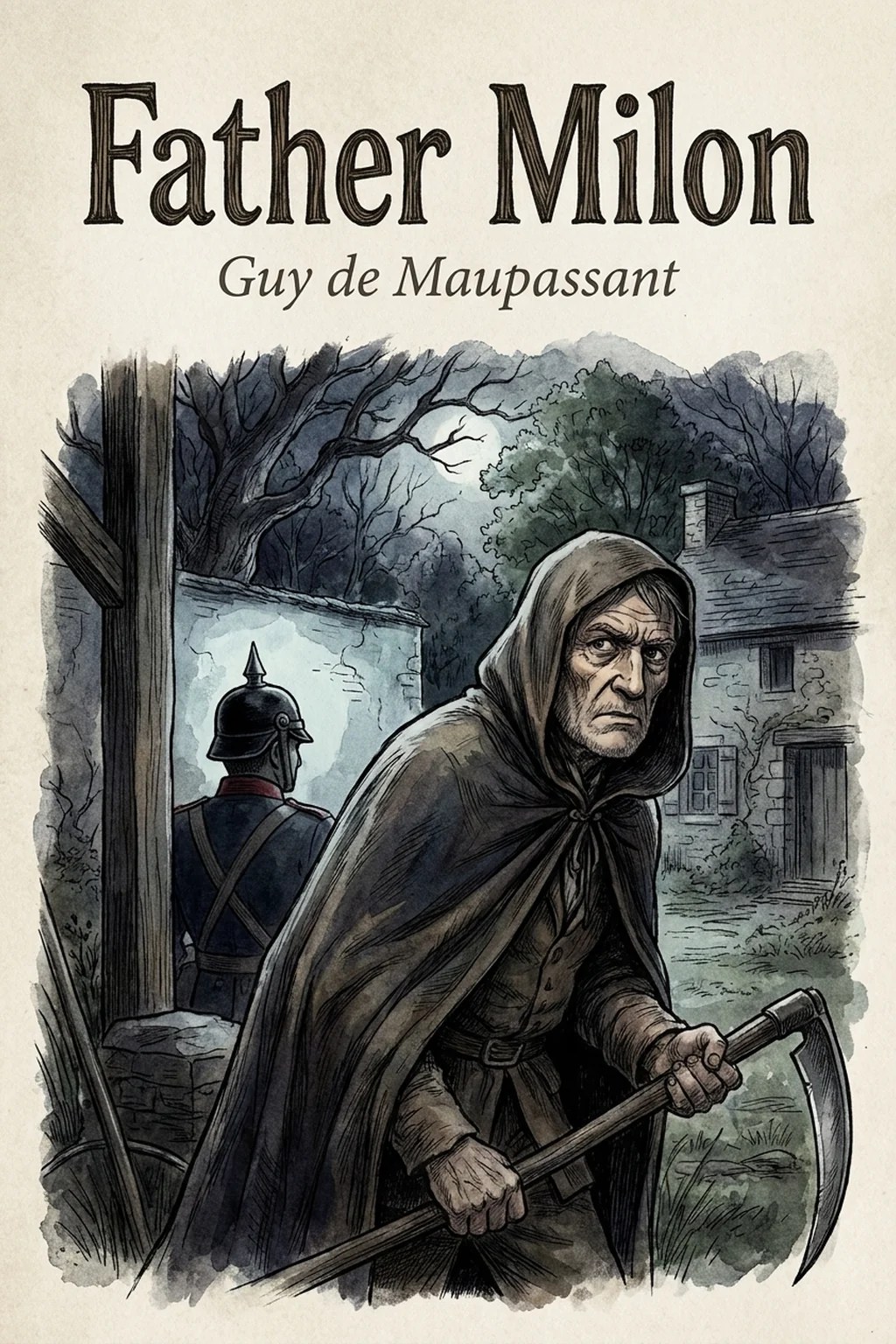
Father Milon
Father Milon
For a month the hot sun has been parching the fields. Nature is expanding beneath its rays; the fields are green as far as the eye can see. The big azure dome of the sky is unclouded. The farms of Normandy, scattered over the plains and surrounded by a belt of tall beeches, look, from a distance, like little woods. On closer view, after lowering the worm-eaten wooden bars, you imagine yourself in an immense garden, for all the ancient apple-trees, as gnarled as the peasants themselves, are in bloom. The sweet scent of their blossoms mingles with the heavy smell of the earth and the penetrating odor of the stables. It is noon. The family is eating under the shade of a pear tree planted in front of the door; father, mother, the four children, and the help—two women and three men are all there. All are silent. The soup is eaten and then a dish of potatoes fried with bacon is brought on.
From time to time one of the women gets up and takes a pitcher down to the cellar to fetch more cider.
The man, a big fellow about forty years old, is watching a grape vine, still bare, which is winding and twisting like a snake along the side of the house.
At last he says: "Father's vine is budding early this year. Perhaps we may get something from it.”
“”
The woman then turns round and looks, without saying a word.
This vine is planted on the spot where their father had been shot.
It was during the war of 1870. The Prussians were occupying the whole country. General Faidherbe, with the Northern Division of the army, was opposing them.
1870
The Prussians had established their headquarters at this farm. The old farmer to whom it belonged, Father Pierre Milon, had received and quartered them to the best of his ability.
For a month the German vanguard had been in this village. The French remained motionless, ten leagues away; and yet, every night, some of the Uhlans disappeared.
Of all the isolated scouts, of all those who were sent to the outposts, in groups of not more than three, not one ever returned.
They were picked up the next morning in a field or in a ditch. Even their horses were found along the roads with their throats cut.
These murders seemed to be done by the same men, who could never be found.
The country was terrorized. Farmers were shot on suspicion, women were imprisoned; children were frightened in order to try and obtain information. Nothing could be ascertained.
But, one morning, Father Milon was found stretched out in the barn, with a sword gash across his face.
Two Uhlans were found dead about a mile and a half from the farm. One of them was still holding his bloody sword in his hand. He had fought, tried to defend himself. A court-martial was immediately held in the open air, in front of the farm. The old man was brought before it.
He was sixty-eight years old, small, thin, bent, with two big hands resembling the claws of a crab. His colorless hair was sparse and thin, like the down of a young duck, allowing patches of his scalp to be seen. The brown and wrinkled skin of his neck showed big veins which disappeared behind his jaws and came out again at the temples. He had the reputation of being miserly and hard to deal with.
68
They stood him up between four soldiers, in front of the kitchen table, which had been dragged outside. Five officers and the colonel seated themselves opposite him.
The colonel spoke in French: "Father Milon, since we have been here we have only had praise for you. You have always been obliging and even attentive to us. But today a terrible accusation is hanging over you, and you must clear the matter up. How did you receive that wound on your face?"
“”
The peasant answered nothing.
The colonel continued: "Your silence accuses you, Father Milon. But I want you to answer me! Do you understand? Do you know who killed the two Uhlans who were found this morning near Calvaire?"
“”
The old man answered clearly "I did."
“”
The colonel, surprised, was silent for a minute, looking straight at the prisoner. Father Milon stood impassive, with the stupid look of the peasant, his eyes lowered as though he were talking to the priest. Just one thing betrayed an uneasy mind; he was continually swallowing his saliva, with a visible effort, as though his throat were terribly contracted.
The man's family, his son Jean, his daughter-in-law and his two grandchildren were standing a few feet behind him, bewildered and affrighted.
The colonel went on: "Do you also know who killed all the scouts who have been found dead, for a month, throughout the country, every morning?"
“”
The old man answered with the same stupid look: "I did."
“”
"You killed them all?"
“”
"Uh huh! I did."
“”
"You alone? All alone?"
“”
"Uh huh!"
“”
"Tell me how you did it."
“”
This time the man seemed moved; the necessity for talking any length of time annoyed him visibly. He stammered: "I dunno! I simply did it."
“”
The colonel continued: "I warn you that you will have to tell me everything. You might as well make up your mind right away. How did you begin?"
“”
The man cast a troubled look toward his family, standing close behind him. He hesitated a minute longer, and then suddenly made up his mind to obey the order.
"I was coming home one night at about ten o'clock, the night after you got here. You and your soldiers had taken more than fifty ecus worth of forage from me, as well as a cow and two sheep. I said to myself: 'As much as they take from you; just so much will you make them pay back.' And then I had other things on my mind which I will tell you. Just then I noticed one of your soldiers who was smoking his pipe by the ditch behind the barn. I went and got my scythe and crept up slowly behind him, so that he couldn't hear me. And I cut his head off with one single blow, just as I would a blade of grass, before he could say 'Booh!' If you should look at the bottom of the pond, you will find him tied up in a potato-sack, with a stone fastened to it.
“50‘’‘’
"I got an idea. I took all his clothes, from his boots to his cap, and hid them away in the little wood behind the yard."
“”
The old man stopped. The officers remained speechless, looking at each other. The questioning began again, and this is what they learned.
Once this murder committed, the man had lived with this one thought: "Kill the Prussians!" He hated them with the blind, fierce hate of the greedy yet patriotic peasant. He had his idea, as he said. He waited several days.
“”
He was allowed to go and come as he pleased, because he had shown himself so humble, submissive and obliging to the invaders. Each night he saw the outposts leave. One night he followed them, having heard the name of the village to which the men were going, and having learned the few words of German which he needed for his plan through associating with the soldiers.
He left through the back yard, slipped into the woods, found the dead man's clothes and put them on. Then he began to crawl through the fields, following along the hedges in order to keep out of sight, listening to the slightest noises, as wary as a poacher.
As soon as he thought the time ripe, he approached the road and hid behind a bush. He waited for a while. Finally, toward midnight, he heard the sound of a galloping horse. The man put his ear to the ground in order to make sure that only one horseman was approaching, then he got ready.
An Uhlan came galloping along, carrying des patches. As he went, he was all eyes and ears. When he was only a few feet away, Father Milon dragged himself across the road, moaning: "Hilfe! Hilfe!" ( Help! Help!) The horseman stopped, and recognizing a German, he thought he was wounded and dismounted, coming nearer without any suspicion, and just as he was leaning over the unknown man, he received, in the pit of his stomach, a heavy thrust from the long curved blade of the sabre. He dropped without suffering pain, quivering only in the final throes. Then the farmer, radiant with the silent joy of an old peasant, got up again, and, for his own pleasure, cut the dead man's throat. He then dragged the body to the ditch and threw it in.
"Hilfe!Hilfe"
The horse quietly awaited its master. Father Milon mounted him and started galloping across the plains.
About an hour later he noticed two more Uhlans who were returning home, side by side. He rode straight for them, once more crying "Hilfe! Hilfe!"
"Hilfe!Hilfe!"
The Prussians, recognizing the uniform, let him approach without distrust. The old man passed between them like a cannon-ball, felling them both, one with his sabre and the other with a revolver.
Then he killed the horses, German horses! After that he quickly returned to the woods and hid one of the horses. He left his uniform there and again put on his old clothes; then going back into bed, he slept until morning.
For four days he did not go out, waiting for the inquest to be terminated; but on the fifth day he went out again and killed two more soldiers by the same stratagem. From that time on he did not stop. Each night he wandered about in search of adventure, killing Prussians, sometimes here and sometimes there, galloping through deserted fields, in the moonlight, a lost Uhlan, a hunter of men. Then, his task accomplished, leaving behind him the bodies lying along the roads, the old farmer would return and hide his horse and uniform.
He went, toward noon, to carry oats and water quietly to his mount, and he fed it well as he required from it a great amount of work.
But one of those whom he had attacked the night before, in defending himself slashed the old peasant across the face with his sabre.
However, he had killed them both. He had come back and hidden the horse and put on his ordinary clothes again; but as he reached home he began to feel faint, and had dragged himself as far as the stable, being unable to reach the house.
They had found him there, bleeding, on the straw.
When he had finished his tale, he suddenly lifted up his head and looked proudly at the Prussian officers.
The colonel, who was gnawing at his mustache, asked: "You have nothing else to say?"
“”
"Nothing more; I have finished my task; I killed sixteen, not one more or less."
“16”
"Do you know that you are going to die?"
“”
"I haven't asked for mercy.”
“”
"Have you been a soldier?"
“”
"Yes, I served my time. And then, you had killed my father, who was a soldier of the first Emperor. And last month you killed my youngest son, Francois, near Evreux. I owed you one for that; I paid. We are quits."
“”
The officers were looking at each other.
The old man continued: "Eight for my father, eight for the boy—we are quits. I did not seek any quarrel with you. I don't know you. I don't even know where you come from. And here you are, ordering me about in my home as though it were your own. I took my revenge upon the others. I'm not sorry.”
“——”
And, straightening up his bent back, the old man folded his arms in the attitude of a modest hero.
The Prussians talked in a low tone for a long time. One of them, a captain, who had also lost his son the previous month, was defending the poor wretch. Then the colonel arose and, approaching Father Milon, said in a low voice: "Listen, old man, there is perhaps a way of saving your life, it is to—” But the man was not listening, and, his eyes fixed on the hated officer, while the wind played with the downy hair on his head, he distorted his slashed face, giving it a truly terrible expression, and, swelling out his chest, he spat, as hard as he could, right in the Prussian's face.
“……”
The colonel, furious, raised his hand, and for the second time the man spat in his face.
All the officers had jumped up and were shrieking orders at the same time.
In less than a minute the old man, still impassive, was pushed up against the wall and shot, looking smilingly the while toward Jean, his eldest son, his daughter-in-law and his two grandchildren, who witnessed this scene in dumb terror.
Minuet
Great misfortunes do not affect me very much, said John Bridelle, an old bachelor who passed for a sceptic. I have seen war at quite close quarters; I walked across corpses without any feeling of pity. The great brutal facts of nature, or of humanity, may call forth cries of horror or indignation, but do not cause us that tightening of the heart, that shudder that goes down your spine at sight of certain little heartrending episodes.
·
The greatest sorrow that anyone can experience is certainly the loss of a child, to a mother; and the loss of his mother, to a man. It is intense, terrible, it rends your heart and upsets your mind; but one is healed of these shocks, just as large bleeding wounds become healed. Certain meetings, certain things half perceived, or surmised, certain secret sorrows, certain tricks of fate which awake in us a whole world of painful thoughts, which suddenly unclose to us the mysterious door of moral suffering, complicated, incurable; all the deeper because they appear benign, all the more bitter because they are intangible, all the more tenacious because they appear almost factitious, leave in our souls a sort of trail of sadness, a taste of bitterness, a feeling of disenchantment, from which it takes a long time to free ourselves.
I have always present to my mind two or three things that others would surely not have noticed, but which penetrated my being like fine, sharp incurable stings.
You might not perhaps understand the emotion that I retained from these hasty impressions. I will tell you one of them. She was very old, but as lively as a young girl. It may be that my imagination alone is responsible for my emotion.
I am fifty. I was young then and studying law. I was rather sad, somewhat of a dreamer, full of a pessimistic philosophy and did not care much for noisy cafes, boisterous companions, or stupid girls. I rose early and one of my chief enjoyments was to walk alone about eight o'clock in the morning in the nursery garden of the Luxembourg.
You people never knew that nursery garden. It was like a forgotten garden of the last century, as pretty as the gentle smile of an old lady. Thick hedges divided the narrow regular paths,—peaceful paths between two walls of carefully trimmed foliage. The gardener's great shears were pruning unceasingly these leafy partitions, and here and there one came across beds of flowers, lines of little trees looking like schoolboys out for a walk, companies of magnificent rose bushes, or regiments of fruit trees.
——
An entire corner of this charming spot was inhabited by bees. Their straw hives skillfully arranged at distances on boards had their entrances—as large as the opening of a thimble—turned towards the sun, and all along the paths one encountered these humming and gilded flies, the true masters of this peaceful spot, the real promenaders of these quiet paths.
————
I came there almost every morning. I sat down on a bench and read. Sometimes I let my book fall on my knees, to dream, to listen to the life of Paris around me, and to enjoy the infinite repose of these old-fashioned hedges.
But I soon perceived that I was not the only one to frequent this spot as soon as the gates were opened, and I occasionally met face to face, at a turn in the path, a strange little old man.
He wore shoes with silver buckles, knee-breeches, a snuff-colored frock coat, a lace jabot, and an outlandish gray hat with wide brim and long-haired surface that might have come out of the ark.
He was thin, very thin, angular, grimacing and smiling. His bright eyes were restless beneath his eyelids which blinked continuously. He always carried in his hand a superb cane with a gold knob, which must have been for him some glorious souvenir.
This good man astonished me at first, then caused me the intensest interest. I watched him through the leafy walls, I followed him at a distance, stopping at a turn in the hedge so as not to be seen.
And one morning when he thought he was quite alone, he began to make the most remarkable motions. First he would give some little springs, then make a bow; then, with his slim legs, he would give a lively spring in the air, clapping his feet as he did so, and then turn round cleverly, skipping and frisking about in a comical manner, smiling as if he had an audience, twisting his poor little puppet-like body, bowing pathetic and ridiculous little greetings into the empty air. He was dancing.
I stood petrified with amazement, asking myself which of us was crazy, he or I.
He stopped suddenly, advanced as actors do on the stage, then bowed and retreated with gracious smiles, and kissing his hand as actors do, his trembling hand, to the two rows of trimmed bushes.
Then he continued his walk with a solemn demeanor.
After that I never lost sight of him, and each morning he began anew his outlandish exercises.
I was wildly anxious to speak to him. I decided to risk it, and one day, after greeting him, I said:
"It is a beautiful day, monsieur."
“”
He bowed.
"Yes, sir, the weather is just as it used to be."
“”
A week later we were friends and I knew his history. He had been a dancing master at the opera, in the time of Louis XV. His beautiful cane was a present from the Comte de Clermont. And when we spoke about dancing he never stopping talking.
One day he said to me:
"I married La Castris, monsieur. I will introduce you to her if you wish it, but she does not get here till later. This garden, you see, is our delight and our life. It is all that remains of former days. It seems as though we could not exist if we did not have it. It is old and distingue, is it not? I seem to breathe an air here that has not changed since I was young. My wife and I pass all our afternoons here, but I come in the morning because I get up early."
“·”
As soon as I had finished luncheon I returned to the Luxembourg, and presently perceived my friend offering his arm ceremoniously to a very old little lady dressed in black, to whom he introduced me. It was La Castris, the great dancer, beloved by princes, beloved by the king, beloved by all that century of gallantry that seems to have left behind it in the world an atmosphere of love.
·
We sat down on a bench. It was the month of May. An odor of flowers floated in the neat paths; a hot sun glided its rays between the branches and covered us with patches of light. The black dress of La Castris seemed to be saturated with sunlight.
·
The garden was empty. We heard the rattling of vehicles in the distance.
"Tell me," I said to the old dancer, "what was the minuet?"
“”“”
He gave a start.
"The minuet, monsieur, is the queen of dances, and the dance of queens, do you understand? Since there is no longer any royalty, there is no longer any minuet."
“”
And he began in a pompous manner a long dithyrambic eulogy which I could not understand. I wanted to have the steps, the movements, the positions, explained to me. He became confused, was amazed at his inability to make me understand, became nervous and worried.
Then suddenly, turning to his old companion who had remained silent and serious, he said:
"Elise, would you like—say—would you like, it would be very nice of you, would you like to show this gentleman what it was?”
“————”
She turned eyes uneasily in all directions, then rose without saying a word and took her position opposite him.
Then I witnessed an unheard-of thing.
They advanced and retreated with childlike grimaces, smiling, swinging each other, bowing, skipping about like two automaton dolls moved by some old mechanical contrivance, somewhat damaged, but made by a clever workman according to the fashion of his time.
And I looked at them, my heart filled with extraordinary emotions, my soul touched with an indescribable melancholy. I seemed to see before me a pathetic and comical apparition, the out-of-date ghost of a former century.
They suddenly stopped. They had finished all the figures of the dance. For some seconds they stood opposite each other, smiling in an astonishing manner. Then they fell on each other's necks sobbing.
I left for the provinces three days later. I never saw them again. When I returned to Paris, two years later, the nursery had been destroyed. What became of them, deprived of the dear garden of former days, with its mazes, its odor of the past, and the graceful windings of its hedges?
Are they dead? Are they wandering among modern streets like hopeless exiles? Are they dancing—grotesque spectres—a fantastic minuet in the moonlight, amid the cypresses of a cemetery, along the pathways bordered by graves?
————
Their memory haunts me, obsesses me, torments me, remains with me like a wound. Why? I do not know.
No doubt you think that very absurd?
Mother Sauvage
Fifteen years had passed since I was at Virelogne. I returned there in the autumn to shoot with my friend Serval, who had at last rebuilt his chateau, which the Prussians had destroyed.
————
I loved that district. It is one of those delightful spots which have a sensuous charm for the eyes. You love it with a physical love. We, whom the country enchants, keep tender memories of certain springs, certain woods, certain pools, certain hills seen very often which have stirred us like joyful events. Sometimes our thoughts turn back to a corner in a forest, or the end of a bank, or an orchard filled with flowers, seen but a single time on some bright day, yet remaining in our hearts like the image of certain women met in the street on a spring morning in their light, gauzy dresses, leaving in soul and body an unsatisfied desire which is not to be forgotten, a feeling that you have just passed by happiness.
At Virelogne I loved the whole countryside, dotted with little woods and crossed by brooks which sparkled in the sun and looked like veins carrying blood to the earth. You fished in them for crawfish, trout and eels. Divine happiness! You could bathe in places and you often found snipe among the high grass which grew along the borders of these small water courses.
I was stepping along light as a goat, watching my two dogs running ahead of me, Serval, a hundred metres to my right, was beating a field of lucerne. I turned round by the thicket which forms the boundary of the wood of Sandres and I saw a cottage in ruins.
Suddenly I remembered it as I had seen it the last time, in 1869, neat, covered with vines, with chickens before the door. What is sadder than a dead house, with its skeleton standing bare and sinister?
1869
I also recalled that inside its doors, after a very tiring day, the good woman had given me a glass of wine to drink and that Serval had told me the history of its people. The father, an old poacher, had been killed by the gendarmes. The son, whom I had once seen, was a tall, dry fellow who also passed for a fierce slayer of game. People called them "Les Sauvage."
“”“”
Was that a name or a nickname?
I called to Serval. He came up with his long strides like a crane.
I asked him: "What's become of those people?”
“”
This was his story: When war was declared the son Sauvage, who was then thirty-three years old, enlisted, leaving his mother alone in the house. People did not pity the old woman very much because she had money; they knew it.
33
She remained entirely alone in that isolated dwelling, so far from the village, on the edge of the wood. She was not afraid, however, being of the same strain as the men folk—a hardy old woman, tall and thin, who seldom laughed and with whom one never jested. The women of the fields laugh but little in any case, that is men's business. But they themselves have sad and narrowed hearts, leading a melancholy, gloomy life. The peasants imbibe a little noisy merriment at the tavern, but their helpmates always have grave, stern countenances. The muscles of their faces have never learned the motions of laughter.
Mother Sauvage continued her ordinary existence in her cottage, which was soon covered by the snows. She came to the village once a week to get bread and a little meat. Then she returned to her house. As there was talk of wolves, she went out with a gun upon her shoulder—her son's gun, rusty and with the butt worn by the rubbing of the hand—and she was a strange sight, the tall "Sauvage," a little bent, going with slow strides over the snow, the muzzle of the piece extending beyond the black headdress, which confined her head and imprisoned her white hair, which no one had ever seen.
——“”
One day a Prussian force arrived. It was billeted upon the inhabitants, according to the property and resources of each. Four were allotted to the old woman, who was known to be rich.
They were four great fellows with fair complexion, blond beards and blue eyes, who had not grown thin in spite of the fatigue which they had endured already and who also, though in a conquered country, had remained kind and gentle. Alone with this aged woman, they showed themselves full of consideration, sparing her, as much as they could, all expense and fatigue. They could be seen, all four of them, making their toilet at the well in their shirt-sleeves in the gray dawn, splashing with great swishes of water their pink-white northern skin, while La Mere Sauvage went and came, preparing their soup. They would be seen cleaning the kitchen, rubbing the tiles, splitting wood, peeling potatoes, doing up all the housework like four good sons around their mother.
But the old woman thought always of her own son, so tall and thin, with his hooked nose and his brown eyes and his heavy mustache which made a roll of black hair upon his lip. She asked every day of each of the soldiers who were installed beside her hearth: "Do you know where the French marching regiment, No. 23, was sent? My boy is in it.”
——“”
They invariably answered, "No, we don't know, don't know a thing at all.” And, understanding her pain and her uneasiness—they who had mothers, too, there at home—they rendered her a thousand little services. She loved them well, moreover, her four enemies, since the peasantry have no patriotic hatred; that belongs to the upper class alone. The humble, those who pay the most because they are poor and because every new burden crushes them down; those who are killed in masses, who make the true cannon's prey because they are so many; those, in fine, who suffer most cruelly the atrocious miseries of war because they are the feeblest and offer least resistance—they hardly understand at all those bellicose ardors, that excitable sense of honor or those pretended political combinations which in six months exhaust two nations, the conqueror with the conquered.
“”————
They said in the district, in speaking of the Germans of La Mere Sauvage: "There are four who have found a soft place."
“”
Now, one morning, when the old woman was alone in the house, she observed, far off on the plain, a man coming toward her dwelling. Soon she recognized him; it was the postman to distribute the letters. He gave her a folded paper and she drew out of her case the spectacles which she used for sewing. Then she read: MADAME SAUVAGE: This letter is to tell you sad news. Your boy Victor was killed yesterday by a shell which almost cut him in two. I was near by, as we stood next each other in the company, and he told me about you and asked me to let you know on the same day if anything happened to him.
——
I took his watch, which was in his pocket, to bring it back to you when the war is done. CESAIRE RIVOT,
Soldier of the 2d class, March. Reg. No. 23. The letter was dated three weeks back.
She did not cry at all. She remained motionless, so overcome and stupefied that she did not even suffer as yet. She thought: "There's Victor killed now.” Then little by little the tears came to her eyes and the sorrow filled her heart. Her thoughts came, one by one, dreadful, torturing. She would never kiss him again, her child, her big boy, never again! The gendarmes had killed the father, the Prussians had killed the son. He had been cut in two by a cannon-ball. She seemed to see the thing, the horrible thing: the head falling, the eyes open, while he chewed the corner of his big mustache as he always did in moments of anger.
“”
What had they done with his body afterward? If they had only let her have her boy back as they had brought back her husband—with the bullet in the middle of the forehead!
——
But she heard a noise of voices. It was the Prussians returning from the village. She hid her letter very quickly in her pocket, and she received them quietly, with her ordinary face, having had time to wipe her eyes.
They were laughing, all four, delighted, for they brought with them a fine rabbit—stolen, doubtless—and they made signs to the old woman that there was to be something good to eat.
She set herself to work at once to prepare breakfast, but when it came to killing the rabbit, her heart failed her. And yet it was not the first. One of the soldiers struck it down with a blow of his fist behind the ears.
The beast once dead, she skinned the red body, but the sight of the blood which she was touching, and which covered her hands, and which she felt cooling and coagulating, made her tremble from head to foot, and she kept seeing her big boy cut in two, bloody, like this still palpitating animal.
She sat down at table with the Prussians, but she could not eat, not even a mouthful. They devoured the rabbit without bothering themselves about her. She looked at them sideways, without speaking, her face so impassive that they perceived nothing.
All of a sudden she said: "I don't even know your names, and here's a whole month that we've been together.” They understood, not without difficulty, what she wanted, and told their names.
“”
That was not sufficient; she had them written for her on a paper, with the addresses of their families, and, resting her spectacles on her great nose, she contemplated that strange handwriting, then folded the sheet and put it in her pocket, on top of the letter which told her of the death of her son.
When the meal was ended she said to the men: "I am going to work for you."
“”
And she began to carry up hay into the loft where they slept.
They were astonished at her taking all this trouble; she explained to them that thus they would not be so cold; and they helped her. They heaped the stacks of hay as high as the straw roof, and in that manner they made a sort of great chamber with four walls of fodder, warm and perfumed, where they should sleep splendidly.
At dinner one of them was worried to see that La Mere Sauvage still ate nothing. She told him that she had pains in her stomach. Then she kindled a good fire to warm herself, and the four Germans ascended to their lodging-place by the ladder which served them every night for this purpose.
As soon as they closed the trapdoor the old woman removed the ladder, then opened the outside door noiselessly and went back to look for more bundles of straw, with which she filled her kitchen. She went barefoot in the snow, so softly that no sound was heard. From time to time she listened to the sonorous and unequal snoring of the four soldiers who were fast asleep.
When she judged her preparations to be sufficient, she threw one of the bundles into the fireplace, and when it was alight she scattered it over all the others. Then she went outside again and looked.
In a few seconds the whole interior of the cottage was illumined with a brilliant light and became a frightful brasier, a gigantic fiery furnace, whose glare streamed out of the narrow window and threw a glittering beam upon the snow.
Then a great cry issued from the top of the house; it was a clamor of men shouting heartrending calls of anguish and of terror. Finally the trapdoor having given way, a whirlwind of fire shot up into the loft, pierced the straw roof, rose to the sky like the immense flame of a torch, and all the cottage flared.
——
Nothing more was heard therein but the crackling of the fire, the cracking of the walls, the falling of the rafters. Suddenly the roof fell in and the burning carcass of the dwelling hurled a great plume of sparks into the air, amid a cloud of smoke.
The country, all white, lit up by the fire, shone like a cloth of silver tinted with red.
A bell, far off, began to toll.
The old "Sauvage" stood before her ruined dwelling, armed with her gun, her son's gun, for fear one of those men might escape.
“”
When she saw that it was ended, she threw her weapon into the brasier. A loud report followed.
People were coming, the peasants, the Prussians.
They found the woman seated on the trunk of a tree, calm and satisfied.
A German officer, but speaking French like a son of France, demanded: "Where are your soldiers?"
“”
She reached her bony arm toward the red heap of fire which was almost out and answered with a strong voice: "There!"
“”
They crowded round her. The Prussian asked: "How did it take fire?"
“”
"It was I who set it on fire."
“”
They did not believe her, they thought that the sudden disaster had made her crazy. While all pressed round and listened, she told the story from beginning to end, from the arrival of the letter to the last shriek of the men who were burned with her house, and never omitted a detail.
When she had finished, she drew two pieces of paper from her pocket, and, in order to distinguish them by the last gleams of the fire, she again adjusted her spectacles. Then she said, showing one: "That, that is the death of Victor." Showing the other, she added, indicating the red ruins with a bend of the head: "Here are their names, so that you can write home." She quietly held a sheet of paper out to the officer, who held her by the shoulders, and she continued: "You must write how it happened, and you must say to their mothers that it was I who did that, Victoire Simon, la Sauvage! Do not forget."
“”“”“··”
The officer shouted some orders in German. They seized her, they threw her against the walls of her house, still hot. Then twelve men drew quickly up before her, at twenty paces. She did not move. She had understood; she waited.
An order rang out, followed instantly by a long report. A belated shot went off by itself, after the others.
The old woman did not fall. She sank as though they had cut off her legs.
The Prussian officer approached. She was almost cut in two, and in her withered hand she held her letter bathed with blood.
My friend Serval added: "It was by way of reprisal that the Germans destroyed the chateau of the district, which belonged to me."
“”
I thought of the mothers of those four fine fellows burned in that house and of the horrible heroism of that other mother shot against the wall.
And I picked up a little stone, still blackened by the flames.
Saint Anthony
They called him Saint Anthony, because his name was Anthony, and also, perhaps, because he was a good fellow, jovial, a lover of practical jokes, a tremendous eater and a heavy drinker and a gay fellow, although he was sixty years old.
60
He was a big peasant of the district of Caux, with a red face, large chest and stomach, and perched on two legs that seemed too slight for the bulk of his body.
He was a widower and lived alone with his two men servants and a maid on his farm, which he conducted with shrewd economy. He was careful of his own interests, understood business and the raising of cattle, and farming. His two sons and his three daughters, who had married well, were living in the neighborhood and came to dine with their father once a month. His vigor of body was famous in all the countryside. "He is as strong as Saint Anthony." had become a kind of proverb.
“”
At the time of the Prussian invasion Saint Anthony, at the wine shop, promised to eat an army, for he was a braggart, like a true Norman, a bit of a coward and a blusterer. He banged his fist on the wooden table, making the cups and the brandy glasses dance, and cried with the assumed wrath of a good fellow, with a flushed face and a sly look in his eye: "I shall have to eat some of them, nom de Dieu!" He reckoned that the Prussians would not come as far as Tanneville, but when he heard they were at Rautot he never went out of the house, and constantly watched the road from the little window of his kitchen, expecting at any moment to see the bayonets go by.
“”
One morning as he was eating his luncheon with the servants the door opened and the mayor of the commune, Maitre Chicot, appeared, followed by a soldier wearing a black copper-pointed helmet. Saint Anthony bounded to his feet and his servants all looked at him, expecting to see him slash the Prussian. But he merely shook hands with the mayor, who said:
"Here is one for you, Saint Anthony. They came last night. Don't do anything foolish, above all things, for they talked of shooting and burning everything if there is the slightest unpleasantness, I have given you warning. Give him something to eat; he looks like a good fellow. Good-day. I am going to call on the rest. There are enough for all." And he went out.
“”
Father Anthony, who had turned pale, looked at the Prussian. He was a big, young fellow with plump, white skin, blue eyes, fair hair, unshaven to his cheek bones, who looked stupid, timid and good. The shrewd Norman read him at once, and, reassured, he made him a sign to sit down. Then he said: "Will you take some soup?"
“”
The stranger did not understand. Anthony then became bolder, and pushing a plateful of soup right under his nose, he said: "Here, swallow that, big pig!"
“”
The soldier answered "Ya," and began to eat greedily, while the farmer, triumphant, feeling he had regained his reputation, winked his eye at the servants, who were making strange grimaces, what with their terror and their desire to laugh.
“”
When the Prussian had devoured his soup, Saint Anthony gave him another plateful, which disappeared in like manner; but he flinched at the third which the farmer tried to insist on his eating, saying: "Come, put that into your stomach; 'twill fatten you or it is your own fault, eh, pig!”
“”
The soldier, understanding only that they wanted to make him eat all his soup, laughed in a contented manner, making a sign to show that he could not hold any more.
Then Saint Anthony, become quite familiar, tapped him on the stomach, saying: "My, there is plenty in my pig's belly!" But suddenly he began to writhe with laughter, unable to speak. An idea had struck him which made him choke with mirth. "That's it, that's it, Saint Anthony and his pig. There's my pig!" And the three servants burst out laughing in their turn.
“”“”
The old fellow was so pleased that he had the brandy brought in, good stuff, 'fil en dix', and treated every one. They clinked glasses with the Prussian, who clacked his tongue by way of flattery to show that he enjoyed it. And Saint Anthony exclaimed in his face: "Eh, is not that superfine? You don't get anything like that in your home, pig!”
“”
From that time Father Anthony never went out without his Prussian. He had got what he wanted. This was his vengeance, the vengeance of an old rogue. And the whole countryside, which was in terror, laughed to split its sides at Saint Anthony's joke. Truly, there was no one like him when it came to humor. No one but he would have thought of a thing like that. He was a born joker!
He went to see his neighbors every day, arm in arm with his German, whom he introduced in a jovial manner, tapping him on the shoulder: "See, here is my pig; look and see if he is not growing fat, the animal!"
“”
And the peasants would beam with smiles. "He is so comical, that reckless fellow, Antoine!"
“”
"I will sell him to you, Cesaire, for three pistoles" (thirty francs).
“”
"I will take him, Antoine, and I invite you to eat some black pudding."
“”
"What I want is his feet."
“”
"Feel his belly; you will see that it is all fat."
“”
And they all winked at each other, but dared not laugh too loud, for fear the Prussian might finally suspect they were laughing at him. Anthony, alone growing bolder every day, pinched his thighs, exclaiming, "Nothing but fat"; tapped him on the back, shouting, "That is all bacon"; lifted him up in his arms as an old Colossus that could have lifted an anvil, declaring, "He weighs six hundred and no waste."
“”“”“”
He had got into the habit of making people offer his "pig" something to eat wherever they went together. This was the chief pleasure, the great diversion every day. "Give him whatever you please, he will swallow everything." And they offered the man bread and butter, potatoes, cold meat, chitterlings, which caused the remark, "Some of your own, and choice ones."
“”“”“”
The soldier, stupid and gentle, ate from politeness, charmed at these attentions, making himself ill rather than refuse, and he was actually growing fat and his uniform becoming tight for him. This delighted Saint Anthony, who said: "You know, my pig, that we shall have to have another cage made for you."
“”
They had, however, become the best friends in the world, and when the old fellow went to attend to his business in the neighborhood the Prussian accompanied him for the simple pleasure of being with him.
The weather was severe; it was freezing hard. The terrible winter of 1870 seemed to bring all the scourges on France at one time.
Father Antoine, who made provision beforehand, and took advantage of every opportunity, foreseeing that manure would be scarce for the spring farming, bought from a neighbor who happened to be in need of money all that he had, and it was agreed that he should go every evening with his cart to get a load.
So every day at twilight he set out for the farm of Haules, half a league distant, always accompanied by his "pig." And each time it was a festival, feeding the animal. All the neighbors ran over there as they would go to high mass on Sunday.
“”
But the soldier began to suspect something, be mistrustful, and when they laughed too loud he would roll his eyes uneasily, and sometimes they lighted up with anger.
One evening when he had eaten his fill he refused to swallow another morsel, and attempted to rise to leave the table. But Saint Anthony stopped him by a turn of the wrist and, placing his two powerful hands on his shoulders, he sat him down again so roughly that the chair smashed under him.
A wild burst of laughter broke forth, and Anthony, beaming, picked up his pig, acted as though he were dressing his wounds, and exclaimed: "Since you will not eat, you shall drink, nom de Dieu!" And they went to the wine shop to get some brandy.
“”“”
The soldier rolled his eyes, which had a wicked expression, but he drank, nevertheless; he drank as long as they wanted him, and Saint Anthony held his head to the great delight of his companions.
The Norman, red as a tomato, his eyes ablaze, filled up the glasses and clinked, saying: "Here's to you!”. And the Prussian, without speaking a word, poured down one after another glassfuls of cognac.
“”
It was a contest, a battle, a revenge! Who would drink the most, nom d'un nom! They could neither of them stand any more when the liter was emptied. But neither was conquered. They were tied, that was all. They would have to begin again the next day.
They went out staggering and started for home, walking beside the dung cart which was drawn along slowly by two horses.
Snow began to fall and the moonless night was sadly lighted by this dead whiteness on the plain. The men began to feel the cold, and this aggravated their intoxication. Saint Anthony, annoyed at not being the victor, amused himself by shoving his companion so as to make him fall over into the ditch. The other would dodge backwards, and each time he did he uttered some German expression in an angry tone, which made the peasant roar with laughter. Finally the Prussian lost his temper, and just as Anthony was rolling towards him he responded with such a terrific blow with his fist that the Colossus staggered.
Then, excited by the brandy, the old man seized the pugilist round the waist, shook him for a few moments as he would have done with a little child, and pitched him at random to the other side of the road. Then, satisfied with this piece of work, he crossed his arms and began to laugh afresh.
But the soldier picked himself up in a hurry, his head bare, his helmet having rolled off, and drawing his sword he rushed over to Father Anthony.
When he saw him coming the peasant seized his whip by the top of the handle, his big holly wood whip, straight, strong and supple as the sinew of an ox.
The Prussian approached, his head down, making a lunge with his sword, sure of killing his adversary. But the old fellow, squarely hitting the blade, the point of which would have pierced his stomach, turned it aside, and with the butt end of the whip struck the soldier a sharp blow on the temple and he fell to the ground.
Then he, gazed aghast, stupefied with amazement, at the body, twitching convulsively at first and then lying prone and motionless. He bent over it, turned it on its back, and gazed at it for some time. The man's eyes were closed, and blood trickled from a wound at the side of his forehead. Although it was dark, Father Anthony could distinguish the bloodstain on the white snow.
He remained there, at his wit's end, while his cart continued slowly on its way.
What was he to do? He would be shot! They would burn his farm, ruin his district! What should he do? What should he do? How could he hide the body, conceal the fact of his death, deceive the Prussians? He heard voices in the distance, amid the utter stillness of the snow. All at once he roused himself, and picking up the helmet he placed it on his victim's head. Then, seizing him round the body, he lifted him up in his arms, and thus running with him, he overtook his team, and threw the body on top of the manure. Once in his own house he would think up some plan.
He walked slowly, racking his brain, but without result. He saw, he felt, that he was lost. He entered his courtyard. A light was shining in one of the attic windows; his maid was not asleep. He hastily backed his wagon to the edge of the manure hollow. He thought that by overturning the manure the body lying on top of it would fall into the ditch and be buried beneath it, and he dumped the cart.
As he had foreseen, the man was buried beneath the manure. Anthony evened it down with his fork, which he stuck in the ground beside it. He called his stableman, told him to put up the horses, and went to his room.
He went to bed, still thinking of what he had best do, but no ideas came to him. His apprehension increased in the quiet of his room. They would shoot him! He was bathed in perspiration from fear, his teeth chattered, he rose shivering, not being able to stay in bed.
He went downstairs to the kitchen, took the bottle of brandy from the sideboard and carried it upstairs. He drank two large glasses, one after another, adding a fresh intoxication to the late one, without quieting his mental anguish. He had done a pretty stroke of work, nom de Dieu, idiot!
He paced up and down, trying to think of some stratagem, some explanations, some cunning trick, and from time to time he rinsed his mouth with a swallow of "fil en dix" to give him courage.
But no ideas came to him, not one.
Towards midnight his watch dog, a kind of cross wolf called "Devorant," began to howl frantically. Father Anthony shuddered to the marrow of his bones, and each time the beast began his long and lugubrious wail the old man's skin turned to goose flesh.
“”
He had sunk into a chair, his legs weak, stupefied, done up, waiting anxiously for "Devorant" to set up another howl, and starting convulsively from nervousness caused by terror.
“”
The clock downstairs struck five. The dog was still howling. The peasant was almost insane. He rose to go and let the dog loose, so that he should not hear him. He went downstairs, opened the hall door, and stepped out into the darkness. The snow was still falling. The earth was all white, the farm buildings standing out like black patches. He approached the kennel. The dog was dragging at his chain. He unfastened it. "Devorant" gave a bound, then stopped short, his hair bristling, his legs rigid, his muzzle in the air, his nose pointed towards the manure heap.
“”
Saint Anthony, trembling from head to foot, faltered:
"What's the matter with you, you dirty hound?" and he walked a few steps forward, gazing at the indistinct outlines, the sombre shadow of the courtyard.
“”
Then he saw a form, the form of a man sitting on the manure heap!
He gazed at it, paralyzed by fear, and breathing hard. But all at once he saw, close by, the handle of the manure fork which was sticking in the ground. He snatched it up and in one of those transports of fear that will make the greatest coward brave he rushed forward to see what it was.
It was he, his Prussian, come to life, covered with filth from his bed of manure which had kept him warm. He had sat down mechanically, and remained there in the snow which sprinkled down, all covered with dirt and blood as he was, and still stupid from drinking, dazed by the blow and exhausted from his wound.
He perceived Anthony, and too sodden to understand anything, he made an attempt to rise. But the moment the old man recognized him, he foamed with rage like a wild animal.
"Ah, pig! pig!" he sputtered. "You are not dead! You are going to denounce me now—wait—wait!”
“”“————”
And rushing on the German with all the strength of leis arms he flung the raised fork like a lance and buried the four prongs full length in his breast.
The soldier fell over on his back, uttering a long death moan, while the old peasant, drawing the fork out of his breast, plunged it over and over again into his abdomen, his stomach, his throat, like a madman, piercing the body from head to foot, as it still quivered, and the blood gushed out in streams.
Finally he stopped, exhausted by his arduous work, swallowing great mouthfuls of air, calmed down at the completion of the murder.
As the cocks were beginning to crow in the poultry yard and it was near daybreak, he set to work to bury the man.
He dug a hole in the manure till he reached the earth, dug down further, working wildly, in a frenzy of strength with frantic motions of his arms and body.
When the pit was deep enough he rolled the corpse into it with the fork, covered it with earth, which he stamped down for some time, and then put back the manure, and he smiled as he saw the thick snow finishing his work and covering up its traces with a white sheet.
He then stuck the fork in the manure and went into the house. His bottle, still half full of brandy stood on the table. He emptied it at a draught, threw himself on his bed and slept heavily.
He woke up sober, his mind calm and clear, capable of judgment and thought.
At the end of an hour he was going about the country making inquiries everywhere for his soldier. He went to see the Prussian officer to find out why they had taken away his man.
As everyone knew what good friends they were, no one suspected him. He even directed the research, declaring that the Prussian went to see the girls every evening.
The Prisoners
There was not a sound in the forest save the indistinct, fluttering sound of the snow falling on the trees. It had been snowing since noon; a little fine snow, that covered the branches as with frozen moss, and spread a silvery covering over the dead leaves in the ditches, and covered the roads with a white, yielding carpet, and made still more intense the boundless silence of this ocean of trees.
Before the door of the forester's dwelling a young woman, her arms bare to the elbow, was chopping wood with a hatchet on a block of stone. She was tall, slender, strong—a true girl of the woods, daughter and wife of a forester.
——
A voice called from within the house: "We are alone tonight, Berthine; you must come in. It is getting dark, and there may be Prussians or wolves about."
“”
"I've just finished, mother," replied the young woman, splitting as she spoke an immense log of wood with strong, deft blows, which expanded her chest each time she raised her arms to strike. "Here I am; there's no need to be afraid; it's quite light still.”
“”“”
Then she gathered up her sticks and logs, piled them in the chimney corner, went back to close the great oaken shutters, and finally came in, drawing behind her the heavy bolts of the door.
Her mother, a wrinkled old woman whom age had rendered timid, was spinning by the fireside.
"I am uneasy," she said, "when your father's not here. Two women are not much good.”
“”“”
"Oh," said the younger woman, "I'd cheerfully kill a wolf or a Prussian if it came to that.”
“”“”
And she glanced at a heavy revolver hanging above the hearth.
Her husband had been called upon to serve in the army at the beginning of the Prussian invasion, and the two women had remained alone with the old father, a keeper named Nicolas Pichon, sometimes called Long-legs, who refused obstinately to leave his home and take refuge in the town.
·“”
This town was Rethel, an ancient stronghold built on a rock. Its inhabitants were patriotic, and had made up their minds to resist the invaders, to fortify their native place, and, if need be, to stand a siege as in the good old days. Twice already, under Henri IV and under Louis XIV, the people of Rethel had distinguished themselves by their heroic defence of their town. They would do as much now, by gad! or else be slaughtered within their own walls.
They had, therefore, bought cannon and rifles, organized a militia, and formed themselves into battalions and companies, and now spent their time drilling all day long in the square. All—bakers, grocers, butchers, lawyers, carpenters, booksellers, chemists—took their turn at military training at regular hours of the day, under the auspices of Monsieur Lavigne, a former noncommissioned officer in the dragoons, now a draper, having married the daughter and inherited the business of Monsieur Ravaudan, Senior.
He had taken the rank of commanding officer in Rethel, and, seeing that all the young men had gone off to the war, he had enlisted all the others who were in favor of resisting an attack. Fat men now invariably walked the streets at a rapid pace, to reduce their weight and improve their breathing, and weak men carried weights to strengthen their muscles.
And they awaited the Prussians. But the Prussians did not appear. They were not far off, however, for twice already their scouts had penetrated as far as the forest dwelling of Nicolas Pichon, called Long-legs.
“”·
The old keeper, who could run like a fox, had come and warned the town. The guns had been got ready, but the enemy had not shown themselves.
Long-legs' dwelling served as an outpost in the Aveline forest. Twice a week the old man went to the town for provisions and brought the citizens news of the outlying district.
“”
On this particular day he had gone to announce the fact that a small detachment of German infantry had halted at his house the day before, about two o'clock in the afternoon, and had left again almost immediately. The noncommissioned officer in charge spoke French.
When the old man set out like this he took with him his dogs—two powerful animals with the jaws of lions—as a safeguard against the wolves, which were beginning to get fierce, and he left directions with the two women to barricade themselves securely within their dwelling as soon as night fell.
The younger feared nothing, but her mother was always apprehensive, and repeated continually: "We'll come to grief one of these days. You see if we don't!”
“”
This evening she was, if possible, more nervous than ever.
"Do you know what time your father will be back?" she asked.
“”
"Oh, not before eleven, for certain. When he dines with the commandant he's always late.”
“”
And Berthine was hanging her pot over the fire to warm the soup when she suddenly stood still, listening attentively to a sound that had reached her through the chimney.
"There are people walking in the wood," she said; "seven or eight men at least."
“”“”
The terrified old woman stopped her spinning wheel, and gasped: "Oh, my God! And your father not here!"
“”
She had scarcely finished speaking when a succession of violent blows shook the door.
As the woman made no reply, a loud, guttural voice shouted: "Open the door!"
“”
After a brief silence the same voice repeated: "Open the door or I'll break it down!”
“”
Berthine took the heavy revolver from its hook, slipped it into the pocket of her skirt, and, putting her ear to the door, asked: "Who are you?" demanded the young woman. "What do you want?".
“”“”
"The detachment that came here the other day," replied the voice.
“”
"My men and I have lost our way in the forest since morning. Open the door or I'll break it down!”
“”
The forester's daughter had no choice; she shot back the heavy bolts, threw open the ponderous shutter, and perceived in the wan light of the snow six men, six Prussian soldiers, the same who had visited the house the day before.
"What are you doing here at this time of night?" she asked dauntlessly.
“”
"I lost my bearings," replied the officer; "lost them completely. Then I recognized this house. I've eaten nothing since morning, nor my men either.”
“”
"But I'm quite alone with my mother this evening," said Berthine.
“”
"Never mind," replied the soldier, who seemed a decent sort of fellow. "We won't do you any harm, but you must give us something to eat. We are nearly dead with hunger and fatigue.”
“”“”
Then the girl moved aside.
"Come in;" she said.
“”
Then entered, covered with snow, their helmets sprinkled with a creamy-looking froth, which gave them the appearance of meringues. They seemed utterly worn out.
The young woman pointed to the wooden benches on either side of the large table.
"Sit down," she said, "and I'll make you some soup. You certainly look tired out, and no mistake.”
“”“”
Then she bolted the door afresh.
She put more water in the pot, added butter and potatoes; then, taking down a piece of bacon from a hook in the chimney earner, cut it in two and slipped half of it into the pot.
The six men watched her movements with hungry eyes. They had placed their rifles and helmets in a corner and waited for supper, as well behaved as children on a school bench.
The old mother had resumed her spinning, casting from time to time a furtive and uneasy glance at the soldiers. Nothing was to be heard save the humming of the wheel, the crackling of the fire, and the singing of the water in the pot.
But suddenly a strange noise—a sound like the harsh breathing of some wild animal sniffing under the door—startled the occupants of the room.
The German officer sprang toward the rifles. Berthine stopped him with a gesture, and said, smilingly: "It's only the wolves. They are like you—prowling hungry through the forest.”
“”
The incredulous man wanted to see with his own eyes, and as soon as the door was opened he perceived two large grayish animals disappearing with long, swinging trot into the darkness.
He returned to his seat, muttering: "I wouldn't have believed it!”
“”
And he waited quietly till supper was ready.
The men devoured their meal voraciously, with mouths stretched to their ears that they might swallow the more. Their round eyes opened at the same time as their jaws, and as the soup coursed down their throats it made a noise like the gurgling of water in a rainpipe.
The two women watched in silence the movements of the big red beards. The potatoes seemed to be engulfed in these moving fleeces.
But, as they were thirsty, the forester's daughter went down to the cellar to draw them some cider. She was gone some time. The cellar was small, with an arched ceiling, and had served, so people said, both as prison and as hiding-place during the Revolution. It was approached by means of a narrow, winding staircase, closed by a trap-door at the farther end of the kitchen.
When Berthine returned she was smiling mysteriously to herself. She gave the Germans her jug of cider.
Then she and her mother supped apart, at the other end of the kitchen.
The soldiers had finished eating, and were all six falling asleep as they sat round the table. Every now and then a forehead fell with a thud on the board, and the man, awakened suddenly, sat upright again.
Berthine said to the officer: "Go and lie down, all of you, round the fire. There's lots of room for six. I'm going up to my room with my mother.”
“”
And the two women went upstairs. They could be heard locking the door and walking about overhead for a time; then they were silent.
The Prussians lay down on the floor, with their feet to the fire and their heads resting on their rolled-up cloaks. Soon all six snored loudly and uninterruptedly in six different keys.
They had been sleeping for some time when a shot rang out so loudly that it seemed directed against the very wall's of the house. The soldiers rose hastily. Two—then three—more shots were fired.
The door opened hastily, and Berthine appeared, barefooted and only half dressed, with her candle in her hand and a scared look on her face.
"There are the French," she stammered; "at least two hundred of them. If they find you here they'll burn the house down. For God's sake, hurry down into the cellar, and don't make a 'sound, whatever you do. If you make any noise we are lost."
“”“”
"We'll go, we'll go," replied the terrified officer. "Which is the way?"
“”“”
The young woman hurriedly raised the small, square trap-door, and the six men disappeared one after another down the narrow, winding staircase, feeling their way as they went.
But as soon as the spike of the out of the last helmet was out of sight Berthine lowered the heavy oaken lid—thick as a wall, hard as steel, furnished with the hinges and bolts of a prison cell—shot the two heavy bolts, and began to laugh long and silently, possessed with a mad longing to dance above the heads of her prisoners.
They made no sound, inclosed in the cellar as in a strong-box, obtaining air only from a small, iron-barred vent-hole.
Berthine lighted her fire again, hung the pot over it, and prepared more soup, saying to herself: "Father will be tired tonight."
“”
Then she sat and waited. The heavy pendulum of the clock swung to and fro with a monotonous tick.
Every now and then the young woman cast an impatient glance at the dial—a glance which seemed to say: "I wish he'd be quick!”
“”
But soon there was a sound of voices beneath her feet. Low, confused words reached her through the masonry which roofed the cellar. The Prussians were beginning to suspect the trick she had played them, and presently the officer came up the narrow staircase, and knocked at the trap-door.
"Open the door!" he cried.
“”
"What do you want?" she said, rising from her seat and approaching the cellarway.
“”
"Open the door!"
“”
"I won't do any such thing!”
“”
"Open it or I'll break it down!" shouted the man angrily.
“”
She laughed.
"Hammer away, my good man! Hammer away!"
“”
He struck with the butt-end of his gun at the closed oaken door. But it would have resisted a battering-ram.
The forester's daughter heard him go down the stairs again. Then the soldiers came one after another and tried their strength against the trapdoor. But, finding their efforts useless, they all returned to the cellar and began to talk among themselves.
The young woman heard them for a short time, then she rose, opened the door of the house; looked out into the night, and listened.
A sound of distant barking reached her ear. She whistled just as a huntsman would, and almost immediately two great dogs emerged from the darkness, and bounded to her side. She held them tight, and shouted at the top of her voice: "Hullo, father!"
“”
A far-off voice replied: "Hullo, Berthine!"
“”
She waited a few seconds, then repeated: "Hullo, father!"
“”
The voice, nearer now, replied: "Hullo, Berthine!"
“”
"Don't go in front of the vent-hole!" shouted his daughter. "There are Prussians in the cellar!"
“”“”
Suddenly the man's tall figure could be seen to the left, standing between two tree trunks.
"Prussians in the cellar?" he asked anxiously. "What are they doing?"
“”“”
The young woman laughed.
"They are the same as were here yesterday. They lost their way, and I've given them free lodgings in the cellar.”
“”
She told the story of how she had alarmed them by firing the revolver, and had shut them up in the cellar.
The man, still serious, asked: "But what am I to do with them at this time of night?"
“”
"Go and fetch Monsieur Lavigne with his men," she replied. "He'll take them prisoners. He'll be delighted.”
“”“”
Her father smiled.
"So he will—delighted.”
“”
"Here's some soup for you," said his daughter. "Eat it quick, and then be off."
“”“”
The old keeper sat down at the table, and began to eat his soup, having first filled two plates and put them on the floor for the dogs.
The Prussians, hearing voices, were silent.
Long-legs set off a quarter of an hour later, and Berthine, with her head between her hands, waited.
“”
The prisoners began to make themselves heard again. They shouted, called, and beat furiously with the butts of their muskets against the rigid trap-door of the cellar.
Then they fired shots through the vent-hole, hoping, no doubt, to be heard by any German detachment which chanced to be passing that way.
The forester's daughter did not stir, but the noise irritated and unnerved her. Blind anger rose in her heart against the prisoners; she would have been only too glad to kill them all, and so silence them.
Then, as her impatience grew, she watched the clock, counting the minutes as they passed.
Her father had been gone an hour and a half. He must have reached the town by now. She conjured up a vision of him telling the story to Monsieur Lavigne, who grew pale with emotion, and rang for his servant to bring him his arms and uniform. She fancied she could bear the drum as it sounded the call to arms. Frightened faces appeared at the windows. The citizen-soldiers emerged from their houses half dressed, out of breath, buckling on their belts, and hurrying to the commandant's house.
Then the troop of soldiers, with Long-legs at its head, set forth through the night and the snow toward the forest.
“”
She looked at the clock. "They may be here in an hour."
“”
A nervous impatience possessed her. The minutes seemed interminable. Would the time never come?
At last the clock marked the moment she had fixed on for their arrival. And she opened the door to listen for their approach. She perceived a shadowy form creeping toward the house. She was afraid, and cried out. But it was her father.
"They have sent me," he said, "to see if there is any change in the state of affairs."
“”“”
"No—none.”
“”
Then he gave a shrill whistle. Soon a dark mass loomed up under the trees; the advance guard, composed of ten men.
"Don't go in front of the vent-hole!" repeated Long-legs at intervals.
“”“”
And the first arrivals pointed out the much-dreaded vent-hole to those who came after.
At last the main body of the troop arrived, in all two hundred men, each carrying two hundred cartridges.
Monsieur Lavigne, in a state of intense excitement, posted them in such a fashion as to surround the whole house, save for a large space left vacant in front of the little hole on a level with the ground, through which the cellar derived its supply of air.
Monsieur Lavigne struck the trap-door a blow with his foot, and called: "I wish to speak to the Prussian officer!"
“”
The German did not reply.
"The Prussian officer!" again shouted the commandant.
“”
Still no response. For the space of twenty minutes Monsieur Lavigne called on this silent officer to surrender with bag and baggage, promising him that all lives should be spared, and that he and his men should be accorded military honors. But he could extort no sign, either of consent or of defiance. The situation became a puzzling one.
The citizen-soldiers kicked their heels in the snow, slapping their arms across their chest, as cabdrivers do, to warm themselves, and gazing at the vent-hole with a growing and childish desire to pass in front of it.
At last one of them took the risk—a man named Potdevin, who was fleet of limb. He ran like a deer across the zone of danger. The experiment succeeded. The prisoners gave no sign of life.
A voice cried: "There's no one there!”
“”
And another soldier crossed the open space before the dangerous vent-hole. Then this hazardous sport developed into a game. Every minute a man ran swiftly from one side to the other, like a boy playing baseball, kicking up the snow behind him as he ran. They had lighted big fires of dead wood at which to warm themselves, and the, figures of the runners were illumined by the flames as they passed rapidly from the camp on the right to that on the left.
Some one shouted: "It's your turn now, Maloison.”
“”
Maloison was a fat baker, whose corpulent person served to point many a joke among his comrades.
He hesitated. They chaffed him. Then, nerving himself to the effort, he set off at a little, waddling gait, which shook his fat paunch and made the whole detachment laugh till they cried.
"Bravo, bravo, Maloison!" they shouted for his encouragement.
“”
He had accomplished about two-thirds of his journey when a long, crimson flame shot forth from the vent-hole. A loud report followed, and the fat baker fell face forward to the ground, uttering a frightful scream. No one went to his assistance. Then he was seen to drag himself, groaning, on all-fours through the snow until he was beyond danger, when he fainted.
He was shot in the upper part of the thigh.
After the first surprise and fright were over they laughed at him again. But Monsieur Lavigne appeared on the threshold of the forester's dwelling. He had formed his plan of attack. He called in a loud voice "I want Planchut, the plumber, and his workmen."
“”
Three men approached.
"Take the eavestroughs from the roof."
“”
In a quarter of an hour they brought the commandant thirty yards of pipes.
Next, with infinite precaution, he had a small round hole drilled in the trap-door; then, making a conduit with the troughs from the pump to this opening, he said, with an air of extreme satisfaction: "Now we'll give these German gentlemen something to drink.”
“”
A shout of frenzied admiration, mingled with uproarious laughter, burst from his followers. And the commandant organized relays of men, who were to relieve one another every five minutes. Then he commanded: "Pump!!!"
“!!!”
And, the pump handle having been set in motion, a stream of water trickled throughout the length of the piping, and flowed from step to step down the cellar stairs with a gentle, gurgling sound.
They waited.
An hour passed, then two, then three. The commandant, in a state of feverish agitation, walked up and down the kitchen, putting his ear to the ground every now and then to discover, if possible, what the enemy were doing and whether they would soon capitulate.
The enemy was astir now. They could be heard moving the casks about, talking, splashing through the water.
Then, about eight o'clock in the morning, a voice came from the vent-hole "I want to speak to the French officer."
“”
Lavigne replied from the window, taking care not to put his head out too far: "Do you surrender?"
“”
"I surrender."
“”
"Then put your rifles outside."
“”
A rifle immediately protruded from the hole, and fell into the snow, then another and another, until all were disposed of. And the voice which had spoken before said: "I have no more. Be quick! I am drowned."
“”
"Stop pumping!" ordered the commandant.
“”
And the pump handle hung motionless.
Then, having filled the kitchen with armed and waiting soldiers, he slowly raised the oaken trapdoor.
Four heads appeared, soaking wet, four fair heads with long, sandy hair, and one after another the six Germans emerged—scared, shivering and dripping from head to foot.
They were seized and bound. Then, as the French feared a surprise, they set off at once in two convoys, one in charge of the prisoners, and the other conducting Maloison on a mattress borne on poles.
They made a triumphal entry into Rethel.
Monsieur Lavigne was decorated as a reward for having captured a Prussian advance guard, and the fat baker received the military medal for wounds received at the hands of the enemy.
Timbuctoo
The boulevard, that river of humanity, was alive with people in the golden light of the setting sun. The whole sky was red, blinding, and behind the Madeleine an immense bank of flaming clouds cast a shower of light the whole length of the boulevard, vibrant as the heat from a brazier.
The gay, animated crowd went by in this golden mist and seemed to be glorified. Their faces were gilded, their black hats and clothes took on purple tints, the patent leather of their shoes cast bright reflections on the asphalt of the sidewalk.
Before the cafes a mass of men were drinking opalescent liquids that looked like precious stones dissolved in the glasses.
In the midst of the drinkers two officers in full uniform dazzled all eyes with their glittering gold lace. They chatted, happy without asking why, in this glory of life, in this radiant light of sunset, and they looked at the crowd, the leisurely men and the hurrying women who left a bewildering odor of perfume as they passed by.
All at once an enormous negro, dressed in black, with a paunch beneath his jean waistcoat, which was covered with charms, his face shining as if it had been polished, passed before them with a triumphant air. He laughed at the passers-by, at the news venders, at the dazzling sky, at the whole of Paris. He was so tall that he overtopped everyone else, and when he passed all the loungers turned round to look at his back.
But he suddenly perceived the officers and darted towards them, jostling the drinkers in his path. As soon as he reached their table he fixed his gleaming and delighted eyes upon them and the corners of his mouth expanded to his ears, showing his dazzling white teeth like a crescent moon in a black sky. The two men looked in astonishment at this ebony giant, unable to understand his delight.
With a voice that made all the guests laugh, he said:
"Good-day, my lieutenant.”
“”
One of the officers was commander of a battalion, the other was a colonel. The former said:
"I do not know you, sir. I am at a loss to know what you want of me."
“”
"Me like you much, Lieutenant Vedie, siege of Bezi, much grapes, find me."
“”
The officer, utterly bewildered, looked at the man intently, trying to refresh his memory. Then he cried abruptly:
"Timbuctoo?"
“”
The negro, radiant, slapped his thigh as he uttered a tremendous laugh and roared:
"Yes, yes, my lieutenant; you remember Timbuctoo, ya. How do you do?"
“”
The commandant held out his hand, laughing heartily as he did so. Then Timbuctoo became serious. He seized the officer's hand and, before the other could prevent it, he kissed it, according to negro and Arab custom. The officer embarrassed, said in a severe tone:
"Come now, Timbuctoo, we are not in Africa. Sit down there and tell me how it is I find you here."
“”
Timbuctoo swelled himself out and, his words falling over one another, replied hurriedly:
"Make much money, much, big restaurant, good food; Prussians, me, much steal, much, French cooking; Timbuctoo cook to the emperor; two thousand francs mine. Ha, ha, ha, ha!"
“”
And he laughed, doubling himself up, roaring, with wild delight in his glances.
When the officer, who understood his strange manner of expressing himself, had questioned him he said:
"Well, au revoir, Timbuctoo. I will see you again."
“”
The negro rose, this time shaking the hand that was extended to him and, smiling still, cried:
"Good-day, good-day, my lieutenant!”
“”
He went off so happy that he gesticulated as he walked, and people thought he was crazy.
"Who is that brute?" asked the colonel.
“”
"A fine fellow and a brave soldier. I will tell you what I know about him. It is funny enough.
“
"You know that at the commencement of the war of 1870 I was shut up in Bezieres, that this negro calls Bezi. We were not besieged, but blockaded. The Prussian lines surrounded us on all sides, outside the reach of cannon, not firing on us, but slowly starving us out.
“
"I was then lieutenant. Our garrison consisted of soldier of all descriptions, fragments of slaughtered regiments, some that had run away, freebooters separated from the main army, etc. We had all kinds, in fact even eleven Turcos [Algerian soldiers in the service of France], who arrived one evening no one knew whence or how. They appeared at the gates of the city, exhausted, in rags, starving and dirty. They were handed over to me.
“
"I saw very soon that they were absolutely undisciplined, always in the street and always drunk. I tried putting them in the police station, even in prison, but nothing was of any use. They would disappear, sometimes for days at a time, as if they had been swallowed up by the earth, and then come back staggering drunk. They had no money. Where did they buy drink and how and with what?
“
"This began to worry me greatly, all the more as these savages interested me with their everlasting laugh and their characteristics of overgrown frolicsome children.
“
"I then noticed that they blindly obeyed the largest among them, the one you have just seen. He made them do as he pleased, planned their mysterious expeditions with the all-powerful and undisputed authority of a leader. I sent for him and questioned him. Our conversation lasted fully three hours, for it was hard for me to understand his remarkable gibberish. As for him, poor devil, he made unheard-of efforts to make himself intelligible, invented words, gesticulated, perspired in his anxiety, mopping his forehead, puffing, stopping and abruptly beginning again when he thought he had found a new method of explaining what he wanted to say.
“
"I gathered finally that he was the son of a big chief, a sort of negro king of the region around Timbuctoo. I asked him his name. He repeated something like 'Chavaharibouhalikranafotapolara.' It seemed simpler to me to give him the name of his native place, 'Timbuctoo.' And a week later he was known by no other name in the garrison.
“‘’‘’
"But we were all wildly anxious to find out where this African ex-prince procured his drinks. I discovered it in a singular manner.
“
"I was on the ramparts one morning, watching the horizon, when I perceived something moving about in a vineyard. It was near the time of vintage, the grapes were ripe, but I was not thinking of that. I thought that a spy was approaching the town, and I organized a complete expedition to catch the prowler. I took command myself, after obtaining permission from the general.
“
"I sent out by three different gates three little companies, which were to meet at the suspected vineyard and form a cordon round it. In order to cut off the spy's retreat, one of these detachments had to make at least an hour's march. A watch on the walls signalled to me that the person I had seen had not left the place. We went along in profound silence, creeping, almost crawling, along the ditches. At last we reached the spot assigned.
“
"I abruptly disbanded my soldiers, who darted into the vineyard and found Timbuctoo on hands and knees travelling around among the vines and eating grapes, or rather devouring them as a dog eats his sop, snatching them in mouthfuls from the vine with his teeth.
“
"I wanted him to get up, but he could not think of it. I then understood why he was crawling on his hands and knees. As soon as we stood him on his feet he began to wabble, then stretched out his arms and fell down on his nose. He was more drunk than I have ever seen anyone.
“
"They brought him home on two poles. He never stopped laughing all the way back, gesticulating with his arms and legs.
“
"This explained the mystery. My men also drank the juice of the grapes, and when they were so intoxicated they could not stir they went to sleep in the vineyard. As for Timbuctoo, his love of the vineyard was beyond all belief and all bounds. He lived in it as did the thrushes, whom he hated with the jealous hate of a rival. He repeated incessantly: 'The thrushes eat all the grapes, captain!'
“‘!'
"One evening I was sent for. Something had been seen on the plain coming in our direction. I had not brought my field-glass and I could not distinguish things clearly. It looked like a great serpent uncoiling itself—a convoy. How could I tell?
“——
"I sent some men to meet this strange caravan, which presently made its triumphal entry. Timbuctoo and nine of his comrades were carrying on a sort of altar made of camp stools eight severed, grinning and bleeding heads. The African was dragging along a horse to whose tail another head was fastened, and six other animals followed, adorned in the same manner.
“
"This is what I learned: Having started out to the vineyard, my Africans had suddenly perceived a detachment of Prussians approaching a village. Instead of taking to their heels, they hid themselves, and as soon as the Prussian officers dismounted at an inn to refresh themselves, the eleven rascals rushed on them, put to flight the lancers, who thought they were being attacked by the main army, killed the two sentries, then the colonel and the five officers of his escort.
“
"That day I kissed Timbuctoo. I saw, however, that he walked with difficulty and thought he was wounded. He laughed and said:
“
“'Me provisions for my country.'
‘’
"Timbuctoo was not fighting for glory, but for gain. Everything he found that seemed to him to be of the slightest value, especially anything that glistened, he put in his pocket. What a pocket! An abyss that began at his hips and reached to his ankles. He had retained an old term used by the troopers and called it his 'profonde,' and it was his 'profonde' in fact.
“‘’‘’
"He had taken the gold lace off the Prussian uniforms, the brass off their helmets, detached their buttons, etc., and had thrown them all into his 'profonde,' which was full to overflowing.
“‘’
"Each day he pocketed every glistening object that came beneath his observation, pieces of tin or pieces of silver, and sometimes his contour was very comical.
“
"He intended to carry all that back to the land of ostriches, whose brother he might have been, this son of a king, tormented with the longing to gobble up all objects that glistened. If he had not had his 'profonde' what would he have done? He doubtless would have swallowed them.
“————‘’
"Each morning his pocket was empty. He had, then, some general store where his riches were piled up. But where? I could not discover it.
“
"The general, on being informed of Timbuctoo's mighty act of valor, had the headless bodies that had been left in the neighboring village interred at once, that it might not be discovered that they were decapitated. The Prussians returned thither the following day. The mayor and seven prominent inhabitants were shot on the spot, by way of reprisal, as having denounced the Prussians.
“
"Winter was here. We were exhausted and desperate. There were skirmishes now every day. The famished men could no longer march. The eight 'Turcos' alone (three had been killed) remained fat and shiny, vigorous and always ready to fight. Timbuctoo was even getting fatter. He said to me one day:
“‘’
“'You much hungry; me good meat.'
‘’
"And he brought me an excellent filet. But of what? We had no more cattle, nor sheep, nor goats, nor donkeys, nor pigs. It was impossible to get a horse. I thought of all this after I had devoured my meat. Then a horrible idea came to me. These negroes were born close to a country where they eat human beings! And each day such a number of soldiers were killed around the town! I questioned Timbuctoo. He would not answer. I did not insist, but from that time on I declined his presents.
“
"He worshipped me. One night snow took us by surprise at the outposts. We were seated, on the ground. I looked with pity at those poor negroes shivering beneath this white frozen shower. I was very cold and began to cough. At once I felt something fall on me like a large warm quilt. It was Timbuctoo's cape that he had thrown on my shoulders.
“
"I rose and returned his garment, saying:
“
“'Keep it, my boy; you need it more than I do.'
‘’
“'Non, my lieutenant, for you; me no need. Me hot, hot!'
‘!'
"And he looked at me entreatingly.
“
“'Come, obey orders. Keep your cape; I insist,' I replied.
‘’
"He then stood up, drew his sword, which he had sharpened to an edge like a scythe, and holding in his other hand the large cape which I had refused, said:
“
“'If you not keep cape, me cut. No one cape.'
‘’
"And he would have done it. So I yielded.
“
"Eight days later we capitulated. Some of us had been able to escape, the rest were to march out of the town and give themselves up to the conquerors.
“
"I went towards the exercising ground, where we were all to meet, when I was dumfounded at the sight of a gigantic negro dressed in white duck and wearing a straw hat. It was Timbuctoo. He was beaming and was walking with his hands in his pockets in front of a little shop where two plates and two glasses were displayed.
“
“'What are you doing?' I said.
“‘’
“'Me not go. Me good cook; me make food for Colonel Algeria. Me eat Prussians; much steal, much.'
“‘’
"There were ten degrees of frost. I shivered at sight of this negro in white duck. He took me by the arm and made me go inside. I noticed an immense flag that he was going to place outside his door as soon as we had left, for he had some shame."
“”
I read this sign, traced by the hand of some accomplice
“'ARMY KITCHEN OF M. TIMBUCTOO, "’Formerly Cook to H. M. the Emperor. “'A Parisian Artist. Moderate Prices.'
“‘’“‘’
"In spite of the despair that was gnawing at my heart, I could not help laughing, and I left my negro to his new enterprise.
“
"Was not that better than taking him prisoner?
“
"You have just seen that he made a success of it, the rascal.
“
"Bezieres today belongs to the Germans. The 'Restaurant Timbuctoo' is the beginning of a retaliation.”
“‘’”
Two Friends
Besieged Paris was in the throes of famine. Even the sparrows on the roofs and the rats in the sewers were growing scarce. People were eating anything they could get.
As Monsieur Morissot, watchmaker by profession and idler for the nonce, was strolling along the boulevard one bright January morning, his hands in his trousers pockets and stomach empty, he suddenly came face to face with an acquaintance—Monsieur Sauvage,
——
Before the war broke out Morissot had been in the habit, every Sunday morning, of setting forth with a bamboo rod in his hand and a tin box on his back. He took the Argenteuil train, got out at Colombes, and walked thence to the Ile Marante. The moment he arrived at this place of his dreams he began fishing, and fished till nightfall.
Every Sunday he met in this very spot Monsieur Sauvage, a stout, jolly, little man, a draper in the Rue Notre Dame de Lorette, and also an ardent fisherman. They often spent half the day side by side, rod in hand and feet dangling over the water, and a warm friendship had sprung up between the two.
——
Some days they did not speak; at other times they chatted; but they understood each other perfectly without the aid of words, having similar tastes and feelings.
In the spring, about ten o'clock in the morning, when the early sun caused a light mist to float on the water and gently warmed the backs of the two enthusiastic anglers, Morissot would occasionally remark to his neighbor: "My, but it's pleasant here.”
“”
To which the other would reply: "I can't imagine anything better!”
“”
And these few words sufficed to make them understand and appreciate each other.
In the autumn, toward the close of day, when the setting sun shed a blood-red glow over the western sky, and the reflection of the crimson clouds tinged the whole river with red, brought a glow to the faces of the two friends, and gilded the trees, whose "What a glorious spectacle!"
“”
And Morissot would answer, without taking his eyes from his float: "This is much better than the boulevard, isn't it?”
“”
As soon as they recognized each other they shook hands cordially, affected at the thought of meeting under such changed circumstances.
Monsieur Sauvage, with a sigh, murmured: "These are sad times!"
“”
Morissot shook his head mournfully.
"And such weather! This is the first fine day of the year."
“”
The sky was, in fact, of a bright, cloudless blue.
They walked along, side by side, reflective and sad.
"And to think of the fishing!" said Morissot. "What good times we used to have!"
“”“”
"When shall we be able to fish again?" asked Monsieur Sauvage.
“”
They entered a small cafe and took an absinthe together, then resumed their walk along the pavement.
Morissot stopped suddenly.
"Shall we have another absinthe?" he said.
“”
"If you like," agreed Monsieur Sauvage.
“”
And they entered another wine shop.
They were quite unsteady when they came out, owing to the effect of the alcohol on their empty stomachs. It was a fine, mild day, and a gentle breeze fanned their faces.
The fresh air completed the effect of the alcohol on Monsieur Sauvage. He stopped suddenly, saying: "Suppose we go there?"
“”
"Where?"
“”
"Fishing."
“”
"But where?"
“”
"Why, to the old place. The French outposts are close to Colombes. I know Colonel Dumoulin, and we shall easily get leave to pass."
“”
Morissot trembled with desire.
"Very well. I agree."
“”
And they separated, to fetch their rods and lines.
An hour later they were walking side by side on the-highroad. Presently they reached the villa occupied by the colonel. He smiled at their request, and granted it. They resumed their walk, furnished with a password.
Soon they left the outposts behind them, made their way through deserted Colombes, and found themselves on the outskirts of the small vineyards which border the Seine. It was about eleven o'clock.
Before them lay the village of Argenteuil, apparently lifeless. The heights of Orgement and Sannois dominated the landscape. The great plain, extending as far as Nanterre, was empty, quite empty—a waste of dun-colored soil and bare cherry trees.
Monsieur Sauvage, pointing to the heights, murmured: "The Prussians are up yonder!"
“”
And the sight of the deserted country filled the two friends with vague misgivings.
The Prussians! They had never seen them as yet, but they had felt their presence in the neighborhood of Paris for months past—ruining France, pillaging, massacring, starving them. And a kind of superstitious terror mingled with the hatred they already felt toward this unknown, victorious nation.
——
"Suppose we were to meet any of them?" said Morissot.
“”
"We'd offer them some fish," replied Monsieur Sauvage, with that Parisian light-heartedness which nothing can wholly quench.
“”
Still, they hesitated to show themselves in the open country, overawed by the utter silence which reigned around them.
At last Monsieur Sauvage said boldly: "Come, we'll make a start; only let us be careful!”
“”
And they made their way through one of the vineyards, bent double, creeping along beneath the cover afforded by the vines, with eye and ear alert.
A strip of bare ground remained to be crossed before they could gain the river bank. They ran across this, and, as soon as they were at the water's edge, concealed themselves among the dry reeds.
Morissot placed his ear to the ground, to ascertain, if possible, whether footsteps were coming their way. He heard nothing. They seemed to be utterly alone.
Their confidence was restored, and they began to fish.
Before them the deserted Ile Marante hid them from the farther shore. The little restaurant was closed, and looked as if it had been deserted for years.
Monsieur Sauvage caught the first gudgeon, Monsieur Morissot the second, and almost every moment one or other raised his line with a little, glittering, silvery fish wriggling at the end; they were having excellent sport.
They slipped their catch gently into a close-meshed bag lying at their feet; they were filled with joy—the joy of once more indulging in a pastime of which they had long been deprived.
The sun poured its rays on their backs; they no longer heard anything or thought of anything. They ignored the rest of the world; they were fishing.
But suddenly a rumbling sound, which seemed to come from the bowels of the earth, shook the ground beneath them: the cannon were resuming their thunder.
Morissot turned his head and could see toward the left, beyond the banks of the river, the formidable outline of Mont-Valerien, from whose summit arose a white puff of smoke.
The next instant a second puff followed the first, and in a few moments a fresh detonation made the earth tremble.
Others followed, and minute by minute the mountain gave forth its deadly breath and a white puff of smoke, which rose slowly into the peaceful heaven and floated above the summit of the cliff.
Monsieur Sauvage shrugged his shoulders.
"They are at it again!" he said.
“”
Morissot, who was anxiously watching his float bobbing up and down, was suddenly seized with the angry impatience of a peaceful man toward the madmen who were firing thus, and remarked indignantly: "What fools they are to kill one another like that!"
“”
"They're worse than animals," replied Monsieur Sauvage.
“”
And Morissot, who had just caught a bleak, declared: "And to think that it will be just the same so long as there are governments!"
“”
"The Republic would not have declared war," interposed Monsieur Sauvage.
“”
Morissot interrupted him: "Under a king we have foreign wars; under a republic we have civil war."
“”
And the two began placidly discussing political problems with the sound common sense of peaceful, matter-of-fact citizens—agreeing on one point: that they would never be free. And Mont-Valerien thundered ceaselessly, demolishing the houses of the French with its cannon balls, grinding lives of men to powder, destroying many a dream, many a cherished hope, many a prospective happiness; ruthlessly causing endless woe and sufferin
"Such is life!" declared Monsieur Sauvage.
“”
"Say, rather, such is death!" replied Morissot, laughing.
“”
But they suddenly trembled with alarm at the sound of footsteps behind them, and, turning round, they perceived close at hand four tall, bearded men, dressed after the manner of livery servants and wearing flat caps on their heads. They were covering the two anglers with their rifles.
The rods slipped from their owners' grasp and floated away down the river.
In the space of a few seconds they were seized, bound, thrown into a boat, and taken across to the Ile Marante.
And behind the house they had thought deserted were about a score of German soldiers.
A shaggy-looking giant, who was bestriding a chair and smoking a long clay pipe, addressed them in excellent French with the words: "Well, gentlemen, have you had good luck with your fishing?"
“”
Then a soldier deposited at the officer's feet the bag full of fish, which he had taken care to bring away. The Prussian smiled.
"Not bad, I see. But we have something else to talk about. Listen to me, and don't be alarmed: "You must know that, in my eyes, you are two spies sent to reconnoitre me and my movements. Naturally, I capture you and I shoot you. You pretended to be fishing, the better to disguise your real errand. You have fallen into my hands, and must take the consequences. Such is war.
“”
"But as you came here through the outposts you must have a password for your return. Tell me that password and I will let you go."
“”
The two friends, pale as death, stood silently side by side, a slight fluttering of the hands alone betraying their emotion.
"No one will ever know," continued the officer. "You will return peacefully to your homes, and the secret will disappear with you. If you refuse, it means death—instant death. Choose!”
“”“——”
They stood motionless, and did not open their lips.
The Prussian, perfectly calm, went on, with hand outstretched toward the river: "Just think that in five minutes you will be at the bottom of that water. In five minutes! You have relations, I presume?"
“”
Mont-Valerien still thundered.
The two fishermen remained silent. The German turned and gave an order in his own language. Then he moved his chair a little way off, that he might not be so near the prisoners, and a dozen men stepped forward, rifle in hand, and took up a position, twenty paces off.
"I give you one minute," said the officer; "not a second longer."
“”“”
Then he rose quickly, went over to the two Frenchmen, took Morissot by the arm, led him a short distance off, and said in a low voice: "Quick! the password! Your friend will know nothing. I will pretend to relent."
“”
Morissot answered not a word.
Then the Prussian took Monsieur Sauvage aside in like manner, and made him the same proposal.
Monsieur Sauvage made no reply.
Again they stood side by side.
The officer issued his orders; the soldiers raised their rifles.
Then by chance Morissot's eyes fell on the bag full of gudgeon lying in the grass a few feet from him.
A ray of sunlight made the still quivering fish glisten like silver. And Morissot's heart sank. Despite his efforts at self-control his eyes filled with tears.
"Good-by, Monsieur Sauvage," he faltered.
“”
"Good-by, Monsieur Morissot," replied Sauvage.
“”
They shook hands, trembling from head to foot with a dread beyond their mastery.
The officer cried: "Fire!"
“”
The twelve shots were as one.
Monsieur Sauvage fell forward instantaneously. Morissot, being the taller, swayed slightly and fell across his friend with face turned skyward and blood oozing from a rent in the breast of his coat.
The German issued fresh orders.
His men dispersed, and presently returned with ropes and large stones, which they attached to the feet of the two friends; then they carried them to the river bank.
Mont-Valerien, its summit now enshrouded in smoke, still continued to thunder.
Two soldiers took Morissot by the head and the feet; two others did the same with Sauvage. The bodies, swung lustily by strong hands, were cast to a distance, and, describing a curve, fell feet foremost into the stream.
The water splashed high, foamed, eddied, then grew calm; tiny waves lapped the shore.
A few streaks of blood flecked the surface of the river.
The officer, calm throughout, remarked, with grim humor: "It's the fishes' turn now!”
“”
Then he retraced his way to the house.
Suddenly he caught sight of the net full of gudgeons, lying forgotten in the grass. He picked it up, examined it, smiled, and called: "Wilhelm!"
“”
A white-aproned soldier responded to the summons, and the Prussian, tossing him the catch of the two murdered men, said: "Have these fish fried for me at once, while they are still alive; they'll make a tasty dish.”
“”
Then he resumed his pipe.
For work background, reading notes, and source credits, see the book introduction.