Section 1
Bridge Bilingual Classics
Jack London's Short Stories (Vol. VII)
·
Great Men
Jack London
·
Chris Farrington, Able Seaman·——
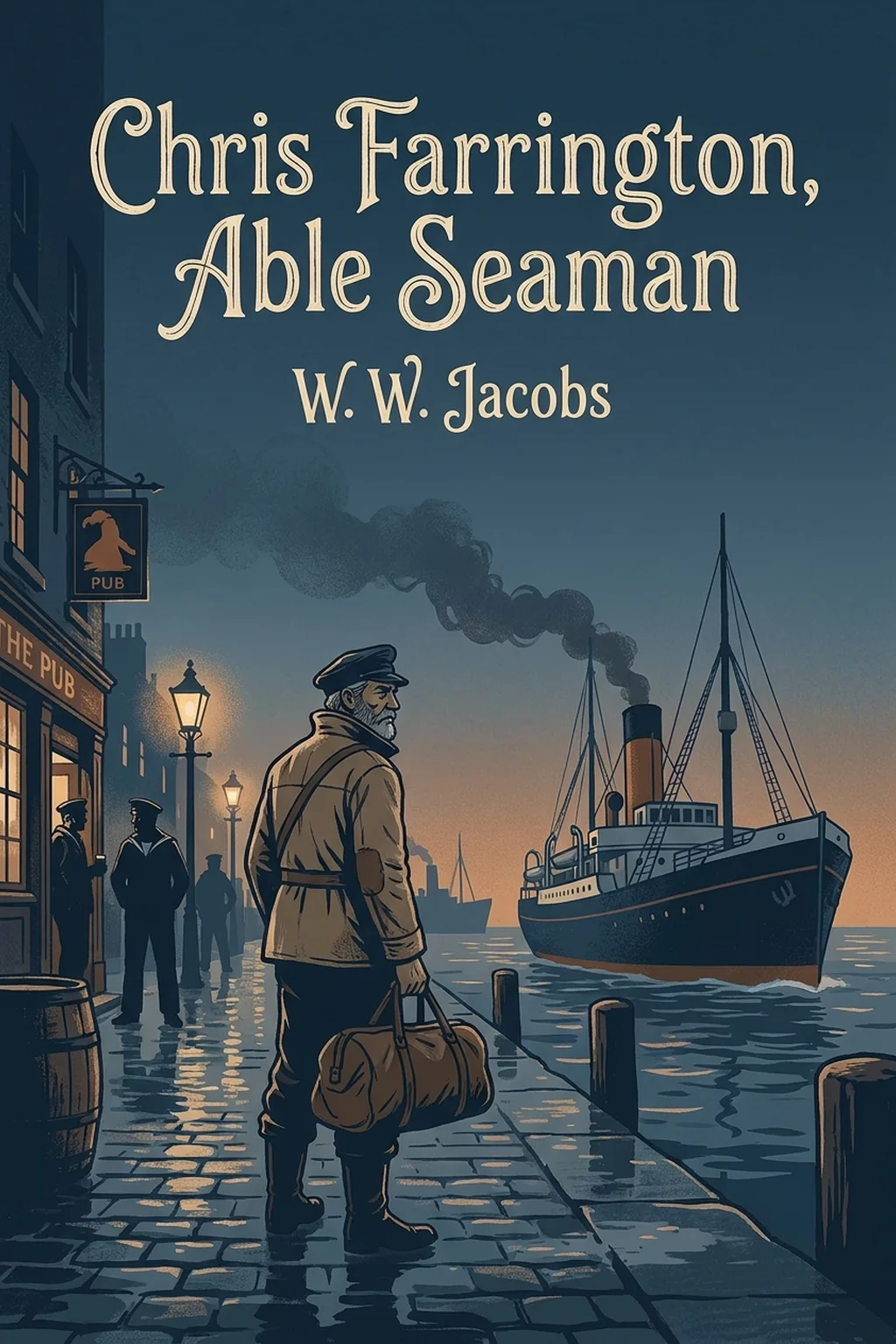
Chris Farrington, Able Seaman
"If you vas in der old country ships, a liddle shaver like you vood pe only der boy, and you vood wait on der able seamen. Und ven der able seaman sing out, 'Boy, der water-jug!' you vood jump quick, like a shot, and bring der water-jug. Und ven der able seaman sing out, 'Boy, my boots!' you vood get der boots. Und you vood pe politeful, and say 'Yessir' and 'No sir.' But you pe in der American ship, and you t'ink you are so good as der able seamen. Chris, mine boy, I haf ben a sailorman for twenty-two years, and do you t'ink you are so good as me? I vas a sailorman pefore you vas borned, and I knot and reef and splice ven you play mit topstrings and fly kites."
“‘’‘’‘’‘’22”
"But you are unfair, Emil!" cried Chris Farrington, his sensitive face flushed and hurt. He was a slender though strongly built young fellow of seventeen, with Yankee ancestry writ large all over him.
“”·17
"Dere you go vonce again!" the Swedish sailor exploded. "My name is Mister Johansen, and a kid of a boy like you call me 'Emil!' It vas insulting, and comes pecause of der American ship!"
“”“‘’”
"But you call me 'Chris'!" the boy expostulated, reproachfully.
“‘’”
"But you vas a boy."
“”
"Who does a man's work," Chris retorted. "And because I do a man's work I have as much right to call you by your first name as you me. We are all equals in this fo'castle, and you know it. When we signed for the voyage in San Francisco, we signed as sailors on the Sophie Sutherland and there was no difference made with any of us. Haven't I always done my work? Did I ever shirk? Did you or any other man ever have to take a wheel for me? Or a lookout? Or go aloft?"
“”“·”
"Chris is right," interrupted a young English sailor. "No man has had to do a tap of his work yet. He signed as good as any of us, and he's shown himself as good—”
“”“……”
"Better!" broke in a Nova Scotia man. "Better than some of us! When we struck the sealing-grounds he turned out to be next to the best boat-steerer aboard. Only French Louis, who'd been at it for years, could beat him. I'm only a boat-puller, and you're only a boat-puller, too, Emil Johansen, for all your twenty-two years at sea. Why don't you become a boat-steerer?”
“”“·22”
"Too clumsy," laughed the Englishman, "and too slow."
“”“”
"Little that counts, one way or the other," joined in Dane Jurgensen, coming to the aid of his Scandinavian brother. "Emil is a man grown and an able seaman; the boy is neither."
“”“”
And so the argument raged back and forth, the Swedes, Norwegians and Danes, because of race kinship, taking the part of Johansen, and the English, Canadians and Americans taking the part of Chris. From an unprejudiced point of view, the right was on the side of Chris. As he had truly said, he did a man's work, and the same work that any of them did. But they were prejudiced, and badly so, and out of the words which passed rose a standing quarrel which divided the forecastle into two parties.
The Sophie Sutherland was a seal-hunter, registered out of San Francisco, and engaged in hunting the furry sea-animals along the Japanese coast north to Bering Sea. The other vessels were two-masted schooners, but she was a three-master and the largest in the fleet. In fact, she was a full-rigged, three-topmast schooner, newly built.
·
Although Chris Farrington knew that justice was with him, and that he performed all his work faithfully and well, many a time, in secret thought, he longed for some pressing emergency to arise whereby he could demonstrate to the Scandinavian seamen that he also was an able seaman.
·
But one stormy night, by an accident for which he was in nowise accountable, in overhauling a spare anchor-chain he had all the fingers of his left hand badly crushed. And his hopes were likewise crushed, for it was impossible for him to continue hunting with the boats, and he was forced to stay idly aboard until his fingers should heal. Yet, although he little dreamed it, this very accident was to give him the long-looked-for opportunity.
One afternoon in the latter part of May the Sophie Sutherland rolled sluggishly in a breathless calm. The seals were abundant, the hunting good, and the boats were all away and out of sight. And with them was almost every man of the crew. Besides Chris, there remained only the captain, the sailing-master and the Chinese cook.
·
The captain was captain only by courtesy. He was an old man, past eighty, and blissfully ignorant of the sea and its ways; but he was the owner of the vessel, and hence the honorable title. Of course the sailing-master, who was really captain, was a thoroughgoing seaman. The mate, whose post was aboard, was out with the boats, having temporarily taken Chris's place as boat-steerer.
When good weather and good sport came together, the boats were accustomed to range far and wide, and often did not return to the schooner until long after dark. But for all that it was a perfect hunting day, Chris noted a growing anxiety on the part of the sailing-master. He paced the deck nervously, and was constantly sweeping the horizon with his marine glasses. Not a boat was in sight. As sunset arrived, he even sent Chris aloft to the mizzen-topmast-head, but with no better luck. The boats could not possibly be back before midnight.
Since noon the barometer had been falling with startling rapidity, and all the signs were ripe for a great storm—how great, not even the sailing-master anticipated. He and Chris set to work to prepare for it. They put storm gaskets on the furled topsails, lowered and stowed the foresail and spanker and took in the two inner jibs. In the one remaining jib they put a single reef, and a single reef in the mainsail.
——
Night had fallen before they finished, and with the darkness came the storm. A low moan swept over the sea, and the wind struck the Sophie Sutherland flat. But she righted quickly, and with the sailing-master at the wheel, sheered her bow into within five points of the wind. Working as well as he could with his bandaged hand, and with the feeble aid of the Chinese cook, Chris went forward and backed the jib over the weather side. This with the flat mainsail left the schooner hove to.
·
"God help the boats! It's no gale! It's a typhoon!" the sailing-master shouted to Chris at eleven o'clock. "Too much canvas! Got to get two more reefs into that mainsail, and got to do it right away!" He glanced at the old captain, shivering in oilskins at the binnacle and holding on for dear life. "There's only you and I, Chris—and the cook; but he's next to worthless!"
“”“”“——”
In order to make the reef, it was necessary to lower the mainsail, and the removal of this after pressure was bound to make the schooner fall off before the wind and sea because of the forward pressure of the jib.
"Take the wheel!" the sailing-master directed. "And when I give the word, hard up with it! And when she's square before it, steady her! And keep her there! We'll heave to again as soon as I get the reefs in!"
“”“”
Gripping the kicking spokes, Chris watched him and the reluctant cook go forward into the howling darkness. The Sophie Sutherland was plunging into the huge head-seas and wallowing tremendously, the tense steel stays and taut rigging humming like harp-strings to the wind. A buffeted cry came to his ears, and he felt the schooner's bow paying off of its own accord. The mainsail was down!
·
He ran the wheel hard-over and kept anxious track of the changing direction of the wind on his face and of the heave of the vessel. This was the crucial moment. In performing the evolution she would have to pass broadside to the surge before she could get before it. The wind was blowing directly on his right cheek, when he felt the Sophie Sutherland lean over and begin to rise toward the sky—up—up—an infinite distance! Would she clear the crest of the gigantic wave?
·——————
Again by the feel of it, he could see nothing, he knew that a wall of water was rearing and curving far above him along the whole weather side. There was an instant's calm as the liquid wall intervened and shut off the wind. The schooner righted, and for that instant seemed at perfect rest. Then she rolled to meet the descending rush.
Chris shouted to the captain to hold tight, and prepared himself for the shock. But the man did not live who could face it. An ocean of water smote Chris's back and his clutch on the spokes was loosened as if it were a baby's. Stunned, powerless, like a straw on the face of a torrent, he was swept onward he knew not whither. Missing the corner of the cabin, he was dashed forward along the poop runway a hundred feet or more, striking violently against the foot of the foremast. A second wave, crushing inboard, hurled him back the way he had come, and left him half-drowned where the poop steps should have been.
Bruised and bleeding, dimly conscious, he felt for the rail and dragged himself to his feet. Unless something could be done, he knew the last moment had come. As he faced the poop, the wind drove into his mouth with suffocating force. This brought him back to his senses with a start. The wind was blowing from dead aft! The schooner was out of the trough and before it! But the send of the sea was bound to breach her to again. Crawling up the runway, he managed to get to the wheel just in time to prevent this. The binnacle light was still burning. They were safe!
That is, he and the schooner were safe. As to the welfare of his three companions he could not say. Nor did he dare leave the wheel in order to find out, for it took every second of his undivided attention to keep the vessel to her course. The least fraction of carelessness and the heave of the sea under the quarter was liable to thrust her into the trough. So, a boy of one hundred and forty pounds, he clung to his herculean task of guiding the two hundred straining tons of fabric amid the chaos of the great storm forces.
——
Half an hour later, groaning and sobbing, the captain crawled to Chris's feet. All was lost, he whimpered. He was smitten unto death. The galley had gone by the board, the mainsail and running-gear, the cook, everything!
"Where's the sailing-master?” Chris demanded when he had caught his breath after steadying a wild lurch of the schooner. It was no child's play to steer a vessel under single-reefed jib before a typhoon.
“”
"Clean up for'ard," the old man replied. "Jammed under the fo'c'slehead, but still breathing. Both his arms are broken, he says, and he doesn't know how many ribs. He's hurt bad."
“”“”
"Well, he'll drown there the way she's shipping water through the hawse-pipes. Go for'ard!" Chris commanded, taking charge of things as a matter of course. "Tell him not to worry; that I'm at the wheel. Help him as much as you can, and make him help"—he stopped and ran the spokes to starboard as a tremendous billow rose under the stern and yawed the schooner to port—"and make him help himself for the rest. Unship the fo'castle hatch and get him down into a bunk. Then ship the hatch again."
“”“”————“”
The captain turned his aged face forward and wavered pitifully. The waist of the ship was full of water to the bulwarks. He had just come through it, and knew death lurked every inch of the way.
"Go!" Chris shouted, fiercely. And as the fear-stricken man started, "And take another look for the cook!"
“”“”
Two hours later, almost dead from suffering, the captain returned. He had obeyed orders. The sailing-master was helpless, although safe in a bunk; the cook was gone. Chris sent the captain below to the cabin to change his clothes.
After interminable hours of toil, day broke cold and gray. Chris looked about him. The Sophie Sutherland was racing before the typhoon like a thing possessed. There was no rain, but the wind whipped the spray of the sea mast-high, obscuring everything except in the immediate neighborhood.
·
Two waves only could Chris see at a time—the one before and the one behind. So small and insignificant the schooner seemed on the long Pacific roll! Rushing up a maddening mountain, she would poise like a cockle-shell on the giddy summit, breathless and rolling, leap outward and down into the yawning chasm beneath, and bury herself in the smother of foam at the bottom. Then the recovery, another mountain, another sickening upward rush, another poise, and the downward crash. Abreast of him, to starboard, like a ghost of the storm, Chris saw the cook dashing apace with the schooner. Evidently, when washed overboard, he had grasped and become entangled in a trailing halyard.
——
For three hours more, along with this gruesome companion, Chris held the Sophie Sutherland before the wind and sea. He had long since forgotten his mangled fingers. The bandages had been torn away, and the cold, salt spray had eaten into the half-healed wounds until they were numb and no longer pained. But he was not cold. The terrific labor of steering forced the perspiration from every pore. Yet he was faint and weak with hunger and exhaustion, and hailed with delight the advent on deck of the captain, who fed him all of a pound of cake-chocolate. It strengthened him at once.
·
He ordered the captain to cut the halyard by which the cook's body was towing, and also to go forward and cut loose the jib-halyard and sheet. When he had done so, the jib fluttered a couple of moments like a handkerchief, then tore out of the bolt-ropes and vanished. The Sophie Sutherland was running under bare poles.
·
By noon the storm had spent itself, and by six in the evening the waves had died down sufficiently to let Chris leave the helm. It was almost hopeless to dream of the small boats weathering the typhoon, but there is always the chance in saving human life, and Chris at once applied himself to going back over the course along which he had fled. He managed to get a reef in one of the inner jibs and two reefs in the spanker, and then, with the aid of the watch-tackle, to hoist them to the stiff breeze that yet blew. And all through the night, tacking back and forth on the back track, he shook out canvas as fast as the wind would permit.
The injured sailing-master had turned delirious and between tending him and lending a hand with the ship, Chris kept the captain busy.
"Taught me more seamanship," as he afterward said, "than I'd learned on the whole voyage." But by daybreak the old man's feeble frame succumbed, and he fell off into exhausted sleep on the weather poop.
“”
Chris, who could now lash the wheel, covered the tired man with blankets from below, and went fishing in the lazaretto for something to eat. But by the day following he found himself forced to give in, drowsing fitfully by the wheel and waking ever and anon to take a look at things.
On the afternoon of the third day he picked up a schooner, dismasted and battered. As he approached, close-hauled on the wind, he saw her decks crowded by an unusually large crew, and on sailing in closer, made out among others the faces of his missing comrades. And he was just in the nick of time, for they were fighting a losing fight at the pumps. An hour later they, with the crew of the sinking craft, were aboard the Sophie Sutherland.
·
Having wandered so far from their own vessel, they had taken refuge on the strange schooner just before the storm broke. She was a Canadian sealer on her first voyage, and as was now apparent, her last.
The captain of the Sophie Sutherland had a story to tell, also, and he told it well—so well, in fact, that when all hands were gathered together on deck during the dog-watch, Emil Johansen strode over to Chris and gripped him by the hand.
·——·
"Chris," he said, so loudly that all could hear, "Chris, I gif in. You vas yoost so good a sailorman as I. You vas a bully boy and able seaman, and I pe proud for you!
“”“
"Und Chris!" He turned as if he had forgotten something, and called back, "From dis time always you call me 'Emil' mitout der 'Mister!'"
“”“‘’‘’”
Chun Ah Chun
There was nothing striking in the appearance of Chun Ah Chun. He was rather undersized, as Chinese go, and the Chinese narrow shoulders and spareness of flesh were his. The average tourist, casually glimpsing him on the streets of Honolulu, would have concluded that he was a good-natured little Chinese, probably the proprietor of a prosperous laundry or tailorshop. In so far as good nature and prosperity went, the judgment would be correct, though beneath the mark; for Ah Chun was as good-natured as he was prosperous, and of the latter no man knew a tithe the tale. It was well known that he was enormously wealthy, but in his case "enormous" was merely the symbol for the unknown.
“”
Ah Chun had shrewd little eyes, black and beady and so very little that they were like gimlet-holes. But they were wide apart, and they sheltered under a forehead that was patently the forehead of a thinker. For Ah Chun had his problems, and had had them all his life. Not that he ever worried over them. He was essentially a philosopher, and whether as coolie, or multi-millionaire and master of many men, his poise of soul was the same. He lived always in the high equanimity of spiritual repose, undeterred by good fortune, unruffled by ill fortune. All things went well with him, whether they were blows from the overseer in the cane field or a slump in the price of sugar when he owned those cane fields himself. Thus, from the steadfast rock of his sure content he mastered problems such as are given to few men to consider, much less to a Chinese peasant.
He was precisely that—a Chinese peasant, born to labour in the fields all his days like a beast, but fated to escape from the fields like the prince in a fairy tale. Ah Chun did not remember his father, a small farmer in a district not far from Canton; nor did he remember much of his mother, who had died when he was six. But he did remember his respected uncle, Ah Kow, for him had he served as a slave from his sixth year to his twenty-fourth. It was then that he escaped by contracting himself as a coolie to labour for three years on the sugar plantations of Hawaii for fifty cents a day.
————
Ah Chun was observant. He perceived little details that not one man in a thousand ever noticed. Three years he worked in the field, at the end of which time he knew more about cane-growing than the overseers or even the superintendent, while the superintendent would have been astounded at the knowledge the weazened little coolie possessed of the reduction processes in the mill. But Ah Chun did not study only sugar processes. He studied to find out how men came to be owners of sugar mills and plantations. One judgment he achieved early, namely, that men did not become rich from the labour of their own hands. He knew, for he had laboured for a score of years himself. The men who grew rich did so from the labour of the hands of others. That man was richest who had the greatest number of his fellow creatures toiling for him.
So, when his term of contract was up, Ah Chun invested his savings in a small importing store, going into partnership with one, Ah Yung. The firm ultimately became the great one of "Ah Chun and Ah Yung," which handled anything from India silks and ginseng to guano islands and blackbird brigs. In the meantime, Ah Chun hired out as cook. He was a good cook, and in three years he was the highest-paid chef in Honolulu. His career was assured, and he was a fool to abandon it, as Dantin, his employer, told him; but Ah Chun knew his own mind best, and for knowing it was called a triple-fool and given a present of fifty dollars over and above the wages due him.
“”50
The firm of Ah Chun and Ah Yung was prospering. There was no need for Ah Chun longer to be a cook. There were boom times in Hawaii. Sugar was being extensively planted, and labour was needed. Ah Chun saw the chance, and went into the labour-importing business. He brought thousands of Cantonese coolies into Hawaii, and his wealth began to grow. He made investments. His beady black eyes saw bargains where other men saw bankruptcy. He bought a fish-pond for a song, which later paid five hundred per cent and was the opening wedge by which he monopolized the fish market of Honolulu. He did not talk for publication, nor figure in politics, nor play at revolutions, but he forecast events more clearly and farther ahead than did the men who engineered them. In his mind's eye he saw Honolulu a modern, electric-lighted city at a time when it straggled, unkempt and sand-tormented, over a barren reef of uplifted coral rock. So he bought land. He bought land from merchants who needed ready cash, from impecunious natives, from riotous traders' sons, from widows and orphans and the lepers deported to Molokai; and, somehow, as the years went by, the pieces of land he had bought proved to be needed for warehouses, or coffee buildings, or hotels. He leased, and rented, sold and bought, and resold again.
But there were other things as well. He put his confidence and his money into Parkinson, the renegade captain whom nobody would trust. And Parkinson sailed away on mysterious voyages in the little Vega. Parkinson was taken care of until he died, and years afterward Honolulu was astonished when the news leaked out that the Drake and Acorn guano islands had been sold to the British Phosphate Trust for three-quarters of a million. Then there were the fat, lush days of King Kalakaua, when Ah Chun paid three hundred thousand dollars for the opium licence. If he paid a third of a million for the drug monopoly, the investment was nevertheless a good one, for the dividends bought him the Kalalau Plantation, which, in turn, paid him thirty per cent for seventeen years and was ultimately sold by him for a million and a half.
7530331730150
It was under the Kamehamehas, long before, that he had served his own country as Chinese Consul—a position that was not altogether unlucrative; and it was under Kamehameha IV that he changed his citizenship, becoming an Hawaiian subject in order to marry Stella Allendale, herself a subject of the brown-skinned king, though more of Anglo-Saxon blood ran in her veins than of Polynesian. In fact, the random breeds in her were so attenuated that they were valued at eighths and sixteenths. In the latter proportions was the blood of her great-grandmother, Paahao—the Princess Paahao, for she came of the royal line. Stella Allendale's great-grandfather had been a Captain Blunt, an English adventurer who took service under Kamehameha I and was made a tabu chief himself. Her grandfather had been a New Bedford whaling captain, while through her own father had been introduced a remote blend of Italian and Portuguese which had been grafted upon his own English stock. Legally a Hawaiian, Ah Chun's spouse was more of any one of three other nationalities.
——·-——·
And into this conglomerate of the races, Ah Chun introduced the Mongolian mixture. Thus, his children by Mrs. Ah Chun were one thirty-second Polynesian, one-sixteenth Italian, one sixteenth Portuguese, one-half Chinese, and eleven thirty-seconds English and American. It might well be that Ah Chun would have refrained from matrimony could he have foreseen the wonderful family that was to spring from this union. It was wonderful in many ways. First, there was its size. There were fifteen sons and daughters, mostly daughters. The sons had come first, three of them, and then had followed, in unswerving sequence, a round dozen of girls. The blend of the race was excellent. Not alone fruitful did it prove, for the progeny, without exception, was healthy and without blemish. But the most amazing thing about the family was its beauty. All the girls were beautiful—delicately, ethereally beautiful. Mamma Ah Chun's rotund lines seemed to modify papa Ah Chun's lean angles, so that the daughters were willowy without being lathy, round-muscled without being chubby. In every feature of every face were haunting reminiscences of Asia, all manipulated over and disguised by Old England, New England, and South of Europe. No observer, without information, would have guessed, the heavy Chinese strain in their veins; nor could any observer, after being informed, fail to note immediately the Chinese traces.
1/321/161/1611/32——
As beauties, the Ah Chun girls were something new. Nothing like them had been seen before. They resembled nothing so much as they resembled one another, and yet each girl was sharply individual. There was no mistaking one for another. On the other hand, Maud, who was blue-eyed and yellow-haired, would remind one instantly of Henrietta, an olive brunette with large, languishing dark eyes and hair that was blue-black. The hint of resemblance that ran through them all, reconciling every differentiation, was Ah Chun's contribution. He had furnished the groundwork upon which had been traced the blended patterns of the races. He had furnished the slim-boned Chinese frame, upon which had been builded the delicacies and subtleties of Saxon, Latin, and Polynesian flesh.
Mrs. Ah Chun had ideas of her own to which Ah Chun gave credence, though never permitting them expression when they conflicted with his own philosophic calm. She had been used all her life to living in European fashion. Very well. Ah Chun gave her a European mansion. Later, as his sons and daughters grew able to advise, he built a bungalow, a spacious, rambling affair, as unpretentious as it was magnificent. Also, as time went by, there arose a mountain house on Tantalus, to which the family could flee when the "sick wind" blew from the south. And at Waikiki he built a beach residence on an extensive site so well chosen that later on, when the United States government condemned it for fortification purposes, an immense sum accompanied the condemnation. In all his houses were billiard and smoking rooms and guest rooms galore, for Ah Chun's wonderful progeny was given to lavish entertainment. The furnishing was extravagantly simple. Kings' ransoms were expended without display—thanks to the educated tastes of the progeny.
“”——
Ah Chun had been liberal in the matter of education. "Never mind expense," he had argued in the old days with Parkinson when that slack mariner could see no reason for making the Vega seaworthy; "you sail the schooner, I pay the bills." And so with his sons and daughters. It had been for them to get the education and never mind the expense. Harold, the eldest-born, had gone to Harvard and Oxford; Albert and Charles had gone through Yale in the same classes. And the daughters, from the eldest down, had undergone their preparation at Mills Seminary in California and passed on to Vassar, Wellesley, or Bryn Mawr. Several, having so desired, had had the finishing touches put on in Europe. And from all the world Ah Chun's sons and daughters returned to him to suggest and advise in the garnishment of the chaste magnificence of his residences. Ah Chun himself preferred the voluptuous glitter of Oriental display; but he was a philosopher, and he clearly saw that his children's tastes were correct according to Western standards.
“”“”
Of course, his children were not known as the Ah Chun children. As he had evolved from a coolie labourer to a multi-millionaire, so had his name evolved. Mamma Ah Chun had spelled it A'Chun, but her wiser offspring had elided the apostrophe and spelled it Achun. Ah Chun did not object. The spelling of his name interfered no whit with his comfort nor his philosophic calm. Besides, he was not proud. But when his children arose to the height of a starched shirt, a stiff collar, and a frock coat, they did interfere with his comfort and calm. Ah Chun would have none of it. He preferred the loose-flowing robes of China, and neither could they cajole nor bully him into making the change. They tried both courses, and in the latter one failed especially disastrously. They had not been to America for nothing. They had learned the virtues of the boycott as employed by organized labour, and he, their father, Chun Ah Chun, they boycotted in his own house, Mamma Achun aiding and abetting. But Ah Chun himself, while unversed in Western culture, was thoroughly conversant with Western labour conditions. An extensive employer of labour himself, he knew how to cope with its tactics. Promptly he imposed a lockout on his rebellious progeny and erring spouse. He discharged his scores of servants, locked up his stables, closed his houses, and went to live in the Royal Hawaiian Hotel, in which enterprise he happened to be the heaviest stockholder. The family fluttered distractedly on visits about with friends, while Ah Chun calmly managed his many affairs, smoked his long pipe with the tiny silver bowl, and pondered the problem of his wonderful progeny.
"A'Chun""Achun"
This problem did not disturb his calm. He knew in his philosopher's soul that when it was ripe he would solve it. In the meantime he enforced the lesson that complacent as he might be, he was nevertheless the absolute dictator of the Achun destinies. The family held out for a week, then returned, along with Ah Chun and the many servants, to occupy the bungalow once more. And thereafter no question was raised when Ah Chun elected to enter his brilliant drawing-room in blue silk robe, wadded slippers, and black silk skull-cap with red button peak, or when he chose to draw at his slender-stemmed silver-bowled pipe among the cigarette-and cigar-smoking officers and civilians on the broad verandas or in the smoking room.
Ah Chun occupied a unique position in Honolulu. Though he did not appear in society, he was eligible anywhere. Except among the Chinese merchants of the city, he never went out; but he received, and he always was the centre of his household and the head of his table. Himself peasant, born Chinese, he presided over an atmosphere of culture and refinement second to none in all the islands. Nor were there any in all the islands too proud to cross his threshold and enjoy his hospitality. First of all, the Achun bungalow was of irreproachable tone. Next, Ah Chun was a power. And finally, Ah Chun was a moral paragon and an honest business man. Despite the fact that business morality was higher than on the mainland, Ah Chun outshone the business men of Honolulu in the scrupulous rigidity of his honesty. It was a saying that his word was as good as his bond. His signature was never needed to bind him. He never broke his word. Twenty years after Hotchkiss, of Hotchkiss, Morterson Company, died, they found among mislaid papers a memorandum of a loan of thirty thousand dollars to Ah Chun. It had been incurred when Ah Chun was Privy Councillor to Kamehameha II. In the bustle and confusion of those heyday, money-making times, the affair had slipped Ah Chun's mind. There was no note, no legal claim against him, but he settled in full with the Hotchkiss' Estate, voluntarily paying a compound interest that dwarfed the principal. Likewise, when he verbally guaranteed the disastrous Kakiku Ditch Scheme, at a time when the least sanguine did not dream a guarantee necessary—"Signed his cheque for two hundred thousand without a quiver, gentlemen, without a quiver," was the report of the secretary of the defunct enterprise, who had been sent on the forlorn hope of finding out Ah Chun's intentions. And on top of the many similar actions that were true of his word, there was scarcely a man of repute in the islands that at one time or another had not experienced the helping financial hand of Ah Chun.
——20——“20”
So it was that Honolulu watched his wonderful family grow up into a perplexing problem and secretly sympathized with him, for it was beyond any of them to imagine what he was going to do with it. But Ah Chun saw the problem more clearly than they. No one knew as he knew the extent to which he was an alien in his family. His own family did not guess it. He saw that there was no place for him amongst this marvellous seed of his loins, and he looked forward to his declining years and knew that he would grow more and more alien. He did not understand his children. Their conversation was of things that did not interest him and about which he knew nothing. The culture of the West had passed him by. He was Asiatic to the last fibre, which meant that he was heathen. Their Christianity was to him so much nonsense. But all this he would have ignored as extraneous and irrelevant, could he have but understood the young people themselves. When Maud, for instance, told him that the housekeeping bills for the month were thirty thousand—that he understood, as he understood Albert's request for five thousand with which to buy the schooner yacht Muriel and become a member of the Hawaiian Yacht Club. But it was their remoter, complicated desires and mental processes that obfuscated him. He was not slow in learning that the mind of each son and daughter was a secret labyrinth which he could never hope to tread. Always he came upon the wall that divides East from West. Their souls were inaccessible to him, and by the same token he knew that his soul was inaccessible to them.
3——5
Besides, as the years came upon him, he found himself harking back more and more to his own kind. The reeking smells of the Chinese quarter were spicy to him. He sniffed them with satisfaction as he passed along the street, for in his mind they carried him back to the narrow tortuous alleys of Canton swarming with life and movement. He regretted that he had cut off his queue to please Stella Allendale in the prenuptial days, and he seriously considered the advisability of shaving his crown and growing a new one. The dishes his highly paid chef concocted for him failed to tickle his reminiscent palate in the way that the weird messes did in the stuffy restaurant down in the Chinese quarter. He enjoyed vastly more a half-hour's smoke and chat with two or three Chinese chums, than to preside at the lavish and elegant dinners for which his bungalow was famed, where the pick of the Americans and Europeans sat at the long table, men and women on equality, the women with jewels that blazed in the subdued light against white necks and arms, the men in evening dress, and all chattering and laughing over topics and witticisms that, while they were not exactly Greek to him, did not interest him nor entertain.
·
But it was not merely his alienness and his growing desire to return to his Chinese flesh-pots that constituted the problem. There was also his wealth. He had looked forward to a placid old age. He had worked hard. His reward should have been peace and repose. But he knew that with his immense fortune peace and repose could not possibly be his. Already there were signs and omens. He had seen similar troubles before. There was his old employer, Dantin, whose children had wrested from him, by due process of law, the management of his property, having the Court appoint guardians to administer it for him. Ah Chun knew, and knew thoroughly well, that had Dantin been a poor man, it would have been found that he could quite rationally manage his own affairs. And old Dantin had had only three children and half a million, while he, Chun Ah Chun, had fifteen children and no one but himself knew how many millions.
50
"Our daughters are beautiful women," he said to his wife, one evening. "There are many young men. The house is always full of young men. My cigar bills are very heavy. Why are there no marriages?"
“”“”
Mamma Achun shrugged her shoulders and waited.
"Women are women and men are men—it is strange there are no marriages. Perhaps the young men do not like our daughters.”
“——”
"Ah, they like them well enough," Mamma Chun answered; "but you see, they cannot forget that you are your daughters' father."
“”“”
"Yet you forgot who my father was," Ah Chun said gravely. "All you asked was for me to cut off my queue."
“”“”
"The young men are more particular than I was, I fancy."
“”
"What is the greatest thing in the world?" Ah Chun demanded with abrupt irrelevance.
“”
Mamma Achun pondered for a moment, then replied: "God."
“”
He nodded. "There are gods and gods. Some are paper, some are wood, some are bronze. I use a small one in the office for a paper-weight. In the Bishop Museum are many gods of coral rock and lava stone.”
“
"But there is only one God," she announced decisively, stiffening her ample frame argumentatively.
“”
Ah Chun noted the danger signal and sheered off.
"What is greater than God, then?" he asked. "I will tell you. It is money. In my time I have had dealings with Jews and Christians, Mohammedans and Buddhists, and with little black men from the Solomons and New Guinea who carried their god about them, wrapped in oiled paper. They possessed various gods, these men, but they all worshipped money. There is that Captain Higginson. He seems to like Henrietta."
“”“”
"He will never marry her," retorted Mamma Achun. "He will be an admiral before he dies—”
“”“……”
"A rear-admiral," Ah Chun interpolated.
“”
"Yes, I know. That is the way they retire."
“”
"His family in the United States is a high one. They would not like it if he married...if he did not marry an American girl."
“……”
Ah Chun knocked the ashes out of his pipe, thoughtfully refilling the silver bowl with a tiny pledget of tobacco. He lighted it and smoked it out before he spoke.
"Henrietta is the oldest girl. The day she marries I will give her three hundred thousand dollars. That will fetch that Captain Higginson and his high family along with him. Let the word go out to him. I leave it to you."
“30”
And Ah Chun sat and smoked on, and in the curling smoke-wreaths he saw take shape the face and figure of Toy Shuey—Toy Shuey, the maid of all work in his uncle's house in the Cantonese village, whose work was never done and who received for a whole year's work one dollar. And he saw his youthful self arise in the curling smoke, his youthful self who had toiled eighteen years in his uncle's field for little more. And now he, Ah Chun, the peasant, dowered his daughter with three hundred thousand years of such toil. And she was but one daughter of a dozen. He was not elated at the thought. It struck him that it was a funny, whimsical world, and he chuckled aloud and startled Mamma Achun from a revery which he knew lay deep in the hidden crypts of her being where he had never penetrated.
——3012
But Ah Chun's word went forth, as a whisper, and Captain Higginson forgot his rear-admiralship and his high family and took to wife three hundred thousand dollars and a refined and cultured girl who was one thirty-second Polynesian, one-sixteenth Italian, one-sixteenth Portuguese, eleven thirty-seconds English and Yankee, and one-half Chinese.
301/321/161/161/321/2
Ah Chun's munificence had its effect. His daughters became suddenly eligible and desirable. Clara was the next, but when the Secretary of the Territory formally proposed for her, Ah Chun informed him that he must wait his turn, that Maud was the oldest and that she must be married first. It was shrewd policy. The whole family was made vitally interested in marrying off Maud, which it did in three months, to Ned Humphreys, the United States immigration commissioner. Both he and Maud complained, for the dowry was only two hundred thousand. Ah Chun explained that his initial generosity had been to break the ice, and that after that his daughters could not expect otherwise than to go more cheaply.
·20
Clara followed Maud, and thereafter, for a space of two years; there was a continuous round of weddings in the bungalow. In the meantime Ah Chun had not been idle. Investment after investment was called in. He sold out his interests in a score of enterprises, and step by step, so as not to cause a slump in the market, he disposed of his large holdings in real estate. Toward the last he did precipitate a slump and sold at sacrifice. What caused this haste were the squalls he saw already rising above the horizon. By the time Lucille was married, echoes of bickerings and jealousies were already rumbling in his ears. The air was thick with schemes and counter-schemes to gain his favour and to prejudice him against one or another or all but one of his sons-in-law. All of which was not conducive to the peace and repose he had planned for his old age.
He hastened his efforts. For a long time he had been in correspondence with the chief banks in Shanghai and Macao. Every steamer for several years had carried away drafts drawn in favour of one, Chun Ah Chun, for deposit in those Far Eastern banks. The drafts now became heavier. His two youngest daughters were not yet married. He did not wait, but dowered them with a hundred thousand each, which sums lay in the Bank of Hawaii, drawing interest and awaiting their wedding day. Albert took over the business of the firm of Ah Chun and Ah Yung, Harold, the eldest, having elected to take a quarter of a million and go to England to live. Charles, the youngest, took a hundred thousand, a legal guardian, and a course in a Keeley institute. To Mamma Achun was given the bungalow, the mountain House on Tantalus, and a new seaside residence in place of the one Ah Chun sold to the government. Also, to Mamma Achun was given half a million in money well invested.
102510
Ah Chun was now ready to crack the nut of the problem. One fine morning when the family was at breakfast—he had seen to it that all his sons-in-law and their wives were present—he announced that he was returning to his ancestral soil. In a neat little homily he explained that he had made ample provision for his family, and he laid down various maxims that he was sure, he said, would enable them to dwell together in peace and harmony. Also, he gave business advice to his sons-in-law, preached the virtues of temperate living and safe investments, and gave them the benefit of his encyclopedic knowledge of industrial and business conditions in Hawaii. Then he called for his carriage, and, in the company of the weeping Mamma Achun, was driven down to the Pacific Mail steamer, leaving behind him a panic in the bungalow. Captain Higginson clamoured wildly for an injunction. The daughters shed copious tears. One of their husbands, an ex-Federal judge, questioned Ah Chun's sanity, and hastened to the proper authorities to inquire into it. He returned with the information that Ah Chun had appeared before the commission the day before, demanded an examination, and passed with flying colours. There was nothing to be done, so they went down and said good-bye to the little old man, who waved farewell from the promenade deck as the big steamer poked her nose seaward through the coral reef.
————
But the little old man was not bound for Canton. He knew his own country too well, and the squeeze of the Mandarins, to venture into it with the tidy bulk of wealth that remained to him. He went to Macao. Now Ah Chun had long exercised the power of a king and he was as imperious as a king. When he landed at Macao and went into the office of the biggest European hotel to register, the clerk closed the book on him. Chinese were not permitted. Ah Chun called for the manager and was treated with contumely. He drove away, but in two hours he was back again. He called the clerk and manager in, gave them a month's salary, and discharged them. He had made himself the owner of the hotel; and in the finest suite he settled down during the many months the gorgeous palace in the suburbs was building for him. In the meantime, with the inevitable ability that was his, he increased the earnings of his big hotel from three per cent to thirty.
330
The troubles Ah Chun had flown began early. There were sons-in-law that made bad investments, others that played ducks and drakes with the Achun dowries. Ah Chun being out of it, they looked at Mamma Ah Chun and her half million, and, looking, engendered not the best of feeling toward one another. Lawyers waxed fat in the striving to ascertain the construction of trust deeds. Suits, cross-suits, and counter-suits cluttered the Hawaiian courts. Nor did the police courts escape. There were angry encounters in which harsh words and harsher blows were struck. There were such things as flower pots being thrown to add emphasis to winged words. And suits for libel arose that dragged their way through the courts and kept Honolulu agog with excitement over the revelations of the witnesses.
In his palace, surrounded by all dear delights of the Orient, Ah Chun smokes his placid pipe and listens to the turmoil overseas. By each mail steamer, in faultless English, typewritten on an American machine, a letter goes from Macao to Honolulu, in which, by admirable texts and precepts, Ah Chun advises his family to live in unity and harmony. As for himself, he is out of it all, and well content. He has won to peace and repose. At times he chuckles and rubs his hands, and his slant little black eyes twinkle merrily at the thought of the funny world. For out of all his living and philosophizing, that remains to him—the conviction that it is a very funny world.
——
For work background, reading notes, and source credits, see the book introduction.