Section 1
Bridge Bilingual Classics
Jack London's Short Stories (Vol. VIII)
·
The Fatal Gold
Jack London
·
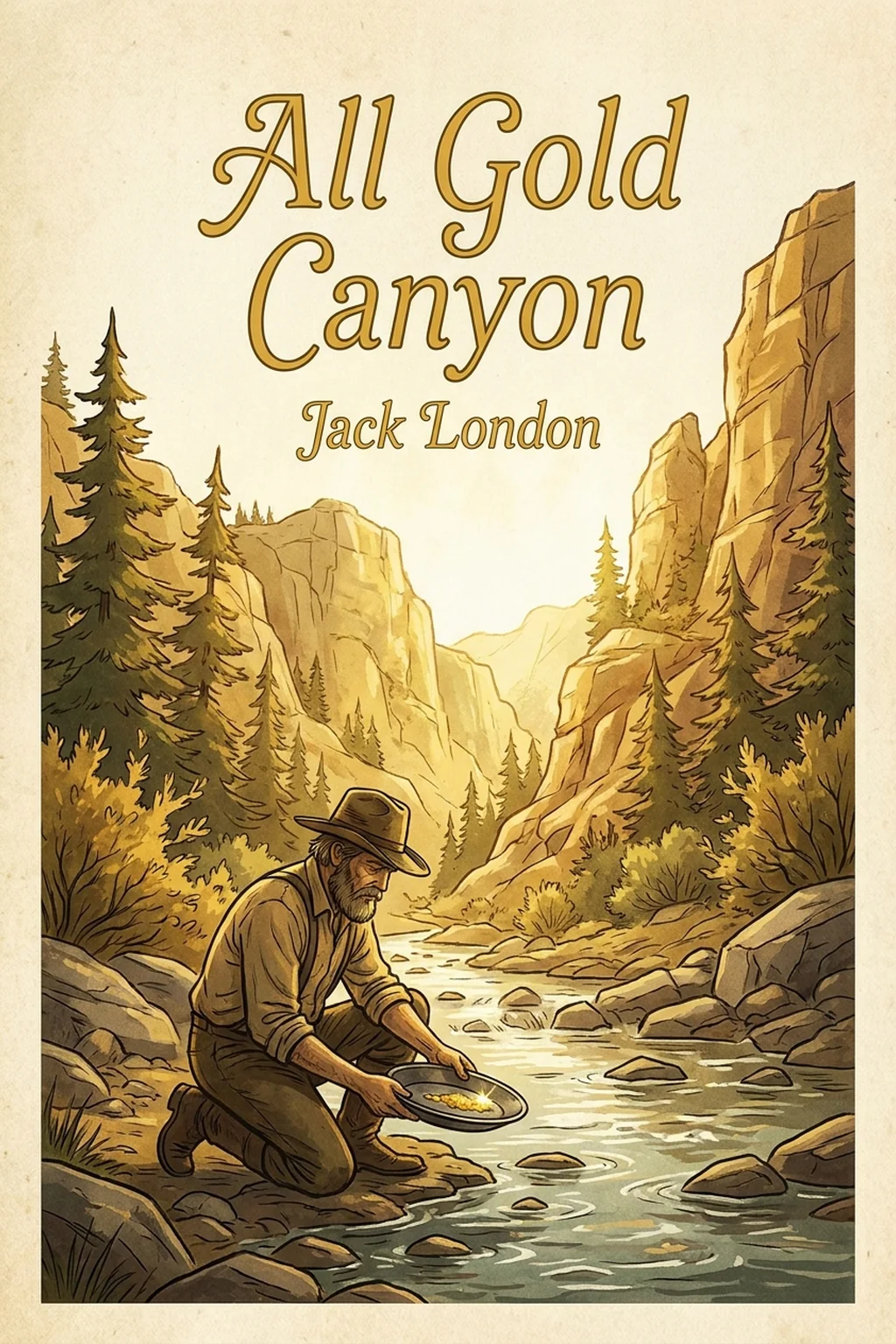
All Gold Canon
All Gold Cañon
It was the green heart of the cañon, where the walls swerved back from the rigid plan and relieved their harshness of line by making a little sheltered nook and filling it to the brim with sweetness and roundness and softness. Here all things rested. Even the narrow stream ceased its turbulent down-rush long enough to form a quiet pool. Knee-deep in the water, with drooping head and half-shut eyes, drowsed a red-coated, many-antlered buck.
On one side, beginning at the very lip of the pool, was a tiny meadow, a cool, resilient surface of green that extended to the base of the frowning wall. Beyond the pool a gentle slope of earth ran up and up to meet the opposing wall. Fine grass covered the slope—grass that was spangled with flowers, with here and there patches of color, orange and purple and golden. Below, the cañon was shut in. There was no view. The walls leaned together abruptly and the cañon ended in a chaos of rocks, moss-covered and hidden by a green screen of vines and creepers and boughs of trees. Up the cañon rose far hills and peaks, the big foot-hills, pine-covered and remote. And far beyond, like clouds upon the border of the sky, towered minarets of white, where the Sierra's eternal snows flashed austerely the blazes of the sun.
There was no dust in the cañon. The leaves and flowers were clean and virginal. The grass was young velvet. Over the pool three cottonwoods sent their snowy fluffs fluttering down the quiet air. On the slope the blossoms of the wine-wooded manzanita filled the air with springtime odors, while the leaves, wise with experience, were already beginning their vertical twist against the coming aridity of summer. In the open spaces on the slope, beyond the farthest shadow-reach of the manzanita, poised the mariposa lilies, like so many flights of jewelled moths suddenly arrested and on the verge of trembling into flight again. Here and there that woods harlequin, the madrone, permitting itself to be caught in the act of changing its pea-green trunk to madder-red, breathed its fragrance into the air from great clusters of waxen bells. Creamy white were these bells, shaped like lilies-of-the-valley, with the sweetness of perfume that is of the springtime.
——
There was not a sigh of wind. The air was drowsy with its weight of perfume. It was a sweetness that would have been cloying had the air been heavy and humid. But the air was sharp and thin. It was as starlight transmuted into atmosphere, shot through and warmed by sunshine, and flower-drenched with sweetness.
An occasional butterfly drifted in and out through the patches of light and shade. And from all about rose the low and sleepy hum of mountain bees—feasting Sybarites that jostled one another good-naturedly at the board, nor found time for rough discourtesy. So quietly did the little stream drip and ripple its way through the cañon that it spoke only in faint and occasional gurgles. The voice of the stream was as a drowsy whisper, ever interrupted by dozings and silences, ever lifted again in the awakenings.
The motion of all things was a drifting in the heart of the cañon. Sunshine and butterflies drifted in and out among the trees. The hum of the bees and the whisper of the stream were a drifting of sound. And the drifting sound and drifting color seemed to weave together in the making of a delicate and intangible fabric which was the spirit of the place. It was a spirit of peace that was not of death, but of smooth-pulsing life, of quietude that was not silence, of movement that was not action, of repose that was quick with existence without being violent with struggle and travail. The spirit of the place was the spirit of the peace of the living, somnolent with the easement and content of prosperity, and undisturbed by rumors of far wars.
The red-coated, many-antlered buck acknowledged the lordship of the spirit of the place and dozed knee-deep in the cool, shaded pool. There seemed no flies to vex him and he was languid with rest. Sometimes his ears moved when the stream awoke and whispered; but they moved lazily, with foreknowledge that it was merely the stream grown garrulous at discovery that it had slept.
But there came a time when the buck's ears lifted and tensed with swift eagerness for sound. His head was turned down the cañon. His sensitive, quivering nostrils scented the air. His eyes could not pierce the green screen through which the stream rippled away, but to his ears came the voice of a man. It was a steady, monotonous, singsong voice. Once the buck heard the harsh clash of metal upon rock. At the sound he snorted with a sudden start that jerked him through the air from water to meadow, and his feet sank into the young velvet, while he pricked his ears and again scented the air. Then he stole across the tiny meadow, pausing once and again to listen, and faded away out of the cañon like a wraith, soft-footed and without sound.
The clash of steel-shod soles against the rocks began to be heard, and the man's voice grew louder. It was raised in a sort of chant and became distinct with nearness, so that the words could be heard:
"Tu'n around an' tu'n yo' face Untoe them sweet hills of grace (D' pow'rs of sin yo' am scornin'!). Look about an' look aroun’, Fling yo' sin-pack on d' groun’ (Yo' will meet wid d' Lord in d' mornin'!).”
“”
A sound of scrambling accompanied the song, and the spirit of the place fled away on the heels of the red-coated buck. The green screen was burst asunder, and a man peered out at the meadow and the pool and the sloping side-hill. He was a deliberate sort of man. He took in the scene with one embracing glance, then ran his eyes over the details to verify the general impression. Then, and not until then, did he open his mouth in vivid and solemn approval:
"Smoke of life an' snakes of purgatory! Will you just look at that! Wood an' water an' grass an' a side-hill! A pocket-hunter's delight an' a cayuse's paradise! Cool green for tired eyes! Pink pills for pale people ain't in it. A secret pasture for prospectors and a resting-place for tired burros, by damn!”
“”
He was a sandy-complexioned man in whose face geniality and humor seemed the salient characteristics. It was a mobile face, quick-changing to inward mood and thought. Thinking was in him a visible process. Ideas chased across his face like wind-flaws across the surface of a lake. His hair, sparse and unkempt of growth, was as indeterminate and colorless as his complexion. It would seem that all the color of his frame had gone into his eyes, for they were startlingly blue. Also, they were laughing and merry eyes, within them much of the naivete and wonder of the child; and yet, in an unassertive way, they contained much of calm self-reliance and strength of purpose founded upon self-experience and experience of the world.
From out the screen of vines and creepers he flung ahead of him a miner's pick and shovel and gold-pan. Then he crawled out himself into the open. He was clad in faded overalls and black cotton shirt, with hobnailed brogans on his feet, and on his head a hat whose shapelessness and stains advertised the rough usage of wind and rain and sun and camp-smoke. He stood erect, seeing wide-eyed the secrecy of the scene and sensuously inhaling the warm, sweet breath of the cañon-garden through nostrils that dilated and quivered with delight. His eyes narrowed to laughing slits of blue, his face wreathed itself in joy, and his mouth curled in a smile as he cried aloud:
"Jumping dandelions and happy hollyhocks, but that smells good to me! Talk about your attar o' roses an' cologne factories! They ain't in it!”
“”
He had the habit of soliloquy. His quick-changing facial expressions might tell every thought and mood, but the tongue, perforce, ran hard after, repeating, like a second Boswell.
The man lay down on the lip of the pool and drank long and deep of its water. "Tastes good to me," he murmured, lifting his head and gazing across the pool at the side-hill, while he wiped his mouth with the back of his hand. The side-hill attracted his attention. Still lying on his stomach, he studied the hill formation long and carefully. It was a practised eye that travelled up the slope to the crumbling cañon-wall and back and down again to the edge of the pool. He scrambled to his feet and favored the side-hill with a second survey.
“”
"Looks good to me," he concluded, picking up his pick and shovel and gold-pan.
“”
He crossed the stream below the pool, stepping agilely from stone to stone. Where the side-hill touched the water he dug up a shovelful of dirt and put it into the gold-pan. He squatted down, holding the pan in his two hands, and partly immersing it in the stream. Then he imparted to the pan a deft circular motion that sent the water sluicing in and out through the dirt and gravel. The larger and the lighter particles worked to the surface, and these, by a skilful dipping movement of the pan, he spilled out and over the edge. Occasionally, to expedite matters, he rested the pan and with his fingers raked out the large pebbles and pieces of rock.
The contents of the pan diminished rapidly until only fine dirt and the smallest bits of gravel remained. At this stage he began to work very deliberately and carefully. It was fine washing, and he washed fine and finer, with a keen scrutiny and delicate and fastidious touch. At last the pan seemed empty of everything but water; but with a quick semicircular flirt that sent the water flying over the shallow rim into the stream, he disclosed a layer of black sand on the bottom of the pan. So thin was this layer that it was like a streak of paint. He examined it closely. In the midst of it was a tiny golden speck. He dribbled a little water in over the depressed edge of the pan. With a quick flirt he sent the water sluicing across the bottom, turning the grains of black sand over and over. A second tiny golden speck rewarded his effort.
The washing had now become very fine—fine beyond all need of ordinary placer-mining. He worked the black sand, a small portion at a time, up the shallow rim of the pan. Each small portion he examined sharply, so that his eyes saw every grain of it before he allowed it to slide over the edge and away. Jealously, bit by bit, he let the black sand slip away. A golden speck, no larger than a pin-point, appeared on the rim, and by his manipulation of the water it returned to the bottom of the pan. And in such fashion another speck was disclosed, and another. Great was his care of them. Like a shepherd he herded his flock of golden specks so that not one should be lost. At last, of the pan of dirt nothing remained but his golden herd. He counted it, and then, after all his labor, sent it flying out of the pan with one final swirl of water.
But his blue eyes were shining with desire as he rose to his feet. "Seven," he muttered aloud, asserting the sum of the specks for which he had toiled so hard and which he had so wantonly thrown away. "Seven," he repeated, with the emphasis of one trying to impress a number on his memory.
“”“”
He stood still a long while, surveying the hillside. In his eyes was a curiosity, new-aroused and burning. There was an exultance about his bearing and a keenness like that of a hunting animal catching the fresh scent of game.
He moved down the stream a few steps and took a second panful of dirt.
Again came the careful washing, the jealous herding of the golden specks, and the wantonness with which he sent them flying into the stream when he had counted their number.
"Five," he muttered, and repeated, "five."
“”“”
He could not forbear another survey of the hill before filling the pan farther down the stream. His golden herds diminished. "Four, three, two, two, one," were his memory-tabulations as he moved down the stream. When but one speck of gold rewarded his washing, he stopped and built a fire of dry twigs. Into this he thrust the gold-pan and burned it till it was blue-black. He held up the pan and examined it critically. Then he nodded approbation. Against such a color-background he could defy the tiniest yellow speck to elude him.
“”
Still moving down the stream, he panned again. A single speck was his reward. A third pan contained no gold at all. Not satisfied with this, he panned three times again, taking his shovels of dirt within a foot of one another. Each pan proved empty of gold, and the fact, instead of discouraging him, seemed to give him satisfaction. His elation increased with each barren washing, until he arose, exclaiming jubilantly:
"If it ain't the real thing, may God knock off my head with sour apples!”
“”
Returning to where he had started operations, he began to pan up the stream. At first his golden herds increased—increased prodigiously. "Fourteen, eighteen, twenty-one, twenty-six," ran his memory tabulations. Just above the pool he struck his richest pan—thirty-five colors.
——“”——
"Almost enough to save," he remarked regretfully as he allowed the water to sweep them away.
“”
The sun climbed to the top of the sky. The man worked on. Pan by pan, he went up the stream, the tally of results steadily decreasing.
"It's just booful, the way it peters out," he exulted when a shovelful of dirt contained no more than a single speck of gold.
“”
And when no specks at all were found in several pans, he straightened up and favored the hillside with a confident glance.
"Ah, ha! Mr. Pocket!" he cried out, as though to an auditor hidden somewhere above him beneath the surface of the slope. "Ah, ha! Mr. Pocket! I'm a-comin’, I'm a-comin’, an' I'm shorely gwine to get yer! You heah me, Mr. Pocket? I'm gwine to get yer as shore as punkins ain't cauliflowers!”
“”“”
He turned and flung a measuring glance at the sun poised above him in the azure of the cloudless sky. Then he went down the cañon, following the line of shovel-holes he had made in filling the pans. He crossed the stream below the pool and disappeared through the green screen. There was little opportunity for the spirit of the place to return with its quietude and repose, for the man's voice, raised in ragtime song, still dominated the cañon with possession.
After a time, with a greater clashing of steel-shod feet on rock, he returned. The green screen was tremendously agitated. It surged back and forth in the throes of a struggle. There was a loud grating and clanging of metal. The man's voice leaped to a higher pitch and was sharp with imperativeness. A large body plunged and panted. There was a snapping and ripping and rending, and amid a shower of falling leaves a horse burst through the screen. On its back was a pack, and from this trailed broken vines and torn creepers. The animal gazed with astonished eyes at the scene into which it had been precipitated, then dropped its head to the grass and began contentedly to graze. A second horse scrambled into view, slipping once on the mossy rocks and regaining equilibrium when its hoofs sank into the yielding surface of the meadow. It was riderless, though on its back was a high-horned Mexican saddle, scarred and discolored by long usage.
The man brought up the rear. He threw off pack and saddle, with an eye to camp location, and gave the animals their freedom to graze. He unpacked his food and got out frying-pan and coffee-pot. He gathered an armful of dry wood, and with a few stones made a place for his fire.
"My!" he said, "but I've got an appetite. I could scoff iron-filings an' horseshoe nails an' thank you kindly, ma'am, for a second helpin’.”
“”“”
He straightened up, and, while he reached for matches in the pocket of his overalls, his eyes travelled across the pool to the side-hill. His fingers had clutched the match-box, but they relaxed their hold and the hand came out empty. The man wavered perceptibly. He looked at his preparations for cooking and he looked at the hill.
"Guess I'll take another whack at her," he concluded, starting to cross the stream.
“”
"They ain't no sense in it, I know," he mumbled apologetically. "But keepin' grub back an hour ain't goin' to hurt none, I reckon.”
“”“”
A few feet back from his first line of test-pans he started a second line. The sun dropped down the western sky, the shadows lengthened, but the man worked on. He began a third line of test-pans. He was cross-cutting the hillside, line by line, as he ascended. The centre of each line produced the richest pans, while the ends came where no colors showed in the pan. And as he ascended the hillside the lines grew perceptibly shorter. The regularity with which their length diminished served to indicate that somewhere up the slope the last line would be so short as to have scarcely length at all, and that beyond could come only a point. The design was growing into an inverted "V." The converging sides of this "V" marked the boundaries of the gold-bearing dirt. The apex of the "V" was evidently the man's goal. Often he ran his eye along the converging sides and on up the hill, trying to divine the apex, the point where the gold-bearing dirt must cease. Here resided "Mr. Pocket"—for so the man familiarly addressed the imaginary point above him on the slope, crying out:
"V""V""V"“”——
"Come down out o' that, Mr. Pocket! Be right smart an' agreeable, an' come down!”
“”
"All right," he would add later, in a voice resigned to determination. "All right, Mr. Pocket. It's plain to me I got to come right up an' snatch you out bald-headed. An' I'll do it! I'll do it!" he would threaten still later.
“”“”
Each pan he carried down to the water to wash, and as he went higher up the hill the pans grew richer, until he began to save the gold in an empty baking-powder can which he carried carelessly in his hip-pocket. So engrossed was he in his toil that he did not notice the long twilight of oncoming night. It was not until he tried vainly to see the gold colors in the bottom of the pan that he realized the passage of time. He straightened up abruptly. An expression of whimsical wonderment and awe overspread his face as he drawled:
"Gosh darn my buttons! if I didn't plumb forget dinner!”
“”
He stumbled across the stream in the darkness and lighted his long-delayed fire. Flapjacks and bacon and warmed-over beans constituted his supper. Then he smoked a pipe by the smouldering coals, listening to the night noises and watching the moonlight stream through the cañon. After that he unrolled his bed, took off his heavy shoes, and pulled the blankets up to his chin. His face showed white in the moonlight, like the face of a corpse. But it was a corpse that knew its resurrection, for the man rose suddenly on one elbow and gazed across at his hillside.
0
"Good night, Mr. Pocket," he called sleepily. "Good night."
“”“”
He slept through the early gray of morning until the direct rays of the sun smote his closed eyelids, when he awoke with a start and looked about him until he had established the continuity of his existence and identified his present self with the days previously lived.
To dress, he had merely to buckle on his shoes. He glanced at his fireplace and at his hillside, wavered, but fought down the temptation and started the fire.
"Keep yer shirt on, Bill; keep yer shirt on," he admonished himself. "What's the good of rushin'? No use in gettin' all het up an' sweaty. Mr. Pocket'll wait for you. He ain't a-runnin' away before you can get yer breakfast. Now, what you want, Bill, is something fresh in yer bill o' fare. So it's up to you to go an' get it.”
“”“”
He cut a short pole at the water's edge and drew from one of his pockets a bit of line and a draggled fly that had once been a royal coachman.
"Mebbe they'll bite in the early morning," he muttered, as he made his first cast into the pool. And a moment later he was gleefully crying: "What 'd I tell you, eh? What 'd I tell you?"
“”“”
He had no reel, nor any inclination to waste time, and by main strength, and swiftly, he drew out of the water a flashing ten-inch trout. Three more, caught in rapid succession, furnished his breakfast. When he came to the stepping-stones on his way to his hillside, he was struck by a sudden thought, and paused.
"I'd just better take a hike down-stream a ways," he said. "There's no tellin' what cuss may be snoopin' around.”
“”“”
But he crossed over on the stones, and with a "I really oughter take that hike," the need of the precaution passed out of his mind and he fell to work.
“”
At nightfall he straightened up. The small of his back was stiff from stooping toil, and as he put his hand behind him to soothe the protesting muscles, he said:
"Now what d'ye think of that, by damn? I clean forgot my dinner again! If I don't watch out, I'll sure be degeneratin' into a two-meal-a-day crank.”
“”
"Pockets is the damnedest things I ever see for makin' a man absent-minded," he communed that night, as he crawled into his blankets. Nor did he forget to call up the hillside, "Good night, Mr. Pocket! Good night!"
“”“”
Rising with the sun, and snatching a hasty breakfast, he was early at work. A fever seemed to be growing in him, nor did the increasing richness of the test-pans allay this fever. There was a flush in his cheek other than that made by the heat of the sun, and he was oblivious to fatigue and the passage of time. When he filled a pan with dirt, he ran down the hill to wash it; nor could he forbear running up the hill again, panting and stumbling profanely, to refill the pan.
He was now a hundred yards from the water, and the inverted "V" was assuming definite proportions. The width of the pay-dirt steadily decreased, and the man extended in his mind's eye the sides of the "V" to their meeting-place far up the hill. This was his goal, the apex of the "V," and he panned many times to locate it.
"V""V"”V"
"Just about two yards above that manzanita bush an' a yard to the right," he finally concluded.
“”
Then the temptation seized him. "As plain as the nose on your face," he said, as he abandoned his laborious cross-cutting and climbed to the indicated apex. He filled a pan and carried it down the hill to wash. It contained no trace of gold. He dug deep, and he dug shallow, filling and washing a dozen pans, and was unrewarded even by the tiniest golden speck. He was enraged at having yielded to the temptation, and cursed himself blasphemously and pridelessly. Then he went down the hill and took up the cross-cutting.
“”
"Slow an' certain, Bill; slow an' certain," he crooned. "Short-cuts to fortune ain't in your line, an' it's about time you know it. Get wise, Bill; get wise. Slow an' certain's the only hand you can play; so go to it, an' keep to it, too.”
“”“”
As the cross-cuts decreased, showing that the sides of the "V" were converging, the depth of the "V" increased. The gold-trace was dipping into the hill. It was only at thirty inches beneath the surface that he could get colors in his pan. The dirt he found at twenty-five inches from the surface, and at thirty-five inches, yielded barren pans. At the base of the "V," by the water's edge, he had found the gold colors at the grass roots. The higher he went up the hill, the deeper the gold dipped. To dig a hole three feet deep in order to get one test-pan was a task of no mean magnitude; while between the man and the apex intervened an untold number of such holes to be dug. "An' there's no tellin' how much deeper it 'll pitch," he sighed, in a moment's pause, while his fingers soothed his aching back.
"V""V"“”
Feverish with desire, with aching back and stiffening muscles, with pick and shovel gouging and mauling the soft brown earth, the man toiled up the hill. Before him was the smooth slope, spangled with flowers and made sweet with their breath. Behind him was devastation. It looked like some terrible eruption breaking out on the smooth skin of the hill. His slow progress was like that of a slug, befouling beauty with a monstrous trail.
Though the dipping gold-trace increased the man's work, he found consolation in the increasing richness of the pans. Twenty cents, thirty cents, fifty cents, sixty cents, were the values of the gold found in the pans, and at nightfall he washed his banner pan, which gave him a dollar's worth of gold-dust from a shovelful of dirt.
"I'll just bet it's my luck to have some inquisitive cuss come buttin' in here on my pasture," he mumbled sleepily that night as he pulled the blankets up to his chin.
“”
Suddenly he sat upright. "Bill!" he called sharply. "Now, listen to me, Bill; d'ye hear! It's up to you, to-morrow mornin’, to mosey round an' see what you can see. Understand? To-morrow morning, an' don't you forget it!”
“”“”
He yawned and glanced across at his side-hill. "Good night, Mr. Pocket," he called.
“”
In the morning he stole a march on the sun, for he had finished breakfast when its first rays caught him, and he was climbing the wall of the cañon where it crumbled away and gave footing. From the outlook at the top he found himself in the midst of loneliness. As far as he could see, chain after chain of mountains heaved themselves into his vision. To the east his eyes, leaping the miles between range and range and between many ranges, brought up at last against the white-peaked Sierras—the main crest, where the backbone of the Western world reared itself against the sky. To the north and south he could see more distinctly the cross-systems that broke through the main trend of the sea of mountains. To the west the ranges fell away, one behind the other, diminishing and fading into the gentle foothills that, in turn, descended into the great valley which he could not see.
——
And in all that mighty sweep of earth he saw no sign of man nor of the handiwork of man—save only the torn bosom of the hillside at his feet. The man looked long and carefully. Once, far down his own cañon, he thought he saw in the air a faint hint of smoke. He looked again and decided that it was the purple haze of the hills made dark by a convolution of the cañon wall at its back.
——
"Hey, you, Mr. Pocket!" he called down into the cañon. "Stand out from under! I'm a-comin’, Mr. Pocket! I'm a-comin'!”
“”“”
The heavy brogans on the man's feet made him appear clumsy-footed, but he swung down from the giddy height as lightly and airily as a mountain goat. A rock, turning under his foot on the edge of the precipice, did not disconcert him. He seemed to know the precise time required for the turn to culminate in disaster, and in the meantime he utilized the false footing itself for the momentary earth-contact necessary to carry him on into safety. Where the earth sloped so steeply that it was impossible to stand for a second upright, the man did not hesitate. His foot pressed the impossible surface for but a fraction of the fatal second and gave him the bound that carried him onward. Again, where even the fraction of a second's footing was out of the question, he would swing his body past by a moment's hand-grip on a jutting knob of rock, a crevice, or a precariously rooted shrub. At last, with a wild leap and yell, he exchanged the face of the wall for an earth-slide and finished the descent in the midst of several tons of sliding earth and gravel.
His first pan of the morning washed out over two dollars in coarse gold. It was from the centre of the "V." To either side the diminution in the values of the pans was swift. His lines of cross-cutting holes were growing very short. The converging sides of the inverted "V" were only a few yards apart. Their meeting-point was only a few yards above him. But the pay-streak was dipping deeper and deeper into the earth. By early afternoon he was sinking the test-holes five feet before the pans could show the gold-trace.
"V""V"
For that matter, the gold-trace had become something more than a trace; it was a placer mine in itself, and the man resolved to come back after he had found the pocket and work over the ground. But the increasing richness of the pans began to worry him. By late afternoon the worth of the pans had grown to three and four dollars. The man scratched his head perplexedly and looked a few feet up the hill at the manzanita bush that marked approximately the apex of the "V." He nodded his head and said oracularly:
"V"
"It's one o' two things, Bill; one o' two things. Either Mr. Pocket's spilled himself all out an' down the hill, or else Mr. Pocket's that damned rich you maybe won't be able to carry him all away with you. And that 'd be hell, wouldn't it, now?” He chuckled at contemplation of so pleasant a dilemma.
“”
Nightfall found him by the edge of the stream, his eyes wrestling with the gathering darkness over the washing of a five-dollar pan.
"Wisht I had an electric light to go on working," he said.
“”
He found sleep difficult that night. Many times he composed himself and closed his eyes for slumber to overtake him; but his blood pounded with too strong desire, and as many times his eyes opened and he murmured wearily, "Wisht it was sun-up.”
“”
Sleep came to him in the end, but his eyes were open with the first paling of the stars, and the gray of dawn caught him with breakfast finished and climbing the hillside in the direction of the secret abiding-place of Mr. Pocket.
The first cross-cut the man made, there was space for only three holes, so narrow had become the pay-streak and so close was he to the fountainhead of the golden stream he had been following for four days.
"Be ca'm, Bill; be ca'm," he admonished himself, as he broke ground for the final hole where the sides of the "V" had at last come together in a point.
“”"V"
"I've got the almighty cinch on you, Mr. Pocket, an' you can't lose me," he said many times as he sank the hole deeper and deeper.
“”
Four feet, five feet, six feet, he dug his way down into the earth. The digging grew harder. His pick grated on broken rock. He examined the rock.
"Rotten quartz," was his conclusion as, with the shovel, he cleared the bottom of the hole of loose dirt. He attacked the crumbling quartz with the pick, bursting the disintegrating rock asunder with every stroke. He thrust his shovel into the loose mass. His eye caught a gleam of yellow. He dropped the shovel and squatted suddenly on his heels. As a farmer rubs the clinging earth from fresh-dug potatoes, so the man, a piece of rotten quartz held in both hands, rubbed the dirt away.
“”
"Sufferin' Sardanopolis!" he cried. "Lumps an' chunks of it! Lumps an' chunks of it!”
“”“”
It was only half rock he held in his hand. The other half was virgin gold. He dropped it into his pan and examined another piece. Little yellow was to be seen, but with his strong fingers he crumbled the rotten quartz away till both hands were filled with glowing yellow. He rubbed the dirt away from fragment after fragment, tossing them into the gold-pan. It was a treasure-hole. So much had the quartz rotted away that there was less of it than there was of gold. Now and again he found a piece to which no rock clung—a piece that was all gold. A chunk, where the pick had laid open the heart of the gold, glittered like a handful of yellow jewels, and he cocked his head at it and slowly turned it around and over to observe the rich play of the light upon it.
——
"Talk about yer Too Much Gold diggin's!" the man snorted contemptuously. "Why, this diggin' 'd make it look like thirty cents. This diggin' is All Gold. An' right here an' now I name this yere cañon 'All Gold cañon,' b' gosh!”
“‘’”“‘’!"
Still squatting on his heels, he continued examining the fragments and tossing them into the pan. Suddenly there came to him a premonition of danger. It seemed a shadow had fallen upon him. But there was no shadow. His heart had given a great jump up into his throat and was choking him. Then his blood slowly chilled and he felt the sweat of his shirt cold against his flesh.
He did not spring up nor look around. He did not move. He was considering the nature of the premonition he had received, trying to locate the source of the mysterious force that had warned him, striving to sense the imperative presence of the unseen thing that threatened him. There is an aura of things hostile, made manifest by messengers too refined for the senses to know; and this aura he felt, but knew not how he felt it. His was the feeling as when a cloud passes over the sun. It seemed that between him and life had passed something dark and smothering and menacing; a gloom, as it were, that swallowed up life and made for death—his death.
——
Every force of his being impelled him to spring up and confront the unseen danger, but his soul dominated the panic, and he remained squatting on his heels, in his hands a chunk of gold. He did not dare to look around, but he knew by now that there was something behind him and above him. He made believe to be interested in the gold in his hand. He examined it critically, turned it over and over, and rubbed the dirt from it. And all the time he knew that something behind him was looking at the gold over his shoulder.
Still feigning interest in the chunk of gold in his hand, he listened intently and he heard the breathing of the thing behind him. His eyes searched the ground in front of him for a weapon, but they saw only the uprooted gold, worthless to him now in his extremity. There was his pick, a handy weapon on occasion; but this was not such an occasion. The man realized his predicament. He was in a narrow hole that was seven feet deep. His head did not come to the surface of the ground. He was in a trap.
He remained squatting on his heels. He was quite cool and collected; but his mind, considering every factor, showed him only his helplessness. He continued rubbing the dirt from the quartz fragments and throwing the gold into the pan. There was nothing else for him to do. Yet he knew that he would have to rise up, sooner or later, and face the danger that breathed at his back. The minutes passed, and with the passage of each minute he knew that by so much he was nearer the time when he must stand up, or else—and his wet shirt went cold against his flesh again at the thought—or else he might receive death as he stooped there over his treasure.
————
Still he squatted on his heels, rubbing dirt from gold and debating in just what manner he should rise up. He might rise up with a rush and claw his way out of the hole to meet whatever threatened on the even footing above ground. Or he might rise up slowly and carelessly, and feign casually to discover the thing that breathed at his back. His instinct and every fighting fibre of his body favored the mad, clawing rush to the surface. His intellect, and the craft thereof, favored the slow and cautious meeting with the thing that menaced and which he could not see. And while he debated, a loud, crashing noise burst on his ear. At the same instant he received a stunning blow on the left side of the back, and from the point of impact felt a rush of flame through his flesh. He sprang up in the air, but halfway to his feet collapsed. His body crumpled in like a leaf withered in sudden heat, and he came down, his chest across his pan of gold, his face in the dirt and rock, his legs tangled and twisted because of the restricted space at the bottom of the hole. His legs twitched convulsively several times. His body was shaken as with a mighty ague. There was a slow expansion of the lungs, accompanied by a deep sigh. Then the air was slowly, very slowly, exhaled, and his body as slowly flattened itself down into inertness.
Above, revolver in hand, a man was peering down over the edge of the hole. He peered for a long time at the prone and motionless body beneath him. After a while the stranger sat down on the edge of the hole so that he could see into it, and rested the revolver on his knee. Reaching his hand into a pocket, he drew out a wisp of brown paper. Into this he dropped a few crumbs of tobacco. The combination became a cigarette, brown and squat, with the ends turned in. Not once did he take his eyes from the body at the bottom of the hole. He lighted the cigarette and drew its smoke into his lungs with a caressing intake of the breath. He smoked slowly. Once the cigarette went out and he relighted it. And all the while he studied the body beneath him.
In the end he tossed the cigarette stub away and rose to his feet. He moved to the edge of the hole. Spanning it, a hand resting on each edge, and with the revolver still in the right hand, he muscled his body down into the hole. While his feet were yet a yard from the bottom he released his hands and dropped down.
At the instant his feet struck bottom he saw the pocket-miner's arm leap out, and his own legs knew a swift, jerking grip that overthrew him. In the nature of the jump his revolver-hand was above his head. Swiftly as the grip had flashed about his legs, just as swiftly he brought the revolver down. He was still in the air, his fall in process of completion, when he pulled the trigger. The explosion was deafening in the confined space. The smoke filled the hole so that he could see nothing. He struck the bottom on his back, and like a cat's the pocket-miner's body was on top of him. Even as the miner's body passed on top, the stranger crooked in his right arm to fire; and even in that instant the miner, with a quick thrust of elbow, struck his wrist. The muzzle was thrown up and the bullet thudded into the dirt of the side of the hole.
The next instant the stranger felt the miner's hand grip his wrist. The struggle was now for the revolver. Each man strove to turn it against the other's body. The smoke in the hole was clearing. The stranger, lying on his back, was beginning to see dimly. But suddenly he was blinded by a handful of dirt deliberately flung into his eyes by his antagonist. In that moment of shock his grip on the revolver was broken. In the next moment he felt a smashing darkness descend upon his brain, and in the midst of the darkness even the darkness ceased.
But the pocket-miner fired again and again, until the revolver was empty. Then he tossed it from him and, breathing heavily, sat down on the dead man's legs.
The miner was sobbing and struggling for breath. "Measly skunk!" he panted; "a-campin' on my trail an' lettin' me do the work, an' then shootin' me in the back!”
“”“”
He was half crying from anger and exhaustion. He peered at the face of the dead man. It was sprinkled with loose dirt and gravel, and it was difficult to distinguish the features.
"Never laid eyes on him before," the miner concluded his scrutiny. "Just a common an' ordinary thief, damn him! An' he shot me in the back! He shot me in the back!”
“”“”
He opened his shirt and felt himself, front and back, on his left side.
"Went clean through, and no harm done!" he cried jubilantly. "I'll bet he aimed all right all right; but he drew the gun over when he pulled the trigger—the cuss! But I fixed 'm! Oh, I fixed 'm!”
“”“——”
His fingers were investigating the bullet-hole in his side, and a shade of regret passed over his face. "It's goin' to be stiffer'n hell," he said. "An' it's up to me to get mended an' get out o' here.”
“”“”
He crawled out of the hole and went down the hill to his camp. Half an hour later he returned, leading his pack-horse. His open shirt disclosed the rude bandages with which he had dressed his wound. He was slow and awkward with his left-hand movements, but that did not prevent his using the arm.
The bight of the pack-rope under the dead man's shoulders enabled him to heave the body out of the hole. Then he set to work gathering up his gold. He worked steadily for several hours, pausing often to rest his stiffening shoulder and to exclaim:
"He shot me in the back, the measly skunk! He shot me in the back!"
“”
When his treasure was quite cleaned up and wrapped securely into a number of blanket-covered parcels, he made an estimate of its value.
"Four hundred pounds, or I'm a Hottentot," he concluded. "Say two hundred in quartz an' dirt—that leaves two hundred pounds of gold. Bill! Wake up! Two hundred pounds of gold! Forty thousand dollars! An' it's yourn—all yourn!”
“”“————”
He scratched his head delightedly and his fingers blundered into an unfamiliar groove. They quested along it for several inches. It was a crease through his scalp where the second bullet had ploughed.
He walked angrily over to the dead man.
"You would, would you?" he bullied. "You would, eh? Well, fixed you good an' plenty, an' I'll give you decent burial, too. That's more'n you'd have done for me.” He dragged the body to the edge of the hole and toppled it in. It struck the bottom with a dull crash, on its side, the face twisted up to the light. The miner peered down at it.
“”“”
"An' you shot me in the back!" he said accusingly.
“”
With pick and shovel he filled the hole. Then he loaded the gold on his horse. It was too great a load for the animal, and when he had gained his camp he transferred part of it to his saddle-horse. Even so, he was compelled to abandon a portion of his outfit—pick and shovel and gold-pan, extra food and cooking utensils, and divers odds and ends.
——
The sun was at the zenith when the man forced the horses at the screen of vines and creepers. To climb the huge boulders the animals were compelled to uprear and struggle blindly through the tangled mass of vegetation. Once the saddle-horse fell heavily and the man removed the pack to get the animal on its feet. After it started on its way again the man thrust his head out from among the leaves and peered up at the hillside.
"The measly skunk!" he said, and disappeared.
“”
There was a ripping and tearing of vines and boughs. The trees surged back and forth, marking the passage of the animals through the midst of them. There was a clashing of steel-shod hoofs on stone, and now and again an oath or a sharp cry of command. Then the voice of the man was raised in song:—
"Tu'n around an' tu'n yo' face Untoe them sweet hills of grace (D' pow'rs of sin yo' am scornin'!). Look about an' look aroun’, Fling yo' sin-pack on d' groun’ (Yo' will meet wid d' Lord in d' mornin'!).”
“”
The song grew faint and fainter, and through the silence crept back the spirit of the place. The stream once more drowsed and whispered; the hum of the mountain bees rose sleepily. Down through the perfume-weighted air fluttered the snowy fluffs of the cottonwoods. The butterflies drifted in and out among the trees, and over all blazed the quiet sunshine. Only remained the hoof-marks in the meadow and the torn hillside to mark the boisterous trail of the life that had broken the peace of the place and passed on.
The Man with the Gash
Jacob Kent had suffered from cupidity all the days of his life. This, in turn, had engendered a chronic distrustfulness, and his mind and character had become so warped that he was a very disagreeable man to deal with. He was also a victim to somnambulic propensities, and very set in his ideas. He had been a weaver of cloth from the cradle, until the fever of Klondike had entered his blood and torn him away from his loom. His cabin stood midway between Sixty Mile Post and the Stuart River; and men who made it a custom to travel the trail to Dawson, likened him to a robber baron, perched in his fortress and exacting toll from the caravans that used his ill-kept roads. Since a certain amount of history was required in the construction of this figure, the less cultured wayfarers from Stuart River were prone to describe him after a still more primordial fashion, in which a command of strong adjectives was to be chiefly noted.
·
This cabin was not his, by the way, having been built several years previously by a couple of miners who had got out a raft of logs at that point for a grub-stake. They had been most hospitable lads, and, after they abandoned it, travelers who knew the route made it an object to arrive there at nightfall. It was very handy, saving them all the time and toil of pitching camp; and it was an unwritten rule that the last man left a neat pile of firewood for the next comer. Rarely a night passed but from half a dozen to a score of men crowded into its shelter. Jacob Kent noted these things, exercised squatter sovereignty, and moved in. Thenceforth, the weary travelers were mulcted a dollar per head for the privilege of sleeping on the floor, Jacob Kent weighing the dust and never failing to steal the down-weight. Besides, he so contrived that his transient guests chopped his wood for him and carried his water. This was rank piracy, but his victims were an easy-going breed, and while they detested him, they yet permitted him to flourish in his sins.
··
One afternoon in April he sat by his door,—for all the world like a predatory spider,—marvelling at the heat of the returning sun, and keeping an eye on the trail for prospective flies. The Yukon lay at his feet, a sea of ice, disappearing around two great bends to the north and south, and stretching an honest two miles from bank to bank. Over its rough breast ran the sled-trail, a slender sunken line, eighteen inches wide and two thousand miles in length, with more curses distributed to the linear foot than any other road in or out of all Christendom.
————
Jacob Kent was feeling particularly good that afternoon. The record had been broken the previous night, and he had sold his hospitality to no less than twenty-eight visitors. True, it had been quite uncomfortable, and four had snored beneath his bunk all night; but then it had added appreciable weight to the sack in which he kept his gold dust. That sack, with its glittering yellow treasure, was at once the chief delight and the chief bane of his existence. Heaven and hell lay within its slender mouth. In the nature of things, there being no privacy to his one-roomed dwelling, he was tortured by a constant fear of theft. It would be very easy for these bearded, desperate-looking strangers to make away with it. Often he dreamed that such was the case, and awoke in the grip of nightmare. A select number of these robbers haunted him through his dreams, and he came to know them quite well, especially the bronzed leader with the gash on his right cheek. This fellow was the most persistent of the lot, and, because of him, he had, in his waking moments, constructed several score of hiding-places in and about the cabin. After a concealment he would breathe freely again, perhaps for several nights, only to collar the Man with the Gash in the very act of unearthing the sack. Then, on awakening in the midst of the usual struggle, he would at once get up and transfer the bag to a new and more ingenious crypt. It was not that he was the direct victim of these phantasms; but he believed in omens and thought-transference, and he deemed these dream-robbers to be the astral projection of real personages who happened at those particular moments, no matter where they were in the flesh, to be harboring designs, in the spirit, upon his wealth. So he continued to bleed the unfortunates who crossed his threshold, and at the same time to add to his trouble with every ounce that went into the sack.
·
As he sat sunning himself, a thought came to Jacob Kent that brought him to his feet with a jerk. The pleasures of life had culminated in the continual weighing and reweighing of his dust; but a shadow had been thrown upon this pleasant avocation, which he had hitherto failed to brush aside. His gold-scales were quite small; in fact, their maximum was a pound and a half,—eighteen ounces,—while his hoard mounted up to something like three and a third times that. He had never been able to weigh it all at one operation, and hence considered himself to have been shut out from a new and most edifying coign of contemplation. Being denied this, half the pleasure of possession had been lost; nay, he felt that this miserable obstacle actually minimized the fact, as it did the strength, of possession. It was the solution of this problem flashing across his mind that had just brought him to his feet. He searched the trail carefully in either direction. There was nothing in sight, so he went inside.
In a few seconds he had the table cleared away and the scales set up. On one side he placed the stamped disks to the equivalent of fifteen ounces, and balanced it with dust on the other. Replacing the weights with dust, he then had thirty ounces precisely balanced. These, in turn, he placed together on one side and again balanced with more dust. By this time the gold was exhausted, and he was sweating liberally. He had never been able to weigh it all at one operation, and hence considered himself to have been shut out from a new and most edifying coign of contemplation. Nevertheless he dusted the sack thoroughly, to the last least grain, till the balance was overcome and one side of the scales sank to the table. Equilibrium, however, was restored by the addition of a pennyweight and five grains to the opposite side. He stood, head thrown back, transfixed. The sack was empty, but the potentiality of the scales had become immeasurable. Upon them he could weigh any amount, from the tiniest grain to pounds upon pounds. Mammon laid hot fingers on his heart. The sun swung on its westering way till it flashed through the open doorway, full upon the yellow-burdened scales. The precious heaps, like the golden breasts of a bronze Cleopatra, flung back the light in a mellow glow. Time and space were not.
"Gawd blime me! but you 'aye the makin' of several quid there, 'aven't you?”
“”
Jacob Kent wheeled about, at the same time reaching for his double-barrelled shot-gun, which stood handy. But when his eyes lit on the intruder's face, he staggered back dizzily. It was the face of the man with the gash!
·
The man looked at him curiously.
"Oh, that's all right," he said, waving his hand deprecatingly. "You needn't think as I'll 'arm you or your blasted dust.
“”“”
"You're a rum 'un, you are," he added reflectively, as he watched the sweat pouring from off Kent's face and the quavering of his knees.
“”
"W'y don't you pipe up an' say somethin'?” he went on, as the other struggled for breath. "Wot's gone wrong o' your gaff? Anythink the matter?”
“”“”
"W—w—where'd you get it?” Kent at last managed to articulate, raising a shaking forefinger to the ghastly scar which seamed the other's cheek.
“————”
"Shipmate stove me down with a marlin-spike from the main-royal. An' now as you 'aye your figger'ead in trim, wot I want to know is, wot's it to you? That's wot I want to know—wot's it to you? Gawd blime me! do it 'urt you? Ain't it smug enough for the likes o' you? That's wot I want to know!”
“——”
"No, no," Kent answered, sinking upon a stool with a sickly grin. "I was just wondering."
“”“”
"Did you ever see the like?" the other went on truculently.
“”
"No."
“”
"Ain't it a beute?”
“”
"Yes." Kent nodded his head approvingly, intent on humoring this strange visitor, but wholly unprepared for the outburst which was to follow his effort to be agreeable.
“”
"You blasted, bloomin', burgoo-eatin' son-of-a-sea-swab! Wot do you mean, a sayin' the most onsightly thing Gawd Almighty ever put on the face o' man is a beute? Wot do you mean, you—”
“””
And thereat this fiery son of the sea broke off into a string of Oriental profanity, mingling gods and devils, lineages and men, metaphors and monsters, with so savage a virility that Jacob Kent was paralyzed. He shrank back, his arms lifted as though to ward off physical violence. So utterly unnerved was he that the other paused in the mid-swing of a gorgeous peroration and burst into thunderous laughter.
·
"The sun's knocked the bottom out o' the trail," said the Man with the Gash, between departing paroxysms of mirth. "An' I only 'ope as you'll appreciate the hoppertunity of consortin' with a man o' my mug. Get steam up in that fire-box o' your'n. I'm goin' to unrig the dogs an' grub 'em. An' don't be shy o' the wood, my lad; there's plenty more where that come from, and it's you've got the time to sling an axe. An' tote up a bucket o' water while you're about it. Lively! or I'll run you down, so 'elp me!”
“”“”
Such a thing was unheard of. Jacob Kent was making the fire, chopping wood, packing water—doing menial tasks for a guest! When Jim Cardegee left Dawson, it was with his head filled with the iniquities of this roadside Shylock; and all along the trail his numerous victims had added to the sum of his crimes. Now, Jim Cardegee, with the sailor's love for a sailor's joke, had determined, when he pulled into the cabin, to bring its inmate down a peg or so. That he had succeeded beyond expectation he could not help but remark, though he was in the dark as to the part the gash on his cheek had played in it. But while he could not understand, he saw the terror it created, and resolved to exploit it as remorselessly as would any modern trader a choice bit of merchandise.
·——··
"Strike me blind, but you're a 'ustler," he said admiringly, his head cocked to one side, as his host bustled about. "You never 'ort to 'ave gone Klondiking. It's the keeper of a pub' you was laid out for. An' it's often as I 'ave 'eard the lads up an' down the river speak o' you, but I 'adn't no idea you was so jolly nice.”
“”“”
Jacob Kent experienced a tremendous yearning to try his shotgun on him, but the fascination of the gash was too potent. This was the real Man with the Gash, the man who had so often robbed him in the spirit. This, then, was the embodied entity of the being whose astral form had been projected into his dreams, the man who had so frequently harbored designs against his hoard; hence—there could be no other conclusion—this Man with the Gash had now come in the flesh to dispossess him. And that gash! He could no more keep his eyes from it than stop the beating of his heart. Try as he would, they wandered back to that one point as inevitably as the needle to the pole.
·————
"Do it 'urt you?” Jim Cardegee thundered suddenly, looking up from the spreading of his blankets and encountering the rapt gaze of the other. "It strikes me as 'ow it 'ud be the proper thing for you to draw your jib, douse the glim, an' turn in, seein' as 'ow it worrits you. Jes' lay to that, you swab, or so 'elp me I'll take a pull on your peak-purchases!”
“”·“”
Kent was so nervous that it took three puffs to blow out the slush-lamp, and he crawled into his blankets without even removing his moccasins. The sailor was soon snoring lustily from his hard bed on the floor, but Kent lay staring up into the blackness, one hand on the shotgun, resolved not to close his eyes the whole night. He had not had an opportunity to secrete his five pounds of gold, and it lay in the ammunition box at the head of his bunk. But, try as he would, he at last dozed off with the weight of his dust heavy on his soul. Had he not inadvertently fallen asleep with his mind in such condition, the somnambulic demon would not have been invoked, nor would Jim Cardegee have gone mining next day with a dish-pan.
·
The fire fought a losing battle, and at last died away, while the frost penetrated the mossy chinks between the logs and chilled the inner atmosphere. The dogs outside ceased their howling, and, curled up in the snow, dreamed of salmon-stocked heavens where dog-drivers and kindred task-masters were not. Within, the sailor lay like a log, while his host tossed restlessly about, the victim of strange fantasies. As midnight drew near he suddenly threw off the blankets and got up. It was remarkable that he could do what he then did without ever striking a light. Perhaps it was because of the darkness that he kept his eyes shut, and perhaps it was for fear he would see the terrible gash on the cheek of his visitor; but, be this as it may, it is a fact that, unseeing, he opened his ammunition box, put a heavy charge into the muzzle of the shotgun without spilling a particle, rammed it down with double wads, and then put everything away and got back into bed.
Just as daylight laid its steel-gray fingers on the parchment window, Jacob Kent awoke. Turning on his elbow, he raised the lid and peered into the ammunition box. Whatever he saw, or whatever he did not see, exercised a very peculiar effect upon him, considering his neurotic temperament. He glanced at the sleeping man on the floor, let the lid down gently, and rolled over on his back. It was an unwonted calm that rested on his face. Not a muscle quivered. There was not the least sign of excitement or perturbation. He lay there a long while, thinking, and when he got up and began to move about, it was in a cool, collected manner, without noise and without hurry.
·
It happened that a heavy wooden peg had been driven into the ridge-pole just above Jim Cardegee's head. Jacob Kent, working softly, ran a piece of half-inch manila over it, bringing both ends to the ground. One end he tied about his waist, and in the other he rove a running noose. Then he cocked his shotgun and laid it within reach, by the side of numerous moose-hide thongs. By an effort of will he bore the sight of the scar, slipped the noose over the sleeper's head, and drew it taut by throwing back on his weight, at the same time seizing the gun and bringing it to bear.
··
Jim Cardegee awoke, choking, bewildered, staring down the twin wells of steel.
·
"Where is it?" Kent asked, at the same time slacking on the rope.
“”
"You blasted—ugh—”
“————”
Kent merely threw back his weight, shutting off the other's wind.
"Bloomin'—Bur—ugh—”
“——————”
"Where is it?" Kent repeated.
“”
"Wot?" Cardegee asked, as soon as he had caught his breath.
“”
"The gold-dust.”
“”
"Wot gold-dust?" the perplexed sailor demanded.
“”
"You know well enough,—mine.”
“——”
"Ain't seen nothink of it. Wot do ye take me for? A safe-deposit? Wot 'ave I got to do with it, any'ow?”
“”
"Mebbe you know, and mebbe you don't know, but anyway, I'm going to stop your breath till you do know. And if you lift a hand, I'll blow your head off!”
“”
"Vast heavin'!” Cardegee roared, as the rope tightened.
“”
Kent eased away a moment, and the sailor, wriggling his neck as though from the pressure, managed to loosen the noose a bit and work it up so the point of contact was just under the chin.
"Well?" Kent questioned, expecting the disclosure.
“”
But Cardegee grinned. "Go ahead with your 'angin’, you bloomin' old pot-wolloper!”
“”
Then, as the sailor had anticipated, the tragedy became a farce. Cardegee being the heavier of the two, Kent, throwing his body backward and down, could not lift him clear of the ground. Strain and strive to the uttermost, the sailor's feet still stuck to the floor and sustained a part of his weight. The remaining portion was supported by the point of contact just under his chin. Failing to swing him clear, Kent clung on, resolved to slowly throttle him or force him to tell what he had done with the hoard. But the Man with the Gash would not throttle. Five, ten, fifteen minutes passed, and at the end of that time, in despair, Kent let his prisoner down.
"Well," he remarked, wiping away the sweat, "if you won't hang you'll shoot. Some men wasn't born to be hanged, anyway.”
“”“”
"An' it's a pretty mess as you'll make o' this 'ere cabin floor.” Cardegee was fighting for time. "Now, look 'ere, I'll tell you wot we do; we'll lay our 'eads 'longside an' reason together. You've lost some dust. You say as 'ow I know, an' I say as 'ow I don't. Let's get a hobservation an' shape a course—”
“”“……”
"Vast heavin'!” Kent dashed in, maliciously imitating the other's enunciation. "I'm going to shape all the courses of this shebang, and you observe; and if you do anything more, I'll bore you as sure as Moses!”
“”“”
"For the sake of my mother—”
“……”
"Whom God have mercy upon if she loves you. Ah! Would you?" He frustrated a hostile move on the part of the other by pressing the cold muzzle against his forehead. "Lay quiet, now! If you lift as much as a hair, you'll get it.”
“”“”
It was rather an awkward task, with the trigger of the gun always within pulling distance of the finger; but Kent was a weaver, and in a few minutes had the sailor tied hand and foot. Then he dragged him without and laid him by the side of the cabin, where he could overlook the river and watch the sun climb to the meridian.
"Now I'll give you till noon, and then—”
“……”
"Wot?"
“”
"You'll be hitting the brimstone trail. But if you speak up, I'll keep you till the next bunch of mounted police come by.”
“”
"Well, Gawd blime me, if this ain't a go! 'Ere I be, innercent as a lamb, an' 'ere you be, lost all o' your top 'amper an' out o' your reckonin’, run me foul an' goin' to rake me into 'ell-fire. You bloomin' old pirut! You—”
“……”
Jim Cardegee loosed the strings of his profanity and fairly outdid himself. Jacob Kent brought out a stool that he might enjoy it in comfort. Having exhausted all the possible combinations of his vocabulary, the sailor quieted down to hard thinking, his eyes constantly gauging the progress of the sun, which tore up the eastern slope of the heavens with unseemly haste. His dogs, surprised that they had not long since been put to harness, crowded around him. His helplessness appealed to the brutes. They felt that something was wrong, though they knew not what, and they crowded about, howling their mournful sympathy.
··
"Chook! Mush-on! you Siwashes!" he cried, attempting, in a vermicular way, to kick at them, and discovering himself to be tottering on the edge of a declivity. As soon as the animals had scattered, he devoted himself to the significance of that declivity which he felt to be there but could not see. Nor was he long in arriving at a correct conclusion. In the nature of things, he figured, man is lazy. He does no more than he has to. When he builds a cabin he must put dirt on the roof. From these premises it was logical that he should carry that dirt no further than was absolutely necessary. Therefore, he lay upon the edge of the hole from which the dirt had been taken to roof Jacob Kent's cabin. This knowledge, properly utilized, might prolong things, he thought; and he then turned his attention to the moose-hide thongs which bound him. His hands were tied behind him, and pressing against the snow, they were wet with the contact. This moistening of the raw-hide he knew would tend to make it stretch, and, without apparent effort, he endeavored to stretch it more and more.
“”·
He watched the trail hungrily, and when in the direction of Sixty Mile a dark speck appeared for a moment against the white background of an ice-jam, he cast an anxious eye at the sun. It had climbed nearly to the zenith. Now and again he caught the black speck clearing the hills of ice and sinking into the intervening hollows; but he dared not permit himself more than the most cursory glances for fear of rousing his enemy's suspicion. Once, when Jacob Kent rose to his feet and searched the trail with care, Cardegee was frightened, but the dog-sled had struck a piece of trail running parallel with a jam, and remained out of sight till the danger was past.
·
"I'll see you 'ung for this," Cardegee threatened, attempting to draw the other's attention. "An' you'll rot in 'ell, jes' you see if you don't.
“”“”
"I say," he cried, after another pause; "d'ye b'lieve in ghosts?” Kent's sudden start made him sure of his ground, and he went on: "Now a ghost 'as the right to 'aunt a man wot don't do wot he says; and you can't shuffle me off till eight bells—wot I mean is twelve o'clock—can you? 'Cos if you do, it'll 'appen as 'ow I'll 'aunt you. D'ye 'ear? A minute, a second too quick, an' I'll 'aunt you, so 'elp me, I will!”
“”“”“————”
Jacob Kent looked dubious, but declined to talk.
·
"'Ow's your chronometer? Wot's your longitude? 'Ow do you know as your time's correct?” Cardegee persisted, vainly hoping to beat his executioner out of a few minutes. "Is it Barrack's time you 'ave, or is it the Company time? 'Cos if you do it before the stroke o' the bell, I'll not rest. I give you fair warnin’. I'll come back. An' if you 'aven't the time, 'ow will you know? That's wot I want—’ow will you tell?”
“”“——”
"I'll send you off all right," Kent replied. "Got a sun-dial here.”
“”“”
"No good. Thirty-two degrees variation o' the needle.”
“”
"Stakes are all set."
“”
"'Ow did you set 'em? Compass?”
“”
"No; lined them up with the North Star."
“”
"Sure?"
“”
"Sure."
“”
Cardegee groaned, then stole a glance at the trail. The sled was just clearing a rise, barely a mile away, and the dogs were in full lope, running lightly.
"'Ow close is the shadows to the line?”
“”
Kent walked to the primitive timepiece and studied it. "Three inches," he announced, after a careful survey.
“”
"Say, jes' sing out 'eight bells' afore you pull the gun, will you?”
“‘’”
Kent agreed, and they lapsed into silence. The thongs about Cardegee's wrists were slowly stretching, and he had begun to work them over his hands.
"Say, 'ow close is the shadows?”
“”
"One inch."
“”
The sailor wriggled slightly to assure himself that he would topple over at the right moment, and slipped the first turn over his hands.
"'Ow close?”
“”
"Half an inch." Just then Kent heard the jarring churn of the runners and turned his eyes to the trail. The driver was lying flat on the sled and the dogs swinging down the straight stretch to the cabin. Kent whirled back, bringing his rifle to shoulder.
“”
"It ain't eight bells yet!” Cardegee expostulated. "I'll 'aunt you, sure!”
“”“”
Jacob Kent faltered. He was standing by the sun-dial, perhaps ten paces from his victim. The man on the sled must have seen that something unusual was taking place, for he had risen to his knees, his whip singing viciously among the dogs.
·
The shadows swept into line. Kent looked along the sights.
"Make ready!" he commanded solemnly. "Eight b—”
“”“……”
But just a fraction of a second too soon, Cardegee rolled backward into the hole. Kent held his fire and ran to the edge. Bang! The gun exploded full in the sailor's face as he rose to his feet. But no smoke came from the muzzle; instead, a sheet of flame burst from the side of the barrel near its butt, and Jacob Kent went down. The dogs dashed up the bank, dragging the sled over his body, and the driver sprang off as Jim Cardegee freed his hands and drew himself from the hole.
··
"Jim!" The new-comer recognized him. "What's the matter?”
“”“”
"Wot's the matter? Oh, nothink at all. It jest 'appens as I do little things like this for my 'ealth. Wot's the matter, you bloomin' idjit? Wot's the matter, eh? Cast me loose or I'll show you wot! 'Urry up, or I'll 'olystone the decks with you!”
“”
"Huh!" he added, as the other went to work with his sheath-knife. "Wot's the matter? I want to know. Jes' tell me that, will you, wot's the matter? Hey?”
“”“”
Kent was quite dead when they rolled him over. The gun, an old-fashioned, heavy-weighted muzzle-loader, lay near him. Steel and wood had parted company. Near the butt of the right-hand barrel, with lips pressed outward, gaped a fissure several inches in length. The sailor picked it up, curiously. A glittering stream of yellow dust ran out through the crack. The facts of the case dawned upon Jim Cardegee.
·
"Strike me standin'!" he roared; "'ere's a go! 'Ere's 'is bloomin' dust! Gawd blime me, an' you, too, Charley, if you don't run an' get the dish-pan!”
“”“”
For work background, reading notes, and source credits, see the book introduction.