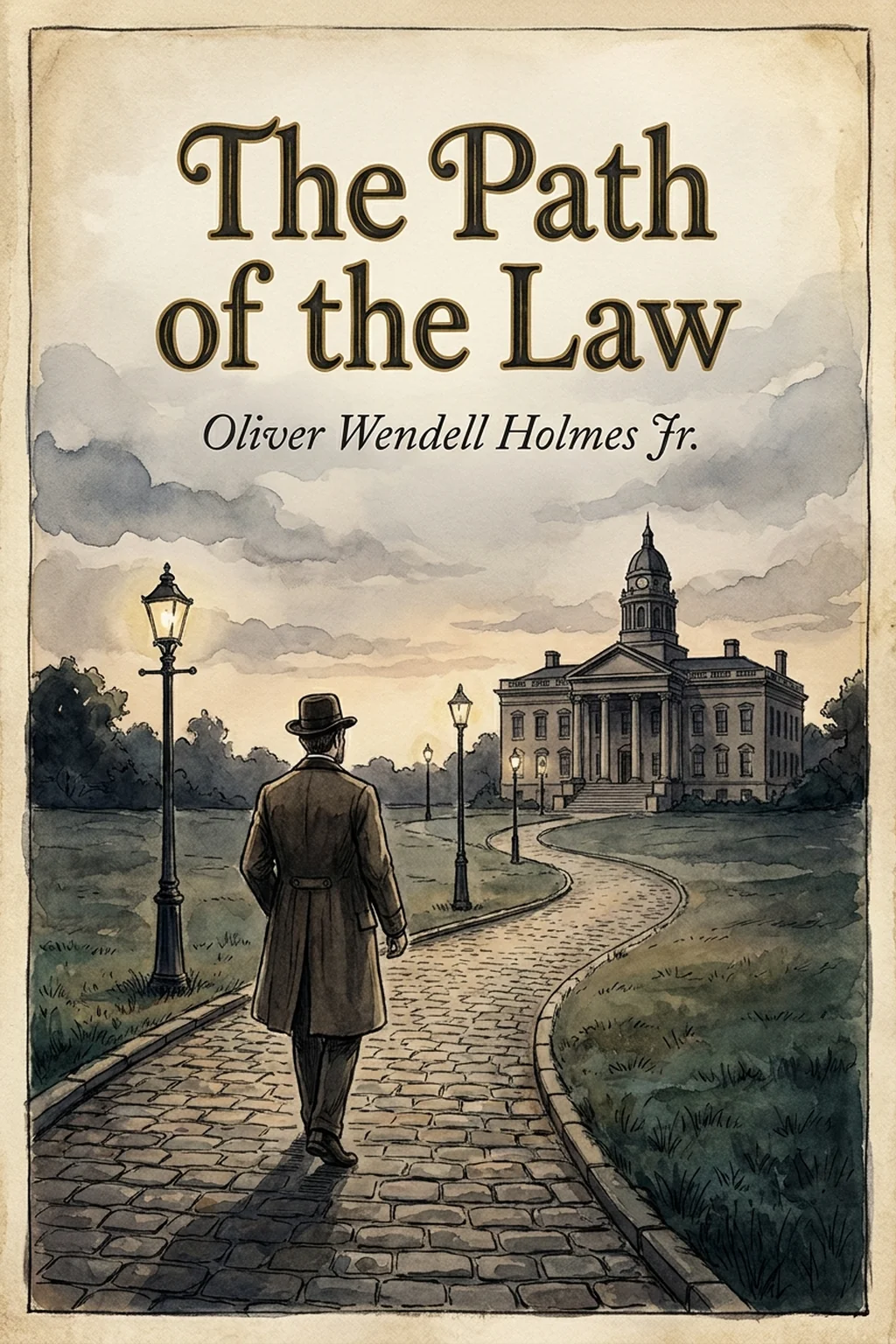
Reading section 1
THE PATH OF THE LAW
by Oliver Wendell Holmes, Jr.
10 HARVARD LAW REVIEW 457 (1897)
When we study law we are not studying a mystery but a well-known profession. We are studying what we shall want in order to appear before judges, or to advise people in such a way as to keep them out of court. The reason why it is a profession, why people will pay lawyers to argue for them or to advise them, is that in societies like ours the command of the public force is intrusted to the judges in certain cases, and the whole power of the state will be put forth, if necessary, to carry out their judgments and decrees. People want to know under what circumstances and how far they will run the risk of coming against what is so much stronger than themselves, and hence it becomes a business to find out when this danger is to be feared. The object of our study, then, is prediction, the prediction of the incidence of the public force through the instrumentality of the courts.
The means of the study are a body of reports, of treatises, and of statutes, in this country and in England, extending back for six hundred years, and now increasing annually by hundreds. In these sibylline leaves are gathered the scattered prophecies of the past upon the cases in which the axe will fall. These are what properly have been called the oracles of the law. Far the most important and pretty nearly the whole meaning of every new effort of legal thought is to make these prophecies more precise, and to generalize them into a thoroughly connected system. The process is one, from a lawyer's statement of a case, eliminating as it does all the dramatic elements with which his client's story has clothed it, and retaining only the facts of legal import, up to the final analyses and abstract universals of theoretic jurisprudence. The reason why a lawyer does not mention that his client wore a white hat when he made a contract, while Mrs. Quickly would be sure to dwell upon it along with the parcel gilt goblet and the sea-coal fire, is that he foresees that the public force will act in the same way whatever his client had upon his head. It is to make the prophecies easier to be remembered and to be understood that the teachings of the decisions of the past are put into general propositions and gathered into textbooks, or that statutes are passed in a general form. The primary rights and duties with which jurisprudence busies itself again are nothing but prophecies. One of the many evil effects of the confusion between legal and moral ideas, about which I shall have something to say in a moment, is that theory is apt to get the cart before the horse, and consider the right or the duty as something existing apart from and independent of the consequences of its breach, to which certain sanctions are added afterward. But, as I shall try to show, a legal duty so called is nothing but a prediction that if a man does or omits certain things he will be made to suffer in this or that way by judgment of the court; and so of a legal right.
The number of our predictions when generalized and reduced to a system is not unmanageably large. They present themselves as a finite body of dogma which may be mastered within a reasonable time. It is a great mistake to be frightened by the ever-increasing number of reports. The reports of a given jurisdiction in the course of a generation take up pretty much the whole body of the law, and restate it from the present point of view. We could reconstruct the corpus from them if all that went before were burned. The use of the earlier reports is mainly historical, a use about which I shall have something to say before I have finished.
I wish, if I can, to lay down some first principles for the study of this body of dogma or systematized prediction which we call the law, for men who want to use it as the instrument of their business to enable them to prophesy in their turn, and, as bearing upon the study, I wish to point out an ideal which as yet our law has not attained.
The first thing for a businesslike understanding of the matter is to understand its limits, and therefore I think it desirable at once to point out and dispel a confusion between morality and law, which sometimes rises to the height of conscious theory, and more often and indeed constantly is making trouble in detail without reaching the point of consciousness. You can see very plainly that a bad man has as much reason as a good one for wishing to avoid an encounter with the public force, and therefore you can see the practical importance of the distinction between morality and law. A man who cares nothing for an ethical rule which is believed and practised by his neighbors is likely nevertheless to care a good deal to avoid being made to pay money, and will want to keep out of jail if he can.
I take it for granted that no hearer of mine will misinterpret what I have to say as the language of cynicism. The law is the witness and external deposit of our moral life. Its history is the history of the moral development of the race. The practice of it, in spite of popular jests, tends to make good citizens and good men. When I emphasize the difference between law and morals I do so with reference to a single end, that of learning and understanding the law. For that purpose you must definitely master its specific marks, and it is for that that I ask you for the moment to imagine yourselves indifferent to other and greater things.
I do not say that there is not a wider point of view from which the distinction between law and morals becomes of secondary or no importance, as all mathematical distinctions vanish in presence of the infinite. But I do say that that distinction is of the first importance for the object which we are here to consider--a right study and mastery of the law as a business with well understood limits, a body of dogma enclosed within definite lines. I have just shown the practical reason for saying so. If you want to know the law and nothing else, you must look at it as a bad man, who cares only for the material consequences which such knowledge enables him to predict, not as a good one, who finds his reasons for conduct, whether inside the law or outside of it, in the vaguer sanctions of conscience. The theoretical importance of the distinction is no less, if you would reason on your subject aright. The law is full of phraseology drawn from morals, and by the mere force of language continually invites us to pass from one domain to the other without perceiving it, as we are sure to do unless we have the boundary constantly before our minds. The law talks about rights, and duties, and malice, and intent, and negligence, and so forth, and nothing is easier, or, I may say, more common in legal reasoning, than to take these words in their moral sense, at some state of the argument, and so to drop into fallacy. For instance, when we speak of the rights of man in a moral sense, we mean to mark the limits of interference with individual freedom which we think are prescribed by conscience, or by our ideal, however reached. Yet it is certain that many laws have been enforced in the past, and it is likely that some are enforced now, which are condemned by the most enlightened opinion of the time, or which at all events pass the limit of interference, as many consciences would draw it. Manifestly, therefore, nothing but confusion of thought can result from assuming that the rights of man in a moral sense are equally rights in the sense of the Constitution and the law. No doubt simple and extreme cases can be put of imaginable laws which the statute-making power would not dare to enact, even in the absence of written constitutional prohibitions, because the community would rise in rebellion and fight; and this gives some plausibility to the proposition that the law, if not a part of morality, is limited by it. But this limit of power is not coextensive with any system of morals. For the most part it falls far within the lines of any such system, and in some cases may extend beyond them, for reasons drawn from the habits of a particular people at a particular time. I once heard the late Professor Agassiz say that a German population would rise if you added two cents to the price of a glass of beer. A statute in such a case would be empty words, not because it was wrong, but because it could not be enforced. No one will deny that wrong statutes can be and are enforced, and we would not all agree as to which were the wrong ones.
The confusion with which I am dealing besets confessedly legal conceptions. Take the fundamental question, What constitutes the law? You will find some text writers telling you that it is something different from what is decided by the courts of Massachusetts or England, that it is a system of reason, that it is a deduction from principles of ethics or admitted axioms or what not, which may or may not coincide with the decisions. But if we take the view of our friend the bad man we shall find that he does not care two straws for the axioms or deductions, but that he does want to know what the Massachusetts or English courts are likely to do in fact. I am much of this mind. The prophecies of what the courts will do in fact, and nothing more pretentious, are what I mean by the law.
Take again a notion which as popularly understood is the widest conception which the law contains--the notion of legal duty, to which already I have referred. We fill the word with all the content which we draw from morals. But what does it mean to a bad man? Mainly, and in the first place, a prophecy that if he does certain things he will be subjected to disagreeable consequences by way of imprisonment or compulsory payment of money. But from his point of view, what is the difference between being fined and taxed a certain sum for doing a certain thing? That his point of view is the test of legal principles is proven by the many discussions which have arisen in the courts on the very question whether a given statutory liability is a penalty or a tax. On the answer to this question depends the decision whether conduct is legally wrong or right, and also whether a man is under compulsion or free. Leaving the criminal law on one side, what is the difference between the liability under the mill acts or statutes authorizing a taking by eminent domain and the liability for what we call a wrongful conversion of property where restoration is out of the question. In both cases the party taking another man's property has to pay its fair value as assessed by a jury, and no more. What significance is there in calling one taking right and another wrong from the point of view of the law? It does not matter, so far as the given consequence, the compulsory payment, is concerned, whether the act to which it is attached is described in terms of praise or in terms of blame, or whether the law purports to prohibit it or to allow it. If it matters at all, still speaking from the bad man's point of view, it must be because in one case and not in the other some further disadvantages, or at least some further consequences, are attached to the act by law. The only other disadvantages thus attached to it which I ever have been able to think of are to be found in two somewhat insignificant legal doctrines, both of which might be abolished without much disturbance. One is, that a contract to do a prohibited act is unlawful, and the other, that, if one of two or more joint wrongdoers has to pay all the damages, he cannot recover contribution from his fellows. And that I believe is all. You see how the vague circumference of the notion of duty shrinks and at the same time grows more precise when we wash it with cynical acid and expel everything except the object of our study, the operations of the law.
Nowhere is the confusion between legal and moral ideas more manifest than in the law of contract. Among other things, here again the so-called primary rights and duties are invested with a mystic significance beyond what can be assigned and explained. The duty to keep a contract at common law means a prediction that you must pay damages if you do not keep it--and nothing else. If you commit a tort, you are liable to pay a compensatory sum. If you commit a contract, you are liable to pay a compensatory sum unless the promised event comes to pass, and that is all the difference. But such a mode of looking at the matter stinks in the nostrils of those who think it advantageous to get as much ethics into the law as they can. It was good enough for Lord Coke, however, and here, as in many others cases, I am content to abide with him. In Bromage v. Genning, a prohibition was sought in the Kings' Bench against a suit in the marches of Wales for the specific performance of a covenant to grant a lease, and Coke said that it would subvert the intention of the covenantor, since he intends it to be at his election either to lose the damages or to make the lease. Sergeant Harra for the plaintiff confessed that he moved the matter against his conscience, and a prohibition was granted. This goes further than we should go now, but it shows what I venture to say has been the common law point of view from the beginning, although Mr. Harriman, in his very able little book upon Contracts has been misled, as I humbly think, to a different conclusion.
I have spoken only of the common law, because there are some cases in which a logical justification can be found for speaking of civil liabilities as imposing duties in an intelligible sense. These are the relatively few in which equity will grant an injunction, and will enforce it by putting the defendant in prison or otherwise punishing him unless he complies with the order of the court. But I hardly think it advisable to shape general theory from the exception, and I think it would be better to cease troubling ourselves about primary rights and sanctions altogether, than to describe our prophecies concerning the liabilities commonly imposed by the law in those inappropriate terms.
I mentioned, as other examples of the use by the law of words drawn from morals, malice, intent, and negligence. It is enough to take malice as it is used in the law of civil liability for wrongs what we lawyers call the law of torts--to show that it means something different in law from what it means in morals, and also to show how the difference has been obscured by giving to principles which have little or nothing to do with each other the same name. Three hundred years ago a parson preached a sermon and told a story out of Fox's Book of Martyrs of a man who had assisted at the torture of one of the saints, and afterward died, suffering compensatory inward torment. It happened that Fox was wrong. The man was alive and chanced to hear the sermon, and thereupon he sued the parson. Chief Justice Wray instructed the jury that the defendant was not liable, because the story was told innocently, without malice. He took malice in the moral sense, as importing a malevolent motive. But nowadays no one doubts that a man may be liable, without any malevolent motive at all, for false statements manifestly calculated to inflict temporal damage. In stating the case in pleading, we still should call the defendant's conduct malicious; but, in my opinion at least, the word means nothing about motives, or even about the defendant's attitude toward the future, but only signifies that the tendency of his conduct under known circumstances was very plainly to cause the plaintiff temporal harm.
In the law of contract the use of moral phraseology led to equal confusion, as I have shown in part already, but only in part. Morals deal with the actual internal state of the individual's mind, what he actually intends. From the time of the Romans down to now, this mode of dealing has affected the language of the law as to contract, and the language used has reacted upon the thought. We talk about a contract as a meeting of the minds of the parties, and thence it is inferred in various cases that there is no contract because their minds have not met; that is, because they have intended different things or because one party has not known of the assent of the other. Yet nothing is more certain than that parties may be bound by a contract to things which neither of them intended, and when one does not know of the other's assent. Suppose a contract is executed in due form and in writing to deliver a lecture, mentioning no time. One of the parties thinks that the promise will be construed to mean at once, within a week. The other thinks that it means when he is ready. The court says that it means within a reasonable time. The parties are bound by the contract as it is interpreted by the court, yet neither of them meant what the court declares that they have said. In my opinion no one will understand the true theory of contract or be able even to discuss some fundamental questions intelligently until he has understood that all contracts are formal, that the making of a contract depends not on the agreement of two minds in one intention, but on the agreement of two sets of external signs--not on the parties' having meant the same thing but on their having said the same thing. Furthermore, as the signs may be addressed to one sense or another--to sight or to hearing--on the nature of the sign will depend the moment when the contract is made. If the sign is tangible, for instance, a letter, the contract is made when the letter of acceptance is delivered. If it is necessary that the minds of the parties meet, there will be no contract until the acceptance can be read; none, for example, if the acceptance be snatched from the hand of the offerer by a third person.
Reading section 2
The impediments to rational generalization, which I illustrated from the law of larceny, are shown in the other branches of the law, as well as in that of crime. Take the law of tort or civil liability for damages apart from contract and the like. Is there any general theory of such liability, or are the cases in which it exists simply to be enumerated, and to be explained each on its special ground, as is easy to believe from the fact that the right of action for certain well known classes of wrongs like trespass or slander has its special history for each class? I think that the law regards the infliction of temporal damage by a responsible person as actionable, if under the circumstances known to him the danger of his act is manifest according to common experience, or according to his own experience if it is more than common, except in cases where upon special grounds of policy the law refuses to protect the plaintiff or grants a privilege to the defendant. I think that commonly malice, intent, and negligence mean only that the danger was manifest to a greater or less degree, under the circumstances known to the actor, although in some cases of privilege malice may mean an actual malevolent motive, and such a motive may take away a permission knowingly to inflict harm, which otherwise would be granted on this or that ground of dominant public good. But when I stated my view to a very eminent English judge the other day, he said, "You are discussing what the law ought to be; as the law is, you must show a right. A man is not liable for negligence unless he is subject to a duty." If our difference was more than a difference in words, or with regard to the proportion between the exceptions and the rule, then, in his opinion, liability for an act cannot be referred to the manifest tendency of the act to cause temporal damage in general as a sufficient explanation, but must be referred to the special nature of the damage, or must be derived from some special circumstances outside of the tendency of the act, for which no generalized explanation exists. I think that such a view is wrong, but it is familiar, and I dare say generally is accepted in England.
Everywhere the basis of principle is tradition, to such an extent that we even are in danger of making the role of history more important than it is. The other day Professor Ames wrote a learned article to show, among other things, that the common law did not recognize the defence of fraud in actions upon specialties, and the moral might seem to be that the personal character of that defence is due to its equitable origin. But if, as I said, all contracts are formal, the difference is not merely historical, but theoretic, between defects of form which prevent a contract from being made, and mistaken motives which manifestly could not be considered in any system that we should call rational except against one who was privy to those motives. It is not confined to specialties, but is of universal application. I ought to add that I do not suppose that Mr. Ames would disagree with what I suggest.
However, if we consider the law of contract, we find it full of history. The distinctions between debt, covenant, and assumpsit are merely historical. The classification of certain obligations to pay money, imposed by the law irrespective of any bargain as quasi contracts, is merely historical. The doctrine of consideration is merely historical. The effect given to a seal is to be explained by history alone. Consideration is a mere form. Is it a useful form? If so, why should it not be required in all contracts? A seal is a mere form, and is vanishing in the scroll and in enactments that a consideration must be given, seal or no seal. Why should any merely historical distinction be allowed to affect the rights and obligations of business men?
Since I wrote this discourse I have come on a very good example of the way in which tradition not only overrides rational policy, but overrides it after first having been misunderstood and having been given a new and broader scope than it had when it had a meaning. It is the settled law of England that a material alteration of a written contract by a party avoids it as against him. The doctrine is contrary to the general tendency of the law. We do not tell a jury that if a man ever has lied in one particular he is to be presumed to lie in all. Even if a man has tried to defraud, it seems no sufficient reason for preventing him from proving the truth. Objections of like nature in general go to the weight, not to the admissibility, of evidence. Moreover, this rule is irrespective of fraud, and is not confined to evidence. It is not merely that you cannot use the writing, but that the contract is at an end. What does this mean? The existence of a written contract depends on the fact that the offerer and offeree have interchanged their written expressions, not on the continued existence of those expressions. But in the case of a bond, the primitive notion was different. The contract was inseparable from the parchment. If a stranger destroyed it, or tore off the seal, or altered it, the obligee count not recover, however free from fault, because the defendant's contract, that is, the actual tangible bond which he had sealed, could not be produced in the form in which it bound him. About a hundred years ago Lord Kenyon undertook to use his reason on the tradition, as he sometimes did to the detriment of the law, and, not understanding it, said he could see no reason why what was true of a bond should not be true of other contracts. His decision happened to be right, as it concerned a promissory note, where again the common law regarded the contract as inseparable from the paper on which it was written, but the reasoning was general, and soon was extended to other written contracts, and various absurd and unreal grounds of policy were invented to account for the enlarged rule.
I trust that no one will understand me to be speaking with disrespect of the law, because I criticise it so freely. I venerate the law, and especially our system of law, as one of the vastest products of the human mind. No one knows better than I do the countless number of great intellects that have spent themselves in making some addition or improvement, the greatest of which is trifling when compared with the mighty whole. It has the final title to respect that it exists, that it is not a Hegelian dream, but a part of the lives of men. But one may criticise even what one reveres. Law is the business to which my life is devoted, and I should show less than devotion if I did not do what in me lies to improve it, and, when I perceive what seems to me the ideal of its future, if I hesitated to point it out and to press toward it with all my heart.
Perhaps I have said enough to show the part which the study of history necessarily plays in the intelligent study of the law as it is today. In the teaching of this school and at Cambridge it is in no danger of being undervalued. Mr. Bigelow here and Mr. Ames and Mr. Thayer there have made important contributions which will not be forgotten, and in England the recent history of early English law by Sir Frederick Pollock and Mr. Maitland has lent the subject an almost deceptive charm. We must beware of the pitfall of antiquarianism, and must remember that for our purposes our only interest in the past is for the light it throws upon the present. I look forward to a time when the part played by history in the explanation of dogma shall be very small, and instead of ingenious research we shall spend our energy on a study of the ends sought to be attained and the reasons for desiring them. As a step toward that ideal it seems to me that every lawyer ought to seek an understanding of economics. The present divorce between the schools of political economy and law seems to me an evidence of how much progress in philosophical study still remains to be made. In the present state of political economy, indeed, we come again upon history on a larger scale, but there we are called on to consider and weigh the ends of legislation, the means of attaining them, and the cost. We learn that for everything we have we give up something else, and we are taught to set the advantage we gain against the other advantage we lose, and to know what we are doing when we elect.
There is another study which sometimes is undervalued by the practical minded, for which I wish to say a good word, although I think a good deal of pretty poor stuff goes under that name. I mean the study of what is called jurisprudence. Jurisprudence, as I look at it, is simply law in its most generalized part. Every effort to reduce a case to a rule is an effort of jurisprudence, although the name as used in English is confined to the broadest rules and most fundamental conceptions. One mark of a great lawyer is that he sees the application of the broadest rules. There is a story of a Vermont justice of the peace before whom a suit was brought by one farmer against another for breaking a churn. The justice took time to consider, and then said that he has looked through the statutes and could find nothing about churns, and gave judgment for the defendant. The same state of mind is shown in all our common digests and textbooks. Applications of rudimentary rules of contract or tort are tucked away under the head of Railroads or Telegraphs or go to swell treatises on historical subdivisions, such as Shipping or Equity, or are gathered under an arbitrary title which is thought likely to appeal to the practical mind, such as Mercantile Law. If a man goes into law it pays to be a master of it, and to be a master of it means to look straight through all the dramatic incidents and to discern the true basis for prophecy. Therefore, it is well to have an accurate notion of what you mean by law, by a right, by a duty, by malice, intent, and negligence, by ownership, by possession, and so forth. I have in my mind cases in which the highest courts seem to me to have floundered because they had no clear ideas on some of these themes. I have illustrated their importance already. If a further illustration is wished, it may be found by reading the Appendix to Sir James Stephen's Criminal Law on the subject of possession, and then turning to Pollock and Wright's enlightened book. Sir James Stephen is not the only writer whose attempts to analyze legal ideas have been confused by striving for a useless quintessence of all systems, instead of an accurate anatomy of one. The trouble with Austin was that he did not know enough English law. But still it is a practical advantage to master Austin, and his predecessors, Hobbes and Bentham, and his worthy successors, Holland and Pollock. Sir Frederick Pollock's recent little book is touched with the felicity which marks all his works, and is wholly free from the perverting influence of Roman models.
The advice of the elders to young men is very apt to be as unreal as a list of the hundred best books. At least in my day I had my share of such counsels, and high among the unrealities I place the recommendation to study the Roman law. I assume that such advice means more than collecting a few Latin maxims with which to ornament the discourse--the purpose for which Lord Coke recommended Bracton. If that is all that is wanted, the title De Regulis Juris Antiqui can be read in an hour. I assume that, if it is well to study the Roman Law, it is well to study it as a working system. That means mastering a set of technicalities more difficult and less understood than our own, and studying another course of history by which even more than our own the Roman law must explained. If any one doubts me, let him read Keller's Der Romische Civil Process und die Actionen, a treatise on the praetor's edict, Muirhead's most interesting Historical Introduction to the Private Law of Rome, and, to give him the best chance, Sohn's admirable Institutes. No. The way to gain a liberal view of your subject is not to read something else, but to get to the bottom of the subject itself. The means of doing that are, in the first place, to follow the existing body of dogma into its highest generalizations by the help of jurisprudence; next, to discover from history how it has come to be what it is; and finally, so far as you can, to consider the ends which the several rules seek to accomplish, the reasons why those ends are desired, what is given up to gain them, and whether they are worth the price.
We have too little theory in the law rather than too much, especially on this final branch of study. When I was speaking of history, I mentioned larceny as an example to show how the law suffered from not having embodied in a clear form a rule which will accomplish its manifest purpose. In that case the trouble was due to the survival of forms coming from a time when a more limited purpose was entertained. Let me now give an example to show the practical importance, for the decision of actual cases, of understanding the reasons of the law, by taking an example from rules which, so far as I know, never have been explained or theorized about in any adequate way. I refer to statutes of limitation and the law of prescription. The end of such rules is obvious, but what is the justification for depriving a man of his rights, a pure evil as far as it goes, in consequence of the lapse of time? Sometimes the loss of evidence is referred to, but that is a secondary matter. Sometimes the desirability of peace, but why is peace more desirable after twenty years than before? It is increasingly likely to come without the aid of legislation. Sometimes it is said that, if a man neglects to enforce his rights, he cannot complain if, after a while, the law follows his example. Now if this is all that can be said about it, you probably will decide a case I am going to put, for the plaintiff; if you take the view which I shall suggest, you possibly will decide it for the defendant. A man is sued for trespass upon land, and justifies under a right of way. He proves that he has used the way openly and adversely for twenty years, but it turns out that the plaintiff had granted a license to a person whom he reasonably supposed to be the defendant's agent, although not so in fact, and therefore had assumed that the use of the way was permissive, in which case no right would be gained. Has the defendant gained a right or not? If his gaining it stands on the fault and neglect of the landowner in the ordinary sense, as seems commonly to be supposed, there has been no such neglect, and the right of way has not been acquired. But if I were the defendant's counsel, I should suggest that the foundation of the acquisition of rights by lapse of time is to be looked for in the position of the person who gains them, not in that of the loser. Sir Henry Maine has made it fashionable to connect the archaic notion of property with prescription. But the connection is further back than the first recorded history. It is in the nature of man's mind. A thing which you have enjoyed and used as your own for a long time, whether property or an opinion, takes root in your being and cannot be torn away without your resenting the act and trying to defend yourself, however you came by it. The law can ask no better justification than the deepest instincts of man. It is only by way of reply to the suggestion that you are disappointing the former owner, that you refer to his neglect having allowed the gradual dissociation between himself and what he claims, and the gradual association of it with another. If he knows that another is doing acts which on their face show that he is on the way toward establishing such an association, I should argue that in justice to that other he was bound at his peril to find out whether the other was acting under his permission, to see that he was warned, and, if necessary, stopped.
I have been speaking about the study of the law, and I have said next to nothing about what commonly is talked about in that connection--text-books and the case system, and all the machinery with which a student comes most immediately in contact. Nor shall I say anything about them. Theory is my subject, not practical details. The modes of teaching have been improved since my time, no doubt, but ability and industry will master the raw material with any mode. Theory is the most important part of the dogma of the law, as the architect is the most important man who takes part in the building of a house. The most important improvements of the last twenty-five years are improvements in theory. It is not to be feared as unpractical, for, to the competent, it simply means going to the bottom of the subject. For the incompetent, it sometimes is true, as has been said, that an interest in general ideas means an absence of particular knowledge. I remember in army days reading of a youth who, being examined for the lowest grade and being asked a question about squadron drill, answered that he never had considered the evolutions of less than ten thousand men. But the weak and foolish must be left to their folly. The danger is that the able and practical minded should look with indifference or distrust upon ideas the connection of which with their business is remote. I heard a story, the other day, of a man who had a valet to whom he paid high wages, subject to deduction for faults. One of his deductions was, "For lack of imagination, five dollars." The lack is not confined to valets. The object of ambition, power, generally presents itself nowadays in the form of money alone. Money is the most immediate form, and is a proper object of desire. "The fortune," said Rachel, "is the measure of intelligence." That is a good text to waken people out of a fool's paradise. But, as Hegel says, "It is in the end not the appetite, but the opinion, which has to be satisfied." To an imagination of any scope the most far-reaching form of power is not money, it is the command of ideas. If you want great examples, read Mr. Leslie Stephen's History of English Thought in the Eighteenth Century, and see how a hundred years after his death the abstract speculations of Descartes had become a practical force controlling the conduct of men. Read the works of the great German jurists, and see how much more the world is governed today by Kant than by Bonaparte. We cannot all be Descartes or Kant, but we all want happiness. And happiness, I am sure from having known many successful men, cannot be won simply by being counsel for great corporations and having an income of fifty thousand dollars. An intellect great enough to win the prize needs other food besides success. The remoter and more general aspects of the law are those which give it universal interest. It is through them that you not only become a great master in your calling, but connect your subject with the universe and catch an echo of the infinite, a glimpse of its unfathomable process, a hint of the universal law.
End of Project Gutenberg's The Path of the Law, by Oliver Wendell Holmes, Jr.
Reading section 3
The impediments to rational generalization, which I illustrated from the law of larceny, are shown in the other branches of the law, as well as in that of crime. Take the law of tort or civil liability for damages apart from contract and the like. Is there any general theory of such liability, or are the cases in which it exists simply to be enumerated, and to be explained each on its special ground, as is easy to believe from the fact that the right of action for certain well known classes of wrongs like trespass or slander has its special history for each class? I think that the law regards the infliction of temporal damage by a responsible person as actionable, if under the circumstances known to him the danger of his act is manifest according to common experience, or according to his own experience if it is more than common, except in cases where upon special grounds of policy the law refuses to protect the plaintiff or grants a privilege to the defendant. I think that commonly malice, intent, and negligence mean only that the danger was manifest to a greater or less degree, under the circumstances known to the actor, although in some cases of privilege malice may mean an actual malevolent motive, and such a motive may take away a permission knowingly to inflict harm, which otherwise would be granted on this or that ground of dominant public good. But when I stated my view to a very eminent English judge the other day, he said, "You are discussing what the law ought to be; as the law is, you must show a right. A man is not liable for negligence unless he is subject to a duty." If our difference was more than a difference in words, or with regard to the proportion between the exceptions and the rule, then, in his opinion, liability for an act cannot be referred to the manifest tendency of the act to cause temporal damage in general as a sufficient explanation, but must be referred to the special nature of the damage, or must be derived from some special circumstances outside of the tendency of the act, for which no generalized explanation exists. I think that such a view is wrong, but it is familiar, and I dare say generally is accepted in England.
Everywhere the basis of principle is tradition, to such an extent that we even are in danger of making the role of history more important than it is. The other day Professor Ames wrote a learned article to show, among other things, that the common law did not recognize the defence of fraud in actions upon specialties, and the moral might seem to be that the personal character of that defence is due to its equitable origin. But if, as I said, all contracts are formal, the difference is not merely historical, but theoretic, between defects of form which prevent a contract from being made, and mistaken motives which manifestly could not be considered in any system that we should call rational except against one who was privy to those motives. It is not confined to specialties, but is of universal application. I ought to add that I do not suppose that Mr. Ames would disagree with what I suggest.
However, if we consider the law of contract, we find it full of history. The distinctions between debt, covenant, and assumpsit are merely historical. The classification of certain obligations to pay money, imposed by the law irrespective of any bargain as quasi contracts, is merely historical. The doctrine of consideration is merely historical. The effect given to a seal is to be explained by history alone. Consideration is a mere form. Is it a useful form? If so, why should it not be required in all contracts? A seal is a mere form, and is vanishing in the scroll and in enactments that a consideration must be given, seal or no seal. Why should any merely historical distinction be allowed to affect the rights and obligations of business men?
Since I wrote this discourse I have come on a very good example of the way in which tradition not only overrides rational policy, but overrides it after first having been misunderstood and having been given a new and broader scope than it had when it had a meaning. It is the settled law of England that a material alteration of a written contract by a party avoids it as against him. The doctrine is contrary to the general tendency of the law. We do not tell a jury that if a man ever has lied in one particular he is to be presumed to lie in all. Even if a man has tried to defraud, it seems no sufficient reason for preventing him from proving the truth. Objections of like nature in general go to the weight, not to the admissibility, of evidence. Moreover, this rule is irrespective of fraud, and is not confined to evidence. It is not merely that you cannot use the writing, but that the contract is at an end. What does this mean? The existence of a written contract depends on the fact that the offerer and offeree have interchanged their written expressions, not on the continued existence of those expressions. But in the case of a bond, the primitive notion was different. The contract was inseparable from the parchment. If a stranger destroyed it, or tore off the seal, or altered it, the obligee count not recover, however free from fault, because the defendant's contract, that is, the actual tangible bond which he had sealed, could not be produced in the form in which it bound him. About a hundred years ago Lord Kenyon undertook to use his reason on the tradition, as he sometimes did to the detriment of the law, and, not understanding it, said he could see no reason why what was true of a bond should not be true of other contracts. His decision happened to be right, as it concerned a promissory note, where again the common law regarded the contract as inseparable from the paper on which it was written, but the reasoning was general, and soon was extended to other written contracts, and various absurd and unreal grounds of policy were invented to account for the enlarged rule.
I trust that no one will understand me to be speaking with disrespect of the law, because I criticise it so freely. I venerate the law, and especially our system of law, as one of the vastest products of the human mind. No one knows better than I do the countless number of great intellects that have spent themselves in making some addition or improvement, the greatest of which is trifling when compared with the mighty whole. It has the final title to respect that it exists, that it is not a Hegelian dream, but a part of the lives of men. But one may criticise even what one reveres. Law is the business to which my life is devoted, and I should show less than devotion if I did not do what in me lies to improve it, and, when I perceive what seems to me the ideal of its future, if I hesitated to point it out and to press toward it with all my heart.
Perhaps I have said enough to show the part which the study of history necessarily plays in the intelligent study of the law as it is today. In the teaching of this school and at Cambridge it is in no danger of being undervalued. Mr. Bigelow here and Mr. Ames and Mr. Thayer there have made important contributions which will not be forgotten, and in England the recent history of early English law by Sir Frederick Pollock and Mr. Maitland has lent the subject an almost deceptive charm. We must beware of the pitfall of antiquarianism, and must remember that for our purposes our only interest in the past is for the light it throws upon the present. I look forward to a time when the part played by history in the explanation of dogma shall be very small, and instead of ingenious research we shall spend our energy on a study of the ends sought to be attained and the reasons for desiring them. As a step toward that ideal it seems to me that every lawyer ought to seek an understanding of economics. The present divorce between the schools of political economy and law seems to me an evidence of how much progress in philosophical study still remains to be made. In the present state of political economy, indeed, we come again upon history on a larger scale, but there we are called on to consider and weigh the ends of legislation, the means of attaining them, and the cost. We learn that for everything we have we give up something else, and we are taught to set the advantage we gain against the other advantage we lose, and to know what we are doing when we elect.
There is another study which sometimes is undervalued by the practical minded, for which I wish to say a good word, although I think a good deal of pretty poor stuff goes under that name. I mean the study of what is called jurisprudence. Jurisprudence, as I look at it, is simply law in its most generalized part. Every effort to reduce a case to a rule is an effort of jurisprudence, although the name as used in English is confined to the broadest rules and most fundamental conceptions. One mark of a great lawyer is that he sees the application of the broadest rules. There is a story of a Vermont justice of the peace before whom a suit was brought by one farmer against another for breaking a churn. The justice took time to consider, and then said that he has looked through the statutes and could find nothing about churns, and gave judgment for the defendant. The same state of mind is shown in all our common digests and textbooks. Applications of rudimentary rules of contract or tort are tucked away under the head of Railroads or Telegraphs or go to swell treatises on historical subdivisions, such as Shipping or Equity, or are gathered under an arbitrary title which is thought likely to appeal to the practical mind, such as Mercantile Law. If a man goes into law it pays to be a master of it, and to be a master of it means to look straight through all the dramatic incidents and to discern the true basis for prophecy. Therefore, it is well to have an accurate notion of what you mean by law, by a right, by a duty, by malice, intent, and negligence, by ownership, by possession, and so forth. I have in my mind cases in which the highest courts seem to me to have floundered because they had no clear ideas on some of these themes. I have illustrated their importance already. If a further illustration is wished, it may be found by reading the Appendix to Sir James Stephen's Criminal Law on the subject of possession, and then turning to Pollock and Wright's enlightened book. Sir James Stephen is not the only writer whose attempts to analyze legal ideas have been confused by striving for a useless quintessence of all systems, instead of an accurate anatomy of one. The trouble with Austin was that he did not know enough English law. But still it is a practical advantage to master Austin, and his predecessors, Hobbes and Bentham, and his worthy successors, Holland and Pollock. Sir Frederick Pollock's recent little book is touched with the felicity which marks all his works, and is wholly free from the perverting influence of Roman models.
The advice of the elders to young men is very apt to be as unreal as a list of the hundred best books. At least in my day I had my share of such counsels, and high among the unrealities I place the recommendation to study the Roman law. I assume that such advice means more than collecting a few Latin maxims with which to ornament the discourse--the purpose for which Lord Coke recommended Bracton. If that is all that is wanted, the title De Regulis Juris Antiqui can be read in an hour. I assume that, if it is well to study the Roman Law, it is well to study it as a working system. That means mastering a set of technicalities more difficult and less understood than our own, and studying another course of history by which even more than our own the Roman law must explained. If any one doubts me, let him read Keller's Der Romische Civil Process und die Actionen, a treatise on the praetor's edict, Muirhead's most interesting Historical Introduction to the Private Law of Rome, and, to give him the best chance, Sohn's admirable Institutes. No. The way to gain a liberal view of your subject is not to read something else, but to get to the bottom of the subject itself. The means of doing that are, in the first place, to follow the existing body of dogma into its highest generalizations by the help of jurisprudence; next, to discover from history how it has come to be what it is; and finally, so far as you can, to consider the ends which the several rules seek to accomplish, the reasons why those ends are desired, what is given up to gain them, and whether they are worth the price.
We have too little theory in the law rather than too much, especially on this final branch of study. When I was speaking of history, I mentioned larceny as an example to show how the law suffered from not having embodied in a clear form a rule which will accomplish its manifest purpose. In that case the trouble was due to the survival of forms coming from a time when a more limited purpose was entertained. Let me now give an example to show the practical importance, for the decision of actual cases, of understanding the reasons of the law, by taking an example from rules which, so far as I know, never have been explained or theorized about in any adequate way. I refer to statutes of limitation and the law of prescription. The end of such rules is obvious, but what is the justification for depriving a man of his rights, a pure evil as far as it goes, in consequence of the lapse of time? Sometimes the loss of evidence is referred to, but that is a secondary matter. Sometimes the desirability of peace, but why is peace more desirable after twenty years than before? It is increasingly likely to come without the aid of legislation. Sometimes it is said that, if a man neglects to enforce his rights, he cannot complain if, after a while, the law follows his example. Now if this is all that can be said about it, you probably will decide a case I am going to put, for the plaintiff; if you take the view which I shall suggest, you possibly will decide it for the defendant. A man is sued for trespass upon land, and justifies under a right of way. He proves that he has used the way openly and adversely for twenty years, but it turns out that the plaintiff had granted a license to a person whom he reasonably supposed to be the defendant's agent, although not so in fact, and therefore had assumed that the use of the way was permissive, in which case no right would be gained. Has the defendant gained a right or not? If his gaining it stands on the fault and neglect of the landowner in the ordinary sense, as seems commonly to be supposed, there has been no such neglect, and the right of way has not been acquired. But if I were the defendant's counsel, I should suggest that the foundation of the acquisition of rights by lapse of time is to be looked for in the position of the person who gains them, not in that of the loser. Sir Henry Maine has made it fashionable to connect the archaic notion of property with prescription. But the connection is further back than the first recorded history. It is in the nature of man's mind. A thing which you have enjoyed and used as your own for a long time, whether property or an opinion, takes root in your being and cannot be torn away without your resenting the act and trying to defend yourself, however you came by it. The law can ask no better justification than the deepest instincts of man. It is only by way of reply to the suggestion that you are disappointing the former owner, that you refer to his neglect having allowed the gradual dissociation between himself and what he claims, and the gradual association of it with another. If he knows that another is doing acts which on their face show that he is on the way toward establishing such an association, I should argue that in justice to that other he was bound at his peril to find out whether the other was acting under his permission, to see that he was warned, and, if necessary, stopped.
I have been speaking about the study of the law, and I have said next to nothing about what commonly is talked about in that connection--text-books and the case system, and all the machinery with which a student comes most immediately in contact. Nor shall I say anything about them. Theory is my subject, not practical details. The modes of teaching have been improved since my time, no doubt, but ability and industry will master the raw material with any mode. Theory is the most important part of the dogma of the law, as the architect is the most important man who takes part in the building of a house. The most important improvements of the last twenty-five years are improvements in theory. It is not to be feared as unpractical, for, to the competent, it simply means going to the bottom of the subject. For the incompetent, it sometimes is true, as has been said, that an interest in general ideas means an absence of particular knowledge. I remember in army days reading of a youth who, being examined for the lowest grade and being asked a question about squadron drill, answered that he never had considered the evolutions of less than ten thousand men. But the weak and foolish must be left to their folly. The danger is that the able and practical minded should look with indifference or distrust upon ideas the connection of which with their business is remote. I heard a story, the other day, of a man who had a valet to whom he paid high wages, subject to deduction for faults. One of his deductions was, "For lack of imagination, five dollars." The lack is not confined to valets. The object of ambition, power, generally presents itself nowadays in the form of money alone. Money is the most immediate form, and is a proper object of desire. "The fortune," said Rachel, "is the measure of intelligence." That is a good text to waken people out of a fool's paradise. But, as Hegel says, "It is in the end not the appetite, but the opinion, which has to be satisfied." To an imagination of any scope the most far-reaching form of power is not money, it is the command of ideas. If you want great examples, read Mr. Leslie Stephen's History of English Thought in the Eighteenth Century, and see how a hundred years after his death the abstract speculations of Descartes had become a practical force controlling the conduct of men. Read the works of the great German jurists, and see how much more the world is governed today by Kant than by Bonaparte. We cannot all be Descartes or Kant, but we all want happiness. And happiness, I am sure from having known many successful men, cannot be won simply by being counsel for great corporations and having an income of fifty thousand dollars. An intellect great enough to win the prize needs other food besides success. The remoter and more general aspects of the law are those which give it universal interest. It is through them that you not only become a great master in your calling, but connect your subject with the universe and catch an echo of the infinite, a glimpse of its unfathomable process, a hint of the universal law.
Edition & source credit
Project Gutenberg eBook #2373: https://www.gutenberg.org/ebooks/2373.
For work background, reading notes, and source credits, see the book introduction.