क्रिएटिव फ़ाइल
AI Bionic Hand Brings Human-Like Movement Closer
Researchers at the University of Utah are applying artificial intelligence to make prosthetic hands feel more natural and intuitive, aiming to give them behavior closer to human-like reflexes rather than purely manual control.
Harper Lane
निर्माता
फ़ाइल नोट
नीचे पूरा ट्यूटोरियल या लेख पढ़ें।
मॉड्यूल
डिजिटल कला
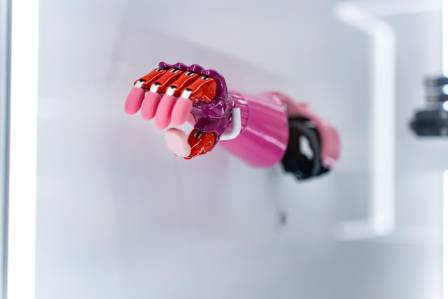
Researchers at the University of Utah are applying artificial intelligence to make prosthetic hands feel more natural and intuitive, aiming to give them behavior closer to human-like reflexes rather than purely manual control.
Engineering professor Jacob A. George and postdoctoral researcher Marshall Trout from the Utah NeuroRobotics Lab incorporated AI into a robotic prosthetic hand equipped with pressure and proximity sensors. This upgrade improves grip accuracy, finger coordination, and reduces the mental effort required from users.
Trout noted that nearly 50% of prosthetic users eventually stop using their devices, mainly due to difficult controls and high cognitive load. The team’s goal is to make the prosthesis function more like a natural extension of the body instead of a tool that requires constant conscious operation.
A major difficulty in prosthetics is recreating the sense of touch. In normal human movement, grasping objects is largely automatic, guided by reflexes rather than deliberate control. To mimic this, the researchers used a TASKA Prosthetics hand fitted with customized fingertips containing optical proximity sensors and pressure sensors capable of detecting extremely light contact, even something as soft as a cotton ball. These inputs provide the AI system with detailed feedback to adjust finger movement in real time.
The next step involved training a neural network on the collected sensor data. Each finger can operate independently, adjusting itself to maintain a stable hold on objects. However, this raised an important issue: how to allow the user to release objects naturally when needed. To solve this, the team developed a shared-control approach that combines user intent with AI assistance, ensuring the system supports movement without overriding human decision-making.
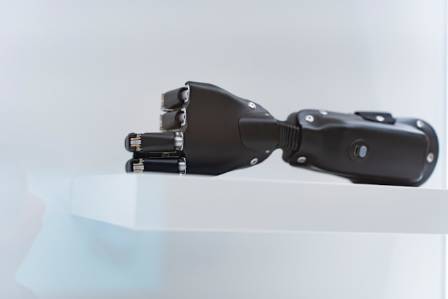
George explained that the lab is also exploring implanted neural interface technology, which could allow users to control prosthetic limbs using thought while also regaining a form of sensory feedback. Future versions may merge brain-based control with advanced tactile sensors to create a seamless human-machine system.
The research team tested the system with four transradial amputees, including individuals with amputations between the wrist and elbow. Participants completed everyday tasks such as holding cups and picking up small objects. With AI assistance, they were able to perform these actions more easily, with minimal training required.
George said that by transferring fine motor adjustments to the robotic system, users can regain more natural control, making everyday actions feel effortless again.
Trout added that in this study, the AI controller did not adapt during real-time use because the testing period was short. This was intentional, to avoid changing system behavior while users were still learning how to operate it.
Looking ahead, the Utah NeuroRobotics Lab aims to combine adaptive AI, advanced sensors, and neural interfaces so that future prosthetics can respond directly to user thoughts while restoring sensory feedback.
Trout also noted that future versions of the system could learn continuously from user interactions, improving performance over time and adapting to different situations. As both the AI and the user learn together, the prosthetic hand could eventually provide increasingly natural and effective assistance.
संबंधित फ़ाइलें

परिवहन में शीर्ष 10 नवाचार
AUTH: कृष्ण

Healthy Smoothie in 5 Easy Steps
AUTH: William Turner
Top 10 Safest Cars of 2023: A Glimpse into Cutting-Edge Safety
AUTH: Amelia Claire

वनस्पति चित्रण मार्गदर्शिका: मेपल के पत्ते का विस्तृत रेखाचित्र बनाना
AUTH: स्वाति सोनी

The world's most famous deserts
AUTH: Evelyn Westbrook

किसी भी अवसर के लिए सरल चीनी स्टिर-फ्राई रेसिपी
AUTH: देबाशीष घोष