← मुख्य पन्ना5 मिनट का पाठ
क्रिएटिव फ़ाइल
Cattle Egret (Bubulcus ibis): The Globally Expanding Commensal Heron
The cattle egret (Bubulcus ibis) is a cosmopolitan heron (family Ardeidae) native to tropical, subtropical, and warm temperate zones. As the only member of the monotypic genus Bubulcus, it has undergone one of the most rapid natural range expansions of any bird species, colonizing much of the world in the last century. Despite superficial similarities to Egretta egrets, it is more closely related to Ardea herons, and its unique commensal relationship with large mammals has been key to its success.
S
Stella
निर्माता
फ़ाइल नोट
नीचे पूरा ट्यूटोरियल या लेख पढ़ें।
मॉड्यूल
डिजिटल कला

The cattle egret (Bubulcus ibis) is a cosmopolitan heron (family Ardeidae) native to tropical, subtropical, and warm temperate zones. As the only member of the monotypic genus Bubulcus, it has undergone one of the most rapid natural range expansions of any bird species, colonizing much of the world in the last century. Despite superficial similarities to Egretta egrets, it is more closely related to Ardea herons, and its unique commensal relationship with large mammals has been key to its success.
Taxonomy
First described by Linnaeus in 1758 as Ardea ibis, the cattle egret was moved to the genus Bubulcus by Charles Lucien Bonaparte in 1855—“Bubulcus” (Latin for “herdsman”) references its association with cattle. Two geographical races are often recognized: the western B. ibis (occupying the Americas, Africa, Europe, and western Asia) and the eastern B. coromandus (breeding in Asia and Australasia), with some authorities recognizing a third Seychelles subspecies (B. i. seychellarum). It hybridizes rarely with other egret species like the little blue heron and snowy egret, and its 亲缘关系 lies closer to Ardea herons than most Egretta egrets.
Physical Description
A stocky heron with an 88–96 cm wingspan, 46–56 cm length, and 270–512 g weight, the cattle egret has a short thick neck, sturdy bill, and hunched posture. Non-breeding adults have white plumage, yellow bills, and greyish-yellow legs, while breeding adults develop orange-buff plumes on the back, breast, and crown—with bright red bills, legs, and irises pre-pairing. Males are marginally larger with longer breeding plumes, and juveniles have black bills and no colored plumes. Subspecies differ slightly: B. i. coromandus has golden plumes and buff cheeks, while B. i. seychellarum is smaller with golden nuptial plumes and white cheeks.
Distribution and Habitat
Originally native to parts of Asia, Africa, and Europe, the cattle egret has expanded globally since the late 19th century. It naturally colonized the Americas (first sighted in 1877, established by the 1930s), Europe (spreading through the Iberian Peninsula and beyond by the late 20th century), Australia, and New Zealand. It was also deliberately introduced to Hawaii, the Chagos Archipelago, and the Seychelles. Unlike most herons, it favors dry, open habitats—seasonally inundated grasslands, pastures, farmlands, and rice paddies—though it may feed in shallow water, relying on terrestrial insects over aquatic prey.
Migration and Movements
Populations vary in mobility: some are migratory, others dispersive, and many are both sedentary and migratory. Northern hemisphere populations migrate to warmer areas, while Australian breeders move to Tasmania and New Zealand in winter. African populations migrate in response to rainfall, and South American birds travel south post-breeding. Young birds can disperse up to 5,000 km from their breeding grounds, with flocks seen crossing oceans. This high mobility has been critical to the species’ rapid range expansion, alongside its adaptability to human-altered landscapes.
Conservation Status
Classified as Least Concern by the IUCN, the cattle egret has a global population of 3.8–6.7 million individuals and a range of over 10 million km². Its successful colonization of new areas has led to it being labeled an invasive species, though it has little documented ecological impact. Threats are minimal: adult birds have few predators, and nest raids or chick mortality from starvation/calcium deficiency are localized issues. Its ability to exploit human farming and livestock habitats ensures stable or increasing populations worldwide.
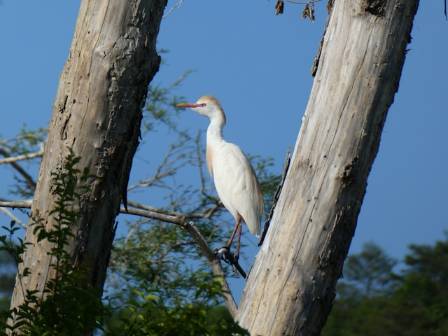
Breeding
Cattle egrets nest in colonies, often near water and alongside other wading birds, building small stick platforms in trees or shrubs. Breeding seasons vary by region: May–monsoon in northern India, November–January in Australia, and April–October in North America. Males display with twig-shaking and sky-pointing to attract mates (new partners each season), and clutches of 3–4 pale bluish-white eggs are incubated by both parents for ~23 days. Chicks are downy at hatching, regulate temperature by 9–12 days, fledge at 30 days, and become independent by 45 days. Low levels of brood parasitism (intraspecific or with other egrets) have been recorded, but starvation from sibling rivalry is the main nesting mortality factor.
Feeding Habits
An opportunistic omnivore, the cattle egret feeds primarily on insects (grasshoppers, crickets, flies), spiders, frogs, and earthworms—with rare instances of fig foraging or seabird egg/chick predation. Its key adaptation is foraging alongside large mammals (cattle, zebras, buffalo) or farm machinery, catching prey disturbed by their movement. Foraging success is 3.6 times higher near large animals than alone, as it avoids faster/slower-moving herds and defends small foraging areas around hosts. Dominant birds feed closest to the host, securing more food, and urban populations have adapted to forage in unusual spots like railway lines.
Relationships with Other Species and Humans
The cattle egret’s commensal relationship with large mammals benefits both: it removes ticks and flies from cattle (reducing pest pressure) while gaining easy access to prey. This bond led to its range expansion as livestock farming spread globally. For humans, it is valued as a biocontrol for cattle parasites, but it poses minor risks—aircraft hazards (feeding in airport verges) and potential spread of tick-borne diseases or avian infections. Common names like “cow heron” or Arabic “abu qerdan” (father of ticks) reflect its close association with livestock and breeding colony parasites.
Vocalization
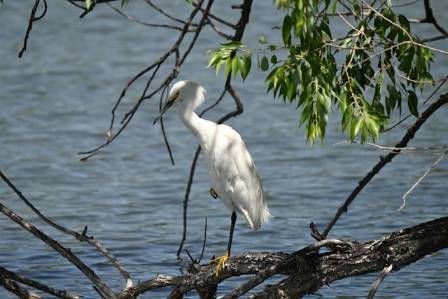
Largely silent outside breeding colonies, the cattle egret emits a quiet, throaty “rick-rack” call during nesting. Vocalizations are minimal in non-breeding seasons, with communication primarily relying on visual displays during foraging or mating interactions.
संबंधित फ़ाइलें

// hi
पश्चिम जाओ, युवा आदमी: जहां पहाड़ समुद्र से मिलते हैं
AUTH: टायलर पेनलैंड

// hi
4 बुनियादी बैडमिंटन कौशल जिन्होंने मेरे खेल को बेहतर बनाया (केस स्टडी)
AUTH: अनन्या

// hi
दुनिया के टॉप 39 चॉकलेट केक
AUTH: नीला
// hi
दुनिया की 9 सबसे खूबसूरत तितलियाँ
AUTH: आरती

// hi
क्या पिज़्ज़ा हेल्दी है? पिज़्ज़ा पसंद करने वालों के लिए न्यूट्रिशन टिप्स
AUTH: उर्वशी

// en
8 Stunning Beaches Viewed From Above
AUTH: Kate