क्रिएटिव फ़ाइल
Convallaria majalis: From Woodland Plant to Garden Favorite
Lily of the valley (Convallaria majalis), sometimes written without hyphens, is a woodland plant known for its delicate, sweet fragrance and its drooping, bell-shaped white blossoms that bloom in clusters during spring. It is native to regions of Europe, as well as parts of western and northern Asia.
Sydney Clark
निर्माता
फ़ाइल नोट
नीचे पूरा ट्यूटोरियल या लेख पढ़ें।
मॉड्यूल
डिजिटल कला
Lily of the valley (Convallaria majalis), sometimes written without hyphens, is a woodland plant known for its delicate, sweet fragrance and its drooping, bell-shaped white blossoms that bloom in clusters during spring. It is native to regions of Europe, as well as parts of western and northern Asia.
Previously, certain varieties such as Convallaria majalis var. montana (found in eastern North America) and Convallaria majalis var. keiskei (from eastern Asia) were classified under this species. However, they are now recognized as separate species: Convallaria pseudomajalis and Convallaria keiskei.
This plant contains high levels of toxic cardiac glycosides, making it extremely poisonous if ingested by humans or animals.
It is also commonly known as May bells, Our Lady’s tears, or Mary’s tears. In French, it is called muguet, a term often used in perfumes inspired by its scent. Historically in England, it was referred to as “glovewort” because it was used in remedies for sore hands, and also “Apollinaris,” based on a legend linking its discovery to the god Apollo.
Description
Leaves and Flowers
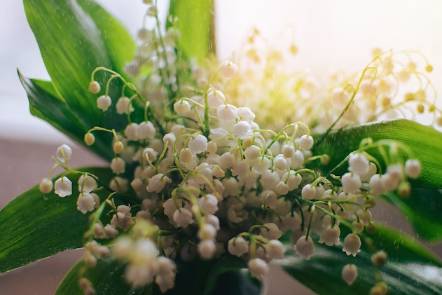
Convallaria majalis is a herbaceous perennial that spreads extensively through underground stems known as rhizomes. During summer, new shoots develop at the ends of these creeping stems, which then emerge in spring as upright leafy growths still connected beneath the soil.
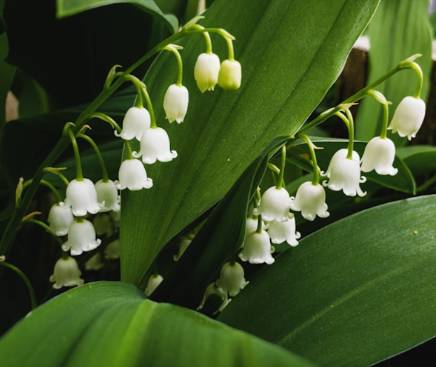
The plant typically reaches a height of 15–35 cm (6–14 inches). Each shoot usually bears two leaves (occasionally three), measuring about 5–20 cm long and 3–7 cm wide. The flowering stem produces a one-sided cluster (raceme) containing six to twelve hanging flowers.
Each flower consists of six fused tepals forming a small bell shape, with slightly flared tips. They are usually white, although a pink form (‘Rosea’) exists. The flowers are strongly fragrant and typically appear in late spring, around May to June in regions like Britain, though they may bloom earlier in milder climates.
The plant produces small, round berries that are orange to red in color and about 5–7 mm in diameter. These fruits are also poisonous and contain several pale seeds that eventually dry into translucent bead-like structures. The berries can remain on the plant for several weeks. The plant is self-incompatible, meaning a colony formed from a single clone will not produce seeds.
Classification
According to the APG III system, Convallaria belongs to the family Asparagaceae, within the subfamily Convallarioideae. It was previously classified under other families, including Ruscaceae and even its own family, Convallariaceae. Earlier classifications also placed it within the broader lily family, Liliaceae.
What were once considered three varieties are now generally treated as distinct species:
Convallaria majalis (Europe and western Asia), characterized by white markings on the flowers
Convallaria keiskei (China and Japan), known for its red berries and more open, bowl-shaped flowers
Convallaria pseudomajalis (southeastern United States), with greenish flower markings
Another form, C. transcaucasica, is sometimes considered separate but is not widely accepted as distinct. A species once called Convallaria japonica has since been reclassified as Ophiopogon japonicus.
Distribution
This species is native to much of Europe, although it is generally absent from Mediterranean areas. It is not originally native to Ireland but has become naturalized there.
Like many perennial plants, it reproduces in two ways: asexually through vegetative growth (rhizomes) and sexually through seed production.
Ecology
Lily of the valley thrives in partially shaded environments and prefers moderate moisture conditions. It grows well in both acidic and alkaline soils, especially those that are sandy or silty and rich in organic matter. It can also be found in damp habitats such as fens.
In Great Britain, it grows from sea level up to about 490 meters (1,600 feet), while in central and southern Europe it can be found at elevations up to 2,300 meters (7,500 feet).
The plant serves as a food source for the larvae of certain moths and butterflies. Some beetles, such as Lilioceris merdigera, can tolerate its toxins and feed on its leaves. Small rodents may consume its fruits and seeds, inadvertently helping to disperse them.
Cultivation
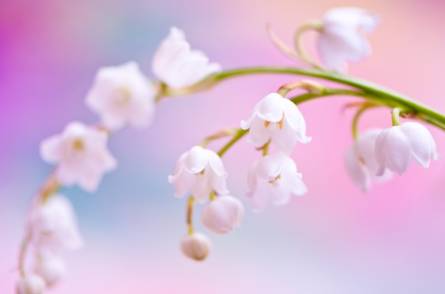
Convallaria majalis is widely cultivated in gardens for its fragrant flowers and ability to act as a ground cover in shaded areas. It has received the Royal Horticultural Society’s Award of Garden Merit. Under suitable conditions, it can spread rapidly and form dense colonies.
There are many cultivated varieties, including those with double flowers, pink blooms, variegated leaves, and larger-than-average growth.
Examples include:
‘Albostriata’ – striped foliage
‘Berlin Giant’ and ‘Géant de Fortin’ – larger plants
‘Flore Pleno’ – double flowers
‘Rosea’ – pink flowers
Other variegated forms such as ‘Variegata’ and ‘Hofheim’
संबंधित फ़ाइलें

How To Draw A Giraffe
AUTH: Faye Sinclair
इंडोर में जल लिली उगाने और देखभाल करने का तरीका
AUTH: साहिल

टोक्यो स्काई ट्री: दुनिया का सबसे ऊँचा टावर! टोक्यो के नए प्रतीक का आनंद लें
AUTH: कुणाल

3 लोकप्रिय डोनट्स की किस्में, समझाई गई
AUTH: काश्यप

पृथ्वी पर 15 सबसे रंगीन प्राकृतिक अजूबे
AUTH: नकुल
वर्मिलियन बर्ड की कहानी
AUTH: नंदिनी