← मुख्य पन्ना2 मिनट का पाठ
क्रिएटिव फ़ाइल
Blue Holes: The Ancient Underwater Sinkholes of the Sea
Blue holes, more accurately classified as marine sinkholes, form via the erosion of carbonate rock. Scattered across the globe from the Red Sea to the South China Sea and the Caribbean, these natural features serve as both habitats for diverse marine life and coveted sites for adventurous divers. Let’s break down what makes them so unique.
I
Iris Cooper
निर्माता
फ़ाइल नोट
नीचे पूरा ट्यूटोरियल या लेख पढ़ें।
मॉड्यूल
डिजिटल कला
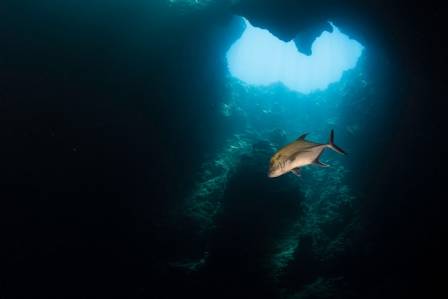
Blue holes, more accurately classified as marine sinkholes, form via the erosion of carbonate rock. Scattered across the globe from the Red Sea to the South China Sea and the Caribbean, these natural features serve as both habitats for diverse marine life and coveted sites for adventurous divers. Let’s break down what makes them so unique.
How Blue Holes Form
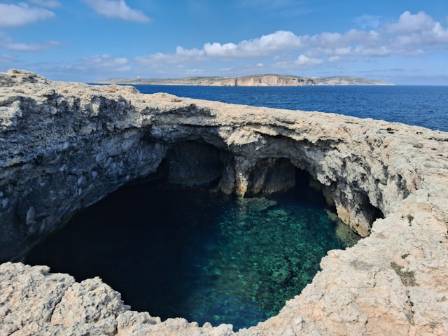
Blue holes are fundamentally equivalent to the sinkholes commonly found on land. Most formed during ice ages, when much of the Earth’s surface was covered by glacial ice. Underground, groundwater flows through cracks in permeable carbonate rock layers (including sandstone and limestone), slowly eroding large caverns over time. Eventually, the cavern ceilings collapse, leaving massive surface sinkholes. As glaciers receded, melting ice raised global sea levels until seawater poured into these voids, creating the flooded sinkholes we now call blue holes.
The Great Blue Hole
Arguably the most famous example is the Great Blue Hole, off the coast of Belize in central South America. It sits near the centre of Lighthouse Reef, a small atoll 70 km (43 miles) off the Belizean mainland. At 124 metres (407 feet) deep and 318 metres (1,043 feet) in diameter, it is the largest blue hole in the world, and forms part of the Belize Barrier Reef Reserve System, a designated UNESCO World Heritage Site.
It was popularised by oceanographer Jacques Cousteau, who declared it one of the top five scuba diving sites in the world after charting its depth aboard his vessel Calypso in 1971; it has remained a bucket-list dive site ever since.
The Great Blue Hole supports rich marine life, including multiple shark species, reef fish and other creatures. Its shallow edges host vibrant coral reefs and diverse fish populations, while deeper, low-light sections harbour specialised ecosystems: Caribbean reef sharks, nurse sharks, hammerheads and blacktip sharks are all regular residents.
Water & Marine Sciences
During a 2018 expedition, marine explorer Erika Bergman reported finding a thick layer of toxic hydrogen sulfide stretching across the sinkhole, blocking oxygen from reaching deeper waters. She noted the stark signs of this anoxic environment at the hole’s base: “We found conchs and conch shells and hermit crabs that had fallen into the hole and suffocated.”
The finding served as a stark reminder of both the hole’s extreme conditions and broader climate-linked risks to marine systems.
Other Notable Blue Holes
Beyond the Great Blue Hole, dozens of other underwater sinkholes dot coastlines worldwide:
-
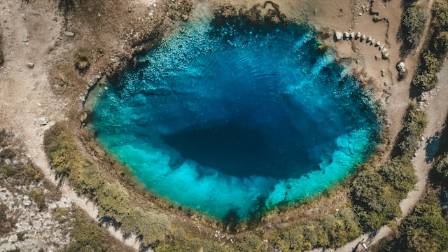
Dean’s Blue Hole: Located in a bay west of Clarence Town in the Bahamas, this is the world’s third-deepest blue hole, reaching 202 metres in depth.(Image: Aerial view of Dean’s Blue Hole)
-
Taam Ja’ Blue Hole: Found on Mexico’s Yucatan Peninsula, not far from the impact site of the asteroid that drove the Cretaceous-Paleogene extinction (which wiped out non-avian dinosaurs 66 million years ago). It was measured to reach 275 metres deep during a 2021 survey.
-
Red Sea Blue Hole: A popular dive site 94 metres deep, located a few kilometres north of Dahab, Egypt.
संबंधित फ़ाइलें

// hi
10 रंग विकल्प जो छोटे कमरों को बड़ा दिखाएंगे
AUTH: कवि
// en
Escape the Urban Hustle: Reconnect with Nature
AUTH: Lily Aurora

// en
The 10 Best Supercars For 2026
AUTH: Adrian Wolfe
// hi
अरोरा बोरेलिस के रंग: विज्ञान और जादू का एक नृत्य
AUTH: कीर्ति

// hi
दुनिया भर में टॉप 3 बेहतरीन आलू चिप ब्रांड्स
AUTH: कृति
// hi
यूरोप में छिपी हुई झीलें
AUTH: अंश